

What This Guide Covers
This article walks you through every stage of the VAT registration process, from understanding the current VAT threshold UK rules to gathering documents, submitting your application, and managing compliance once you receive your VAT number. Whether you’re a sole trader hitting the threshold or a marketplace seller expanding internationally, you’ll find the practical steps you need right here.
By the end, you’ll know exactly when registration is required, how to complete your VAT number application, and how to avoid the most common mistakes businesses make along the way.
Understanding the VAT Threshold UK Businesses Must Know
Before you begin any paperwork, you need to know whether you’re actually required to register for VAT. The answer depends almost entirely on your taxable turnover.
From 1 April 2024, the UK’s 12-month VAT registration threshold increased from £85,000 to £90,000. This was the first increase to the threshold since it was frozen with effect from 1 April 2017, making it a significant shift for small businesses.
The new threshold is higher than any EU Member State’s and joint highest in the OECD. In practical terms, roughly 28,000 businesses were taken out of paying VAT altogether by this change, and on average 14,000 fewer businesses per year will need to register between 2024-25 and 2028-29.
For an even deeper breakdown of how the UK’s VAT threshold compares to the rest of the OECD and EU, and for a five-point checklist before registering, check out the VAT Tax Registration: Complete Step-by-Step Guide.
When Registration Becomes Mandatory
You must register for VAT if either of these conditions applies:
- Past turnover test: Your VAT-taxable turnover exceeded £90,000 in any rolling 12-month period.
- Future turnover test: You expect your VAT-taxable turnover to exceed £90,000 in the next 30 days alone.
For example, imagine you run a consultancy and your revenue was £7,000 per month for most of the year, then jumped to £12,000 monthly after landing a large contract. The moment your rolling 12-month total crosses £90,000, you have 30 days to notify HMRC.
Voluntary Registration
Even if your turnover sits below the threshold, you can choose to register voluntarily. This makes sense if most of your customers are VAT-registered businesses, since you can reclaim VAT on your purchases while your clients simply reclaim the VAT you charge them. It also lends credibility to newer businesses that want to appear established.
Knowing exactly where you stand relative to the threshold is the essential first step. Once you’ve confirmed that registration is necessary, or strategically beneficial, you can move on to preparing your application.
Gathering the Documents You Need
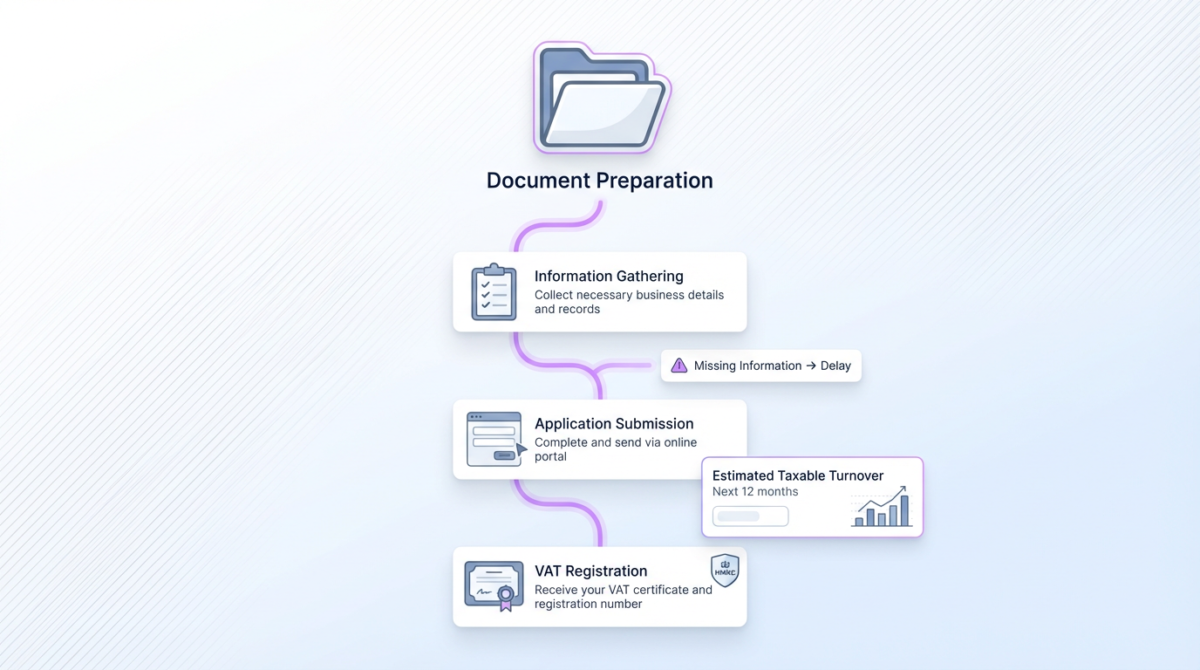
A smooth VAT number application depends on having the right information ready before you start. HMRC’s online form will ask for specific details, and missing even one item can delay your registration.
Here’s what you should have on hand:
- Your business name, trading name (if different), and registered address
- Your National Insurance number or Tax Identifier (UTR)
- Details of your business structure (sole trader, partnership, limited company)
- Your bank account details for VAT repayments
- Estimated taxable turnover for the next 12 months
- The date you crossed, or expect to cross, the VAT threshold UK limit
- Details of any previous VAT registrations
For in-depth checklists, practical examples on digital document management, and common mistakes that lead to rejected registrations, don’t miss the Online VAT Registration: Step-by-Step Guide for Businesses.
For Limited Companies
If you’re registering a limited company, you’ll also need your company registration number from Companies House and the details of all directors. Keep your most recent accounts accessible too, as HMRC may request supporting financial information.
Having these documents organized upfront means you won’t need to pause midway through the application. With everything prepared, the actual submission process is straightforward. For specific document requirements, effective scans, and pitfalls around company details, see How to Register for VAT: A Complete Guide.
Completing Your VAT Number Application Online
Most businesses register for VAT through HMRC’s online portal. The process typically takes about 15 to 20 minutes if your documents are ready.
For an illustrated walkthrough with screen-by-screen instructions, visit the VAT Registration Online: Quick & Easy Setup Guide.
Step 1: Create or Sign In to Your Government Gateway Account
If you don’t already have a Government Gateway account, you’ll need to create one. This is the same login used for Self Assessment, PAYE, and other HMRC services. Keep your credentials somewhere secure because you’ll use this account for all future VAT returns.
Step 2: Select Your Registration Reason
HMRC will ask why you’re registering. The most common options are:
- Your taxable turnover has exceeded the £90,000 threshold
- You expect to exceed the threshold within the next 30 days
- You’re registering voluntarily
Choose the option that matches your situation. Getting this wrong can trigger follow-up questions and slow things down.
Step 3: Enter Your Business Details
Fill in your business name, structure, contact information, and the date your obligation to register began. For mandatory registrations, this date is critical because HMRC will backdate your VAT obligations to it.
A common mistake here involves the “effective date of registration.” If your rolling 12-month turnover exceeded the threshold at the end of March, your registration should typically be effective from the first day of the second month following that, which would be 1 May. Getting this date wrong can lead to penalties.
Step 4: Choose Your VAT Scheme
During registration, you’ll select how you want to account for VAT. Your main options include:
- Standard VAT accounting: You charge VAT on sales, reclaim it on purchases, and file quarterly returns.
- Flat Rate Scheme: You pay a fixed percentage of your turnover as VAT, which simplifies record-keeping for smaller businesses.
- Cash Accounting Scheme: You only account for VAT when you actually receive or make payments, rather than when you issue invoices.
A freelance web designer earning just above the threshold, for instance, might benefit from the Flat Rate Scheme because it reduces the admin of tracking every input VAT receipt.
For more information on choosing the correct scheme and avoiding errors in your online application, read the VAT Tax Registration: Complete Step-by-Step Guide.
Step 5: Submit and Wait
Once you’ve reviewed everything, submit the application. HMRC typically processes online VAT registrations within 5 to 10 working days, though it can occasionally take up to 30 working days during busy periods. You’ll receive your VAT registration certificate with your unique VAT number by post.
With your application submitted, the next step is understanding what happens once you’re on the register.
What Happens After You Register for VAT
Receiving your VAT number is just the beginning. From your effective date of registration onward, you have ongoing responsibilities that require consistent attention.
Charging VAT Correctly
You must add VAT at the correct rate (currently 20% standard rate, with 5% and 0% rates for certain goods and services) to all eligible sales. Your invoices need to include your VAT number, the VAT amount, and the total including VAT.
Filing VAT Returns
Most businesses file VAT returns quarterly through HMRC’s Making Tax Digital (MTD) platform. You’ll need compatible software to submit your returns digitally. Each return reports your output VAT (charged on sales) and input VAT (paid on purchases), with the difference either paid to HMRC or reclaimed.
If you want a practical guide on digital filing, calendar reminders, and the latest MTD rules, see How to File VAT Returns Online: Streamlining Digital Submission.
As of 2024-25, 2,285,900 businesses remained active on the UK VAT register, all of them managing these same filing obligations. Missing a deadline results in penalties and interest charges, so setting calendar reminders is essential.
Keeping Proper Records
HMRC requires you to maintain VAT records for at least 6 years. This includes sales and purchase invoices, import and export records, and any credit or debit notes. Digital record-keeping under MTD means spreadsheets alone may not be sufficient; you need software that can connect to HMRC’s systems.
For an actionable breakdown of VAT-compliant recordkeeping and automation tools, see Accurately Filling Out a VAT Return.
Staying compliant with these obligations is manageable for most domestic businesses. However, if your business sells across borders, the complexity grows significantly, which is where many sellers need additional support.
Managing VAT When Selling Internationally
For businesses selling on marketplaces like Amazon or eBay across multiple countries, VAT compliance becomes a different challenge entirely. Each country has its own registration thresholds, filing schedules, and rules.
If you’d like clear tips and a compliance checklist for marketplace sellers, see Marketplace VAT Obligations for Online Sellers: What You Need to Know.
This is where working with a specialist like 1StopVAT can make a real difference. As a global VAT compliance provider with 40+ certified tax specialists covering 100+ countries, 1StopVAT acts as a single point of contact for marketplace sellers who need VAT registration, filing, and ongoing compliance across multiple jurisdictions. Rather than juggling separate advisors in each country, sellers get dedicated guidance through one provider.
Even domestically, 218,000 VAT deregistrations occurred in 2024-25, partly because the threshold increase reduced the burden on micro businesses. The annual VAT-related administrative burden dropped by about £5 million thanks to the revised threshold. For businesses that do need to stay registered, especially those trading internationally, professional support ensures nothing slips through the cracks.
Common Mistakes to Avoid
Even with a clear process, businesses frequently stumble on a few predictable issues:
- Late registration: If you breach the threshold and fail to notify HMRC within 30 days, you’ll face backdated VAT charges and potential penalties.
- Incorrect effective dates: Entering the wrong start date on your application creates discrepancies in your first return.
- Not reclaiming input VAT: Many new registrants forget they can reclaim VAT on business purchases made up to 4 years before registration (for goods still held) and 6 months (for services).
- Mixing personal and business expenses: HMRC will disallow input VAT claims on purchases that aren’t exclusively for business use.
For an up-to-date list of the most common pitfalls at the registration stage, see The obligation to register for VAT: 6 common mistakes.
Avoiding these errors from day one saves time, money, and stress when your first return comes due.
Conclusion
Registering for VAT does not have to be complicated if you understand when registration becomes necessary, what information HMRC requires, and which VAT scheme best supports your business. The most important step is acting at the right time. Businesses that monitor their taxable turnover, prepare their documents in advance, and submit accurate information are far more likely to avoid delays, penalties, and unnecessary stress.
VAT registration is also not just a one-time admin task. Once your business is registered, you need to stay on top of invoicing, recordkeeping, and return filing to remain compliant. Whether you are a UK sole trader or a business expanding into international markets, getting VAT registration right from the start creates a stronger foundation for smooth compliance and long-term growth.
Frequently asked questions
Yes, the same VAT threshold UK rules apply regardless of whether you sell online or in person. If your taxable turnover exceeds £90,000 in any rolling 12-month period, you must register for VAT. Online marketplace sales count toward this total.
HMRC typically processes online applications within **5 to 10 working days**. In some cases it can take up to 30 working days. You’ll receive your VAT registration certificate and number by post once approved.
Yes, you can request a backdated registration. This is useful if you want to reclaim input VAT on purchases made before your registration date. HMRC allows claims on goods still held going back up to 4 years and on services received within the previous 6 months.
From 1 April 2024, [the UK’s VAT deregistration threshold increased from £83,000 to **£88,000**](https://www.gov.uk/government/publications/vat-increasing-the-registration-and-deregistration-thresholds/increasing-the-vat-registration-threshold). If your taxable turnover drops below this level, you can apply to deregister.
It depends on each country’s rules. Many EU countries require VAT registration once you store goods or exceed local distance-selling thresholds. For sellers managing obligations across multiple countries, providers like 1StopVAT offer streamlined registration and filing support through a single point of contact.