

Overview
Online VAT registration has become the standard way for businesses to obtain a VAT number and comply with tax regulations. As governments digitize their tax systems and tighten enforcement, companies must understand how to register correctly through official online portals.
This guide explains how online VAT registration works, when your business is required to register, and which documents are needed to complete a successful application. It also covers the main digital portals used for domestic and cross-border VAT registration, including systems such as OSS and IOSS.
By the end of this article, you will understand:
- when your business must register for VAT
- how to prepare the required documentation
- which portal to use for domestic or international sales
- how the online VAT application process works step-by-step
- how to avoid common registration mistakes
Whether you are a startup, an e-commerce seller, or an international company expanding into new markets, understanding VAT registration online is essential to staying compliant and operating confidently across borders.
What Is Online VAT Registration?
Online VAT registration is the digital process of notifying a tax authority that your business is taxable, submitting your corporate details via a web portal, and receiving a VAT identification number. This number authorizes you to collect VAT from customers, reclaim VAT on business expenses, and submit periodic tax returns. It replaces traditional paper-based applications, offering a faster, more secure, and traceable way to achieve tax compliance.
Assessing Your Registration Obligations
Before you begin navigating government websites or creating user accounts, you must first confirm that your business actually needs to register. Not every transaction requires a VAT number, and applying prematurely can add unnecessary administrative burdens to your operations. Understanding your specific threshold is the foundation of a smooth process.
Most jurisdictions set a specific revenue threshold for domestic businesses. If your taxable turnover exceeds this limit over a rolling 12-month period, registration becomes compulsory. However, the rules change significantly if you sell goods or services across borders. For example, many countries have a zero threshold for non-resident businesses, meaning you might need to register from the very first sale you make in that territory. The landscape is shifting rapidly, and EU Member States lost an estimated €61 billion in VAT revenues in recent years due to non-compliance and fraud. This gap has pushed authorities to enforce stricter, digitally-driven registration rules to capture every owed cent.
You should verify your status based on these criteria:
- Domestic Thresholds check your local tax authority’s limit (e.g., £90,000 in the UK or €85,000 in France) to see if your turnover mandates registration.
- Voluntary Registration consider registering even if you are below the threshold if you want to reclaim VAT on business expenses or increase your credibility with suppliers.
- Cross-Border Rules identify if you are selling digital services or goods to consumers in other countries, as this often triggers immediate registration requirements regardless of turnover.
For a deeper dive and practical benchmarks on compliance triggers, see the VAT Compliance Checklist for Startups and Small Businesses.
Once you have established that registration is necessary, the next logical step involves gathering the evidence to prove your business is legitimate.
Gathering Essential Documentation
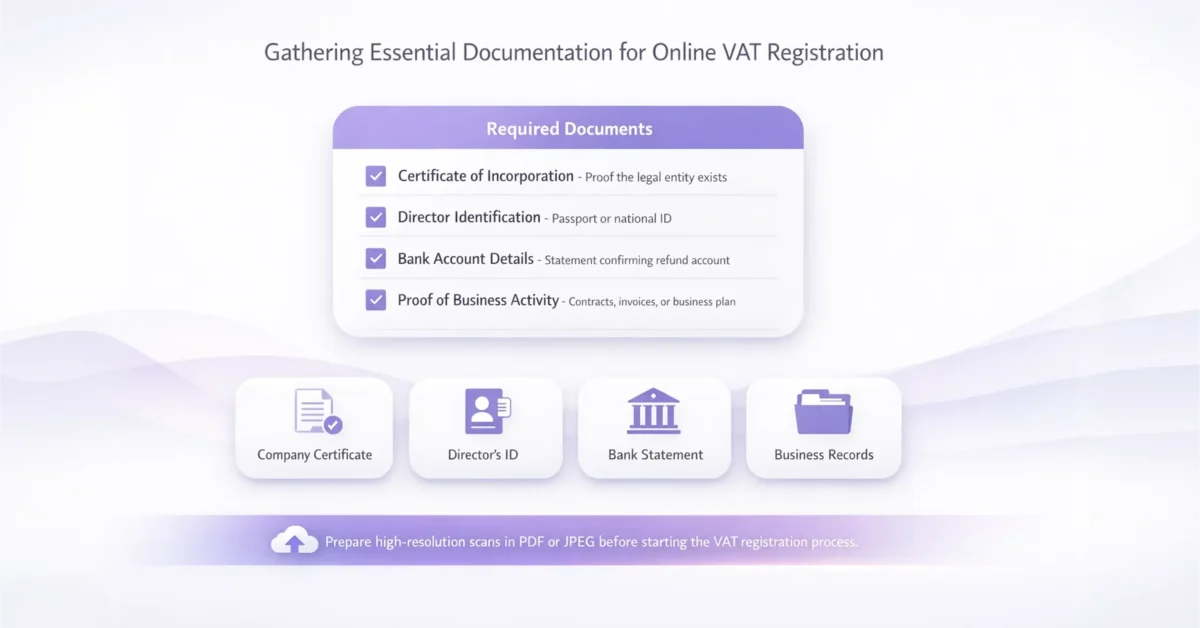
A successful vat registration online depends heavily on the quality and accuracy of the documents you prepare before you even open the application portal. Digital tax systems are designed to process data quickly, but they will reject applications just as fast if the supporting documentation is blurry, incomplete, or outdated.
You will need digital copies of specific legal documents. Ensure these are scanned in high resolution and saved in standard formats like PDF or JPEG, as most portals have strict file type and size limits. Having these ready prevents the session from timing out while you search for files.
Prepare the following standard documents:
- Certificate of Incorporation or a trade register extract that proves your legal entity exists.
- Director Identification such as a passport or national ID card for the primary business owner or authorized signatory.
- Bank Account Details including an official bank statement or letter confirming the business account where refunds should be sent.
- Proof of Activity which might include contracts, invoices, or a business plan showing your intent to trade.
If you want a full list and digital organization tips, see How to Register for VAT: A Complete Guide.
Certain jurisdictions may ask for more specific items, such as a localized translation of your articles of association. If you are operating in complex markets, you might find that different countries have vastly different requirements for the same process. This is where a partner like 1stopVAT can be invaluable. Their team of 40+ certified tax specialists simplifies cross-border VAT obligations across 100+ countries, ensuring you have the exact documentation needed for each specific territory.
With your digital paperwork organized, you are ready to select the correct entry point for your application.
Choosing the Right Digital Portal
The pathway you take to register depends entirely on where your customers are located. Governments have developed distinct portals for domestic companies versus international sellers. Choosing the wrong portal can lead to immediate rejection or, worse, being registered under the wrong tax regime which complicates your filing duties later.
For a business operating strictly within one country, the local tax authority’s website is the correct destination. However, if you sell to customers across multiple European countries, you likely want to avoid registering separately in every single state. The European Union has introduced streamlined systems to combat fragmentation. In fact, all VAT reporting obligations for cross-border EU sales must be fully digital by 2030, signaling a permanent move away from paper-based or decentralized systems.
Select the portal that matches your business model:
- Local Tax Authority Portal use this for your home country or if you hold physical inventory in a specific foreign country.
- One-Stop Shop (OSS) use this central portal to register for VAT in one member state and declare sales for all other EU member states.
- Import One-Stop Shop (IOSS) use this for importing low-value goods (under €150) from outside the EU to consumers within the EU.
For clarity on these routes and administrative best practices, see VAT Tax Registration: Complete Step-by-Step Guide.
These consolidated portals are highly effective. Recent data shows that the new rules will improve and expand online VAT one-stop shops so that businesses do not have to go through costly registrations for VAT in every member state. This centralization is vital for efficiency.
Once you have identified the correct website, you can proceed to the actual data entry and submission phase.
Executing the Online Application
The online VAT application process is generally structured to be linear, moving from identity verification to business activity profiling. While the interface varies by country, the core workflow remains consistent. Attention to detail here is paramount; a typo in your business name or a transposed digit in your bank account number can cause weeks of delays.
For a UK walk-through with practical screenshots and pitfalls to avoid, see the Online VAT Registration: Step-by-Step Guide for Businesses.
Most portals will require you to create a secure government gateway account before you can access the tax forms. This often involves two-factor authentication or a digital ID app.
Follow this standard workflow:
- Create User Credentials set up your secure login ID, often linked to your personal or business email.
- Select Business Entity Type clearly indicate if you are a sole trader, partnership, or limited company.
- Enter Trading Details provide your trade classification codes (like SIC or NACE codes) that describe what your business actually does.
- Upload Supporting Docs attach the PDF files you gathered earlier in the designated sections.
- Review and Submit carefully check every field before clicking the final submission button.
After submission, you will typically receive an acknowledgment receipt or a reference number. Keep this safe, as it is your only proof that the process is underway.
Now, if your business involves selling to customers in different countries, you need to understand how the simplified cross-border schemes fit into this picture.
Leveraging Cross-Border VAT Schemes
For e-commerce businesses scaling internationally, registering individually in every country where a customer resides is no longer necessary or efficient. The introduction of the One-Stop Shop (OSS) and Import One-Stop Shop (IOSS) has revolutionized digital VAT registration for cross-border sellers. These schemes allow you to handle VAT for multiple countries through a single registration.
To see whether to choose individual registrations or a centralized OSS route – and for recent statistics and a guide to VAT in European Union: EU VAT Rules Explained for International Sellers – see that dedicated resource.
The adoption of these schemes has been massive because they work. By the end of 2024, over 170,000 businesses had registered for the EU’s OSS/IOSS VAT schemes, proving that companies prefer centralized compliance over managing dozens of local tax numbers. Instead of tracking threshold limits in Germany, France, and Italy separately, you register once in your home state (or a chosen state for non-EU companies) and report all EU sales there.
The benefits of using these unified schemes include:
- Single Return Filing submit one quarterly return for all eligible cross-border sales.
- Single Payment make one tax payment to the member state of identification, which then distributes the money to other countries.
- Reduced Admin Costs avoid paying for tax representation in 27 different jurisdictions.
For more on when OSS/IOSS beats multiple registrations—and real case studies – review the VAT Tax Registration: Complete Step-by-Step Guide.
The volume handled by these systems is immense. In 2024 alone, EU e-commerce VAT schemes (OSS/IOSS) collected over €33 billion in VAT revenue. This figure confirms that the system is robust and reliable for high-volume sellers.
Understanding these schemes ensures you don’t over-complicate your setup. Once your application – whether local or OSS – is submitted, the verification phase begins.
Verification and Issuance
After you hit submit, the timeline for receiving your VAT number is largely out of your hands. Tax authorities use this period to verify your identity and check for fraudulent activity. In standard cases, vat registration online results in a number being issued within a few weeks, but complex cases involving foreign directors or unclear business activities can take significantly longer.
For best practices on ensuring your VAT number is valid (and how to perform verification using the EU VIES system), see How to Verify a VAT Number: A Simple Guide.
During this waiting period, you should not charge VAT on your invoices, but you will still be liable for it once your number arrives. This creates a tricky interim period where you must adjust your pricing to be “gross” (inclusive of the VAT you will eventually pay) without displaying a VAT number on the invoice.
What happens during verification:
- Automated Checks databases cross-reference your directors and business address.
- Manual Review a tax officer may inspect your uploaded documents for discrepancies.
- Additional Requests the authority may email you for clarification on your business activities.
- Issuance you receive your VAT certificate and number, often via a secure message in the portal.
Once you have the number, you must update your website, invoices, and accounting software immediately. This marks the transition from applicant to compliant taxpayer. However, getting registered is only the first hurdle; maintaining that status requires avoiding common errors.
Troubleshooting Common Registration Issues
Even with a digital process, human error remains the biggest obstacle to a smooth registration. A rejected application forces you to restart the queue, potentially halting your ability to trade or import goods. Awareness of frequent pitfalls can save you weeks of lost time.
For a dedicated VAT registration pitfalls checklist and examples of avoidable delays, visit The obligation to register for VAT: 6 common mistakes.
One major issue is data mismatch. If the company name on your bank statement differs slightly from the name on your incorporation certificate, the system may flag it as potential fraud. Another common error is selecting the wrong effective date. If you backdate your registration too far, you may instantly incur penalties for late filings you didn’t know you had to make.
Watch out for these frequent stumbling blocks:
- Inconsistent Addresses ensure the address on your application matches your official proofs exactly.
- Wrong Signatory only authorized directors should sign or submit the application.
- Ignoring Correspondence missing a deadline to reply to a tax officer’s query will usually void your application.
For businesses aiming to expand globally, these small errors can compound into major compliance risks. While software helps, human insight is often required to navigate the nuances of local tax laws. This is why 1stopVAT acts as a single point of contact, combining automated tools with human expertise to review your application details, preventing rejection and ensuring you are set up correctly from day one.
Conclusion
Securing your VAT registration online is a fundamental step in legitimizing your business and enabling scalable growth. As governments continue transitioning toward digital VAT registration systems, the process has become faster and more accessible through official tax portals. While this shift to digital platforms has simplified the mechanics of applying, the need for accuracy and strategic planning regarding thresholds and cross-border schemes remains high. By gathering the right documents, choosing the correct portal, and understanding the nuances of schemes like OSS, you can navigate this obligation efficiently. Compliance is not just about avoiding penalties; it is about building a foundation that supports your business wherever it expands.
Frequently asked questions
The timeline varies significantly by country. In streamlined digital systems like the UK or Netherlands, you might receive your number in as little as 3 to 10 working days. However, in other jurisdictions or for non-resident businesses, it can take 4 to 8 weeks. Always factor in potential delays when planning your launch.
Yes, you can trade, but you cannot show a VAT number on your invoices or charge VAT as a separate line item. You should adjust your prices to account for the VAT you will owe to the tax authority for this period. Once your number arrives, you can reissue invoices if necessary.
A tax ID (often called a TIN or UTR) identifies your business for general corporate income tax purposes. A VAT number is a specific sub-identifier used solely for value-added tax transactions. Having a tax ID does not automatically mean you are registered for VAT; they are separate registrations.
In many jurisdictions, you do not need a local bank account and can use your foreign business account (IBAN). However, some countries still prefer or require a local account for direct debiting of taxes. Always check the specific requirements of the portal you are using.
In many countries, VAT registration can now be completed entirely through official government portals. Businesses submit their company details, upload supporting documents, and receive their VAT number digitally through a secure online account. However, in some jurisdictions – especially for non-resident companies – tax authorities may still require additional verification steps, such as appointing a fiscal representative or providing notarized documents before the VAT number is issued.