Overview
Expanding into new markets is easier than ever, but tax compliance hasn’t kept up with that simplicity. As soon as your business starts selling across borders, VAT obligations can arise faster than expected - sometimes from the very first transaction.
VAT registration for companies is no longer just a back-office task. It’s a critical part of operating internationally, especially for e-commerce brands, SaaS providers, and marketplace sellers. Different thresholds, local rules, and reporting requirements create a complex landscape that can quickly slow down growth if handled incorrectly.
This guide breaks down how VAT business registration works in practice and what companies need to do to stay compliant while scaling globally.
Why VAT Registration Matters for Growing Companies
Value Added Tax is a consumption tax applied at every stage of a product's supply chain. Governments rely on it heavily. In the EU alone, over €33.0 billion in VAT revenue was collected in 2024 through e-commerce VAT systems. That figure grew 26% year over year, signaling that tax authorities are watching cross-border sellers more closely than ever.
For companies, VAT registration for companies isn't optional once you cross certain revenue thresholds or begin selling into a new country. It's a legal obligation. And the rules differ significantly depending on where your customers are based.
Here's the core principle: if your business supplies taxable goods or services in a country, you likely owe VAT there. Registration is how you get a VAT number, start charging VAT, file returns, and reclaim input tax on your business expenses.
Determine Whether You Need to Register
Before gathering documents, figure out if registration is actually required. Every country sets its own threshold, and some require registration from the very first sale.
In the UK, the VAT registration threshold currently sits at £90,000 in taxable turnover over a rolling 12-month period. That's significant because the UK's threshold is higher than any EU Member State and tied with Switzerland as the highest in the OECD, more than double the OECD average. The recent threshold increase is projected to reduce businesses' VAT compliance burden by about £5 million per year and means roughly 28,000 fewer micro-businesses need to register for VAT in 2024-25.
In the EU, it's different. Most member states have domestic thresholds ranging from €10,000 to €100,000. However, non-EU businesses selling to EU consumers often must register from the first euro of sales, unless they use the One-Stop Shop (OSS) simplification.
For a broader comparison of EU and global VAT thresholds and compliance triggers, see the VAT Compliance Checklist for Startups and Small Businesses.
Quick Checklist: Do You Need to Register?
Ask yourself these questions:
-
Are you selling taxable goods or services in a specific country?
-
Have you exceeded (or expect to exceed) that country's VAT threshold?
-
Are you a non-resident business making sales without a local establishment?
-
Do you hold inventory in a foreign country, such as through Amazon FBA?
If you answered yes to any of these, VAT registration is likely required. And in some jurisdictions, like Germany and France, holding stock in-country triggers an immediate obligation, regardless of sales volume.
Choose the Right Registration Scheme
Not all registrations work the same way. Depending on your business model and where you sell, you may have options that simplify the process considerably.
Standard (Domestic) Registration
This is the default. You register directly with a country's tax authority, receive a local VAT number, charge VAT on sales, and file periodic returns. In the UK, for instance, there were 234,000 new VAT registrations in 2024-25, with approximately 2,285,900 active VAT-registered traders overall.
EU One-Stop Shop (OSS) and Import OSS (IOSS)
If you sell to consumers across multiple EU countries, the OSS lets you file a single return covering all member states. To determine whether to choose individual registrations or a centralized OSS route, and for a recent statistics guide, explore VAT in European Union: EU VAT Rules Explained for International Sellers. By end-2024, over 170,000 businesses had registered for the EU's OSS/IOSS VAT schemes, with more than 20,000 new Union-OSS registrations in the past year alone. The system collected €24.0 billion via the Union OSS, €2.8 billion via the non-Union OSS, and €6.3 billion via the Import OSS in 2024.
For marketplace sellers shipping low-value goods into the EU, IOSS is particularly valuable. It lets you collect VAT at the point of sale and remit it through a single filing.
Choosing the right scheme depends on your sales channels, inventory locations, and transaction volumes. Getting this decision right early saves months of administrative headaches down the road.
Gather Required Documents

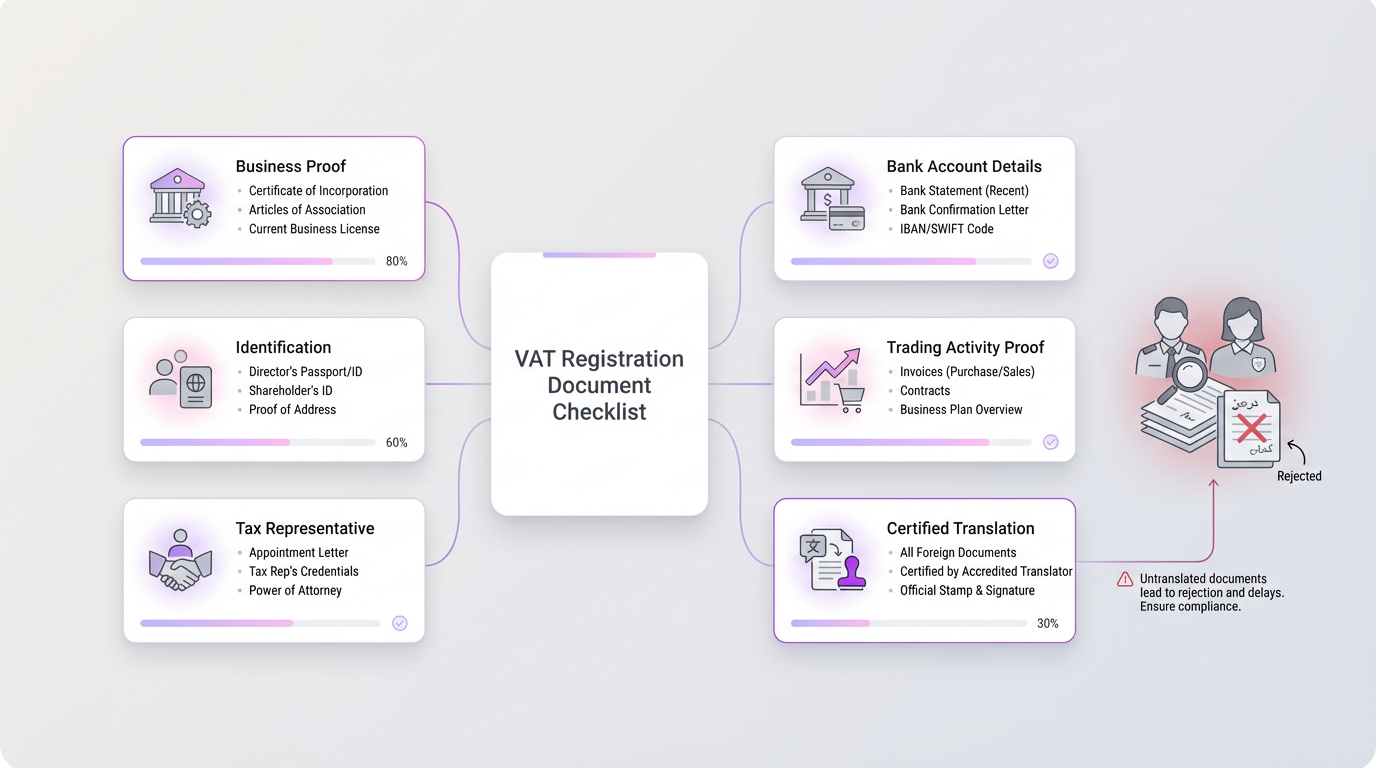
Once you know where and how to register, it's time to prepare your documentation. While each country has its own requirements, the core documents are remarkably consistent.
-
Certificate of incorporation (or equivalent proof of business formation)
-
Articles of association or company bylaws
-
Proof of taxable activity in the country (contracts, invoices, warehouse agreements)
-
Director or authorized signatory identification (passport copies, proof of address)
-
Bank account details (some countries require a local bank account)
-
Power of attorney if a tax representative or agent files on your behalf
Some jurisdictions add requirements. For example, Italy requires a fiscal representative for non-EU businesses. Germany often requests a detailed description of planned business activities. The UK's HMRC may ask for evidence of trading history and projected turnover.
For practical examples of efficient document management and a detailed checklist to avoid delays, see How to Register for VAT: A Complete Guide.
A practical tip: get certified translations of all documents before submitting. Many tax authorities reject applications simply because supporting documents aren't in the local language.
Submit Your Application
With documents ready, the actual application process varies by country, but follows a common pattern.
In the UK, you apply online through the HMRC Government Gateway. The process is relatively straightforward for UK-established businesses, though non-resident companies may need to submit paper forms and appoint a tax agent.
In the EU, you apply to the tax authority in the member state where your business is established, or where you've chosen to register for OSS. Each country has its own portal. France uses impots.gouv.fr, Germany uses the BZSt online portal, and the Netherlands routes applications through the Belastingdienst.
In the Gulf states, like the UAE and Saudi Arabia, VAT registration happens through dedicated government portals (the FTA portal for the UAE, ZATCA for Saudi Arabia). Processing times tend to be shorter, often under two weeks.
For a thorough, illustrated walk-through of how online VAT registration works in practice - including document tips and processing times - see the VAT Registration Online: Quick & Easy Setup Guide.
Typical Processing Times
-
UK: 2 to 4 weeks (can take longer for non-resident applications)
-
Germany: 4 to 8 weeks
-
France: 2 to 6 weeks
-
Netherlands: 1 to 3 weeks
-
UAE: 5 to 15 business days
Keep in mind that incomplete applications are the number one cause of delays. Double-check every field before hitting submit.
Set Up Compliance After Registration
Receiving your VAT number isn't the finish line. It's the starting point for ongoing compliance. This is where many companies stumble, especially those registered in multiple countries simultaneously.
Once registered, you'll need to:
-
Charge the correct VAT rate on invoices (rates vary by country and product category)
-
File VAT returns on schedule (monthly, quarterly, or annually depending on the jurisdiction)
-
Maintain detailed records of all transactions for audit purposes
-
Submit additional reports like EC Sales Lists or Intrastat declarations if trading within the EU
To build a robust routine and stay penalty-free in the months that follow, consult these best practices for VAT Reporting Made Simple: Best Practices for Businesses.
For a company selling on Amazon across five EU countries while also shipping to the UK, this means managing different filing frequencies, different VAT rates, and different portal logins. The complexity multiplies fast.
This is exactly where working with a specialist makes a difference. 1stopVAT, for example, acts as a single point of contact for VAT registration and filing across 100+ countries. Their team of 40+ certified tax specialists handles the entire compliance cycle for marketplace sellers, from initial registration through periodic filings, so companies can focus on growing sales rather than chasing tax deadlines.
Monitor Thresholds and Regulatory Changes
VAT rules aren't static. Thresholds shift, new reporting obligations emerge, and digital filing requirements keep evolving.
The UK threshold increase to £90,000, for instance, is expected to result in about 14,000 fewer registrations per year on average from 2024-25 through 2028-29. If your UK sales hover near that threshold, the change directly affects your obligations.
The EU is also expanding its digital reporting requirements. Several member states are introducing mandatory e-invoicing, and the VAT in the Digital Age (ViDA) reforms will reshape how businesses report transactions across the bloc starting in the coming years.
Stay informed. Review your registration obligations quarterly, especially if you're entering new markets or adjusting your supply chain. For additional expert tips and to learn when to seek outside help, see VAT Compliance & Consultancy: Why Expert Advice Matters. A warehouse relocation from Poland to the Czech Republic, for example, could trigger a new registration requirement overnight.
Conclusion
VAT registration for companies is not just a legal formality. It is a critical part of building a business that can sell, ship, and scale across borders without disruption. The process may seem administrative on the surface, but in practice it directly affects cash flow, market access, and long-term compliance. To get it right, companies need to follow a clear sequence: determine the obligation, choose the right scheme, gather the required documents, submit the application correctly, and build a compliance routine that can keep pace with changing rules.
While each jurisdiction has its own requirements, the core framework remains consistent. The companies that treat VAT registration for companies as a strategic priority from the start are far better positioned to avoid delays, penalties, and operational setbacks later on. Whether you are entering one new market or expanding into several, a strong business VAT setup protects both your revenue and your reputation.