

What This Guide Covers
This article walks you through a practical compliance checklist for selling across borders. You’ll learn how to identify where your VAT obligations arise, how registration thresholds work, which filing schemes can simplify your life, and how to keep everything running smoothly as you scale. Each section builds on the last, so by the end, you’ll have a clear, repeatable process for staying compliant no matter how many markets you enter.
Understand Why Multi-Country VAT Compliance Matters
Before jumping into the how, it’s worth understanding the stakes. VAT isn’t just a line item on an invoice. It’s a major revenue source for governments, and they’re paying closer attention than ever.
EU Member States lost around €89 billion in VAT revenues in 2022 due to the so-called VAT Gap, which covers fraud, errors, and non-compliance. In the UK, the VAT gap for 2024-25 is estimated at 6.5% of theoretical VAT liability, roughly £11.9 billion. These numbers explain why tax authorities are tightening enforcement and investing in digital reporting tools.
For sellers, non-compliance can trigger penalties, blocked marketplace accounts, and reputational damage. Getting this right from the start protects both your cash flow and your ability to keep growing.
With the “why” in place, let’s look at the first concrete step: figuring out where your obligations actually exist.
Map Your VAT Obligations by Country
The foundation of multi-country VAT compliance is knowing exactly where you’re liable. This depends on several factors, not just where your customers are.
Start by answering these questions for each market:
- Where is your inventory physically stored? If you hold stock in a country, you likely need a local VAT registration, regardless of sales volume.
- Are you selling to consumers (B2C) or businesses (B2B)? B2C cross-border sales within the EU trigger distance-selling rules. B2B transactions often shift the VAT obligation to the buyer through the reverse charge mechanism.
- Have you exceeded local registration thresholds? Many countries outside the EU set their own thresholds. The UK, for example, requires registration once taxable turnover exceeds £90,000.
For a broader comparison of EU and global VAT thresholds and compliance triggers, see the VAT Compliance Checklist for Startups and Small Businesses.
Determine Whether the One-Stop Shop (OSS) Applies
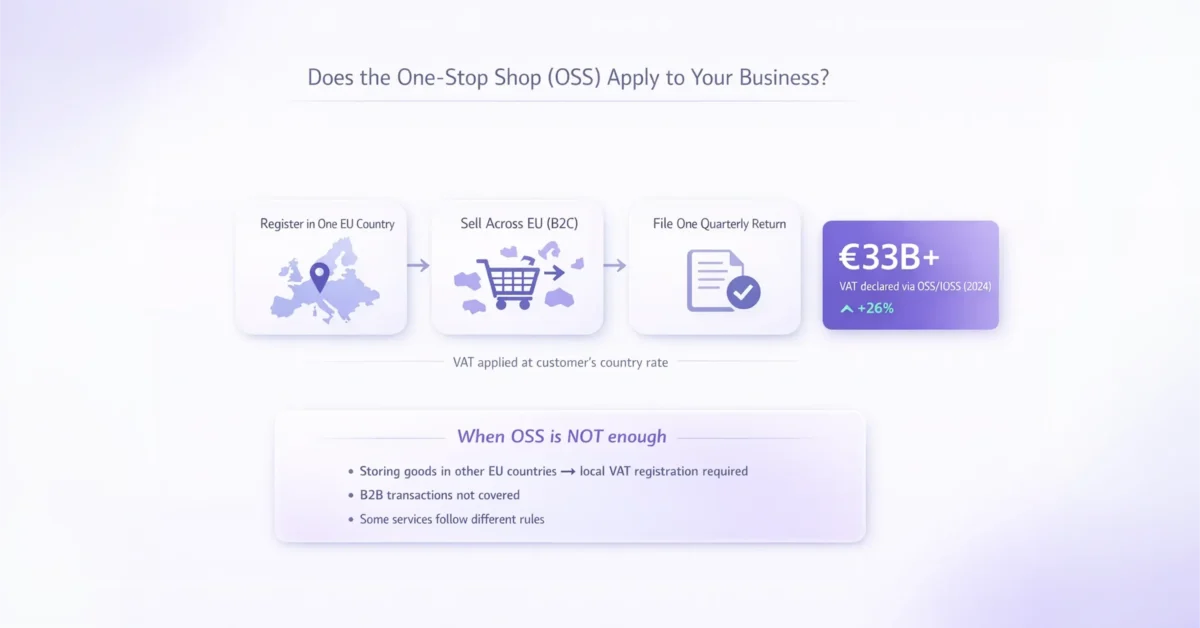
The EU introduced the One-Stop Shop system in July 2021 to reduce the burden of registering in every member state. If you sell B2C across EU borders, this scheme is central to your compliance strategy.
Here’s how it works:
- You register for OSS in your home EU member state (or a single EU state if you’re based outside the EU).
- You file one quarterly return covering all EU B2C distance sales.
- VAT is declared at the rate of the customer’s country, but you submit everything through a single portal.
For more on when OSS/IOSS beats multiple registrations – and real case studies – review the VAT Tax Registration: Complete Step-by-Step Guide.
The adoption numbers speak for themselves. In 2024, EU businesses declared €33.1 billion in VAT through OSS and IOSS schemes, a 26% increase over 2023. By the end of 2024, over 170,000 traders were registered under these systems, with Union OSS registrations alone growing 16% in 2024, from 132,609 to 153,550 traders.
When OSS Isn’t Enough
OSS covers distance sales, but it doesn’t replace the need for local registration when you store goods in another member state. If you use fulfillment centers in multiple countries, you still need VAT numbers in those countries for stock movements and local sales. OSS also doesn’t apply to B2B transactions or sales of services that follow different place-of-supply rules.
For a detailed explanation of OSS and IOSS, don’t miss VAT in European Union: EU VAT Rules Explained for International Sellers.
For low-value imports from outside the EU (goods up to €150), the Import One-Stop Shop (IOSS) offers a parallel simplification. IOSS registrations rose 6% in 2024, reaching 12,799 traders.
Knowing which schemes apply is crucial, but getting the rates and invoicing right is where many sellers stumble.
Apply the Correct VAT Rates and Invoice Requirements
Each country sets its own standard, reduced, and zero VAT rates. The same product can be taxed at 25% in Denmark and 21% in the Netherlands. Applying the wrong rate means either overcharging your customer or underpaying the tax authority.
Your compliance checklist for rates and invoicing should include:
- Verify the applicable VAT rate for each product category in every country of sale. Some countries apply reduced rates to items like books, food, or children’s clothing.
- Issue invoices that meet the destination country’s requirements. This typically includes your VAT number, the customer’s details, the applicable rate, and the VAT amount broken out separately.
- Store invoices and supporting documentation for the retention period required by each jurisdiction, often 5 to 10 years depending on the country.
For step-by-step guidance on e-invoicing and digital reporting, visit EU Invoicing Rules Explained for Businesses.
The Digital Reporting Shift
The EU’s VAT in the Digital Age (ViDA) package, agreed upon by the Council in November 2024, will gradually introduce mandatory e-invoicing and digital reporting requirements. Hungarian Finance Minister Mihály Varga described these reforms as “a cornerstone for the digital transition and a significant step in improving the competitiveness of the EU”, noting they will update VAT systems to reflect the digitalization of economies and help combat fraud. For sellers, this means investing in accurate record-keeping now will pay off as digital reporting mandates roll out.
To discover how these changes will affect your operations—including new e-invoicing mandates—consult EU – Digital Reporting Regime after Parliament Approves Draft Legislation ViDA 2025.
Getting rates and invoicing right is a recurring task. The next question is how to manage the ongoing filing cycle without drowning in deadlines.
Build a Filing Calendar and Stick to It
Multi-country VAT compliance isn’t a one-time setup. It’s a continuous process with different deadlines in every jurisdiction.
Some countries require monthly VAT returns. Others are quarterly. A few allow annual filings for low-volume sellers. Miss a deadline, even by a day, and many authorities will issue automatic penalties or interest charges.
Here’s what a solid filing system looks like:
- Create a master calendar with every filing deadline across all registered countries.
- Track threshold changes annually. Countries periodically adjust their registration limits and VAT rates.
- Reconcile sales data with marketplace reports before each filing. Discrepancies between what Amazon or Shopify reports and what you declare to tax authorities are a common audit trigger.
- Monitor Intrastat and EC Sales List requirements if you move goods between EU member states above certain value thresholds.
For an actionable compliance framework, explore VAT Filing & Returns: A Complete Guide for Businesses.
A seller operating in six EU countries, for instance, might face quarterly OSS returns plus monthly local returns in Germany and Poland, annual Intrastat filings, and periodic EC Sales List submissions. The administrative load compounds quickly, which is why many growing businesses turn to a dedicated compliance partner.
This is where 1StopVAT becomes particularly valuable for marketplace sellers. With a team of over 40 certified tax specialists covering 100+ countries, 1StopVAT acts as a single point of contact for VAT registration, ongoing filings, threshold monitoring, and country-specific rule changes. Rather than juggling multiple local advisors, sellers get streamlined compliance management that scales with their business.
Prepare for Audits and Keep Clean Records
Even with perfect filings, audits happen. Tax authorities increasingly use data-matching tools to cross-reference marketplace reports with VAT declarations. Being audit-ready isn’t optional; it’s part of compliance.
Key records to maintain include:
- Proof of where goods were shipped from and delivered to
- Evidence of the customer’s location (two pieces of non-contradictory evidence for EU digital services)
- Copies of all VAT invoices issued and received
- Import and export documentation
- Correspondence with tax authorities
For step-by-step guidance on keeping VAT filings accurate and audit-ready, explore VAT Reporting Made Simple: Best Practices for Businesses.
A Practical Tip
Keep your records organized by country and tax period rather than in one large file. When an authority requests documentation, they want to see their jurisdiction’s data quickly and clearly. A well-organized archive signals professionalism and can shorten the audit process significantly.
With records in order, you’re not just prepared for audits. You’re also building the data foundation that supports every future compliance decision as you enter new markets.
Your Multi-Country VAT Compliance Checklist at a Glance
To stay VAT compliant when selling in multiple countries, follow this checklist: identify every country where you have a tax obligation (through inventory storage, sales thresholds, or registration requirements); register for the OSS or IOSS where eligible to simplify EU filings; verify VAT rates and invoicing rules for each market; build a filing calendar covering all jurisdictions; reconcile marketplace data before every submission; and maintain organized, audit-ready records for each country and tax period.
Conclusion
Multi-country VAT compliance is not just an administrative task. It is part of the operational infrastructure that supports sustainable international growth. Every step, from identifying where obligations arise to applying the correct VAT rates, meeting filing deadlines, and maintaining audit-ready records, affects how confidently your business can scale across borders.
The companies that handle VAT well are not simply avoiding penalties. They are building a stronger foundation for expansion, protecting cash flow, reducing operational friction, and staying ready for regulatory change. Whether you manage compliance internally or partner with a specialist like 1StopVAT, the priority is the same: create a system that keeps your business accurate, consistent, and prepared in every market you enter.
Frequently asked questions
Not necessarily. In the EU, the One-Stop Shop scheme lets you declare VAT on B2C distance sales through a single registration in your home member state. However, if you store inventory in another country or exceed local thresholds outside the EU, you will likely need a separate registration there.
Most tax authorities impose automatic late-filing penalties, which can range from fixed fees to a percentage of the VAT owed. Some countries also charge daily interest on overdue amounts. Repeated late filings can trigger audits or even suspension of your VAT number.
No. The OSS scheme applies specifically to B2C distance sales and certain services. B2B cross-border transactions within the EU typically use the reverse charge mechanism, where the buyer accounts for VAT in their own country.
Each country publishes its own VAT rate schedule, including standard, reduced, and zero rates by product category. You need to classify your products correctly for each market. Misclassification is a frequent audit finding, so it’s worth verifying rates with a tax specialist when entering a new market.
The IOSS simplifies VAT collection on goods imported into the EU with a value of €150 or less. If you ship low-value goods directly from outside the EU to EU consumers, registering for IOSS allows you to charge VAT at the point of sale and file through a single return, avoiding customs VAT charges that delay delivery.