

Overview
By the end of this article, you will understand whether you are required to register for VAT or can delay registration, what documents regulators typically request, and how to submit a VAT application online without errors. You will also learn how special schemes such as the EU’s OSS and IOSS work, as well as how to manage your obligations after registration, including invoicing, filing returns, and potential deregistration. In addition, the guide explains how recent regulatory changes – such as the UK’s new £90,000 VAT threshold introduced in 2024 – affect who must register and when.
Confirm Whether You Must Register
Not every enterprise needs a VAT number on day one. Your obligation depends on turnover, place of supply, and sector-specific rules.
- In the United Kingdom, registration becomes compulsory once your taxable turnover in any rolling 12-month period exceeds £90,000.
- That figure is now the highest in the OECD, more than double the EU average of roughly £44,000.
- The increase keeps 3.2 million UK small businesses outside the VAT net, but around 28,000 micro-businesses still crossed the new line in 2024–25.
A French SaaS startup with €110,000 in domestic sales must register because France’s threshold is €85,800. The same firm would need an additional UK registration only after it tops the UK’s £90,000 limit on sales to British customers.
For a broader comparison of EU and global VAT thresholds and compliance triggers, see the VAT Compliance Checklist for Startups and Small Businesses.
Failing to register on time can lead to penalties that climb quickly. So, calculate turnover monthly and set calendar reminders.
The next section explains what documents and data authorities normally request.
Gather All VAT Registration Requirements
You will complete the actual VAT application online, but first pull together a small dossier. Having everything to hand trims the process from days to hours.
Typical VAT registration requirements include:
- Business identification
- Certificate of incorporation or partnership agreement
- National tax ID, social security number for sole traders
- Proof of trading address (recent utility bill or lease)
- Bank account details in the business name
- Description of business activity and main product categories
- Projected turnover for the next 12 months
- Copy of contracts or invoices proving taxable sales where available
Some jurisdictions ask for additional data:
- Director identification documents or shareholder lists
- VAT registrations in other countries
- Evidence of online marketplace accounts (for e-commerce sellers)
To see practical examples of efficient document management and a detailed checklist to avoid delays, review How to Register for VAT: A Complete Guide.
Make digital scans in PDF or JPEG format. File names should be short, clear, and free of spaces. That small habit reduces upload errors inside government portals.
Once you feel confident your paperwork is complete, you are ready for the official forms.
Choose the Right Registration Route
Most tax authorities now run dedicated VAT portals that guide you through numbered screens. Still, choices appear along the way.
- Standard domestic registration: for businesses established in the country.
- Non-resident registration: when you have no fixed establishment but taxable local sales.
- Group registration: combines several related entities under one VAT number.
- Special schemes: margin, flat-rate, agriculture, or e-commerce OSS/IOSS.
A UK retailer expanding to Germany could either:
- Create a German non-resident VAT registration, or
- Register for the EU Union OSS scheme if all sales are B2C and fulfilled from a single EU warehouse.
Which path saves most admin largely depends on your supply chain. Providers such as 1stopVAT, whose 40 plus tax specialists handle registrations in 100 jurisdictions, can map the simplest option when multiple routes seem viable. For more on the step-by-step process and regional differences, explore How to Register for VAT in the EU: Step-by-Step Guide.
With the route chosen, move to the form itself.
Complete and Submit Your VAT Application
Government forms differ in layout but usually follow the same logic.
Key Sections to Watch
- Business details: Enter legal name exactly as on incorporation papers.
- Contact person: Use someone reachable during business hours.
- Bank account: Double-check IBAN or sort code. Rejections over a single digit are common.
- Activity description: Avoid jargon. Instead of “SaaS solution provider leveraging AI”, say “online software subscription service”.
- Forecast turnover: Be realistic. Over- or under-shooting by 50 percent invites queries.
For a UK walk-through and practical screenshots, see the Online VAT Registration: Step-by-Step Guide for Businesses.
Common Mistakes and How to Avoid Them
- Uploading illegible scans: Use 300 dpi resolution, color preferred.
- Forgetting to tick “Sells digital services” where required: This box decides your VAT place of supply rules.
- Mixing personal and business bank details: A freelancer who registers before opening a business account may receive a letter requesting an update, delaying the VAT number.
On submission, you will see a confirmation screen. Save or print the reference number.
Processing times vary:
- United Kingdom: 10 working days on average
- Germany: 4–6 weeks for non-resident applications
- Ireland: sometimes within 3 days when documents are flawless
Stay patient but proactive. If the portal shows no movement after the quoted window, phone or email the VAT helpline with your reference number.
Receive Your VAT Number and Put It to Work
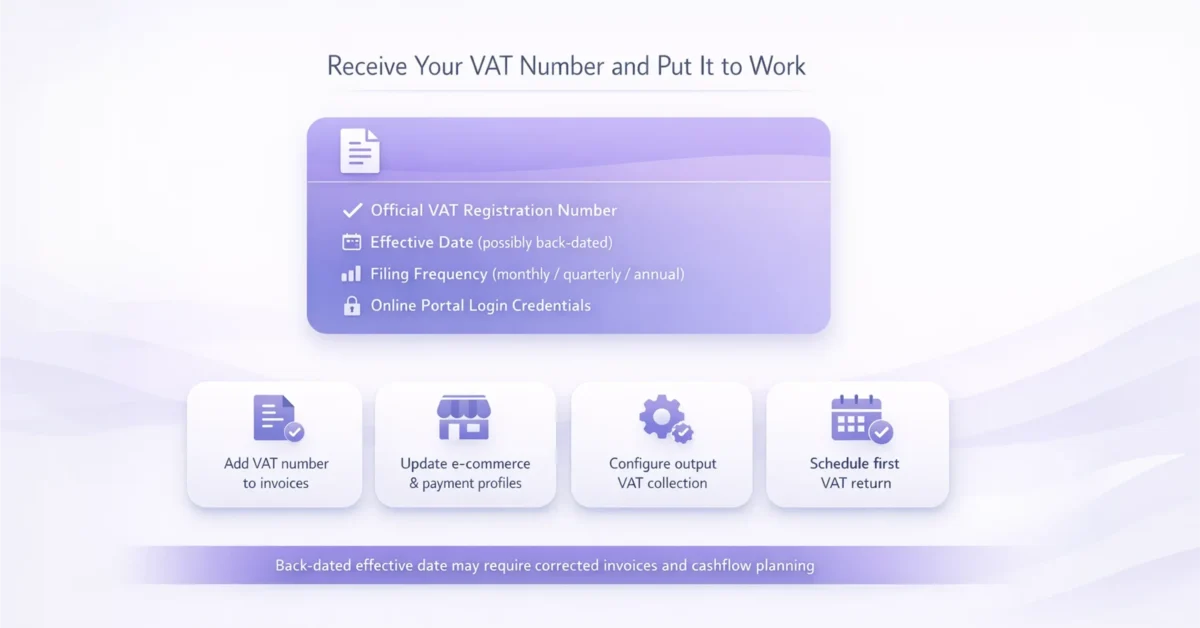
The approval letter or secure-mail message will include:
- Official VAT registration number
- Effective date of registration (sometimes back-dated)
- Filing frequency (monthly, quarterly, or annual)
- Login credentials for online return submission
Take immediate action:
- Add the VAT number to invoices issued from the effective date.
- Update e-commerce marketplace and payment-service profiles.
- Configure your accounting software to start collecting output VAT.
- Schedule the first return filing reminder.
For best practices after digital registration and VAT number integration, How to Register for VAT: A Complete Guide has additional tips.
A London agency that received its VAT number on 15 June but with effective date 1 May must issue corrected invoices for May and early June. Those additional invoices often generate a cashflow spike, so plan for it.
With domestic compliance sorted, you may now eye overseas sales. That is where multi-country rules get interesting.
Navigating International VAT Schemes (OSS/IOSS)
Cross-border sales within the EU used to mean a separate VAT registration in every destination state once thresholds were breached. The 2021 e-commerce package rewrote the rulebook.
- Union One-Stop-Shop (OSS) for EU-based sellers of goods and digital services to consumers.
- Non-Union OSS for non-EU sellers of digital services.
- Import One-Stop-Shop (IOSS) for consignments valued below €150 shipped from outside the EU.
For a detailed guide on when and how to use the OSS/IOSS, don’t miss VAT in European Union: EU VAT Rules Explained for International Sellers.
These schemes collected over €33 billion in VAT during 2024, with €24 billion declared under Union OSS alone. Registrations keep rising, passing 170,000 businesses by the end of 2024.
When OSS/IOSS Beats Multiple Registrations
- Your goods ship from one EU warehouse to shoppers in several member states.
- Digital services flow automatically online with customer downloads.
- Low-value parcels (< €150) dispatch daily to EU buyers from outside Europe.
Instead of juggling returns in France, Spain, and Italy, you file one OSS return in your chosen “Member State of Identification”. That saves translation costs and headaches.
Looking for practical compliance and common pitfalls? See the VAT Compliance for SaaS and Digital Services in the EU for best-practice guidance on threshold management and compliant invoicing.
Still, OSS does not solve every scenario. Holding inventory in multiple EU countries, or B2B sales, could trigger local registrations. Specialist teams like 1stopVAT evaluate warehouse footprint, supply chain, and transaction mix to decide whether a hybrid model makes sense.
Stay Compliant or Deregister When Eligible
Getting the number is half the story. Keeping it – or letting it go-matters just as much.
Ongoing Compliance Checklist
- File returns on schedule: late filings may attract surcharges as high as 15% in some EU states.
- Pay VAT due in full: partial payments accrue daily interest.
- Keep digital records for the statutory retention period (often 10 years).
- Reconcile sales platforms and bank statements quarterly to catch errors early.
For a deeper dive into compliance triggers, threshold monitoring, and the importance of document retention, see the VAT Deregistration: When and How to Deregister Your Business.
When and How to Deregister
Your business can deregister if turnover falls below a national deregistration threshold. In the UK, voluntary deregistration is possible when taxable turnover drops below £88,000. Roughly 218,000 UK traders did so in 2024–25, a reminder that deregistration is common.
Steps to deregister:
- Submit an online request and final return.
- Pay any outstanding VAT or reclaim balance owed.
- Remove VAT from invoices after the official cancellation date.
Ceasing to trade? Retain records for the mandated years because audits may still occur.
5-Point VAT Registration Checklist
Need a lightning summary? To register for VAT you must: 1) Verify your turnover exceeds the national threshold, 2) Collect ID, bank, and address documents, 3) Choose the correct registration route (domestic, non-resident, or OSS/IOSS), 4) Complete the online VAT application accurately and submit scans, 5) Add the issued VAT number to invoices and file returns from the effective date.
Conclusion
Vat tax registration is less about filling forms and more about understanding where your business fits in the VAT ecosystem. First, confirm you need to register, then gather airtight documentation, pick the right route, and submit a precise application. After your VAT number arrives, invoice correctly, file on time, and monitor turnover for potential deregistration. When global expansion beckons, schemes like OSS/IOSS and advisory partners such as 1stopVAT can simplify multinational compliance while you focus on growth.
Frequently asked questions
Processing times differ by country. The UK usually issues a VAT number within 10 working days, while Germany can take four to six weeks for non-resident businesses.
Yes. Many startups register early to reclaim input VAT on purchases and boost credibility with suppliers.
You owe VAT on all taxable sales from the date you should have registered, plus possible interest and penalties. Immediate disclosure minimises fines.
Not if you only make B2C sales of goods from one warehouse or sell digital services. Union OSS allows a single filing that covers all member states.
No. Sales tax is levied only at the final point of sale, while VAT is collected at every stage of the supply chain and allows credit for tax already paid.