Overview
Choosing between managing VAT yourself or hiring a consultant is not just a cost decision. It is a strategic one that directly impacts your time, risk exposure, and ability to scale.
This article compares DIY VAT compliance and traditional consultancy across real-world factors: time investment, penalty risk, operational complexity, and cost structure. It also introduces a third approach used by modern e-commerce and marketplace sellers - a consolidated compliance model that combines expert support with a streamlined, scalable process.
If you are operating across multiple countries or planning to expand, this guide will help you understand which approach aligns with your growth stage - and where each option starts to break down.
The True Cost of Managing VAT on Your Own
Before you write off consultant fees as an unnecessary expense, it helps to understand what "doing it yourself" actually demands. The price of DIY goes well beyond the software subscription on your bookkeeping tool.
Time Is the Hidden Invoice
Small businesses are resource-constrained by definition. According to the Federation of Small Businesses, small firms spend an average of 15 working days per year, roughly 120 hours, on tax compliance alone. That is three full working weeks you could spend on product development, customer acquisition, or simply running your shop.
For a solo founder selling on Amazon across three EU countries, those hours multiply quickly. Each jurisdiction has its own filing calendar, local-language portals, and registration quirks. The learning curve is steep, and the clock keeps ticking.
Where DIY Can Work
To be fair, self-managed VAT is perfectly viable in certain situations:
-
You sell domestically in a single country with a straightforward tax structure.
-
Your transaction volume is low enough to track in a basic spreadsheet.
-
You already have accounting training or a background in tax.
If all three boxes are checked, handling VAT yourself is a sensible, cost-effective choice. The trouble starts when your business outgrows those conditions.
Where DIY Breaks Down
Complexity creeps in faster than most sellers expect. One new marketplace listing in Germany, a warehouse move to Poland, or a change in local VAT rates can turn a manageable task into a compliance minefield. At that point, the risk of errors rises sharply, and with it, the risk of penalties. For an in-depth look at common pitfalls and practical advice to avoid them, see Determining VAT: mistakes to avoid.
The Rising Price of Getting It Wrong
Errors on VAT returns are not just embarrassing. They are increasingly expensive, and tax authorities are paying closer attention than they did five years ago.

Penalties Are Getting Steeper
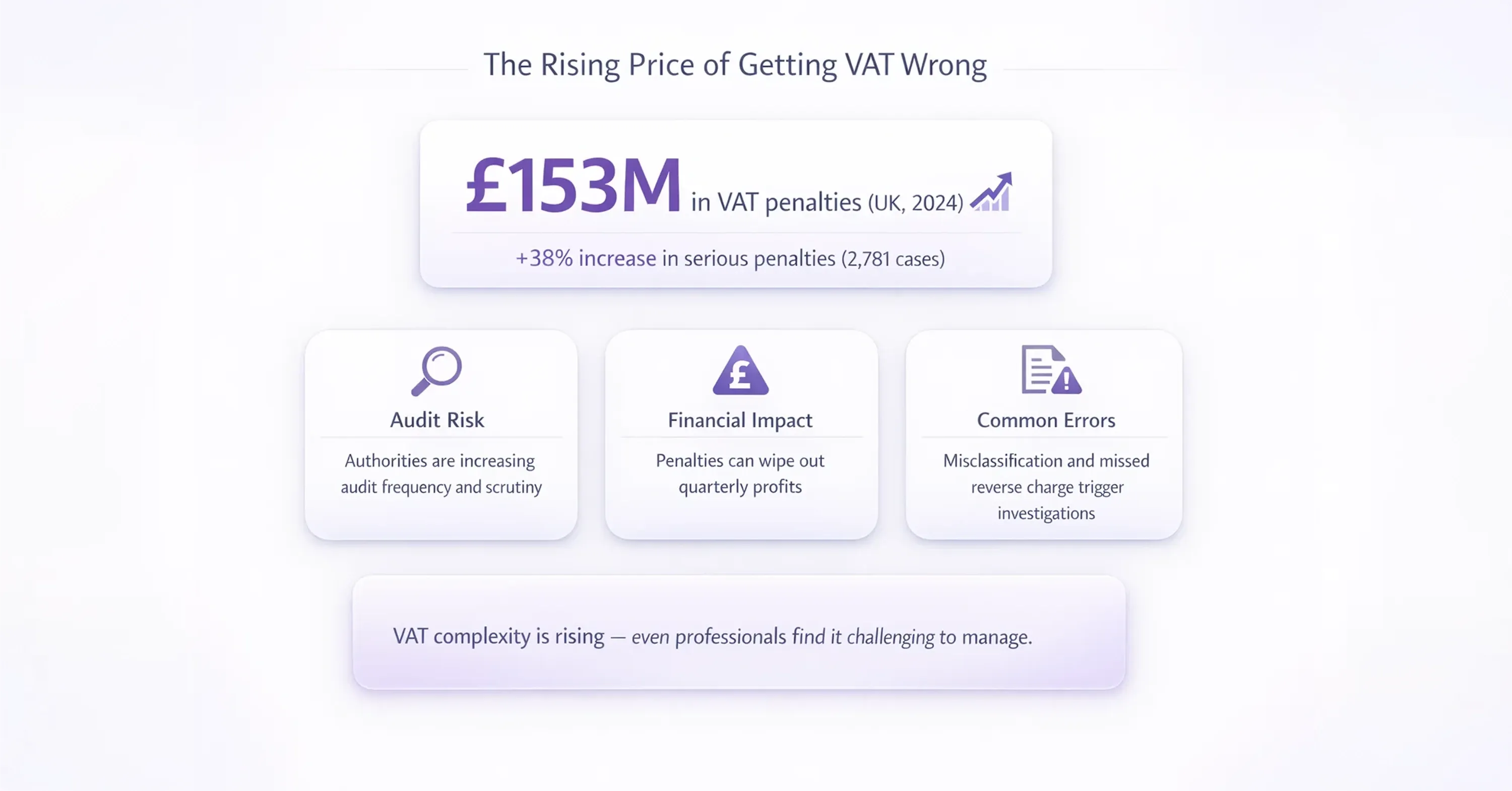
In the UK alone, HMRC collected £153 million in VAT penalties across 46,376 cases in the year to March 2024. More concerning, HMRC issued 2,781 serious penalties for deliberate VAT return errors that same year, up from 2,011 in the prior period, a 38% jump. The trajectory is clear: authorities are auditing more aggressively and punishing more harshly.
A single misclassified supply or a missed reverse-charge entry can trigger an inquiry. For a small e-commerce seller, even a moderate penalty can wipe out a quarter's profit. Read more about the real-world costs of missteps in VAT Compliance: How EU Businesses Lost €159M in Penalties.
Complexity Is Not a Sign of Weakness
ICAEW member Laura Beales put it bluntly: "VAT is a complicated tax, even for accountants," and it remains "expensive to get help with". If qualified professionals find VAT tricky, there is no shame in a business owner admitting the same. Recognizing that complexity is the first step toward managing it well.
So if DIY carries hidden time costs and growing penalty risk, is a traditional VAT consultant the obvious answer? Not always.
What a Traditional VAT Consultant Brings to the Table
Hiring a dedicated tax advisor does remove the burden from your shoulders. You get specialist knowledge, audit support, and someone who tracks legislative changes for you. For many businesses, that is exactly what they need.
The Advantages Are Real
-
Accuracy: A qualified consultant applies current rules and case law to your specific situation.
-
Audit protection: If a tax authority raises questions, your advisor handles correspondence and negotiations.
-
Strategic input: Good consultants spot VAT recovery opportunities, such as reclaiming input tax on imports, that most business owners miss entirely.
Consider a UK-based DTC brand that expanded to France and Spain. Their consultant identified that they had been overpaying import VAT for months because the customs broker had applied the wrong commodity code. The refund claim covered the consultant's annual fee twice over.
For deeper insight on why expert guidance matters and how consultancy support goes far beyond simple filing, see VAT Compliance & Consultancy: Why Expert Advice Matters.
The Drawbacks Are Equally Real
Traditional advisory relationships come with friction:
-
High hourly rates: Senior VAT specialists in Europe commonly charge £200 to £400 per hour, making ad hoc queries expensive.
-
Multiple contacts: If you sell in several countries, you may need a separate local advisor for each jurisdiction, each with their own onboarding process and invoice.
-
Communication lag: Email chains with a busy tax partner can stretch a simple question into a week-long wait.
An HMRC customer survey found that 31% of UK small businesses outsource all of their tax administration to agents. That still leaves nearly 70% who either go it alone or use a partial hybrid. Why? Because the traditional model does not always fit the budget or workflow of a lean, fast-growing seller.
This is precisely where the middle ground becomes relevant.
The Middle Ground: Expert Support Without the Overhead
What most marketplace sellers actually need is not a choice between total self-reliance and a premium Big Four advisory retainer. They need accessible expertise, consolidated filing, and predictable costs.
To see how market-leading VAT firms solve these requirements for online sellers, check Top VAT Firms for Online Marketplaces.
What "Middle Ground" Looks Like in Practice
-
A single point of contact that covers registrations, filings, and consulting across multiple countries.
-
Certified specialists who know marketplace-specific rules, including OSS declarations, deemed-supplier models, and local thresholds.
-
Transparent, subscription-style pricing that replaces unpredictable hourly bills.
A mid-size fashion seller on multiple European marketplaces, for instance, might operate in eight VAT jurisdictions simultaneously. Coordinating eight local accountants is a logistical headache. Consolidating everything under one provider eliminates duplicate onboarding, conflicting advice, and fragmented communication.
For a primer on the benefits of tech-enabled, cross-border compliance services, see Best Cross-Border VAT Experts for International Businesses.
Where 1StopVAT Fits
This is the model that 1StopVAT was built around. With a team of over 40 certified tax specialists covering 100+ countries, the firm acts as a single compliance partner for businesses selling internationally. Marketplace sellers get dedicated guidance on registrations and filings without juggling multiple local advisors or trying to decode foreign tax portals on their own.
The value proposition is straightforward: you retain the accuracy and peace of mind of professional support while keeping costs predictable and communication centralized. For sellers scaling across borders, that combination of expert support, a streamlined process, and cost efficiency is hard to replicate with either a pure DIY approach or a patchwork of traditional consultants.
Quick-Reference Comparison
-
DIY VAT compliance works best for single-country, low-volume businesses with some tax knowledge. It saves on fees but costs significant time and carries increasing penalty risk as complexity grows.
-
Traditional VAT consultants deliver deep expertise and audit protection but can be expensive, fragmented across jurisdictions, and slow to respond for routine queries.
-
Consolidated compliance partners offer the expertise of a consultant with the simplicity of a single relationship, making them the most practical choice for marketplace sellers operating across multiple countries.
Conclusion
The real question is not whether VAT support is worth the cost. It is whether your current approach can still support the complexity of your business. DIY VAT compliance may work for small, domestic businesses with simple transactions. But once you expand across borders, sell through marketplaces, or deal with multiple VAT rules, compliance becomes far more than an admin task. It turns into a growing operational and financial risk. At that point, errors can lead to penalties, missed deadlines, and wasted time that should be spent on growth. Traditional consultants reduce that risk, but they can also bring higher costs, slower communication, and fragmented support across jurisdictions. That is why the middle path is becoming the stronger option for many modern sellers. A consolidated compliance model gives businesses expert support, centralized communication, and a more scalable way to manage VAT without the burden of handling everything alone.
In the end, VAT compliance should support growth, not slow it down. The businesses that scale more confidently are usually the ones that build the right compliance structure before complexity becomes a costly problem.