Overview
Making Tax Digital VAT is now a mandatory requirement for all VAT-registered businesses in the UK, yet many companies still struggle to understand what full compliance actually involves in practice. From digital recordkeeping to software-based submissions, the shift to MTD has fundamentally changed how VAT is managed and reported.
This guide explains everything businesses need to know about Making Tax Digital for VAT, including who must comply, key deadlines, and how to set up MTD-compatible systems. It also breaks down the practical steps to automate VAT filing and maintain accurate digital records over time. Whether you're transitioning from spreadsheets or optimizing an existing setup, this article provides a clear path to achieving and maintaining VAT digital compliance.
What Making Tax Digital VAT Actually Requires
Making Tax Digital (MTD) for VAT is HMRC's programme to move VAT administration from paper and spreadsheets into compatible digital software.
The core obligation has two parts:
-
Digital recordkeeping: You must store VAT records (sales, purchases, VAT account summaries) in a digital format using functional compatible software, not in paper ledgers or standalone spreadsheets.
-
Digital submission: Your VAT return must be filed directly from that software to HMRC via an Application Programming Interface (API). Manual re-keying of figures into HMRC's online portal no longer satisfies the rules.
Think of it this way: if your bookkeeper previously typed totals from a spreadsheet into the HMRC website, that process is no longer compliant. The software itself must transmit the nine-box return data.
The programme isn't unique to the UK. Governments worldwide are digitising tax reporting. The OECD confirms that digital reporting and effective audits have played a significant role in reducing the VAT gap in recent years. The EU, for instance, saw its VAT compliance gap fall from roughly €121 billion in 2018 to about €89 billion in 2022. Digital mandates are the clear direction of travel.
Who Must Comply with HMRC VAT Rules for MTD
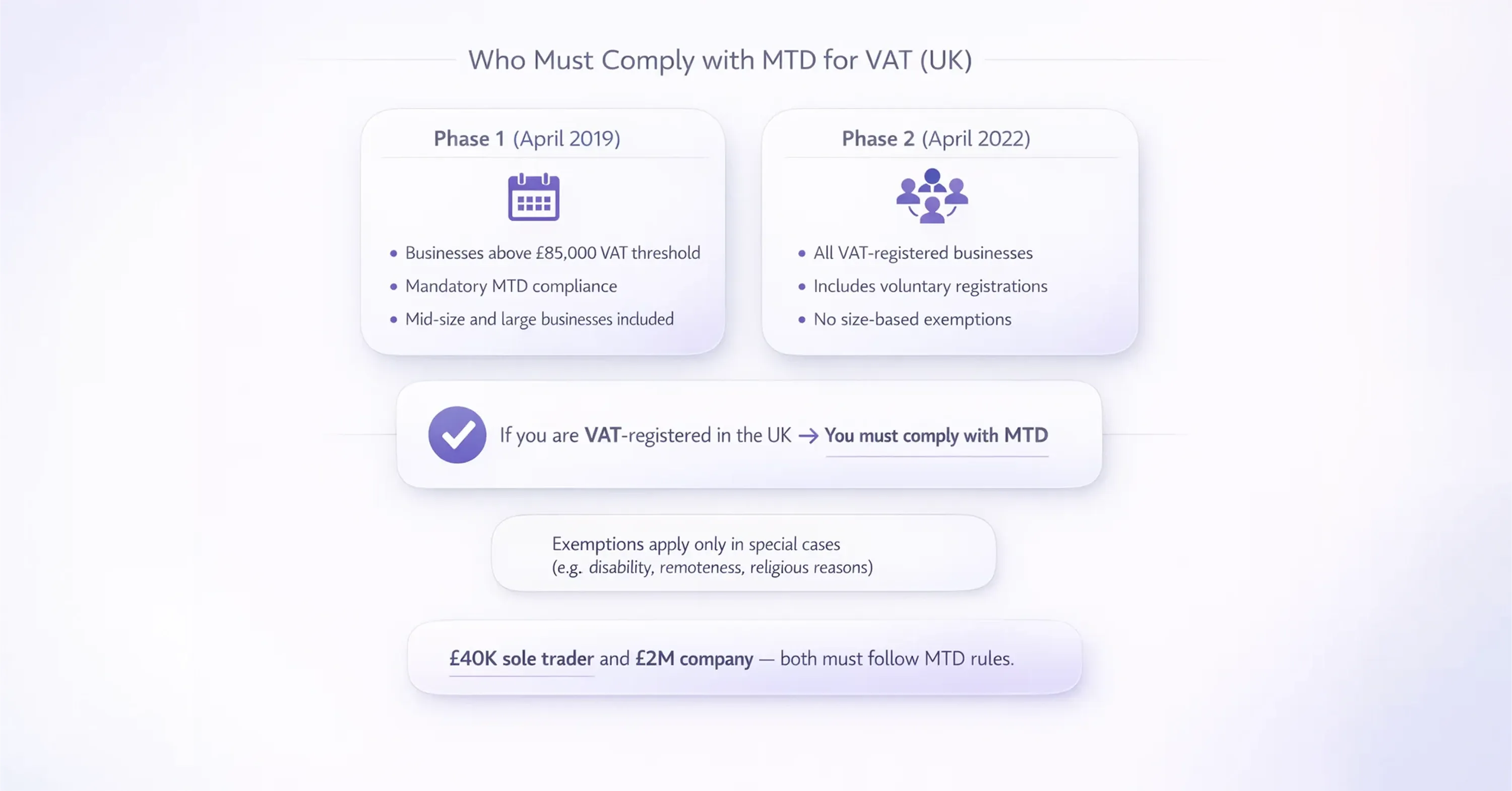
MTD for VAT rolled out in two phases, and both are now fully in effect.
Phase 1: Above the VAT Threshold (April 2019)
Businesses with taxable turnover above £85,000 were required to join MTD from their first VAT period starting on or after 1 April 2019. This covered the majority of mid-size and larger VAT-registered businesses.
Phase 2: Below the VAT Threshold (April 2022)
From April 2022, all remaining VAT-registered businesses, including those voluntarily registered with turnover below £85,000, were brought into scope. There are no longer any VAT-registered businesses exempt from MTD simply because of their size.
In practical terms, if you have an active UK VAT registration, you must comply. The only businesses outside MTD for VAT are those that have received a specific exemption from HMRC, typically on grounds such as disability, age, remoteness of location, or religious objections to using electronic communications.
For example, a sole trader selling handmade goods online who voluntarily registered for VAT at £40,000 turnover is just as bound by MTD as a £2 million-revenue wholesaler. Both need compatible software and digital submissions.
For more on eligibility and practical registration steps, see the guidance in How to Register for VAT: A Complete Guide.
Now that you know who's in scope, let's look at the deadlines and filing rhythm you need to follow.

Key Deadlines and Filing Schedule
Once you're signed up for MTD, the filing calendar mirrors traditional VAT return deadlines. Nothing changes about when you file, only how.
-
Quarterly returns: Most businesses submit every three months, with the return and payment due one calendar month and seven days after the quarter ends.
-
Monthly returns: Some businesses file monthly, either by choice or HMRC direction. The same "one month and seven days" window applies.
-
Annual Accounting Scheme: If you're on this scheme, you still need to maintain digital records throughout the year and submit your annual return via MTD-compatible software.
There's one critical date many businesses overlook: you must sign up for MTD before your next return is due. HMRC recommends allowing at least five working days to process your registration. Filing a return through the old HMRC portal after you should have migrated can trigger penalties.
For details on deadlines, penalties, and the new points-based system - including practical ways to avoid costly mistakes - see VAT Return Deadlines: Dates, Rules & Penalties Explained.
HMRC's newer points-based penalty system also means late submissions now accumulate points. Hit the threshold (typically four points for quarterly filers), and you'll receive a £200 penalty for every subsequent late return. It resets only after a period of full compliance.
With deadlines clear, the real question becomes: how do you actually set this up?
How to Set Up MTD-Compatible Software
Choosing and configuring the right software is where most of the effort sits. Here's a step-by-step approach.
Step 1: Pick HMRC-Recognised Software
HMRC publishes a list of compatible software on GOV.UK. You have two main options:
-
Full MTD software: Cloud accounting platforms like Xero, QuickBooks, FreeAgent, or Sage that handle bookkeeping, digital records, and API submission in one place.
-
Bridging software: Lightweight tools that connect an existing spreadsheet to HMRC's API. Useful if you want to keep your current workflow, though you still need a digital link between your records and the return.
HMRC's own evaluation found that among below-threshold businesses, 54% now use fully functional MTD software while 26% use bridging. Full software users tend to see broader benefits, but bridging works fine for compliance.
For further insights on choosing and automating with digital tools (and avoiding major pitfalls), check out Tax Technology Tools – VAT Compliance Automation.
Step 2: Sign Up Through Your HMRC Business Tax Account
Before your software can talk to HMRC, you need to authorise it. Log in to your Government Gateway account, navigate to the MTD for VAT section, and follow the sign-up process. You'll need your VAT registration number, business entity details, and the date of your latest VAT return.
Step 3: Connect and Test
Once signed up, link your chosen software to HMRC by granting it API access. Most platforms walk you through this in a few clicks. Run a test submission if your provider offers one. Confirm the nine-box figures match what you'd expect before going live.
A bakery chain owner in Manchester, for instance, switched from a paper ledger to Xero in 2019. The initial setup took half a day, but within two quarters, the team had cut their VAT admin from a full weekend to under two hours.
With software in place, the next step is building habits that keep you compliant quarter after quarter.
Automating VAT Filing for Ongoing Compliance
Setting up software once isn't enough. VAT digital compliance depends on maintaining clean digital records between filings.
-
Record transactions in real time: Enter sales and purchases as they happen, or use bank feeds to pull them in automatically. Batch-entering a quarter's worth of transactions the night before a deadline is a recipe for errors.
-
Use digital links throughout: If data moves between systems (say, from a point-of-sale system to your accounting platform), the transfer must be digital. Copy-pasting numbers manually breaks the digital link requirement.
-
Reconcile monthly: Even if you file quarterly, a monthly bank reconciliation catches miscodings early. It's far easier to fix a miscategorised expense in week three than in week thirteen.
-
Review the VAT return before submission: Your software will generate the nine boxes automatically. Spend ten minutes comparing them to the prior quarter. Any wild swings deserve investigation before you hit submit.
For an actionable checklist and advice on accurate preparations, see Accurately Filling Out a VAT Return.
The payoff is real. HMRC found that businesses using fully functional MTD software saved 26 to 40 hours each per year on VAT recordkeeping, totalling 32 to 49 million hours across all businesses (worth roughly £603 million to £915 million) in 2022-23. Meanwhile, 49% of below-threshold businesses said MTD saved their business time overall.
For businesses selling across borders, particularly marketplace sellers with obligations in multiple countries, managing VAT extends well beyond UK MTD. That's where a provider like 1stopVAT can help. With a team of over 40 certified tax specialists covering 100+ countries, 1stopVAT acts as a single point of contact for VAT registration, compliance, and filing internationally, giving marketplace sellers dedicated guidance so they can focus on growth rather than juggling filings in every jurisdiction. If you need an explainer on cross-border VAT rules and compliance, check out Cross-Border Tax Compliance: Tips for Global Businesses.
What the Data Says About MTD's Impact
It's worth pausing to see whether all this effort actually pays off.
HMRC's final evaluation, published in February 2025, is encouraging. MTD for VAT generated roughly £185 to £195 million in additional revenue for 2019-20, driven by fewer errors on returns. Around 69% of businesses mandated in 2019 (and 67% of those in 2022) reported at least one benefit from adopting MTD.
Confidence matters too. Among the 2019 cohort, 53% said MTD increased their confidence in getting VAT right. And 63% of those mandated in 2019 found their first MTD submission easy.
There are costs, of course. Among below-threshold businesses, 58% reported financial costs (mostly new software) and 72% reported time costs during implementation. But 41% felt the benefits outweighed the costs, versus just 23% who felt the opposite.
Beyond compliance, 59% of below-threshold businesses found improvements in other areas, like automated invoicing, better time management, and stronger business continuity. MTD isn't just a tax obligation; for many, it's become a genuine operational upgrade.
This trend is global. The EU has agreed that all cross-border VAT reporting obligations must be fully digital by 2030, with e-invoicing at the core. The direction is unmistakable: digital VAT compliance is becoming the norm everywhere.
Conclusion
Making Tax Digital for VAT is now a fundamental part of staying compliant with HMRC VAT rules, not a future change businesses can afford to ignore. If your business is VAT-registered in the UK, HMRC expects digital recordkeeping, software-based submissions, and a filing process built to reduce manual errors. Businesses that get MTD right are doing more than avoiding penalties. They are creating faster, more accurate, and more resilient finance operations. By choosing the right MTD-compatible software, setting up clean digital workflows, and reviewing returns consistently, businesses can turn VAT compliance into a more efficient and reliable process. In practice, getting Making Tax Digital VAT right is no longer just about meeting HMRC VAT rules. It is a practical advantage for reducing risk, saving time, and improving long-term financial control.