Business analyst reviewing sales tax data and financial metrics on a dashboard with multiple tax rate notes and performance charts.

Figuring Sales Tax: How to Calculate Correctly

Sales tax looks simple, yet one wrong decimal can erase a profit margin or trigger an audit. Whether you run a weekend market stall or manage a multinational ecommerce store, getting the numbers right is non-negotiable. Below you will find a clear, step-by-step method for figuring sales tax, from finding the right rate to reporting the totals. Real examples, plain language, and a few cautionary tales keep the process practical.

Content authorBy Rūta ŠvobienėPublished onReading time9 min read

What You Will Learn

This guide starts with the basics - what sales tax is and why it varies - then walks through five connected steps:

  • locating the right rate with a fast tax rate lookup

  • running a bullet-proof sales tax calculation

  • catching special cases such as shipping or multiple jurisdictions

  • recording, reporting, and remitting without stress

Along the way, you will see how other indirect taxes, like VAT, shape global trade, and why services such as 1stopVAT exist to keep cross-border sellers compliant. For deeper insights into global compliance strategies, explore the Global Sales Tax Solutions & VAT Compliance Guide.

What Is Sales Tax and How Does It Work?

Sales tax is a consumption-based tax charged on the sale of taxable goods and, in some jurisdictions, certain digital products or services. Sellers collect it from the buyer at the point of sale and calculate it using the applicable combined rate, which may include state, county, city, and special district taxes depending on the customer’s location. The seller does not keep this money as revenue. Instead, it is held on behalf of the tax authority and later reported and remitted through scheduled tax returns. In practice, sales tax rules depend on what is being sold, where the sale takes place, whether the buyer qualifies for an exemption, and how the jurisdiction applies sourcing and filing requirements.

Understand What Sales Tax Covers

Every sales tax transaction has three building blocks: the taxable item, the place of sale, and the buyer’s exemptions. Skipping any of them causes miscalculations.

Most U.S. states tax tangible personal property; a handful also tax digital goods or services. For example, the tax treatment of software and digital products varies by state. California generally does not tax electronically downloaded canned software, while other states may apply different rules depending on the product, delivery method, and use. If you sell software nationwide, that difference changes invoice totals by several dollars per order.

  • Identify your taxable products in each state

  • Check for statutory exemptions (e.g., groceries, medical equipment)

  • Keep exemption certificates on file for resale or nonprofit buyers

Grasping scope now prevents refunds and penalties later. Once you know what is taxable, you can move to the rate. For a detailed playbook on exemption rules and documentation, review Sales Tax Exempt Explained: Who Qualifies and How to Apply.

Locate the Correct Rate With Smart Tax Rate Lookup

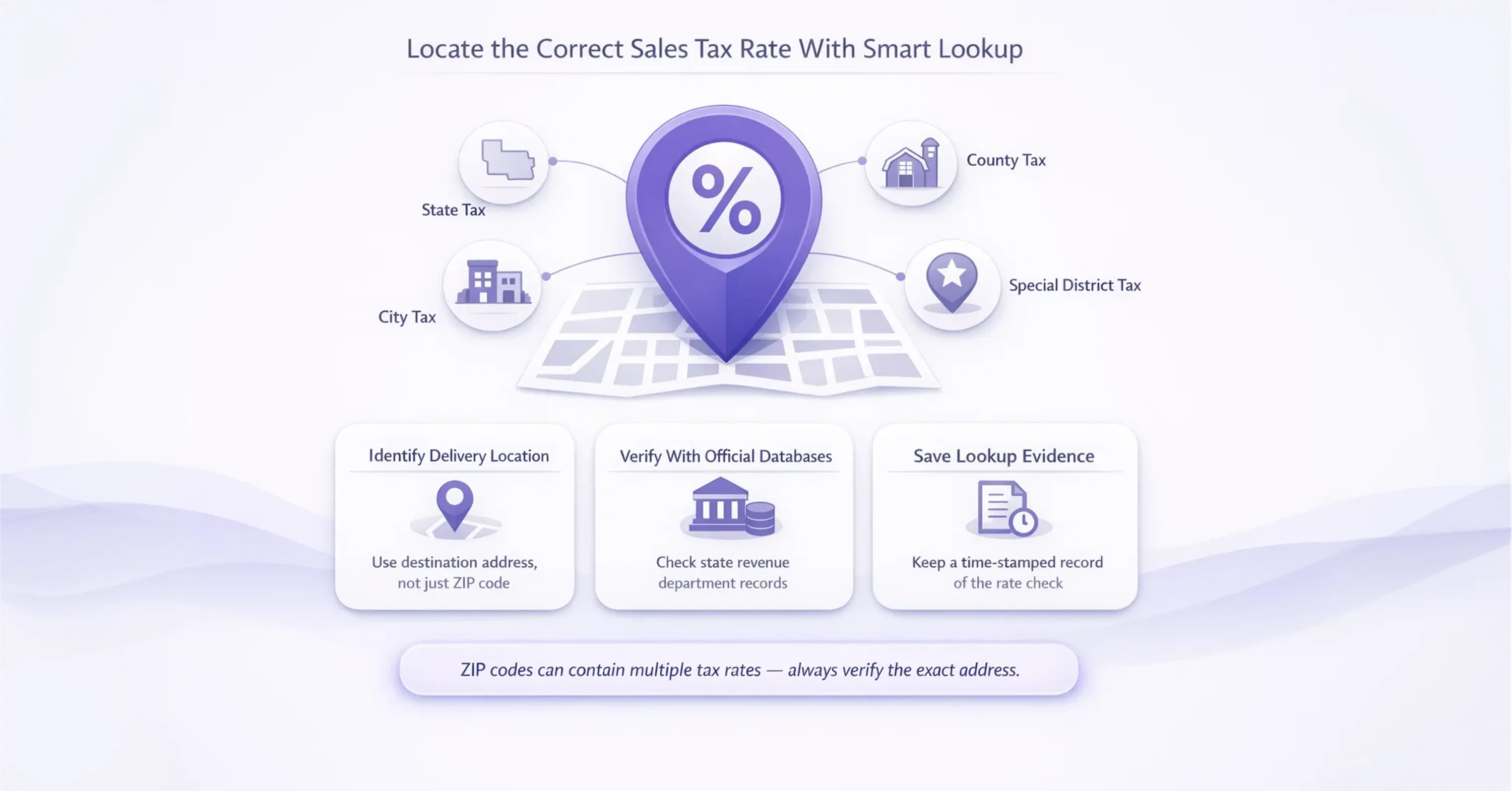
Diagram showing how to locate the correct sales tax rate by identifying state, county, city, and special district taxes based on the delivery address

Sales tax rates come from multiple layers: state, county, city, and sometimes special districts. A single ZIP code can contain more than one rate.

Start the lookup by pinning down the place of delivery, not just the shipping ZIP. Many states follow “destination-based” sourcing, which taxes according to where the buyer receives the goods.

  • Use official state revenue department databases

  • Cross-check addresses down to the street level, not the ZIP alone

  • Save a time-stamped record of each lookup as proof

Some sellers rely on automated APIs, but manual confirmation is still wise for unusual addresses. That safeguard paid off for a New York retailer when a street-level check revealed an overlooked transit district tax, preventing a future underpayment notice.

To better track these changes and leverage technology, see the US Sales Tax Explained: State-by-State Guide.

By the end of this step, you have a rate expressed as a percentage, ready for math.

Run the Core Sales Tax Calculation

With the taxable amount and rate in hand, the arithmetic is straightforward:

Tax = (Taxable Sale Amount) × (Combined Tax Rate)

For example, you ship a $120 coffee grinder to Denver, Colorado, at 8.81 percent.


Tax = $120 × 0.0881 = $10.57 (rounded to the nearest cent).

Rounding rules can vary by jurisdiction and filing format, so businesses should follow the guidance issued by the relevant tax authority and apply a consistent method across transactions and returns.

  • Confirm whether shipping is taxable (varies by state)

  • Apply the rate only to taxable line items, not the whole invoice, if exemptions exist

  • Show the tax as a separate line on the receipt for transparency

That visible line helps customers and auditors alike trace the math.

Sub-Step: Reverse Calculation for Tax-Inclusive Prices

Some marketplaces display tax-inclusive prices. To back out the tax, divide by (1 + rate). A $50 tax-inclusive price at 7 percent equals a taxable base of $46.73 and tax of $3.27. These reverse calculations prevent accidental double taxation when systems mix inclusive and exclusive prices.

The math is done, but the story is not over. Complexities still lurk. For more on managing state differences and intricate edge cases, consult the Sales Tax Compliance: Key Steps for Your Business.

Handle Special Situations Before They Bite

No two sales are identical. Discounts, mixed taxability, and multi-state sales complicate life. Address them systematically.

Mixed Taxability on a Single Invoice

A children’s clothing store in Massachusetts sells a coat for $70 (tax-exempt) and a leather belt for $25 (taxable). Only the belt carries 6.25 percent tax, so the customer pays $1.56 in tax, not $5.94 on the full $95.

Maintain SKU-level tax codes so your system applies rates correctly.

Volume Discounts and Coupons

States disagree on whether tax applies to the pre-discount or post-discount price. For manufacturer coupons, many states tax the price before the discount. Retailer coupons usually reduce the taxable base.

  • Label each discount with its origin (store or manufacturer)

  • Document each calculation method in your tax policy manual

Origin vs. Destination Conflicts

Sourcing rules vary by state, which means sales tax is not always determined in the same way. In some jurisdictions, tax is based on the seller’s location, while in others it depends on the customer’s delivery address or the applicable local district rules. For businesses selling across multiple states, this distinction matters because the correct method can change as operations expand.

A company that begins selling from one location may follow one sourcing approach, then face different requirements after adding a warehouse, office, or fulfillment point in another state. That is why businesses should review sourcing rules regularly and track physical presence carefully to avoid billing errors, under-collection, or the need to reissue invoices later.

Catching these wrinkles now avoids the nightmare of reissuing 3,000 invoices. If you're looking to optimize automation or handle complications across multiple jurisdictions, the Top Sales Tax Compliance Firms for Businesses article compares top consulting options.

With edge cases covered, compliance turns to paperwork and payment.

Record, Report, and Remit on Time

Proper calculation means little if you miss a filing deadline. Most states assign monthly, quarterly, or annual filing based on sales volume. Large sellers may also face more frequent filing and prepayment requirements, which makes disciplined reporting and cash-flow control even more important.

  • Reconcile daily sales to bank deposits

  • Segregate tax collected from operating cash to avoid accidental spending

  • File early to buffer technical glitches; almost 85% of tax administrations run electronic post-filing checks, as highlighted in the OECD Tax Administration 2024 report

Some states, including Florida and Illinois, provide a small allowance or discount for timely filing and payment, subject to their specific rules. For more on U.S. registration nuances, see US Sales Tax Registration Services: A Practical Guide. And for ongoing processes and quarterly self-checks, check out Compliance Checks: Ensuring Your Business Meets U.S. Tax Laws.

Many businesses maintain a calendar containing all filing due dates and pre-populate returns from accounting data. After submission, store confirmation numbers alongside payment receipts.

When Multi-State Sales Morph Into Global VAT

As you expand overseas, your tax story shifts from sales tax to VAT. The principle is similar - tax on consumption - but filings are typically monthly and require reverse-charge rules. In the EU alone, the One-Stop Shop generated €20.0 billion of VAT revenue in 2022. Compliance is manageable when a dedicated provider like 1stopVAT acts as a single point of contact across more than 100 countries, as discussed in VAT services for US companies: How to Stay Compliant When Selling Internationally.

Keep Skills and Records Current

Tax rules evolve. Rate changes, new economic nexus thresholds, and digital services taxes appear every year.

  • Subscribe to state revenue department bulletins

  • Schedule a semi-annual rate audit against your POS or ecommerce platform

  • Train staff on exemption certificate acceptance and storage

Global data reinforces the need. Across OECD members, 20.8 percent of total tax revenues came from VAT/GST in 2022. Indirect tax is pivotal for government budgets, so enforcement only intensifies.

By treating sales tax as an ongoing process rather than a one-off calculation, you reduce risk and free time for growth projects.

Conclusion

Figuring sales tax correctly is a repeatable process: know what is taxable, perform a precise tax rate lookup, apply clean calculations, handle edge cases, and file on schedule. Investment in recordkeeping and periodic reviews pays off in lower risk and smoother audits. As you grow across borders, similar principles apply to VAT, and reliable partners such as 1stopVAT can keep you on track worldwide.

With the steps above, you can approach every sale - across any state or country - with confidence that the tax is right, the paperwork is ready, and your business can focus on serving customers, not fighting fines.

Use your state revenue department’s online tool, enter the complete delivery address, and save a screenshot or PDF as evidence. Many ZIP codes contain multiple rates, so address-level lookup avoids errors.

Yes, but you must disclose that the price is tax-inclusive and then reverse-calculate the tax portion for reporting. Divide the total price by one plus the tax rate to find the taxable base.

No. Roughly half of U.S. states tax shipping when it is part of the sale, while others exempt separately stated shipping charges. Check each state’s rule and code your checkout accordingly.

Under-collecting means you still owe the full amount to the state, cutting into profit. Over-collecting requires refunding customers or remitting the excess, depending on state law.

You need a permit only in states where you have nexus, which can be physical (office, warehouse) or economic (sales above a revenue or transaction threshold). Track thresholds monthly to register on time.

Simple Compliance

Free consultation with 1StopVAT experts

You Might Also Like

Discover more insights and articles

Business professional managing EU VAT compliance and tax reports on a laptop with financial documents and EU flag in the background.

European VAT Number: What It Is & How to Verify

Expanding into the European market creates growth opportunities but also introduces tax obligations. The European VAT number is essential for businesses trading goods or services within the EU, allowing them to charge VAT, reclaim tax on expenses, and conduct cross-border transactions legally. This article explains what a European VAT number is, how it works, and how to verify it to ensure compliant and secure trade across the EU.

Business professional reviewing online sales tax reports and analytics dashboard on a laptop in an office.

Leading Firms for Texas Sales Tax Compliance: Your Guide

Texas presents a unique challenge for businesses trying to manage their tax obligations. With a vast array of local jurisdictions and distinct filing requirements, staying on the right side of the law requires more than just good intentions. This guide explores the specific complexities of the Texas sales tax system and why professional assistance is often necessary. You will discover the current landscape of compliance, review the top firms that can manage these liabilities for you, and learn practical steps to secure your business against costly audits.

Laptop displaying an online VAT registration form with business documents and passport on a desk

VAT Registration Online: Quick & Easy Setup Guide

Tax compliance may not be the most exciting part of starting a business, but it is essential for long-term growth. As governments continue to digitize tax systems, online VAT registration and digital VAT registration processes have become the standard approach in many countries. This guide explains how to determine if your business needs to register, which documents are required, and how to complete the VAT registration process through official digital portals for both domestic and cross-border activities.

Corporate finance team analyzing global market data and financial reports during a strategy meeting in a modern office with city skyline view

Top Advisors for Multi-Country VAT Compliance

International expansion is thrilling until value added tax starts pulling the handbrake. Different rates, reporting calendars, and place-of-supply rules can trip up even seasoned finance teams and lead to eye-watering penalties. The surest shortcut is to lean on specialists who live and breathe cross-border VAT every day. A well-chosen advisor keeps cash flowing, shields margins, and frees leadership to scale, instead of firefighting audits in half a dozen jurisdictions.