

Overview
This guide walks CFOs, finance managers, and business owners through every stage of United Kingdom VAT deregistration. You’ll learn what it involves, when you should deregister, the step-by-step application, and what to file after cancelling your VAT number. We also flag the risks of delaying and show where expert support can make a difference.
VAT deregistration explained
VAT deregistration is the formal process of removing your business from the VAT system.
Once VAT deregistration is over, you:
- Cease charging VAT on sales
- Stop submitting regular VAT returns
- Issue final VAT invoices and settle any outstanding liability.
Essentially, you’re switching off a tax that may no longer be relevant to your turnover, trading status, or corporate structure. VAT deregistration is HMRC procedure for cancelling a company’s VAT number so it no longer charges, collects, or reports value added tax after meeting specific thresholds or ceasing taxable activities.
1. Check whether deregistration is mandatory or voluntary
1.1 Mandatory triggers
Part of the end-of-trade VAT process, you should cancel your VAT number within 30 days if:
- Your taxable turnover over the past 12-month fell below the deregistration threshold. Since 1 April 2024, the limit rose to £88,000.
- You stopped making taxable supplies, i.e. sale of goods or services, or the legal entity has been closed, sold, or merged.
- You became exclusively zero-rated (in rare cases).
Failing to act will result in late deregistration penalties and interest.
1.2 Voluntary reasons
You may request deregistration even if you’re above £88,000 limit if:
- Future sales are expected to tumble below the threshold (e.g., major contract lost).
- Group restructuring moves trading offshore.
- A sole trader goes part-time and requires admin relief.
Pro Tip:
A voluntary request is granted only if your next 12-month turnover remains under £88,000.
2. Weigh the pros and cons of leaving the VAT regime
While deregistering may seem appealing, here are some trade-offs:
Pro: Fewer filings and record-keeping; HMRC estimates £5 million in annual admin savings.
Pro: Simpler pricing for B2C sales, and no VAT imposed.
Con: You can no longer reclaim input VAT on costs.
Con: Large one-off cash outflow may arise if you still have to repay input VAT on assets.
Con: Loss of credibility for certain B2B customers.
For a practical breakdown of different VAT schemes and their pros and cons for small businesses, explore the VAT Compliance Checklist for Startups and Small Businesses.
Spreadsheet these numbers before you push the button.
3. Confirm your turnover against the new thresholds
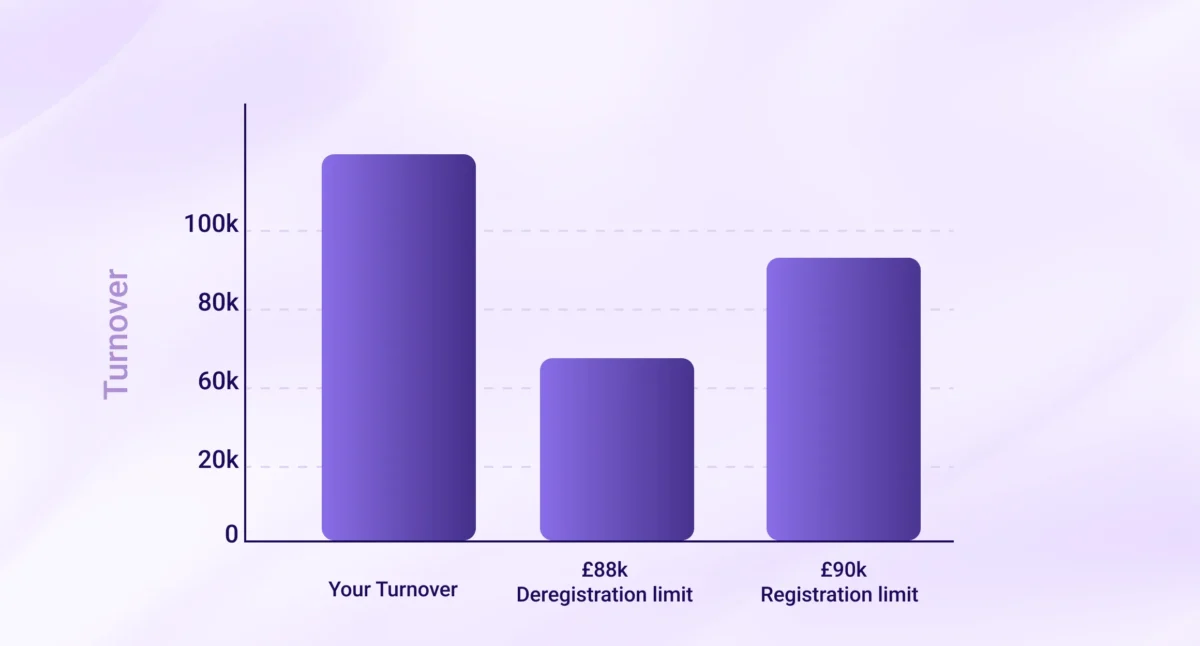
The UK now boasts the joint-highest VAT threshold in the OECD. With £90,000, it outranks every EU member state. That lofty bar keeps 3.2 million small UK businesses out of the VAT net.
To test eligibility:
- Use rolling 12-month taxable turnover, not calendar year sales.
- Exclude exempt and outside-scope income.
- Include reverse-charge purchases.
Pro Tip:
Once you anticipate a drop below £88,000 for the next 12 months, submit a voluntary application.
4. Prepare your paperwork
Having clean records at hand speeds HMRC’s approval and soothes the final return.
Get this paperwork ready:
- Last four VAT returns and working papers
- Management accounts showing turnover decline or cessation date
- Details of stock and fixed assets subject to VAT reclamation
- Any outstanding EC sales lists or Intrastat declarations
Learn more about the importance of documentation and digital filing
5. File the VAT deregistration application
5.1 Online submission
- Log in to your Government Gateway account.
- Select “Cancel VAT registration.”
- Enter the deregistration reason: closure, turnover reduction, or restructure.
- Provide the effective date, usually the day circumstances changed.
- Upload supporting documents if requested.
Most applications are approved within 3–4 weeks.
5.2 Paper form VAT7
Use it in case:
- You’ve lost your Gateway credentials.
- You’re transferring a going concern.
- Your company is in insolvency.
Mail to the address on the form; expect a longer turnaround.
6. What happens after HMRC confirms deregistration
HMRC sends a letter indicating the date of your VAT number cancellation. From that date you must:
- Issue invoices without VAT.
- Adjust your accounting software settings.
- Display the cancellation notice in a visible internal file.
- Submit the final VAT return, usually due one month and seven days after the effective date.
6.1 Completing the final return
- Account for output VAT on stock and assets if their VAT-inclusive value is over £1,000.
- Declare any credit notes issued after the effective date.
- Pay or reclaim the resulting net figure.
FLeverage further tips on accurate return preparation and timely filing
6.2 Record-keeping duties
Retain VAT records for six years even after deregistration. Archive them in a secure, searchable format. Here’s our practical record-keeping checklist for startups and small businesses
7. Handle post-deregistration adjustments
Afterwards the deregistration:
Bad debt relief: claim within four years and six months of the invoice date on your last return.
Purchase refunds: VAT on expenses dated after the effective date is not recoverable.
Returned goods: issue a normal commercial credit note, instead of VAT.
1stopVAT is here to help you:
- Take over reconciliation.
- File final return.
- Liaise with HMRC.
8. The risks of late deregistration
Non-compliance causes fines, audits, and reputational damage, while timely action will save you from potential losses:
Penalties: daily default surcharges accumulate once the 30-day deadline passes.
Extra VAT due: HMRC can assess VAT on deemed supplies you shouldn’t have made.
Lost cash: You may forfeit input VAT reclaims on post-deregistration costs.
Reputational knock: Investors see late tax compliance as sloppy governance.
Here’s how startups and SMEs manage compliance.
Conclusion
VAT deregistration is more than ticking a box. It closes your tax obligations, protects cash flow, and lets you focus on strategic goals. By matching your turnover to the new £88,000 threshold, filing the right forms, and wrapping up the final return duly, you’ll avoid penalties and save precious hours for priorities. Whether you need to cancel your VAT number as part of an end-of-trade VAT process, or simply streamline your compliance, 1stopVAT Expets Safeguard Clean VAT Exits
Frequently asked questions
HMRC aims to issue the VRT 23 confirmation letter within 40 days of receiving your VAT 7. Until that letter arrives you must continue charging and accounting for VAT.
Yes, if the total VAT-inclusive value of all stock and assets on hand exceeds £1,000, output VAT is due on your final return. This prevents businesses from reclaiming VAT on purchases and then selling them VAT-free.
You may request voluntary deregistration if you can prove your taxable turnover will remain below £88,000 for the next 12 months. HMRC can refuse if evidence is weak. For the wider context of expedited registrations and deregistrations—including eligibility criteria—explore [Expedited VAT Registration: Checklist for Fast EU Entry](https://1stopvat.com/articles/expedited-vat-registration-guide#section-0).
You must re-register within 30 days of knowing you will exceed the £90,000 registration threshold, or immediately if you breach it in any rolling 12-month period.
Yes. Firms like 1stopVAT combine automated tools and a team of 40+ tax specialists to handle VAT registration, compliance, filing, and deregistration across more than 100 countries, serving as a single point of contact for expanding businesses.