Overview
This article walks you through the entire VAT filing schedule, from standard UK quarter-ends to special EU One Stop Shop (OSS) rules. You will learn:
-
How the return cycle works and why due dates differ by regime
-
Exact UK and EU VAT due dates and how to calculate them
-
The new UK penalty-point system and the £200 charges that follow missed filings
-
Proven ways to stay compliant and avoid costly surprises
By the end, you will hold a clear, practical roadmap for meeting every deadline, supported by real examples and authoritative data.
What Is a VAT Return Deadline and When Is It Due?
A VAT return deadline is the final date by which a business must submit its VAT return and pay any VAT owed for a specific accounting period. In the UK this is usually one calendar month plus seven days after the period ends, while under the EU OSS scheme returns are due by the last day of the month following the quarter.
Understanding the VAT Return Cycle
Every VAT regime runs on a recurring calendar, but the cycle length varies. Starting with a short orientation makes it easier to map your own obligations.
-
Standard UK cycle: quarterly by default, though businesses can opt for monthly or annual schedules when turnover patterns demand it.
-
EU OSS: quarterly for intra-EU B2C sales and non-Union supplies, monthly for the Import One Stop Shop (IOSS) covering low-value imports.
-
Other jurisdictions: many Gulf Cooperation Council states and Asia-Pacific markets impose monthly filings, while Australia offers quarterly lodgement for smaller taxpayers.
Whichever timetable applies, the pattern repeats: record transactions, complete the return, submit, then pay.
At the end of each accounting period, a new countdown begins. Closing one quarter, for instance, automatically starts the “one month plus seven days” clock for UK filers. Knowing when the clock starts is half the battle; acting on that knowledge is the other half. This groundwork leads straight into the precise dates you need to note.
For practical advice on streamlining the compliance process in both the UK and EU, refer to How to Submit VAT Online: A Step-by-Step Guide.
Aligning accounting periods with your operations
A VAT calendar that clashes with internal reporting is a recipe for missed filings. Align your bookkeeping month-end close so that VAT data is finalised at least a week before submission. Then reconciliation feels like a final review rather than a last-minute scramble.
Synchronising timelines now sets you up for the next section, where we pinpoint the actual days the tax authority expects your return.
Key VAT Due Dates in the UK and EU

A headline date is useful, but nuance matters. Different payment methods or submission channels tweak cut-offs, and overseas sales introduce extra layers.
-
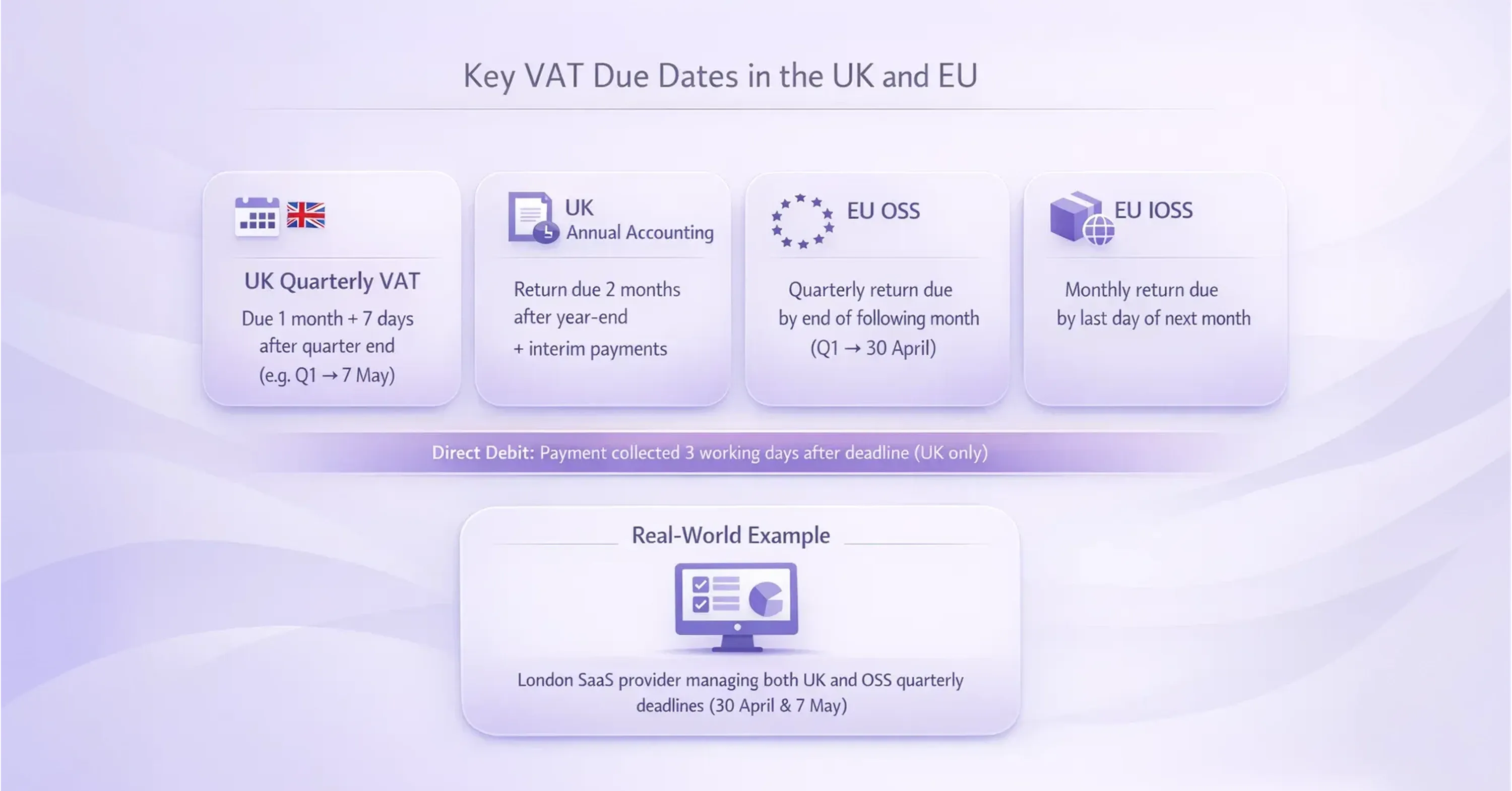
UK HMRC quarterly schedule: the filing and payment fall one month and seven days after the period ends. For a 1 January–31 March quarter, the return and payment must reach HMRC by 7 May.
-
Annual accounting scheme: returns are due two months after the year-end, while interim payments spread across the year reduce the final liability.
-
EU OSS scheme: the OSS return is due by the end of the month following the quarter. A Q1 OSS return covering January–March must therefore be submitted and paid by 30 April.
-
EU IOSS: monthly returns, every filing due by the last day of the subsequent month.
-
Direct debit nuance: in the UK, setting up a direct debit lets HMRC collect the amount three working days after the 7-day window, but the return must still be filed on time.
These VAT due dates form the backbone of your compliance diary. Each date is non-negotiable, so the cost of slipping is next on the agenda.
Real-World Example of Managing UK and OSS VAT Deadlines
A London-based SaaS provider sells both domestically and to EU consumers. It files UK VAT quarterly and OSS VAT quarterly. In April it prepares two separate returns: the UK Q1 return due 7 May and the OSS return due 30 April. By mapping both sets of deadlines into the same calendar, the finance lead reduces the risk of confusion and double work. The example shows why clarity on dates must feed straight into clarity on consequences, which brings us to penalties.
What Happens When You Miss the Deadline
Starting January 2023, HMRC launched a points-based late-submission system that many businesses still overlook.
Initial deadlines may feel forgiving, but crossing them triggers two escalating mechanisms: points and fixed penalties.
For additional detail and up-to-date rates in the UK, explore High Importance: UK Penalty and Surcharges.
Penalty points expire after two years, but only if the taxpayer meets a compliance “reset” period of timely filings.
Taken together, penalties may seem small at first glance. Yet they stack quickly. A business that files late for four consecutive quarters in its first trading year will pay £800 in fixed penalties, plus interest on any unpaid VAT.
Ending this section, the key takeaway is simple: avoidance is cheaper than cure. To avoid points, you need to know why slips occur in the first place.
Why Deadlines Slip: Common Pitfalls
Even organised finance teams miss deadlines. Understanding the behavioural and structural triggers helps you design countermeasures.
-
Fragmented data sources: sales platforms, payment gateways, and ERP systems do not reconcile automatically.
-
Staff turnover: new hires often inherit incomplete process notes.
-
Cash-flow prioritisation: delaying payment to preserve liquidity leads to missed submissions.
-
Manual filing fatigue: despite widespread e-filing, about 57 million tax returns were still on paper as of 2022, showing manual processes persist.
Leaving these issues unresolved feeds late filings, so the next part offers practical ways to stay ahead.
Staying Compliant: Practical Tips and Tools
Adopting proven habits and the right support structures keeps your VAT filing schedule intact.
-
Move to e-filing: 95% of business tax returns in OECD countries are already electronic, confirming that digital is mainstream and reliable.
-
Calendar reminders with owner accountability: assign names beside each task in the schedule, not just dates.
-
Reconcile weekly, not quarterly: smaller data sets are easier to check and fix.
-
Contingency workflow: have a two-person review if the main preparer is absent.
-
Specialist support: a VAT compliance partner like 1stopVAT, whose team of 40+ certified specialists covers more than 100 jurisdictions, can centralise registrations and filings so businesses meet every deadline while expanding abroad.
For an actionable compliance framework, explore VAT Filing & Returns: A Complete Guide for Businesses.
By embedding these habits, you make compliance a natural by-product of daily operations, not a stressful month-end project. The emphasis on preventative structure concludes the narrative arc, leaving only the most common quick-reference queries.
Conclusion
VAT compliance is a recurring race against the clock. From the UK’s “one month plus seven days” rule to EU OSS month-end submissions, the calendar is unforgiving. Penalties add up fast, with each late filing bringing you closer to a £200 charge and potential interest.
The good news is that disciplined processes, electronic filing, and, where needed, expert support can keep every deadline within reach. By mapping your VAT due dates, monitoring your points balance, and maintaining clear internal ownership, you transform filing from an annual headache into a routine task that protects cash flow and reputation alike.
If you’re wondering when to file or how to prepare each monthly or quarterly return, this VAT Return: When to File and How to Prepare checklist breaks the process down step-by-step.
For best practices on recordkeeping, digital workflow, and automation, see VAT Reporting Made Simple: Best Practices for Businesses.
If your business files in multiple countries or is scaling its cross-border operations, practical support is available. Discover how dedicated experts can ensure compliance in every jurisdiction: VAT Compliance & Consultancy: Why Expert Advice Matters.