

What you will learn
Below you will find the what, who, when, and how of VAT filing & returns, plus proven tactics to submit VAT reports faster and error-free.
Today, we will help you:
- Understand why timely VAT filing matters to your bottom line and national budgets
- Confirm whether your company is required to file, and how often
- Follow an online filing checklist you can reuse each period
- Spot common errors that lead to penalties
- Compare software, automated VAT compliance, and outsourcing options so you can pick the right mix for your finance stack.
1. Why VAT filing matters
Value-added tax (VAT) looks small on each invoice, but it funds schools, roads, and hospitals.
When businesses under-report, treasuries bleed cash. EU member states alone lost around €89 billion in VAT revenue in 2022, roughly 7 % of the tax that should have been collected.
For businesses, accurate returns:
- Keep cash flow predictable
- Protect against audits and reputational damage
- Unlock refunds faster
Mistakes can also fuel fraud. Missing Trader Intra-Community schemes cost between €13 billion and €33 billion every year. Regulators respond with tighter rules, so getting returns right is not optional. Here’s how EU businesses lost €159M in penalties.
2. Who should file VAT returns
If your taxable turnover exceeds the local registration threshold, you must register and file. Typical triggers include:
- Crossing a sales threshold (£90 000 in the UK, €85 000 in Ireland)
- Importing goods into the country
- Selling digital services to private consumers in another EU state
- Storing goods in a foreign warehouse (consignment or fulfilment models)
Check special cases:
- Non-resident businesses often need a fiscal representative.
- Marketplace operators may be deemed the supplier and shoulder VAT duties instead of sellers.
When unsure, request a written ruling from the tax authority or consult a specialist.
3. Know your filing frequency
Your reporting cadence affects working capital and admin work.
Monthly: Standard in many EU states once turnover tops a set figure. Improves refund speed.
Quarterly: Common for SMEs, balances effort and cash flow.
Annually: Reserved for small businesses or special schemes.
Pro Tip:
If you regularly reclaim VAT, opting for monthly filings can improve liquidity even if you are allowed to file quarterly.
Here’s more on how to prepare and when to file VAT return
4. Gather data to submit VAT reports
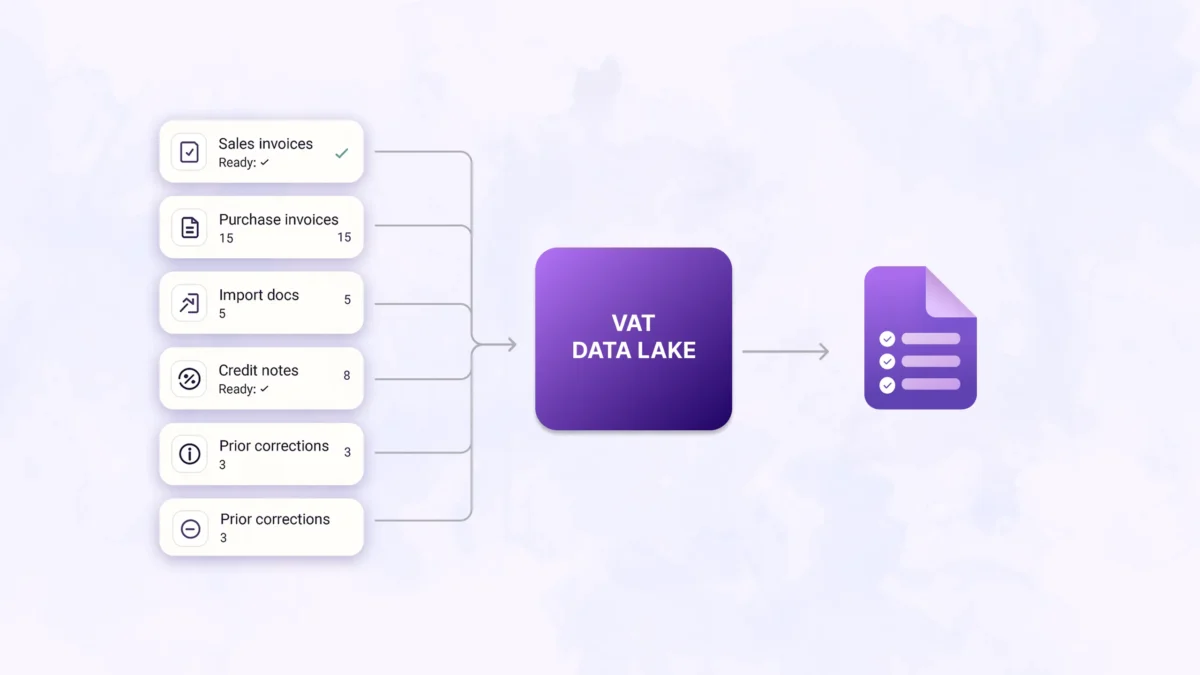
Preparing data is often 70 % of the job:
- Sales invoices: date, taxable amount, VAT rate, customer VAT ID (for intra-EU supplies)
- Purchase invoices: VAT amount and reclaim eligibility
- Imports and customs documents
- Credit notes, bad-debt relief adjustments
- Currency conversions at official rates
- Previous period corrections.
Build a reconciliation routine
Each period, compare:
- GL revenue vs. VAT ledger
- Imports declared to customs vs. purchases ledger
- EC Sales List values vs. zero-rated sales in your return
Automating reconciliation is a quick win. Businesses using the UK’s Making Tax Digital (MTD) platform with fully-functional software saved 26 to 40 hours per year on average and valued the time at £603 million to £915 million.
5. Follow online VAT filing process
The exact portal varies by country, but the workflow is similar.
- Log in tax authority portal with secure credentials or e-ID.
- Choose the period and form type (standard return, nil return, correction)
- Upload data or connect the API/bridging software
- Validate totals: net sales, net purchases, VAT due, VAT recoverable
- Submit and receive the acknowledgement number
- Pay any VAT due by the stated deadline.
Leverage bridging or API software to:
- Meitigate copy-paste errors
- Create an audit trail
- Comply with digital links rules under MTD and similar regimes.
45 % of businesses said MTD software saved them time.
6. Common mistakes that trigger penalties
Finance CEOs know errors are costly. Late filings in many EU countries end up in a fixed fine plus interest, while repeated offenses result in audits:
- Wrong VAT rate applied to cross-border services
- Omitting zero-rated intra-EU sales from recapitulative statements
- Failing to adjust partial exemption calculations
- Reporting in the wrong currency
- Missing the payment deadline even if the return was submitted on time
Learn more about how to avoid costly mistakes
7. Penalties for late filing and payment
Each jurisdiction sets its own sanctions, but the pattern is clear:
- Fixed fines: €100 to €2 000 per return
- Interest: base rate plus surcharge, often 0.33 % to 1 % per month
- Reputational hit if public “name and shame” lists are used
- Criminal liability for intentional evasion.
With the VAT revenue gap shrinking from €121 billion in 2018 to €89 billion in 2022, tax offices are tightening compliance measures, while audits are unlikely to soothe.
8. Tools, automated VAT compliance, and outsourcing
The global tax automation market forecast indicates growth up to 36.37 b. at 12.1 % CAGR by 2030.
That’s because manual VAT filing & returns steal time from higher-value work.
Spreadsheets with manual portal entry: cheap but risky
Bridging software: meets digital-link rules, keeps data in-house
ERP-native tax modules: consistent data, higher licence cost
Specialist platforms: real-time validation, cross-country rules engine, automated VAT compliance alerts
Outsourcing to VAT experts: end-to-end data review, filing, and representation
Dive deeper into how automation streamlines compliance and what to evaluate
Simplify VAT returns with 1stopVAT’s filing services
VAT return explained
A VAT return is a periodic summary sent by registered businesses to the tax authorities stating total sales, purchases, VAT collected, and VAT reclaimable. VAT return triggers payments to and refunds from the treasury.
Conclusion
VAT filing & returns should come as a monthly scramble. Clarify your filing obligations, set the right frequency, prepare clean data, and integrate technology or expert help. Proper VAT practices will save your business from errors, fines, and allow more time for strategic finance. Simplify VAT returns with 1stopVAT’s filing services
Frequently asked questions
Most countries impose a fixed monetary fine plus daily or monthly interest. Penalties escalate for repeated late filings and can prompt a full audit
Yes, provided you meet the revenue or refund conditions set by your tax office. Apply through the online portal before the start of the next tax year.
Tools reduce risk by applying up-to-date tax rates and checks, but you remain legally responsible for the accuracy of each return.
In almost all jurisdictions, a nil return is mandatory. Failure to submit can still incur penalties even when no VAT is due.
Record-keeping rules vary, but five to ten years is typical. Digital backups that match the original invoices are acceptable in most EU states.