Desk with tax refund documents, approval stamps, calculator, and laptop displaying financial records in an accounting workspace

Claiming VAT Back: Complete Guide for Businesses & Travelers

Paying Value Added Tax (VAT) is a standard part of purchasing goods and services abroad, but leaving that money with foreign tax authorities isn't mandatory. Whether you represent a company managing international expenses or a tourist returning home with holiday purchases, significant refunds often go unclaimed simply because the process seems difficult.

Content authorBy Beata ČepėPublished onReading time9 min read

Overview

This guide provides a practical roadmap for retrieving the tax you have already paid. You will learn the specific eligibility rules for both commercial entities and private travelers, the exact documentation required to support your claim, and the step-by-step methods for submitting a successful VAT refund application. By following these instructions, you can navigate the complexities of cross-border taxation and ensure you or your business recovers funds that are rightfully yours.

What Is Claiming VAT Back?

Claiming VAT back is the process by which a non-resident business or individual traveler requests a refund of the Value Added Tax (VAT) paid on goods or services purchased in a foreign country. This mechanism exists to prevent double taxation for businesses and to encourage tourism for individuals. The procedure requires proving eligibility, retaining valid tax invoices, and submitting a formal application or customs-validated form to the relevant tax authorities within a strict timeframe.

Understanding VAT Recovery Eligibility

Before collecting receipts, you must determine if your specific situation qualifies for a refund. VAT recovery rules differ sharply depending on whether you are a business entity incurring professional expenses or an individual shopper exporting goods. The fundamental principle for claiming vat back is that the tax system should not burden the final consumer if that consumer is a foreign business or a non-resident taking goods out of the economy.

For businesses, the stakes are high. Tax compliance is a massive economic factor, evidenced by the fact that the EU-wide VAT compliance gap stood at €89.3 billion, or roughly 7% of expected revenues in 2022. This figure represents money that falls through the cracks of the system. For a legitimate business, failing to reclaim VAT is essentially a voluntary contribution to a foreign treasury.

To qualify as a business claimant:

  • You must not be registered for VAT in the country where you incurred the cost.

  • You must be a taxable person (registered business) in your own country.

  • The expenses must be related to your business activities, such as conferences, trade shows, or logistics.

For even more on international business eligibility, see VAT Refunds & Reclaims: How to Recover Input VAT Costs.

For tourists, eligibility hinges on residence. You generally must live outside the region (e.g., a US citizen visiting France) and purchase goods for personal use that you physically take home. Since consumption taxes like VAT and excise duties account for 26.9% of total tax revenue in the EU-27, authorities are strict about proving export to prevent tax evasion.

Once you confirm you are eligible, the next hurdle is gathering the correct paperwork, which serves as the foundation of your claim.

Essential Documentation for a Successful Claim
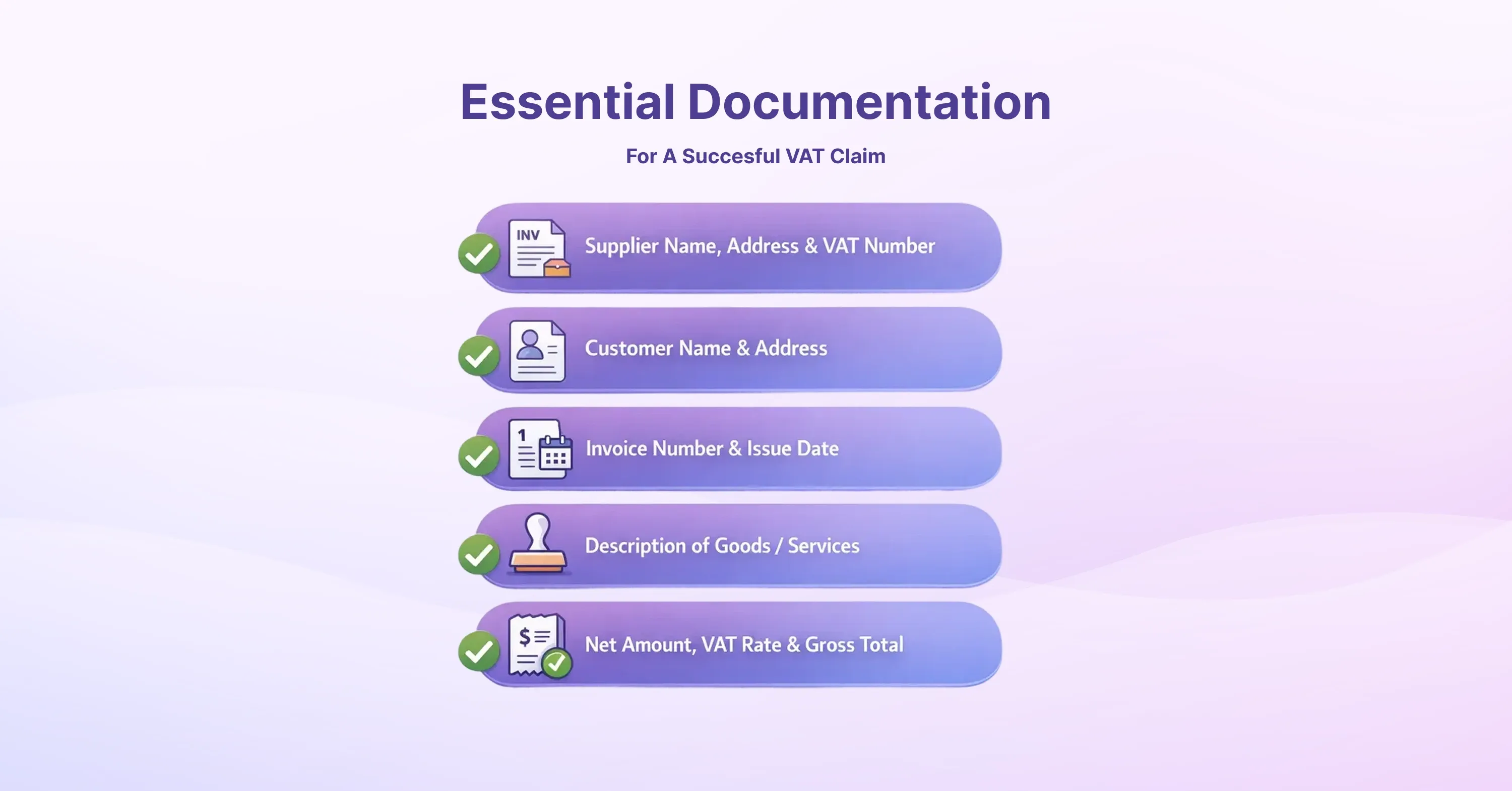
Checklist of essential documentation for a successful VAT claim, including supplier details, customer information, invoice data, goods description, and VAT amounts

A VAT refund application will fail instantly without a valid invoice. A standard credit card slip or a generic till receipt is rarely sufficient for tax authorities. They require a formal tax invoice that proves the transaction took place and that VAT was paid. This requirement applies equally to a business recovering thousands of euros in exhibition costs and a traveler claiming back tax on a designer handbag.

A valid tax invoice must typically include:

  • The supplier’s name, address, and VAT identification number.

  • The customer’s name and address (crucial for business claims).

  • A unique invoice number and date of issue.

  • A clear description of the goods or services.

  • The net amount, the VAT rate applied, and the total gross amount.

For a more detailed breakdown of what invoices should include and best practices, check out EU Invoicing Rules Explained for Businesses.

If you are a traveler, you also need a "Tax-Free Form" issued by the retailer at the time of purchase. You cannot create this document later; it must be generated when you buy the item. For businesses, the challenge is often volume. Managing hundreds of invoices in different languages can lead to errors. Missing a single detail on an invoice can cause a rejection, delaying your cash flow.

With your documentation in hand, you must follow the specific procedure for your category. We will start with the process for businesses, which involves strict deadlines and digital portals.

The Business VAT Reclaim Process

Cross-border VAT recovery for businesses is governed by specific directives (often the 8th or 13th Directive in the EU). The process is digital but rigorous. You cannot simply deduct foreign VAT on your domestic return; you must apply directly to the foreign tax authority or through your local portal, depending on where your business is based.

Step 1: Identify the Correct Directive

If your business is established in an EU country and claiming from another EU country, you use the electronic cross-border refund system via your local tax portal. This is often faster. If your business is established outside the EU (e.g., a US company claiming from Germany), you must use the 13th Directive paper-based or direct digital application, which is more complex and often requires a local fiscal representative.

For a step-by-step explanation of filing channels and timelines, including EU portals and paper-based claims, refer to How to File VAT Returns Online: Streamlining Digital Submission.

Step 2: Organize Your Expenses

Group your invoices by country and expense type. Common categories include:

  • Fuel and transportation costs.

  • Accommodation and hotel bills.

  • Admission to fairs and exhibitions.

  • Training and seminar costs.

Step 3: Submission and Deadlines

Timing is critical. For EU businesses, the deadline is typically September 30th of the following calendar year. For non-EU businesses, deadlines vary, often falling on June 30th. Missing these dates usually means losing the refund permanently.

The complexity of managing these varying rules and deadlines across multiple jurisdictions leads many companies to seek external help. A service like 1stopVAT can be invaluable here. As a global provider, they act as a single point of contact, utilizing a team of 40+ certified tax specialists to handle the VAT reclaim process across 100+ countries. This ensures that your applications are accurate and filed on time, preventing administrative errors that could lead to rejection.

For guidance on establishing best practices and internal controls for VAT compliance, see VAT Filing & Returns: A Complete Guide for Businesses.

While businesses navigate digital portals, travelers face a more physical process involving customs officers and airport queues.

The Traveler’s Route to Refunds

The mechanism for tourists is often called "Tax-Free Shopping." It is a major economic driver, considering the travel and tourism sectors contribute about 10% of EU GDP. The process relies on proving that the goods have left the country.

Step 1: Shop at Participating Stores

Not every shop offers tax-free services. Look for "Tax-Free" signage in the window. When you make a purchase, ask the staff for a refund form. You will need your passport to prove you are a non-resident.

Step 2: Validation at Customs

This is the most critical step for a traveler. Before you leave the country (or the EU), you must show your unused goods, receipts, and refund forms to a customs officer. They will stamp your documents. Without this stamp, there is no refund.

  • Pack your purchases in your hand luggage if possible, or visit customs before checking your bags.

  • Allow extra time at the airport; queues can be long.

  • Digital validation kiosks are becoming common in countries like France and Singapore, speeding up the process.

Step 3: Collecting the Refund

Once stamped, you can collect your money. You can often do this at a refund counter at the airport (for cash or credit card refund) or mail the stamped forms back to the processing provider.

The volume of these transactions is substantial. For example, even in a smaller market like Latvia, non-EU tourist tax-free purchases totaled €19.6 million in 2017 alone. Whether you are claiming a few euros for souvenirs or thousands for luxury items, the stamp is your key to payment.

However, simply following the steps does not guarantee success if you fall victim to common errors.

Common Pitfalls and How to Avoid Them

Rejection rates for claiming vat back can be frustratingly high due to simple mistakes. Understanding these pitfalls protects your claim.

  • Invoice Errors: As mentioned, the invoice must be addressed to the claimant. If a hotel invoice is made out to "Guest" or an employee's personal name rather than the company name, the tax authority will likely reject the business claim. Ensure your staff knows to request invoices in the company’s legal name.

  • Incorrect Expense Categories: Not everything is refundable. Most countries do not allow VAT recovery on entertainment or client meals. Attempting to claim these can flag your entire application for an audit.

    • Refundable: Trade show entry fees, accommodation (in some countries), transport.

    • Non-Refundable: Client entertainment, personal items, exempt services.

  • Missing the Window: The compliance gap is widening - the 2022 shortfall was €13.3 billion higher than in 2021 - which means tax authorities are under pressure to be strict. They will not accept late applications.

To avoid these common missteps, consult Determining VAT: mistakes to avoid.

For companies expanding internationally, maintaining compliance while chasing refunds is a balancing act. Leveraging a partner like 1stopVAT allows you to combine automated tracking with human oversight, ensuring you don't accidentally claim non-deductible expenses or miss a hard deadline in a foreign jurisdiction.

Conclusion

Successfully claiming vat back requires attention to detail and a clear understanding of the rules, whether you are managing corporate finances or finishing a vacation. The process may seem demanding, involving strict deadlines and specific paperwork, but the financial return is often substantial. By ensuring your eligibility, preserving valid tax invoices, and following the correct submission route for your status, you can recover these funds efficiently. Treat the process as a necessary financial habit rather than an afterthought, and you will ensure that your budget - business or personal - remains as healthy as possible.

The timeline varies significantly by country and method. For travelers claiming at an airport kiosk, the refund can be immediate in cash, or take 3 to 5 days for credit cards. For businesses submitting a formal cross-border application, tax authorities legally have up to four months to make a decision, though this can extend to eight months if they request additional information or invoices. Learn more about international timelines in [VAT vs GST Registration: Key Differences Explained](https://1stopvat.com/articles/vat-vs-gst-registration-differences).

Yes, most countries have a minimum purchase threshold for tourists. For example, you might need to spend at least €100 or €175 in a single store to qualify for a tax-free form. For businesses, there are also minimum claim amounts per application (often around €400 for interim claims and €50 for annual claims), below which the administrative cost is considered too high by the tax authority.

Rules differ by country. For travelers, services like hotels and meals are consumed "on the spot" and are generally not refundable; only exported goods qualify. For businesses, hotel VAT is recoverable in many EU countries, but restaurant meals and client entertainment are frequently blocked from recovery. You must check the specific deductibility rules of the country where the expense occurred.

If your application is rejected, the tax authority will provide a reason, such as an invalid invoice or ineligible expense. You typically have the right to appeal this decision within a specific timeframe (often one month). It is vital to correct the specific error - such as providing a scanned copy of a missing invoice - and resubmit promptly.

For tourists, yes, you must present original receipts to customs. For businesses filing electronically within the EU, high-quality digital scans are usually sufficient. However, tax authorities reserve the right to request the original paper invoices for verification, so you should always archive your physical documents until the refund is finalized.

Simple Compliance

Free consultation with 1StopVAT experts

You Might Also Like

Discover more insights and articles

Executive team discussing global market data and financial analytics during business strategy meeting with world map dashboard

Best Consultants for Standard VAT Procedures?

Value-added tax (VAT) can feel like a moving target. Rates differ across borders, rules update every quarter, and a single misclassification can drain profit margins. No wonder companies turn to experts. The question is simple yet pressing: who are the best consultants for standard VAT procedures? A laser-focused answer follows.

Business professional reviewing and signing official documents at desk with contract papers and laptop in office

How to Find a VAT Number: Fast & Reliable Methods

A missing VAT number can stall payments, nullify input-tax deductions, or even trigger audits. The good news: locating that elusive ID is usually a matter of following the right trail, not guessing. This guide shows you every legitimate path, from reading an invoice to running a VAT number lookup through official databases. A short read, big payoff: by the end you will know which source to check first, how to cross-verify in seconds, and how to document your search so it stands up to scrutiny.

Approved VAT refund documents with invoices, stamps, calculator, and financial paperwork on a desk

Leading companies for VAT certificate verification?

VAT verification is no longer optional - one invalid VAT number can lead to penalties, denied deductions, or audits. In cross-border trade, real-time validation is essential. This article explains the key verification tools available, from official databases to compliance providers, and highlights how digital certificates are reshaping VAT compliance.

Two financial analysts reviewing reports and charts on a laptop during a business data analysis meeting

Reclaiming VAT: A Simple Guide for Businesses

Every year, businesses lose money simply because reclaiming VAT feels too complex. While paying tax is required, overpaying is not. For companies operating locally or across borders, mastering VAT recovery is essential to protect cash flow and margins. This guide explains who qualifies, which expenses can be claimed, and how to submit a successful refund - turning VAT recovery from an administrative burden into a structured financial process.