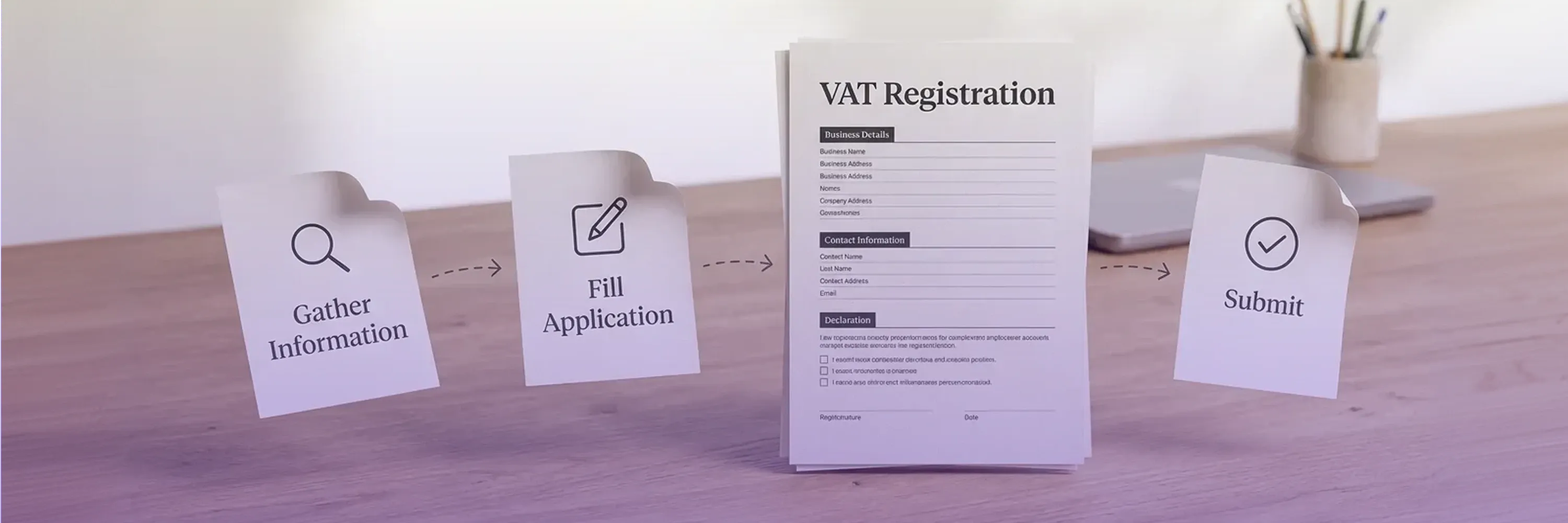
Approved VAT refund documents with invoices, stamps, calculator, and financial paperwork on a desk

Leading companies for VAT certificate verification?

VAT verification is no longer optional - one invalid VAT number can lead to penalties, denied deductions, or audits. In cross-border trade, real-time validation is essential. This article explains the key verification tools available, from official databases to compliance providers, and highlights how digital certificates are reshaping VAT compliance.

Content authorBy Beata ČepėPublished onReading time10 min read

Overview

This article provides a structured overview of the leading companies and systems used for VAT certificate verification. It explains the different categories of solutions available - from official government databases like VIES, to ERP-based validation tools, to full-service compliance providers that manage verification as part of broader VAT support. You will learn how each option works, what its limitations are, and how to choose the right approach based on your company’s size and transaction volume. The article also outlines a practical step-by-step verification process and examines the growing shift toward electronic VAT certificates and digital reporting, helping you understand how to stay compliant in an increasingly automated tax environment.

What is VAT Certificate Verification?

VAT certificate verification is the process of confirming that a business entity holds a valid VAT registration number and is authorized to conduct taxable transactions. This procedure involves cross-referencing a trader's VAT number against official government databases (such as VIES in the EU) to ensure the number is active and matches the company's name and address. Successful verification allows businesses to apply the correct tax rates, such as zero-rating for exports, and serves as critical proof of due diligence to avoid liability in cases of tax fraud.

The Critical Need for Accurate VAT Verification

The stakes for Value Added Tax (VAT) compliance have never been higher. Tax administrations across Europe and beyond are aggressively targeting gaps in revenue collection. This urgency is driven by staggering figures, such as the €128 billion VAT compliance gap recorded in 2023. This gap represents revenue that was due but never collected, often because of fraud, evasion, or simple administrative errors. When you fail to verify a partner's VAT certificate, you inadvertently expose your business to these risks.

If you treat a transaction as zero-rated (tax-free for export) based on an invalid VAT number, the liability shifts back to you. The tax authorities will demand the VAT you failed to charge, plus interest and penalties. Verification is your only defense. It proves you acted in "good faith" and performed due diligence.

  • Reverse Charge Failures: Incorrectly applying the reverse charge mechanism to a non-business customer can result in immediate tax demands.

  • Joint Liability: In some jurisdictions, you can be held jointly liable for VAT fraud committed by your supplier if you should have known their credentials were suspect.

  • Audit Triggers: Frequent errors in your EC Sales Lists or VAT returns act as red flags, inviting invasive audits that consume time and resources.

To protect your business, you need a robust verification strategy that goes beyond a quick Google search. This brings us to the specific companies and systems designed to handle this verification.

Leading Solutions and Companies for Verification

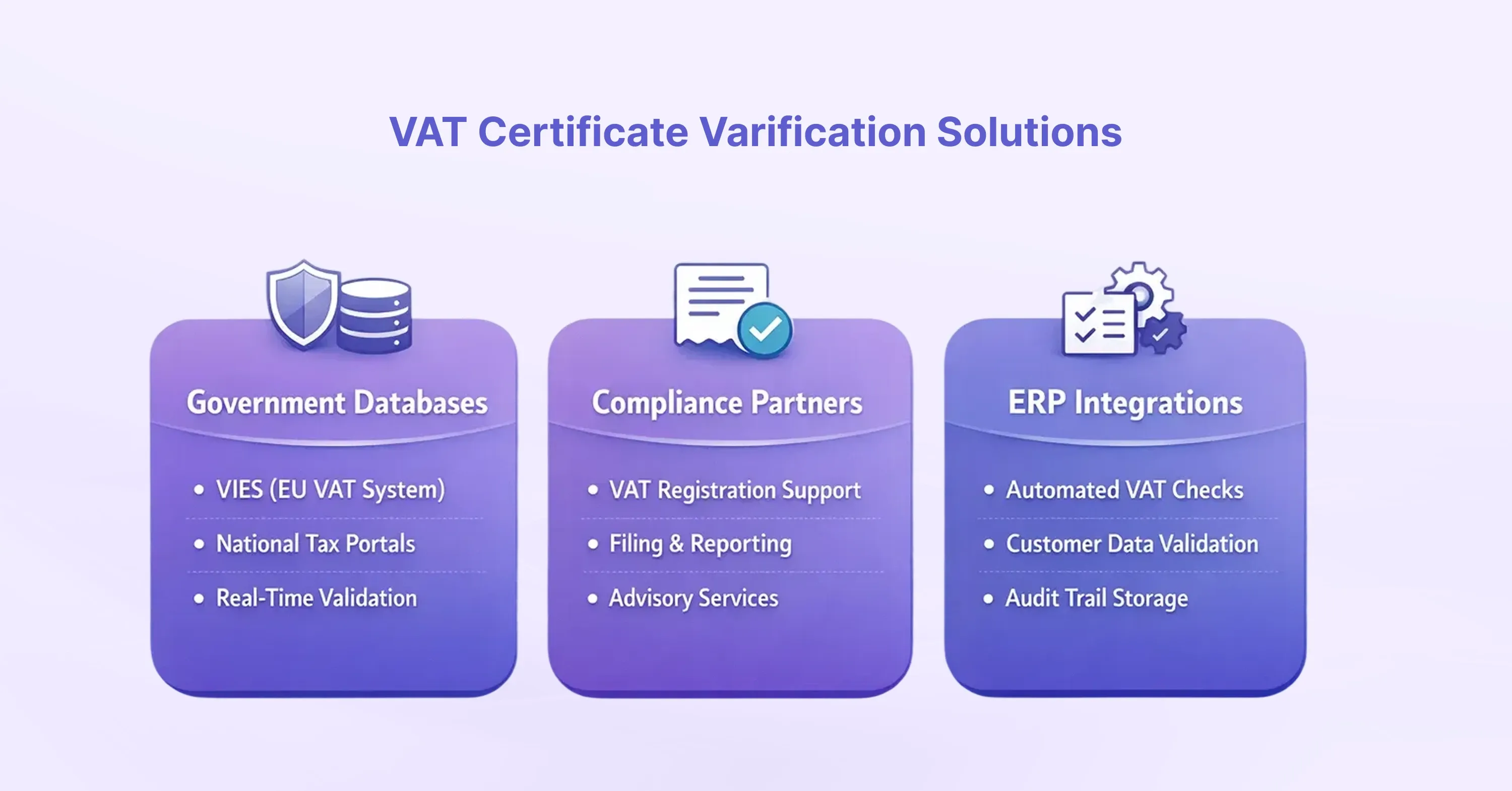
VAT certificate verification solutions showing government databases, compliance partners, and ERP integration validation systems

When asking about leading companies for VAT certificate verification, it is helpful to categorize them by their role. You have the primary data sources (government bodies), the integrated systems (ERPs), and the comprehensive compliance partners who manage the process as part of a broader service.

Official Government Databases

The first line of defense is always the official source. While not "companies" in the commercial sense, these platforms are the engine behind every other verification tool. The European Commission’s VIES (VAT Information Exchange System) is the gold standard for EU transactions. It allows you to check the validity of a VAT number issued by any Member State.

However, these databases have limitations. They often experience downtime, and they verify only the validity of the number at that specific moment, not the historical reliability of the trader. For a practical, step-by-step approach, check How to Perform an EU VAT ID Check (VIES Guide).

Comprehensive Compliance Partners

For businesses scaling internationally, checking numbers one by one is impossible. This is where full-service firms come in. Unlike software-only solutions that might just ping a database, a partner like 1stopVAT offers a holistic approach. 1stopVAT is a one-stop global VAT compliance provider, offering comprehensive services like VAT registration, VAT compliance and filing, and consulting for businesses selling internationally.

Rather than just flagging an invalid number, a team of 40+ certified tax specialists can help you understand why a registration is problematic and how to fix it. By combining automated tools with human expertise, 1stopVAT streamlines complex VAT processes and enables companies to expand internationally while remaining fully compliant. This distinguishes them from purely automated software, which may generate alerts but lacks the consultative support to resolve the underlying tax issues.

For a deeper overview of comparison and feature sets of company solutions, see Best Services for VAT Vendor Search: Find Reliable Suppliers.

Enterprise Resource Planning (ERP) Integrations

Large multinational corporations often rely on their ERP providers to handle verification. Companies like SAP, Oracle NetSuite, and Microsoft Dynamics 365 offer modules that integrate directly with tax authority databases. These systems are powerful but often require significant configuration and maintenance to keep up with changing local laws.

  • SAP S/4HANA: Offers built-in checks against VIES and other national databases during the invoicing creation process.

  • Oracle NetSuite: Provides tax engines that validate customer details upon entry, reducing the risk of bad data entering the master records.

  • Microsoft Dynamics 365 Finance: Includes features to validate EU VAT numbers and store the response ID for audit trails.

Choosing the right partner depends on your volume. A small business might rely on VIES, while a growing exporter benefits more from the dedicated support of a firm like 1stopVAT to navigate the nuance of cross-border rules.

How to Verify a VAT Number: A Step-by-Step Guide

Once you have identified your tools or partners, you need a standard operating procedure. Verification is not a "one and done" task; it must be a repeating part of your customer onboarding and invoicing process.

The process has shifted from manual phone calls to digital validation. This transition is effective, with data showing that 12 Member States found that additional VAT revenue collected exceeds the costs of implementing digital reporting systems. This efficiency means authorities expect you to be just as rigorous.

Step 1: Check the Format

Every country has a specific structure for its VAT numbers. Before you even run a database check, ensure the format is correct. For example, a German VAT number (USt-IdNr) always starts with "DE" followed by 9 digits. If the format is wrong, the number is definitely invalid.

Step 2: Validate Against the Database

Input the number into the VIES system or the UK’s "Check a VAT Number" service for British traders.

  • Valid: The system confirms the number exists and is currently active.

  • Invalid: The number does not exist, or it has been de-registered.

  • Consultation: In some cases, the system is unavailable. You must wait and retry; you cannot proceed with a zero-rated invoice during downtime.

If you want a detailed, screenshot-driven walkthrough - including backup national portals and batch validation - consult How to Verify a VAT Number: A Simple Guide.

Step 3: Verify the Name and Address

A valid number is useless if it belongs to a different company. "Identity theft" of VAT numbers is a common fraud tactic. You must ensure the name and address returned by the database match the details on your invoice exactly. If the database returns "Hidden" for the name (which some countries allow for privacy), you must request a copy of the VAT certificate directly from the supplier.

Step 4: Save the Proof

Taking a screenshot or saving the digital consultation number provided by VIES is mandatory. In an audit five years from now, you must prove the number was valid at the time of the transaction. For further best practices on maintaining audit trails, read VAT Certificate Verification: Ensuring Compliance.

The Shift to Electronic VAT Certificates

The world of paper certificates is rapidly disappearing. Tax administrations are modernizing to close the VAT gap and reduce administrative burdens. The European Council notes that replacing paper VAT certificates with electronic ones will simplify and streamline the process for everyone involved.

This modernization is not just about convenience; it is about security. The European Commission explicitly states that switching to electronic VAT certificates aims to increase flexibility, reduce costs across the EU. For businesses, this means faster onboarding of new clients and less physical archiving.

However, this shift requires better IT readiness. You need systems that can read and store digital certificates securely. The move to electronic verification is also expected to reduce instances of fraud related to VAT-exempt transactions, giving honest businesses a level playing field.

  • Real-time Validation: Electronic certificates allow for instant validity checks.

  • Reduced Forgery: Digital signatures make it much harder to create fake documents.

  • Cost Savings: Less postage, printing, and physical storage.

For deeper guidance on the coming transition and how to keep your processes audit-ready, see VAT Certificate Verification: Ensuring Compliance.

Best Practices for Cross-Border Compliance

Understanding the tools and the trends is essential, but daily discipline protects your bottom line. Compliance is not a software setting; it is a business process.

Regular Database Cleansing

A customer who was VAT registered three years ago might not be registered today. Run batch checks on your entire customer master file at least once a quarter. This helps you catch deregistered entities before you ship the next order. For up-to-date strategies and tech solutions for automation, review Tax Technology Tools – VAT Compliance Automation.

Specialized Support for Expansion

As you enter new markets, the rules change. Italy has different invoicing mandates than France; the UK is outside the EU VAT area entirely. Relying solely on internal teams can lead to burnout and errors. Utilizing a specialized partner can act as a safeguard. 1stopVAT, acting as a single point of contact, simplifies these cross-border obligations across 100+ countries, ensuring that your expansion isn't slowed down by regulatory hurdles.

Document Everything

Always assume you will be audited. Maintain a digital archive that links every invoice to a proof of verification.

  • Keep VIES consultation receipts.

  • Archive electronic certificates.

  • Log the date and time of every check.

Conclusion

Navigating the landscape of VAT certificate verification requires more than just access to a database; it requires a strategy. From the massive VAT gaps driving regulatory changes to the new era of electronic certificates, the pressure on businesses to be compliant is intense. Whether you rely on official government portals, integrate verification into your ERP, or partner with dedicated specialists like 1stopVAT, the goal remains the same: certainty. By implementing rigorous checking procedures and keeping detailed records, you protect your revenue and ensure your global growth is built on a solid foundation.

Verification is the primary way to protect your business from tax liability. If you sell goods without charging VAT (zero-rating) to a customer with an invalid or fake VAT number, tax authorities will demand that you pay the missing VAT. Additionally, accurate verification prevents you from falling victim to "Missing Trader" fraud and ensures your VAT returns pass automated government checks without triggering audits.

VIES is the official tool for intra-EU transactions, but it has limitations. It does not cover non-EU countries, and the database can experience downtime. Furthermore, VIES only tells you if a number is valid right now; it does not guarantee the honesty of the trader. For a robust defense, you should combine VIES checks with additional due diligence, such as verifying the trader's address and keeping a permanent record of the consultation number.

First, double-check the format and ensure you have not made a typing error. If the number is still invalid, contact the customer immediately. They may have a new number or there might be a registration delay. Do not issue a VAT-exempt invoice until the number is validated. If they cannot provide a valid number, you must treat the transaction as a domestic sale and charge the applicable local VAT rate to protect yourself from fines.

You should verify a new customer's VAT number before the first transaction. However, validation is not a one-time event. Companies can go bankrupt or deregister. Best practice is to validate numbers before every major shipment or, at a minimum, run a batch check on your customer database every quarter. This ensures you do not inadvertently trade tax-free with a company that has lost its VAT status.

Verify a VAT number at the start of every new business relationship and before applying zero-rated VAT. Since registrations can change, re-check active customers periodically and always keep proof of verification for audit purposes.

Simple Compliance

Free consultation with 1StopVAT experts

You Might Also Like

Discover more insights and articles

Desk with tax refund documents, approval stamps, calculator, and laptop displaying financial records in an accounting workspace

Claiming VAT Back: Complete Guide for Businesses & Travelers

Paying Value Added Tax (VAT) is a standard part of purchasing goods and services abroad, but leaving that money with foreign tax authorities isn't mandatory. Whether you represent a company managing international expenses or a tourist returning home with holiday purchases, significant refunds often go unclaimed simply because the process seems difficult.

Two financial analysts reviewing reports and charts on a laptop during a business data analysis meeting

Reclaiming VAT: A Simple Guide for Businesses

Every year, businesses lose money simply because reclaiming VAT feels too complex. While paying tax is required, overpaying is not. For companies operating locally or across borders, mastering VAT recovery is essential to protect cash flow and margins. This guide explains who qualifies, which expenses can be claimed, and how to submit a successful refund - turning VAT recovery from an administrative burden into a structured financial process.

Financial analysis workspace with investment charts, stacked coins, calculator, and open notebook representing budgeting, accounting, and business planning.

Top Advisory Firms for VAT Calculation: Ensure Accurate Tax

A single VAT miscalculation can erase an entire quarter’s profit, yet many finance teams still depend on spreadsheets and fragmented processes. In today’s environment, accurate VAT calculation is a control function - not a back-office task - requiring precise rule interpretation and flawless execution at scale. This article revisits VAT fundamentals, highlights complex calculation risks, and ranks advisory firms with proven VAT accuracy expertise.

Business professionals analyzing financial reports and performance charts during a team meeting with documents, tablet, and calculator on the desk.

VAT Tax Refund Explained: How to Get Your VAT Back

Buying goods abroad or incurring cross-border business expenses often means paying value added tax at the point of sale. The question on every traveler’s or finance manager’s mind is simple: can I recover that money? This article unpacks the answer in plain language. A VAT refund may look straightforward, yet it hinges on clear eligibility rules, precise paperwork, tight deadlines, and plenty of room for error. By the end, you will know exactly who qualifies, what purchases count, how to file, how long the process takes, and the pitfalls that derail many claims.