Business professionals reviewing e-commerce VAT guidance documents alongside an online shopping dashboard during a tax compliance consultation

VAT Guide for Every E Commerce Seller: What You Need to Know

If you sell products online across borders, VAT is not optional knowledge. It's a compliance requirement that can result in penalties, blocked shipments, or marketplace removal if you get it wrong.

Content authorBy Donatas StasytisPublished onReading time10 min read

Overview

Cross-border e-commerce creates tax obligations far earlier than many sellers expect. A single international shipment, marketplace transaction, or overseas warehouse transfer can trigger VAT registration requirements, reporting duties, and ongoing compliance exposure in multiple countries at once. This guide explains how VAT works for e commerce sellers operating across borders, covering key EU and UK rules, marketplace obligations, OSS and IOSS schemes, and the growing compliance pressures facing online businesses. You'll learn how platforms like Amazon, eBay, and Shopify affect tax responsibilities, when marketplaces become the deemed supplier, and what happens when you sell through multiple channels simultaneously.

By the end, you'll have a practical understanding of ecommerce VAT rules, online seller tax obligations, and the compliance systems needed to scale internationally without creating costly tax risks along the way.

How VAT Works for Online Sellers

VAT, or Value Added Tax, is a consumption tax applied at each stage of the supply chain. For an e commerce seller, it typically means charging VAT to the buyer at the point of sale and remitting it to the relevant tax authority. The rate depends on the country where the goods are consumed, not where they're shipped from.

That distinction matters. If you're based in Germany but selling to a customer in France, the French VAT rate applies once you exceed certain thresholds. This is the core principle behind ecommerce VAT rules across the EU: tax follows the consumer.

Here's what makes online seller tax obligations tricky:

  • VAT rates vary significantly between countries (from 5% in some jurisdictions to 27% in Hungary).

  • Thresholds for registration differ depending on the region.

  • Marketplaces may collect VAT on your behalf in some cases, but not all.

  • Non-compliance can lead to fines, interest charges, or even being barred from selling in a market.

Understanding where your tax liability starts is the first step toward keeping your business on solid ground.

The EU's VAT E-Commerce Package: A Turning Point

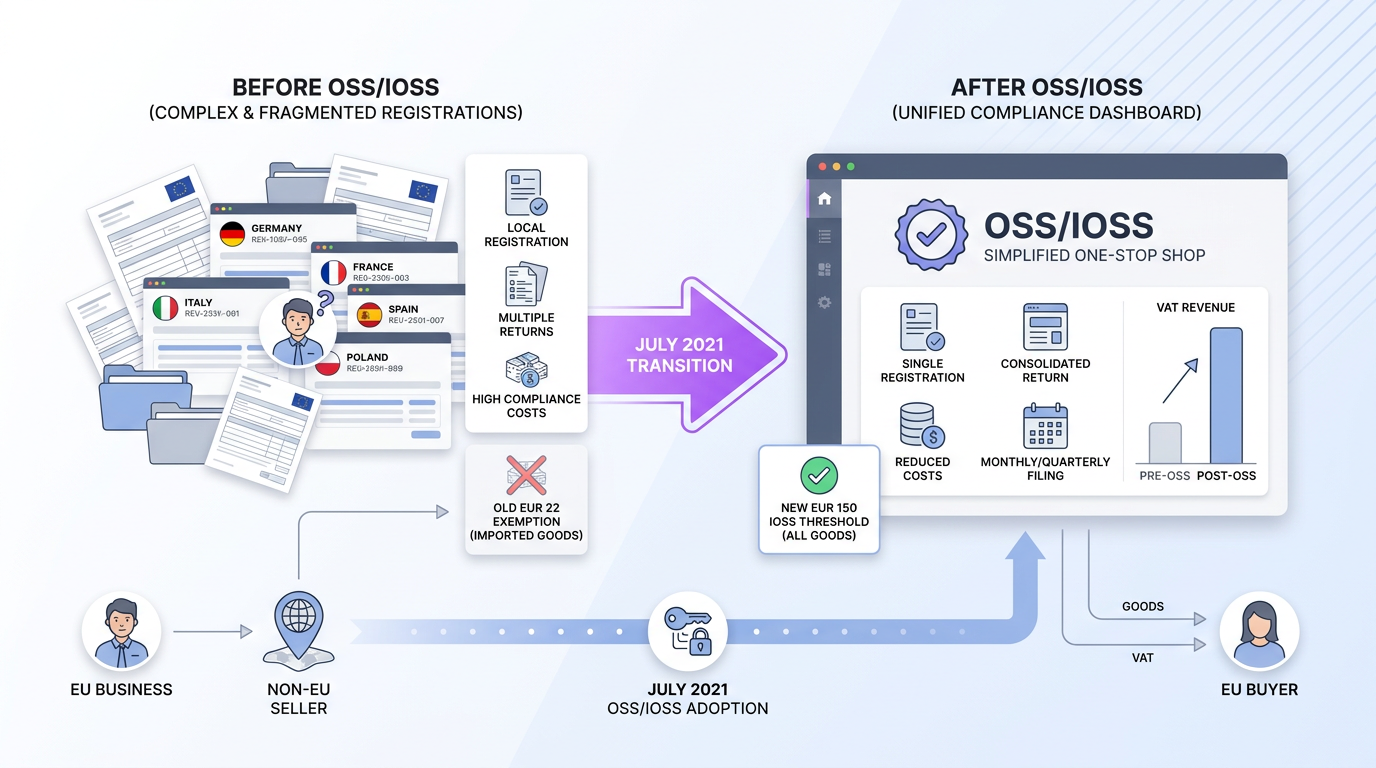
Infographic showing EU VAT process transformation pre- and post-OSS/IOSS adoption with clear visuals, icons, and a timeline.

Before July 2021, selling across EU borders meant potentially registering for VAT in every country where you had customers. That changed when the European Commission introduced its VAT e-commerce package.

This package brought two major simplification mechanisms: the One-Stop Shop (OSS) and the Import One-Stop Shop (IOSS).

One-Stop Shop (OSS)

The OSS allows businesses to register in a single EU Member State to declare and pay VAT on all intra-EU distance sales of goods and cross-border supplies of services. Instead of filing returns in every country where you have buyers, you submit one quarterly return through your home member state.

For example, a Polish e commerce seller shipping to customers in Spain, Italy, and the Netherlands can handle all three countries' VAT through a single OSS registration in Poland. The tax authority then distributes the collected VAT to each destination country.

For a thorough breakdown on how the OSS and IOSS systems have revolutionized cross-border VAT registration, see the VAT Tax Registration: Complete Step-by-Step Guide.

Import One-Stop Shop (IOSS)

The IOSS facilitates the declaration and payment of VAT for distance sales of imported goods with a value not exceeding EUR 150. Sellers collect VAT at checkout and remit it through one registration, which means the buyer doesn't face surprise charges at customs.

This scheme was especially significant because the EU removed the VAT exemption for imported goods valued up to EUR 22. Now, all goods imported into the EU are subject to VAT, regardless of value. That change alone affected millions of small parcels shipped from non-EU countries each year.

A comprehensive guide on selecting the right route for EU VAT obligations in your business can be found in VAT in European Union: EU VAT Rules Explained for International Sellers.

Together, OSS and IOSS represent a meaningful shift. The aim is to ensure VAT is paid where goods are consumed, creating a uniform regime for cross-border supplies while offering businesses a simplified system.

When Marketplaces Become the Tax Collector

One of the most important e-commerce VAT rules to understand is the concept of "deemed supplier." In certain situations, online marketplaces facilitating supplies of goods are deemed for VAT purposes to have received and supplied the goods themselves, making them responsible for collecting and remitting VAT.

This doesn't mean sellers are off the hook entirely. It means the platform handles a specific portion of the VAT obligation. Sellers still need proper registrations, accurate product classifications, and correct record-keeping.

UK Marketplace Rules

The UK applies its own version of this principle. Online marketplaces are responsible for collecting and remitting VAT on sales of goods located outside the UK at the point of sale, if the consignment value is £135 or less. For goods located in the UK at the point of sale, the marketplace is liable for VAT if the seller is not established in the UK.

Consider a seller based in China who stores inventory in a UK warehouse and sells through Amazon UK. Amazon would be responsible for collecting and remitting the VAT on those sales because the seller isn't UK-established.

The consequences of ignoring these rules are real. If an overseas seller does not comply with VAT requirements, HMRC may direct them to appoint a VAT representative, require a security deposit, or inform online marketplaces, which may remove the seller from their platform. Losing access to a major marketplace can be devastating for any online business.

For deeper guidance and practical checklist on marketplace VAT duties, see Marketplace VAT Obligations for Online Sellers: What You Need to Know.

Online Seller Tax Obligations in the United States

While the US doesn't have VAT, it does have sales tax, and the rules for remote sellers have tightened considerably since the landmark 2018 Supreme Court decision in South Dakota v. Wayfair. For any e commerce seller with US customers, understanding state-by-state obligations is essential.

The thresholds and rules vary, but the pattern is consistent:

  • In Ohio, out-of-state sellers exceeding $100,000 in gross sales are required to collect and remit sales tax on all taxable sales made through their own channels, excluding those facilitated by marketplace facilitators.

  • In South Dakota, remote sellers exceeding $100,000 in gross sales must register and collect sales tax, with marketplace providers required to collect on behalf of sellers using their platforms.

  • In North Dakota, remote sellers surpassing $100,000 in sales must collect and remit sales tax, while marketplace facilitators handle collection for sellers on their platforms.

For a comprehensive, state-by-state breakdown of sales tax nexus and rates, refer to US Sales Tax Explained: State-by-State Guide.

How This Affects Cross-Border E-Commerce Sellers

If you're an EU-based or UK-based online seller expanding into the US market, these state thresholds add another layer of complexity. You might already be managing VAT filings in multiple European countries while also needing to track nexus thresholds across dozens of US states.

The key takeaway: marketplace facilitator laws in the US shift collection responsibility to the platform in many cases, similar to the EU's deemed supplier rules. But selling through your own website means the burden stays with you.

Practical Steps to Stay Compliant

With rules varying by country and platform, compliance requires a structured approach.

Here's what every e commerce seller should prioritize:

  • Know your registration triggers. Track sales volumes by country and state. Crossing a threshold without registering creates retroactive liability.

  • Classify your products correctly. VAT rates depend on product type. A standard-rated item in one country might be reduced-rate in another.

  • Keep clean records. Tax authorities expect detailed transaction logs, including customer locations, amounts charged, and VAT collected.

  • Understand platform responsibilities. Confirm which VAT or sales tax obligations your marketplace handles and which remain yours.

  • File on time. Late filings trigger penalties and interest in virtually every jurisdiction.

For best practices in recordkeeping and multi-country VAT compliance, see How Do I Stay VAT Compliant When Selling in Multiple Countries?.

For sellers operating across multiple countries, managing these obligations internally can quickly become overwhelming. This is where working with a dedicated compliance partner makes a difference. 1stopVAT, for instance, provides marketplace sellers with VAT registration, filing, and consulting services across 100+ countries through a single point of contact. Their team of certified tax specialists handles the complexity so sellers can focus on growing their business rather than navigating filing deadlines in a dozen jurisdictions.

What Happens When You Sell Through Multiple Channels

Many online sellers operate on Amazon, eBay, Shopify, and their own direct-to-consumer website simultaneously. Each channel may have different VAT implications.

On a marketplace where the platform is the deemed supplier, VAT collection happens automatically for qualifying transactions. But sales through your own website don't have that safety net. You're fully responsible for charging the correct rate, collecting the tax, and filing returns.

A practical example: a UK-based seller uses Amazon for EU sales (where Amazon handles VAT on certain transactions) and also runs a Shopify store selling directly to French customers. The Shopify sales require the seller to either register for VAT in France or use the OSS scheme. Ignoring this creates a compliance gap.

For actionable tips tailored to multi-channel e-commerce operations, read VAT Compliance Services for Shopify and WooCommerce Stores.

The more channels you sell through, the more critical it becomes to have a clear compliance framework. Providers like 1stopVAT help sellers map out exactly where obligations arise and ensure nothing falls through the cracks, especially when marketplace rules shift or new countries enter the picture.

Key Definition for E-Commerce VAT

E-commerce VAT refers to the Value Added Tax obligations that apply when goods or services are sold online to consumers across borders. These obligations include registering for VAT in relevant jurisdictions, charging the correct local rate, collecting the tax at the point of sale, and filing periodic returns with each applicable tax authority, either directly or through simplified mechanisms like OSS and IOSS.

Conclusion

VAT compliance for e-commerce sellers is no longer a side issue that can be handled reactively once sales begin to grow. The moment you start selling across borders, storing inventory internationally, or operating through multiple marketplaces, tax obligations become part of your operational infrastructure. A missed registration threshold, incorrect VAT rate, or misunderstanding of marketplace rules can quickly lead to penalties, shipment delays, frozen marketplace accounts, or long-term compliance exposure.

The sellers that scale successfully are usually the ones that treat VAT compliance as a core part of their international growth strategy, not just an administrative task. That means understanding where obligations arise, using schemes like OSS and IOSS strategically, maintaining accurate records, and building processes that can adapt as regulations evolve.

As global e-commerce continues expanding and tax authorities increase enforcement, having a scalable compliance framework becomes just as important as logistics, payments, or customer acquisition.

It depends on the country and the nature of the sale. In the EU and UK, marketplaces act as deemed suppliers for certain transactions and handle VAT collection. However, you may still need a VAT registration for inventory storage, B2B sales, or transactions that don't fall under deemed supplier rules. Always verify your specific situation.

OSS covers intra-EU distance sales of goods and cross-border services, allowing a single VAT registration for all EU member states. IOSS is specifically for goods imported into the EU from outside the bloc with a value of EUR 150 or less. Both simplify filing, but they address different transaction types.

Yes. Tax authorities can impose fines, charge interest on unpaid VAT, and in some cases direct marketplaces to remove non-compliant sellers from their platforms. In the UK, HMRC can also require overseas sellers to appoint a VAT representative or pay a security deposit.

The US does not have VAT but imposes state-level sales taxes. After the 2018 Wayfair ruling, most states require remote sellers who exceed certain sales thresholds (often $100,000) to collect and remit sales tax. Marketplace facilitator laws shift this responsibility to platforms for sales made through them.

The applicable rate depends on the product category and the destination country. Standard rates, reduced rates, and zero rates vary across jurisdictions. Incorrect classification can lead to underpayment or overcharging, both of which create compliance issues.

Simple Compliance

Free consultation with 1StopVAT experts

You Might Also Like

Discover more insights and articles

Business team in a conference room reviewing VAT registration documentation during a compliance or tax consultation meeting

Company VAT Registration Guide for Businesses

Getting your company VAT registration wrong can cost you months of delays, rejected applications, or even penalties. With 17% of businesses applying to HMRC in 2024 failing to secure approval, the stakes are real, and the process deserves your full attention.

Office workspace with laptops displaying spreadsheets and EU VAT 2025 compliance reporting documents being reviewed by a business professional

How Do SaaS Companies Handle EU VAT in 2025?

If you sell software subscriptions to customers across Europe, there's a good chance VAT rules are already shaping how you invoice, where you register, and how much tax you collect. The problem is that these rules keep evolving, and 2025 brings some of the most significant shifts in years.

Business professional reviewing VAT Making Tax Digital compliance documents beside a laptop displaying tax filing spreadsheets and organized business records

VAT Making Tax Digital Rules: What Businesses Must Do

If you're VAT-registered in the UK and still unsure whether you're fully compliant with HMRC's digital reporting rules, you're not alone. The shift from paper-based record keeping to mandatory digital filing has reshaped how every VAT-registered business handles its tax obligations.

Woman signing documents at a home office desk with digital workflow icons representing business, contracts, and document management

How to Register Your Company for VAT Easily

If you're growing a business and watching your revenue climb, there's a question you can't afford to ignore: when and how do you register company for VAT? Getting it wrong, or getting it late, can mean penalties, lost credibility, and missed opportunities to reclaim tax.