Overview
Accurate VAT reporting depends on far more than submitting returns on time. It requires consistent processes, clean transactional data, and reporting systems capable of adapting to increasingly complex digital tax requirements across jurisdictions. This article explores the reporting strategies businesses use to maintain VAT compliance, reduce filing errors, and stay prepared for audits in an environment of tightening regulatory scrutiny. You'll learn which reporting mistakes most commonly trigger penalties, how weak internal workflows create compliance gaps, and what practical safeguards help businesses maintain accurate, audit-ready VAT records over time.
Whether you operate in a single country or manage cross-border obligations across multiple markets, this guide will help you build a more reliable and scalable VAT reporting framework.
Why VAT Compliance Gaps Keep Growing
Before we can fix reporting errors, it's worth understanding why they're so widespread. The scale of non-compliance across the EU alone tells a striking story.
In 2023, EU Member States and candidate countries saw the VAT compliance gap reach 9.5% of the total VAT tax liability, with approximately €128 billion in VAT revenues lost due to non-compliance, insolvency, and administrative errors. That figure actually rose 1.6 percentage points compared to 2022, reversing earlier progress.
This gap isn't just about fraud. The European Commission notes that the VAT compliance gap encompasses a wide range of sources, from the legal exploitation of loopholes to evasion and organized large-scale fraud. For individual businesses, the most relevant causes are far more mundane: data entry mistakes, misapplied tax rates, late filings, and poor record-keeping.
The good news? When compliance efforts are taken seriously, the numbers improve. In 2021, EU Member States managed to reduce the VAT compliance gap to €61 billion, down from €99 billion in 2020. That kind of progress shows the impact of well-targeted compliance measures, and it's achievable at the company level, too.
Understanding the landscape is the first step. The next is identifying exactly where things go wrong inside your reporting workflow. For a broader view of the problem - and best practices that can help narrow the VAT gap - see VAT Reporting Made Simple: Best Practices for Businesses.
Common Reporting Errors That Trigger Penalties
Most VAT reporting failures don't stem from intent. They come from process breakdowns. Recognizing the usual suspects helps you build defenses against them.
Misclassified Transactions and Wrong Tax Rates
Applying the wrong VAT rate is one of the most frequent errors, especially for businesses selling goods or services across multiple categories or countries. A company selling both food products (often reduced-rate) and electronics (standard-rate) in Germany, for instance, can easily misclassify a bundled sale and under-report its liability.
Incomplete or Inconsistent Records
Tax authorities expect your input and output VAT records to match your filed returns precisely. Gaps in documentation, such as missing invoices, incomplete supplier details, or inconsistent transaction dates, create discrepancies that invite audits.
The most common record-keeping failures include:
-
Failing to store credit notes or corrective invoices alongside originals
-
Not reconciling purchase ledgers with supplier statements before filing
-
Using inconsistent currency conversion methods for cross-border transactions
-
Omitting reverse-charge entries on intra-EU acquisitions
For practical steps to avoid these pitfalls and details on filing requirements (including digital archiving and currency conversion), review VAT Filing & Returns: A Complete Guide for Businesses.
Late Filings and Missed Deadlines
Every EU Member State sets its own VAT return deadlines, and they don't always align. A marketplace seller registered in five countries faces five different calendars, each with its own penalties for late submission. Even a single missed deadline can cascade into interest charges and increased scrutiny on future filings.
These errors compound quickly when a business operates across jurisdictions. And that's precisely where the reporting challenge becomes a structural one.
Building a Reporting Framework That Holds Up
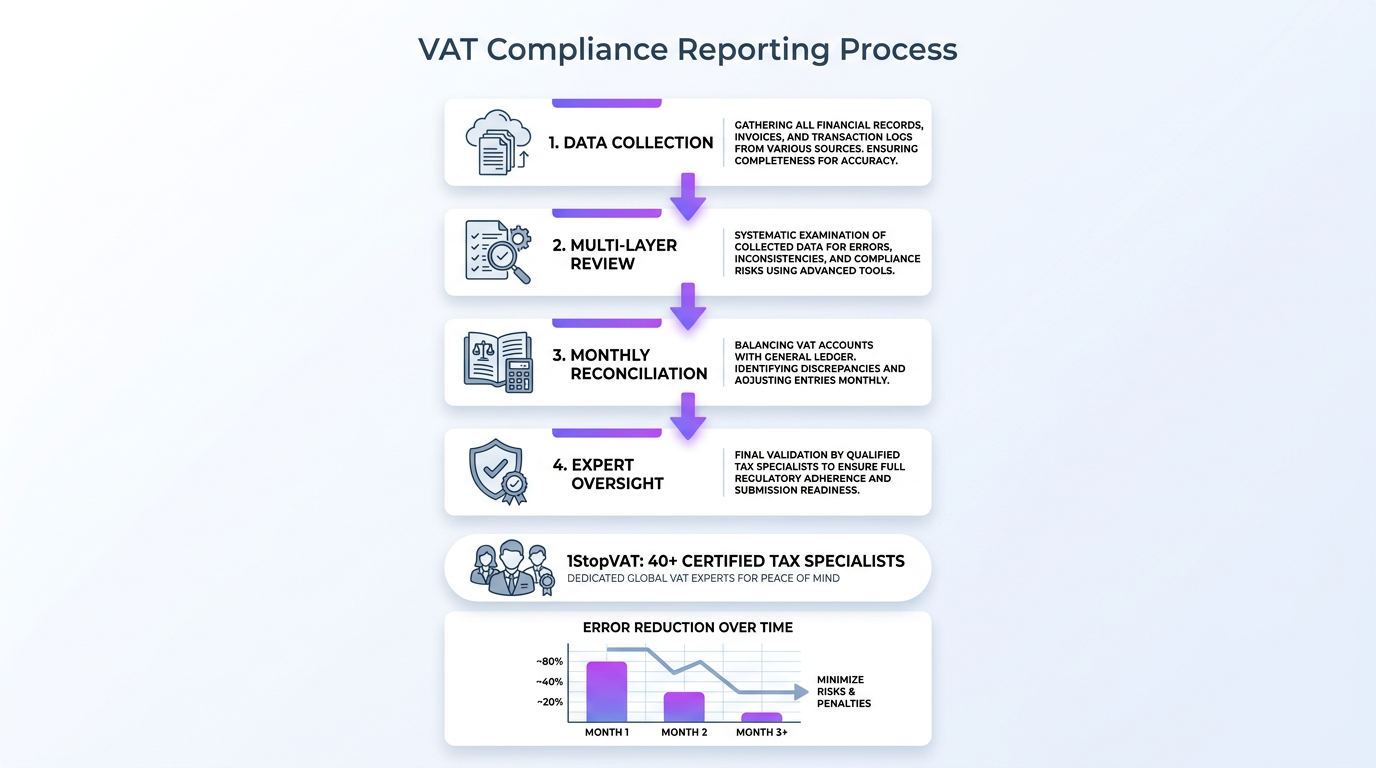
Fixing individual mistakes is reactive. What actually prevents compliance failures is a reporting framework designed to catch errors before they reach the tax authority.
Standardize Your Data Collection
Accuracy starts at the point of transaction. If your invoicing system captures incomplete data, no amount of downstream review will fix it.
A reliable data collection process should ensure:
-
Every invoice includes the correct VAT identification numbers for both buyer and seller
-
Transaction descriptions clearly identify the goods or services and their applicable tax treatment
-
Currency conversions follow a documented, consistent methodology
-
Timestamps and delivery locations are recorded for every cross-border sale
For a marketplace seller shipping from a warehouse in Poland to customers in France and Italy, getting these details right at the source eliminates hours of correction work later.
Implement Multi-Layer Review Before Filing
A single person preparing and submitting a VAT return is a recipe for undetected errors. Even small teams benefit from separating preparation from review.
The review should check for:
-
Arithmetic accuracy across all line items
-
Consistency between the return and underlying accounting records
-
Correct application of place-of-supply rules
-
Proper treatment of exempt, zero-rated, and out-of-scope transactions
This is where expert oversight becomes critical. 1StopVAT, a global VAT compliance provider with 40+ certified tax specialists, builds this kind of multi-layer expert review directly into its filing process. For marketplace sellers managing obligations across dozens of countries, that combination of human expertise and structured workflows removes the guesswork from reporting.
Reconcile Monthly, Not Quarterly
Many businesses only reconcile their VAT accounts when a return is due. By then, errors have had weeks or months to accumulate and become harder to trace.
Monthly reconciliation, even in countries with quarterly filing obligations, keeps discrepancies small and manageable. It also means your quarterly or annual returns are essentially pre-verified, reducing last-minute scrambles that breed mistakes.
For more details on streamlining your monthly reconciliation and the core benefits it brings - including faster refunds and clearer cash flow insights - read VAT Return: When to File and How to Prepare.
With a solid internal framework in place, the next challenge is keeping that framework current as reporting rules evolve.

Adapting to Changing Digital Reporting Requirements
VAT compliance isn't static. Governments worldwide are moving toward real-time digital reporting, and the pace of change is accelerating.
The OECD highlights that the rapid global expansion of Digital Continuous Transactional Reporting (DCTR) regimes has occurred in a largely uncoordinated manner, creating significant complexity for businesses engaged in cross-border trade. Italy's SdI e-invoicing system, Poland's upcoming KSeF mandate, and France's planned e-invoicing rollout all operate under different rules, formats, and timelines.
For businesses, this means:
-
Monitoring regulatory changes in every country where you're VAT-registered
-
Updating invoicing formats to meet country-specific digital requirements
-
Ensuring your systems can generate and transmit data in the prescribed electronic formats
-
Testing new reporting workflows well before mandatory go-live dates
To get prepared for the EU’s upcoming VAT in the Digital Age (ViDA) reforms—including practical steps for digital readiness - see Handling VAT for Digital Services: A Practical Guide.
A company that sells across 10 EU markets can't afford to treat each country's digital reporting shift as a separate project. It needs a centralized compliance approach that tracks all jurisdictions simultaneously.
The variations between EU countries in their estimated compliance gaps point to differences in tax administration performance and compliance culture, which means the enforcement environment you face varies significantly depending on where you sell. Staying ahead of digital mandates isn't just about avoiding fines. It's about maintaining operational continuity as reporting becomes more granular and more frequent.
What Accurate VAT Reporting Actually Looks Like
Pulling all of this together, VAT compliance and reporting accuracy depend on five core elements working in concert:
-
Clean data at the source: every transaction captured with complete, correct details from the start
-
Consistent processes: standardized workflows that don't vary by person or mood
-
Expert review: qualified tax professionals checking returns before submission
-
Timely reconciliation: monthly matching of records to catch errors early
-
Regulatory monitoring: continuous tracking of rule changes across all relevant jurisdictions
The European Commission emphasizes that studies on the scale of the VAT compliance gap help develop well-targeted measures to improve compliance. At the business level, the same principle applies: measuring where your errors occur tells you exactly where to strengthen your process.
If you operate on a marketplace or sell internationally, don’t overlook your specific obligations. For checklists and actionable guidance, refer to VAT Rules for Ecommerce Marketplaces Explained.
For marketplace sellers operating across borders, partnering with a compliance provider like 1StopVAT means these five elements are handled through a single point of contact, with dedicated guidance and filings tailored to each jurisdiction. That kind of structure turns VAT reporting from a recurring headache into a predictable, managed process.
Conclusion
VAT compliance and reporting accuracy are no longer just administrative responsibilities. They are operational requirements that directly affect cash flow, audit exposure, and a company’s ability to scale across markets without disruption. As governments move toward increasingly digital, real-time reporting systems, the margin for error continues to shrink.
The businesses that stay compliant long term are the ones that build structured, repeatable VAT processes rather than relying on reactive fixes at filing time. Standardized data collection, regular reconciliations, expert review, and continuous monitoring of regulatory changes all work together to create reporting systems that remain accurate under pressure.
Ultimately, accurate VAT reporting is about more than avoiding penalties. It is about building a reliable compliance infrastructure that protects revenue, supports international growth, and gives your business the confidence to operate across jurisdictions without unnecessary risk.