Business team in a conference room reviewing VAT registration documentation during a compliance or tax consultation meeting

Company VAT Registration Guide for Businesses

Getting your company VAT registration wrong can cost you months of delays, rejected applications, or even penalties. With 17% of businesses applying to HMRC in 2024 failing to secure approval, the stakes are real, and the process deserves your full attention.

Content authorBy Donatas StasytisPublished onReading time10 min read

What This Guide Covers

This guide walks you through the entire VAT registration process, step by step. You'll learn what triggers a registration requirement, which documents you need to prepare, how timelines work across different jurisdictions, and where businesses commonly stumble. Whether you're a UK-based company crossing the mandatory threshold or an e-commerce seller expanding into the EU, every section builds on the last to give you a clear, complete path from decision to corporate VAT number.

By the end, you'll understand not just how to register, but how to register correctly the first time.

Determine Whether Your Company Must Register

Before you fill out a single form, you need to confirm whether VAT registration is mandatory or voluntary for your business. This distinction shapes everything that follows, from your timeline to your filing obligations.

In the UK, companies must register for VAT once taxable turnover exceeds £90,000 in any rolling 12-month period. You can also register voluntarily below that threshold, which many B2B companies do to reclaim input VAT. At the start of 2025, 46% of UK private sector businesses were registered for VAT and/or PAYE, meaning the majority of small businesses still operate without registration.

In the EU, thresholds vary by member state, and distance selling rules add another layer. If your company sells goods cross-border to EU consumers, you may trigger registration obligations in countries where you hold no physical presence.

Key triggers to watch for

  • Domestic turnover crossing the local VAT threshold

  • Cross-border sales to consumers in another country exceeding that country's distance-selling limits

  • Storing inventory in a foreign warehouse (common for Amazon FBA sellers)

  • Acquisitions of goods from other EU member states above local thresholds

A UK-based clothing brand, for example, that stores inventory in a German fulfillment center would need a German VAT registration regardless of its turnover there. The physical presence of goods creates the obligation.

Understanding your specific triggers avoids both premature registration and costly late registration penalties. For more actionable help, the VAT Tax Registration: Complete Step-by-Step Guide provides practical examples and detailed coverage of multi-country thresholds and compliance triggers. Once you've confirmed the requirement, the next step is assembling the right paperwork.

Gather the Required Documents

Documentation is where many applications fail. Tax authorities reject incomplete or inconsistent submissions routinely, and each resubmission adds weeks to your timeline. Getting this right from the start is the single most effective way to speed up the VAT registration process.

While exact requirements differ by country, most tax authorities request a core set of documents:

  • Certificate of incorporation or equivalent company formation proof

  • Articles of association or memorandum of association

  • Proof of business activity, such as invoices, contracts, or purchase orders

  • Director and shareholder identification, typically passport copies and proof of address

  • Bank account details for the registered entity

  • Evidence of taxable supplies, especially for voluntary registrations

Country-specific extras

Some jurisdictions require additional documentation. Germany, for instance, often asks for a tax residency certificate from your home country. France may require a French-language power of attorney if you're using a fiscal representative. The UK's HMRC has tightened its verification process significantly in recent years, sometimes requesting detailed business plans or website URLs.

A practical example: an Irish e-commerce company registering for French VAT needed to provide not just standard incorporation documents, but also translated supplier contracts and warehouse agreements. The entire package ran to over 30 pages.

For specific checklists and tips on digital document management, visit the VAT Registration Online: Quick & Easy Setup Guide, which covers best practices to ensure your submission meets every requirement.

Preparing a thorough documentation package before you begin the application prevents the back-and-forth that causes most delays. With your documents ready, you can move to the actual submission.

Submit Your VAT Registration Application

The application itself varies depending on whether you're registering domestically or in a foreign jurisdiction. In most cases, applications are submitted online, though some countries still require postal submissions or notarized forms.

UK registration via HMRC

For UK companies, the process runs through the Government Gateway portal. You'll need a Government Gateway account linked to your company's Corporation Tax registration. The online form asks for business details, expected turnover, bank information, and the date you crossed (or expect to cross) the threshold.

HMRC aims to process straightforward applications within 30 business days, though complex cases can take significantly longer. The UK VAT population reached 2,330,400 traders in the financial year ending March 2025, reflecting steady growth in registrations, so processing queues remain a factor.

For illustrated walkthroughs and practical step-by-step advice, see the Online VAT Registration: Step-by-Step Guide for Businesses.

EU registration and the One Stop Shop

For businesses selling to EU consumers from outside a member state, the EU's One Stop Shop (OSS) framework simplifies things considerably. Rather than registering in every country where you have customers, you can register in one EU member state and report all cross-border B2C sales through a single return. By the end of 2024, over 170,000 businesses had registered for the EU's OSS and IOSS frameworks, a strong signal of how widely adopted these systems have become.

However, OSS doesn't cover every scenario. If you hold inventory in a member state, you still need a local registration there.

  • OSS covers: cross-border B2C sales of goods and services within the EU

  • OSS does not cover: B2B transactions, goods stored locally, or imports below the IOSS threshold without IOSS registration

For a comprehensive breakdown of these schemes, including when OSS/IOSS does or doesn't apply, see How Do I Stay VAT Compliant When Selling in Multiple Countries? and VAT in European Union: EU VAT Rules Explained for International Sellers.

For marketplace sellers juggling multiple countries, the complexity can be overwhelming. This is where working with a dedicated compliance partner like 1StopVAT makes a measurable difference. With 40+ certified tax specialists covering 100+ countries, 1StopVAT acts as a single point of contact for registration, filings, and ongoing compliance, so sellers can focus on growth instead of paperwork.

Once your application is submitted, the waiting period begins, and that brings its own set of considerations.

Navigate the Approval Timeline
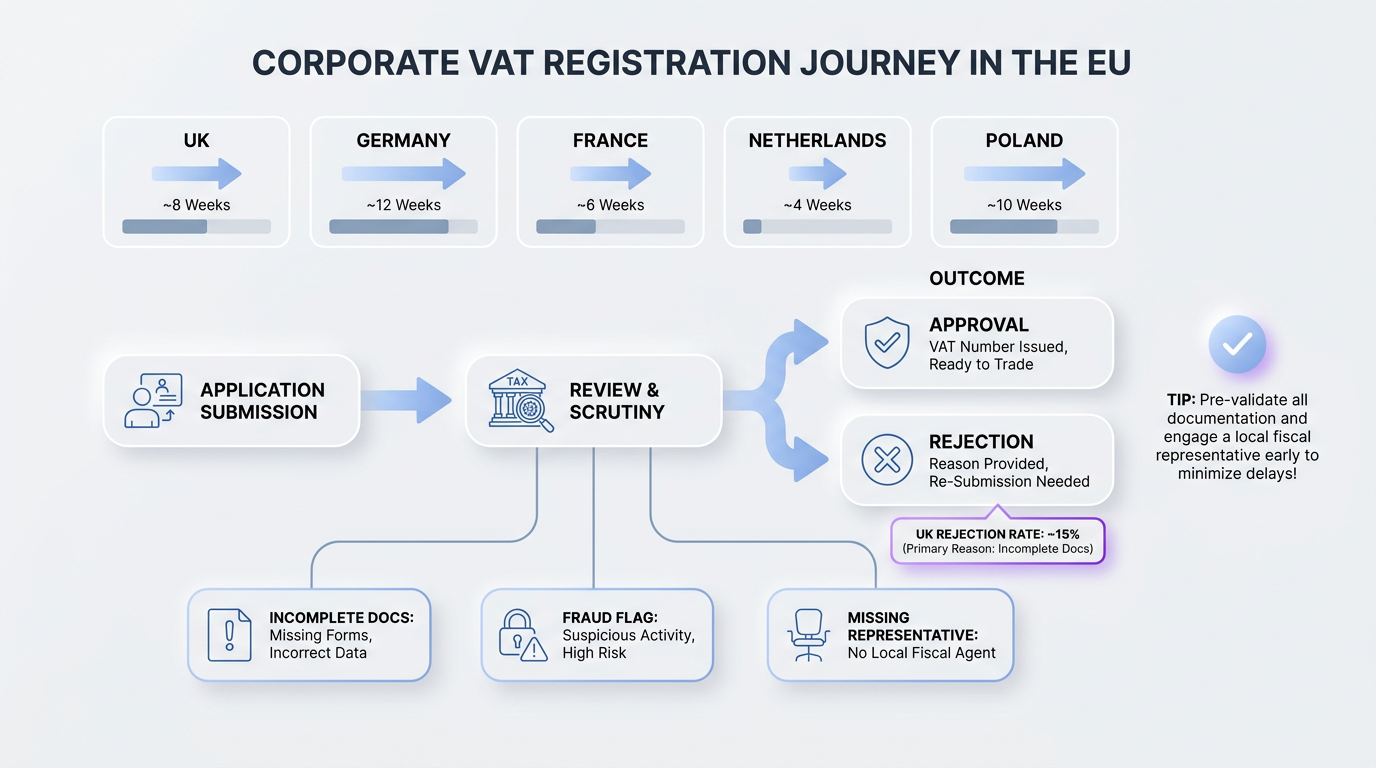
Infographic illustrating the corporate VAT registration journey in the EU, featuring a timeline and mini-charts on a light gray background.

Timelines for receiving your corporate VAT number differ widely depending on the country and the completeness of your application. Setting realistic expectations here prevents unnecessary stress and helps you plan your operations accordingly.

Typical processing times:

  • UK (HMRC): 30 business days for standard online applications; up to 3 months for complex or flagged cases

  • Germany: 4 to 8 weeks, sometimes longer for non-EU applicants

  • France: 2 to 6 weeks with a fiscal representative in place

  • Netherlands: 2 to 4 weeks for EU companies; longer for non-EU

  • Poland: up to 2 months, with additional verification steps common

What causes delays

Tax authorities commonly request additional information mid-process, which resets the clock. The most frequent causes include:

  • Incomplete or inconsistent documentation

  • Mismatch between declared business activity and submitted evidence

  • Missing fiscal representative where one is legally required

  • Applications flagged for fraud checks

In the UK specifically, HMRC has increased scrutiny in response to VAT fraud, contributing to that 17% rejection rate in 2024. Over 50,000 applications were refused or withdrawn. Many of these weren't fraudulent; they were simply incomplete or poorly supported.

To avoid unnecessary delays, consult the VAT Tax Registration: Complete Step-by-Step Guide for checklists and common mistakes that could impact your approval timeline.

Respond promptly to any queries from the tax authority and keep copies of every submission. This diligence shortens the approval window and brings you closer to your active VAT status.

Set Up Compliance from Day One

Receiving your VAT number isn't the finish line. It's actually the starting point for ongoing obligations. The moment your registration is active, you're required to charge VAT correctly, maintain records, and file returns on schedule.

Your immediate post-registration checklist should include:

  • Update invoicing systems to include your new VAT number and apply correct rates

  • Confirm your filing frequency, whether monthly, quarterly, or annually

  • Set calendar reminders for return deadlines and payment due dates

  • Establish record-keeping procedures that meet local retention requirements (usually 6 to 10 years)

A real-world scenario: a UK e-commerce company received its VAT number but failed to update its checkout system for three weeks. During that period, it collected payments without charging VAT, creating an immediate liability it had to absorb from its margins.

The scale of VAT collected through compliant systems continues to grow rapidly. In 2024, over €33 billion in VAT revenues were collected via the EU's e-commerce VAT systems, a 26% increase over 2023. Tax authorities are investing heavily in digital reporting, which means errors are caught faster than ever.

For practical guides on digital record-keeping, filing deadlines, and multi-country compliance, see VAT Filing & Returns: A Complete Guide for Businesses and VAT Compliance Services for Shopify and WooCommerce Stores.

For companies managing VAT across multiple jurisdictions, partnering with a specialist provider like 1StopVAT ensures filings are accurate and deadlines are met, combining human expertise with streamlined processes to keep you fully compliant as you scale internationally.

What Is Company VAT Registration?

Company VAT registration is the formal process by which a business registers with a tax authority to collect and remit Value Added Tax. It involves determining registration obligations, submitting an application with supporting documents, receiving a unique corporate VAT number, and maintaining ongoing compliance through periodic filings. Registration may be mandatory (when turnover exceeds a threshold) or voluntary (to reclaim input tax).

Conclusion

Company VAT registration is a structured process, but it demands attention to detail at every stage. From confirming your obligations and assembling thorough documentation to submitting a complete application and setting up compliance systems immediately, each step builds on the last. The businesses that get it right the first time are the ones that treat registration not as an administrative chore, but as foundational infrastructure for growth. As 2.73 million VAT-registered businesses in the UK demonstrate, proper VAT registration is simply part of doing business at scale. Whether you're expanding into new markets, selling through international marketplaces, or managing cross-border operations, VAT compliance directly affects invoicing, cash flow, customer trust, and long-term operational stability.

The reality is that VAT obligations rarely become simpler as a business grows. New sales channels, additional countries, inventory storage arrangements, and evolving digital reporting rules all increase complexity over time. Companies that build strong compliance processes early are far better positioned to scale internationally without disruptions, penalties, or unnecessary administrative overhead.


Registration is mandatory when your taxable turnover exceeds the local threshold, which is £90,000 in the UK. It's also required when you store goods in a foreign country or make taxable supplies there. You must register within 30 days of crossing the threshold to avoid penalties.

Timelines vary by country. UK registrations through HMRC typically take around 30 business days, while EU member states range from 2 weeks to 3 months. Incomplete applications or additional verification requests can extend these timelines significantly.

Most tax authorities require your certificate of incorporation, articles of association, director identification, proof of business activity, and bank details. Some countries request additional items like tax residency certificates, translated contracts, or powers of attorney for fiscal representatives.

Yes. Many businesses, especially e-commerce sellers, register in several countries simultaneously. The EU's One Stop Shop framework can reduce the number of registrations needed for B2C sales, but local registrations are still required where you store inventory or make B2B supplies.

Common reasons include incomplete documentation, inconsistencies between declared activity and submitted evidence, and missing fiscal representatives. In the UK, over 50,000 applications were refused or withdrawn in 2024, often due to insufficient supporting information rather than fraud.

Simple Compliance

Free consultation with 1StopVAT experts

You Might Also Like

Discover more insights and articles

Office workspace with laptops displaying spreadsheets and EU VAT 2025 compliance reporting documents being reviewed by a business professional

How Do SaaS Companies Handle EU VAT in 2025?

If you sell software subscriptions to customers across Europe, there's a good chance VAT rules are already shaping how you invoice, where you register, and how much tax you collect. The problem is that these rules keep evolving, and 2025 brings some of the most significant shifts in years.

Business professional reviewing VAT Making Tax Digital compliance documents beside a laptop displaying tax filing spreadsheets and organized business records

VAT Making Tax Digital Rules: What Businesses Must Do

If you're VAT-registered in the UK and still unsure whether you're fully compliant with HMRC's digital reporting rules, you're not alone. The shift from paper-based record keeping to mandatory digital filing has reshaped how every VAT-registered business handles its tax obligations.

Woman signing documents at a home office desk with digital workflow icons representing business, contracts, and document management

How to Register Your Company for VAT Easily

If you're growing a business and watching your revenue climb, there's a question you can't afford to ignore: when and how do you register company for VAT? Getting it wrong, or getting it late, can mean penalties, lost credibility, and missed opportunities to reclaim tax.

Illustration showing VAT compliance connected to eCommerce platforms like Shopify and WooCommerce

VAT Compliance Services for Shopify and WooCommerce Stores

Selling across borders through Shopify or WooCommerce sounds straightforward, until VAT obligations start stacking up. Different tax rates, shifting marketplace rules, and digital goods classifications can turn a growing online store into a compliance nightmare.