Overview
This article walks through how SaaS companies determine customer location, collect the right evidence, issue compliant invoices, and stay ahead of incoming regulatory changes across the EU. It explains how the place-of-supply rules work for digital services, when reverse charge mechanisms apply, and how OSS registration simplifies VAT reporting for cross-border sales.
You'll also learn how upcoming reforms under the VAT in the Digital Age (ViDA) package are reshaping e-invoicing, reporting obligations, and VAT enforcement for SaaS providers operating in Europe. By the end, you'll have a clear picture of what the current EU VAT framework demands from digital service companies and how to stay compliant without creating unnecessary operational complexity.
Why EU VAT Matters More Than Ever for SaaS Providers
SaaS products are, by definition, delivered electronically. Under EU VAT law, that makes them "electronically supplied services," a category with its own set of location-based tax rules. Unlike physical goods, where the place of supply often follows the warehouse or shipping origin, digital services are taxed where the customer is located.
That single principle creates a cascade of obligations. A SaaS company based in the US, Singapore, or even within the EU itself must charge VAT at the rate applicable in the customer's country, not the seller's. With 27 EU member states each setting their own standard and reduced VAT rates, this can get complicated fast.
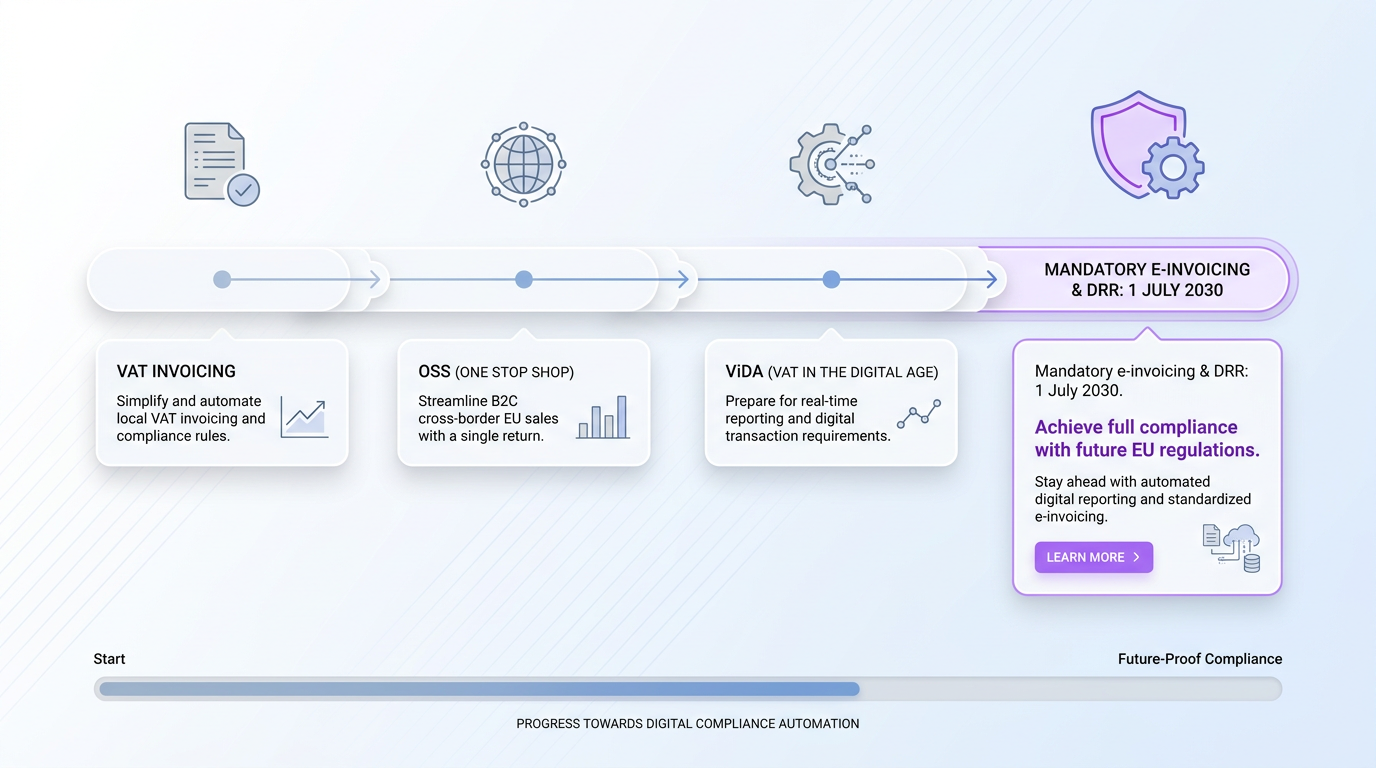
The regulatory environment is also tightening. The VAT in the Digital Age (ViDA) package, adopted on 11 March 2025, will be rolled out progressively until January 2035, introducing digital reporting requirements, expanded platform liability, and streamlined registration. SaaS companies that treat VAT as an afterthought risk penalties, lost revenue, and blocked access to European markets.
For a step-by-step compliance framework and practical quick wins, see VAT Compliance for SaaS and Digital Services in the EU.
Determining Where Your Customer Is Located
The foundation of EU VAT for SaaS is the "place of supply" rule. For B2C sales of electronic services, you charge VAT based on the customer's location. For B2B sales, the customer's business establishment determines the applicable rate, and in many cases, a reverse charge mechanism shifts the reporting duty to the buyer.
Getting this right requires distinguishing between two scenarios:
-
B2B transactions: The customer provides a valid VAT identification number. You verify it, apply the reverse charge, and issue an invoice without charging VAT (the customer self-assesses). For a breakdown of evidence rules and digital product obligations, see Digital Services VAT Compliance: What You Need to Know.
-
B2C transactions: No VAT number is provided. You must determine the customer's country and charge the local VAT rate yourself.
Collecting Two Pieces of Non-Contradictory Evidence
For B2C sales, EU rules require SaaS companies to gather at least two pieces of non-contradictory evidence confirming the customer's location.
These can include:
-
Billing address
-
IP address geolocation
-
Country of the bank or payment provider
-
Country code of the SIM card (for mobile access)
-
Other commercially relevant information
If two pieces of evidence point to the same EU country, that country's VAT rate applies. When evidence conflicts, the billing address typically takes priority, but companies should document how they resolve discrepancies.
This isn't just a formality. Tax authorities can and do audit the evidence trail. A SaaS business selling monthly subscriptions to thousands of EU customers needs a reliable system for capturing, storing, and reconciling this data at the point of sale. For best documentation techniques and automation tips, see VAT Certificate Verification: Ensuring Compliance.
Registering for VAT: OSS and Direct Registration
Once you know where your customers are, the next question is how to report and remit the VAT you've collected. Historically, this meant registering for VAT in every EU country where you had customers, a burden that discouraged many smaller SaaS companies from selling into Europe at all.
The One Stop Shop (OSS) scheme changed that. The VAT One Stop Shop allows businesses to declare their EU-wide sales through a single tax return, without having to VAT register in multiple Member States. For non-EU SaaS companies, the equivalent is the non-Union OSS, which works the same way but requires registration in one chosen EU member state.
Here's how the two paths compare:
-
OSS/non-Union OSS: One registration, one quarterly return covering all EU B2C sales. VAT is broken down by member state and remitted through the country of registration.
-
Direct VAT registration: Required if you have a fixed establishment in an EU country, sell B2B with local invoicing needs, or exceed thresholds that the OSS doesn't cover.
If you're navigating OSS options or want detailed best practices, the Handling VAT for Digital Services: A Practical Guide covers threshold management, compliant invoicing, and adapting to changes like ViDA.
For most SaaS companies selling subscriptions directly to consumers, the OSS is the simplest route. But companies with enterprise B2B clients, local entities, or complex supply chains may still need direct registrations in specific countries.
Invoicing Rules That SaaS Companies Can't Ignore

EU invoicing requirements vary by member state, but certain elements are mandatory across the board. Every VAT invoice must include the supplier's and customer's name and address, the VAT identification number (where applicable), a sequential invoice number, the date of supply, a description of the service, the taxable amount, the VAT rate, and the VAT amount.
For SaaS companies using the OSS, invoicing rules are somewhat simplified since the scheme follows the rules of the member state of identification. Still, there are nuances:
-
B2C invoices: Some countries don't require a full VAT invoice for B2C digital services, but it's good practice to issue one anyway for audit readiness.
-
B2B reverse charge invoices: Must include a note such as "Reverse charge applies" and the customer's VAT number. For more on these requirements, see Reverse Charge VAT for B2B Digital Services Explained.
-
Currency: Invoices can typically be issued in any currency, but the VAT amount must be convertible to the local currency using the European Central Bank's exchange rate.
E-Invoicing Is Coming
The ViDA package introduces Digital Reporting Requirements (DRR) that will reshape how invoices are issued and transmitted. These requirements mandate e-invoicing and near real-time digital reporting for intra-EU transactions, effective from 1 July 2030. Several member states, including Italy, France, and Germany, are already implementing or planning national e-invoicing mandates ahead of that deadline.
If you're preparing for ViDA or want to understand upcoming e-invoicing rules and compliance essentials, see EU Invoicing Rules Explained for Businesses.
For SaaS businesses, this means invoice formats will need to follow structured electronic standards (like EN 16931) rather than simple PDF generation. Starting to plan for this transition now will prevent a scramble later. Companies that already generate invoices programmatically through their billing systems have a head start, but the compliance layer, ensuring the right fields, formats, and transmission protocols, still requires careful attention.
How ViDA Changes the Landscape Through 2035
The ViDA reforms go well beyond e-invoicing. The package aims to modernize the EU's VAT system, making it more resilient to fraud and addressing challenges raised by the development of the platform economy. For SaaS companies, three pillars matter most.
Single VAT Registration simplifies obligations further. Starting from 1 July 2028, reforms include mandatory reverse charge for non-identified suppliers, reducing the need for multiple country registrations in scenarios that currently require them.
Platform economy rules are also expanding. While most directly affecting short-term accommodation and transport platforms, the new rules make platforms facilitating certain services responsible for collecting and remitting VAT under certain conditions. SaaS companies that operate as marketplaces or facilitate third-party transactions should assess whether these deemed-supplier provisions apply to them.
The financial stakes are significant. The ViDA package is projected to help Member States collect up to €18 billion more in VAT revenues annually over a ten-year period, with €11 billion resulting from anti-fraud measures. That level of expected recovery signals increased enforcement and audit activity, giving SaaS companies every reason to get compliance right now.
Staying Compliant Without Building an In-House Tax Team
Many SaaS companies, especially those in growth stages, don't have dedicated tax departments. Yet the obligations described above demand consistent attention: verifying customer locations, applying correct rates, filing returns on time, and adapting to regulatory changes across dozens of jurisdictions.
This is where working with a specialized VAT compliance partner makes a real difference. Top Companies for Digital Services VAT Compliance provides in-depth reviews of providers who can handle everything from VAT registration to ongoing filings and audits. 1StopVAT, for example, combines a team of over 40 certified tax specialists with coverage across 100+ countries, acting as a single point of contact for VAT registration, filing, and consulting. For SaaS companies selling into the EU, having that kind of dedicated guidance means you can focus on your product while the compliance side is handled by people who track these regulatory shifts daily.
A practical example: a US-based SaaS company launching in Europe might start with the non-Union OSS, then expand into direct registrations as enterprise B2B contracts grow. A compliance partner like 1StopVAT can manage both tracks, ensuring invoices meet local requirements and filings stay current as the ViDA timeline unfolds.
Conclusion
EU VAT compliance for SaaS companies in 2025 comes down to a few core disciplines: correctly identifying customer location with documented evidence, choosing the right registration path, issuing compliant invoices, and preparing for the structural changes ViDA will bring over the next decade. None of these steps are optional, and together they form a continuous obligation rather than a one-time setup. As SaaS companies grow across Europe, VAT becomes part of everyday operations, affecting pricing, billing, subscription management, and customer onboarding. Even small compliance gaps, such as incorrect VAT rates or unverified customer information, can quickly turn into larger financial and regulatory risks.
With ViDA introducing more automated reporting and e-invoicing requirements, EU tax enforcement is moving toward greater transparency and real-time oversight. SaaS businesses that build scalable VAT processes early, whether through automation or specialized compliance support, will be far better positioned to expand smoothly across European markets.
The companies that treat VAT as part of their long-term growth strategy rather than a reactive obligation are the ones most likely to scale confidently, avoid costly disruptions, and maintain trust with customers and regulators alike.