Business professional reviewing VAT Making Tax Digital compliance documents beside a laptop displaying tax filing spreadsheets and organized business records

VAT Making Tax Digital Rules: What Businesses Must Do

If you're VAT-registered in the UK and still unsure whether you're fully compliant with HMRC's digital reporting rules, you're not alone. The shift from paper-based record keeping to mandatory digital filing has reshaped how every VAT-registered business handles its tax obligations.

Content authorBy Beata ČepėPublished onReading time10 min read

Overview

This guide explains what VAT Making Tax Digital (MTD) requires, who it applies to, and the practical steps businesses need to take to remain compliant with HMRC's digital reporting rules. As part of the UK's move toward more automated tax administration, businesses must keep digital VAT records, use compatible software, and submit VAT returns through secure API connections rather than manual filing methods.

You'll learn how the HMRC MTD rules work in practice, what qualifies as compliant software, and how to manage VAT digital filing more efficiently. The guide also covers common compliance challenges, record-keeping obligations, and the key steps businesses can take to avoid penalties and maintain accurate VAT reporting.

What Making Tax Digital for VAT Actually Means

Before getting into the how-to steps, it's worth understanding what MTD for VAT is and why HMRC introduced it. At its core, Making Tax Digital is designed to make it easier for individuals and businesses to get their tax right and keep on top of their affairs. It replaces manual record keeping and portal-based submissions with a system that requires digital records and API-based filing.

Here's what changed in practical terms:

  • Businesses must keep VAT records digitally using compatible software.

  • VAT returns must be submitted directly from that software to HMRC via an Application Programming Interface (API).

  • Manual data entry between software programs is not allowed; digital links must connect any tools in the chain.

The definition is simple, but the implications are broad. Every VAT-registered business in the UK, regardless of size or turnover, now falls under these rules. For a full breakdown of requirements and real-world examples, see MTD VAT Explained: Everything You Need to Know.

Determine Whether Your Business Is Within Scope

The first thing you need to do is confirm that MTD applies to you. The answer, in almost every case, is yes.

MTD became mandatory from April 2019 for VAT-registered businesses with taxable turnover above the VAT registration threshold and from April 2022 for those below the threshold. That means both mandatory and voluntary VAT registrations are now covered.

There are very few exemptions. HMRC may grant them in cases involving:

  • Religious objections to using electronic communications

  • Disability or age-related inability to use digital tools

  • Remote locations where internet access is unreliable

If none of those apply, your business must comply. Even if you've been filing VAT returns online through HMRC's old portal, that doesn't count as MTD compliance. The submission method itself has changed.

Understanding your status is the foundation for everything that follows, so get this sorted first. For more on how to confirm compliance and avoid missed deadlines or penalties, check VAT Return Deadlines: Dates, Rules & Penalties Explained.

Set Up MTD-Compatible Software

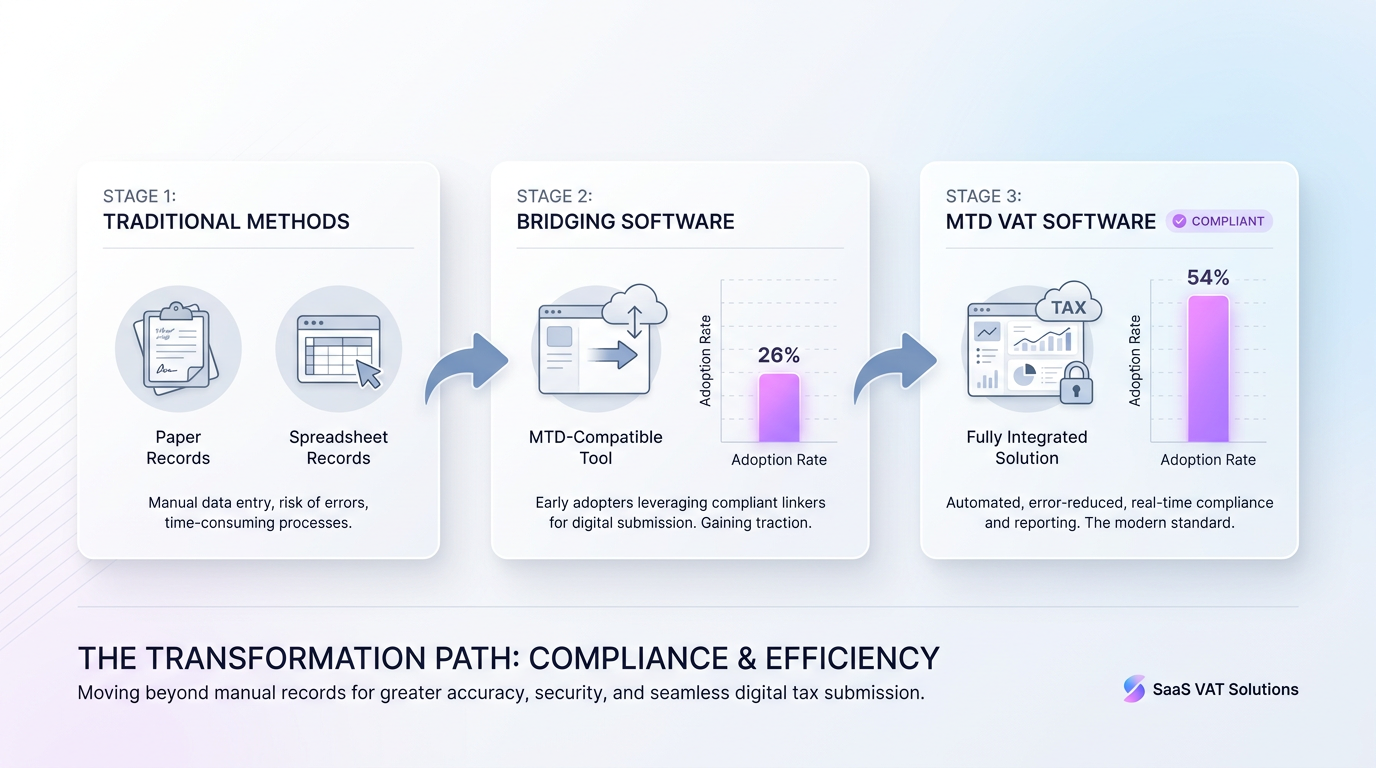
A clean educational visual showing the transition from paper records to MTD-compatible VAT software, with adoption statistics and icons.

Once you've confirmed you're in scope, the next step is choosing and implementing compatible software. This is where many businesses initially stumbled, but the landscape has matured significantly.

Prior to MTD, there was an even split among businesses using software, spreadsheets, or paper records for VAT administration; post-MTD, 54% use fully functional software, and 26% use bridging software. That shift tells a clear story: most businesses have moved to dedicated digital tools.

Fully Functional Software vs. Bridging Software

You have two main options:

  • Fully functional software handles everything: digital record keeping, VAT calculations, and direct submission to HMRC. Examples include cloud accounting platforms like Xero, QuickBooks, and FreeAgent.

  • Bridging software connects spreadsheets (like Excel or Google Sheets) to HMRC's API. You keep your records in the spreadsheet, and the bridging tool handles the submission.

Both are acceptable under HMRC MTD rules. However, if you use bridging software, you must ensure the digital link between your spreadsheet and the submission tool is genuinely automated. Copy-pasting figures manually breaks compliance.

For a small retailer tracking VAT on a handful of product lines, bridging software might be perfectly adequate. A marketplace seller handling cross-border transactions across multiple countries, on the other hand, will likely need a more robust setup.

The key takeaway here is that your software must be on HMRC's approved list, and it must connect digitally from record to return. For help with software selection and automation, visit Tax Technology Tools – VAT Compliance Automation.

Maintain Digital Records That Meet HMRC Standards

Having the right software is only half the equation. You also need to keep the right records in the right format.

HMRC requires you to store certain data points digitally for each transaction:

  • Your business name, address, and VAT registration number

  • The date and value of every supply (sale or purchase)

  • The rate of VAT charged

  • The time of supply (tax point)

What Counts as a "Digital Record"

A digital record doesn't mean scanning paper receipts. It means the underlying data, the numbers and categories, must live within your software. You can still keep paper copies of invoices, but the figures from those invoices need to be entered into your digital system.

For example, a construction firm receiving supplier invoices by post would need to enter each invoice's details into its accounting software. The paper invoice can go in a filing cabinet, but the VAT-relevant data must exist digitally.

This record-keeping requirement runs continuously, not just at return time. If HMRC audits your records, they'll expect to see a complete digital trail for the entire period.

Getting your records right from the start prevents headaches when it's time to file, which is exactly where we turn next. To ensure you capture everything, refer to Accurately Filling Out a VAT Return.

Submit VAT Returns Through Your Software

Under MTD, you can no longer log into HMRC's online portal and type in your nine VAT return boxes manually. Instead, your software pulls the figures from your digital records and submits them directly.

The process typically looks like this:

  1. Review the VAT return figures your software has calculated.

  2. Confirm the figures are accurate.

  3. Click "submit" within the software, which sends the return to HMRC via API.

  4. Receive a confirmation receipt from HMRC.

Common Filing Pitfalls

Even with software handling the submission, errors creep in. Watch out for:

  • Incorrect VAT codes on transactions, which throw off your return totals

  • Missing transactions that weren't entered before the filing deadline

  • Dual entries from importing bank feeds and manually entering the same invoice

A mid-sized e-commerce business, for instance, might import sales data from multiple platforms. If the same order appears twice due to overlapping data feeds, the VAT return will overstate output tax. Regular reconciliation before filing catches these issues.

The efficiency gains here are real. Businesses using fully functional MTD software saved between 26 and 40 hours per year on business finances and record-keeping. Across all VAT businesses, total estimated time savings for the 2022 to 2023 tax year ranged between 32 million and 49 million hours.

To see a breakdown of the digital VAT submission process and what to watch out for, read VAT Filing & Returns: A Complete Guide for Businesses.

Once you've filed your first return through software, the process becomes routine. But there's more to compliance than just hitting "submit."

Ensure Ongoing Compliance and Avoid Penalties

VAT digital filing under MTD isn't a one-time setup. It's an ongoing obligation that HMRC monitors and enforces.

HMRC uses a points-based penalty system for late submissions. Each missed deadline adds a point, and once you hit the threshold (which varies by filing frequency), you receive a financial penalty. Late payment penalties and interest charges apply separately.

To stay compliant over time:

  • Set calendar reminders for each VAT period deadline

  • Reconcile your records monthly, not just at quarter-end

  • Keep your software updated to maintain API compatibility with HMRC

  • Review any HMRC correspondence promptly

Approximately 40% of businesses reported spending less time on VAT returns since implementing MTD, which suggests that once the system is running, it genuinely reduces administrative burden. The initial effort pays off.

For businesses selling across borders, particularly marketplace sellers operating in multiple VAT jurisdictions, compliance becomes more complex. Managing UK MTD alongside EU VAT obligations requires careful coordination. This is where providers like 1stopVAT can make a meaningful difference: their team of 40+ certified tax specialists handles VAT registration, compliance, and filing across 100+ countries, acting as a single point of contact. For marketplace sellers juggling multiple VAT obligations, that kind of dedicated guidance keeps UK MTD compliance from falling through the cracks while cross-border filings are managed in parallel. For more on global VAT solutions, see Which VAT Provider Supports Worldwide Tax Compliance?.

Review and Improve Your Process

After a few filing cycles, take stock of how your MTD setup is working. This isn't just about compliance; it's about getting genuine value from the system.

Ask yourself:

  • Is my software capturing all transaction types correctly?

  • Am I spending less time on VAT admin than before?

  • Are there recurring errors that need a process fix?

  • Do I need to upgrade from bridging software to a fully integrated solution?

More than 80% of VAT-mandated businesses were aware of MTD by name or concept as of December 2018, well before the first mandate took effect. Awareness was never the problem. Execution is where businesses either thrive or struggle. For a detailed step-by-step compliance guide - including automation tips - check Making Tax Digital VAT: What It Means for Your Business.

A periodic review, even just once a year, ensures your VAT digital filing process stays efficient and accurate as your business evolves.

Conclusion

VAT Making Tax Digital is no longer optional for VAT-registered businesses in the UK. To stay compliant, businesses must keep digital VAT records, use HMRC-compatible software, and submit returns through secure API connections rather than manual filing methods. Whether you're a sole trader, an ecommerce seller, or a company managing VAT across multiple countries, the same principles apply: maintain accurate records, file on time, and ensure your systems are digitally connected.

For many businesses, the real challenge is not understanding the rules, but building a reliable process that works consistently every quarter. Errors caused by disconnected spreadsheets, incorrect VAT coding, or missing transactions can quickly create compliance risks and unnecessary stress. A structured digital workflow helps reduce those risks while improving visibility into your financial operations.

Making Tax Digital is also part of a wider move toward more automated and transparent tax reporting. Businesses that modernize their VAT processes early are often better prepared for growth, international expansion, and future regulatory changes. Once the right systems are in place, VAT digital filing becomes far more manageable and less time-consuming. Ultimately, businesses that treat MTD as an integrated operational system rather than a quarterly admin task are the ones that spend less time dealing with compliance issues and more time focusing on growth.

Every VAT-registered business in the UK must comply, regardless of turnover. Since April 2022, this includes businesses with taxable turnover below the VAT registration threshold who are voluntarily registered. Very limited exemptions exist for specific circumstances like disability or lack of internet access.

Yes, but only if you pair them with HMRC-approved bridging software that submits your return via API. The link between your spreadsheet and the bridging tool must be fully digital, with no manual copying or retyping of data.

HMRC operates a points-based penalty system. Each late submission adds a point to your record. Once you reach the penalty threshold for your filing frequency (for example, four points for quarterly filers), you'll receive a £200 penalty. Late payment attracts separate interest and penalty charges.

Your UK MTD obligations require HMRC-compatible software for UK VAT returns. If you also have VAT obligations in other countries, you may need additional tools or a provider like 1stopVAT that manages multi-country compliance through a single point of contact.

Evidence suggests it does. HMRC data shows that businesses using fully functional MTD software saved between 26 and 40 hours per year on VAT administration, and around 40% of businesses reported spending less time on returns after implementing the system.

Simple Compliance

Free consultation with 1StopVAT experts

You Might Also Like

Discover more insights and articles

Woman signing documents at a home office desk with digital workflow icons representing business, contracts, and document management

How to Register Your Company for VAT Easily

If you're growing a business and watching your revenue climb, there's a question you can't afford to ignore: when and how do you register company for VAT? Getting it wrong, or getting it late, can mean penalties, lost credibility, and missed opportunities to reclaim tax.

Illustration showing VAT compliance connected to eCommerce platforms like Shopify and WooCommerce

VAT Compliance Services for Shopify and WooCommerce Stores

Selling across borders through Shopify or WooCommerce sounds straightforward, until VAT obligations start stacking up. Different tax rates, shifting marketplace rules, and digital goods classifications can turn a growing online store into a compliance nightmare.

Two business professionals discussing VAT compliance documents in a modern office meeting

VAT Rules for Ecommerce Marketplaces Explained

If you sell through an online marketplace, or you operate one, there's a good chance VAT obligations are more complex than you think. Tax authorities worldwide have shifted the compliance burden directly onto platforms, and the rules keep evolving.

Businesswoman reviewing a VAT compliance guide while working on a laptop in a modern office

Making Tax Digital for VAT: Compliance Guide for Businesses

If you're VAT-registered in the UK and still relying on spreadsheets or paper records, you're already behind. HMRC's Making Tax Digital programme has fundamentally changed how businesses manage their VAT obligations, and non-compliance can trigger penalties you'd rather avoid.