Overview
Selling internationally creates tax obligations much faster than many businesses expect. What begins as a straightforward expansion into new markets can quickly turn into a complex web of VAT registrations, local filing rules, marketplace obligations, and country-specific reporting requirements across the EU, the UK, and non-EU jurisdictions.
This article explains why worldwide VAT compliance has become a critical part of global growth, what risks businesses face when their provider lacks true international coverage, and what to look for in a partner that can support cross-border operations at scale. It also shows why centralized guidance matters for reducing risk, avoiding costly gaps, and staying compliant as your business enters new markets.
Why Global VAT Obligations Keep Getting More Complex
Cross-border selling has never been easier from a logistics standpoint. But the tax side tells a different story. Every country sets its own VAT rules, rates, thresholds, and filing deadlines. And those rules change constantly.
Consider the sheer scale: VAT and GST revenues account for more than 20% of total tax revenue on average across OECD countries, with VAT now implemented in 174 countries worldwide. That's 174 different regulatory environments, each with unique registration triggers, invoicing formats, and reporting requirements.
A business selling from Germany into France, the UK, and Saudi Arabia faces three entirely separate compliance regimes. Miss a threshold in one, file late in another, and the penalties stack up fast. This complexity is exactly why the choice of VAT provider matters so much. A provider limited to one region leaves gaps that regulators are increasingly eager to exploit.
For a detailed comparison of tax experts who offer broad global coverage - not just in the EU but beyond - see Best Cross-Border VAT Experts for International Businesses.
The EU's Evolving VAT Framework
The European Union has tried to simplify things. The 2021 e-commerce VAT reforms introduced the One-Stop Shop (OSS) system, letting sellers report VAT across multiple EU member states through a single return. The results have been significant: more than €33 billion in VAT revenues were collected through the EU's e-commerce VAT systems in 2024, confirming the system's growing reach.
But OSS doesn't cover everything. Sellers with warehoused stock in multiple EU countries, marketplace operators with complex supply chains, and businesses with B2B transactions still need country-specific registrations. The simplification helps, yet it hasn't eliminated the need for expert guidance in each jurisdiction.
Meanwhile, the compliance gap remains enormous. EU Member States lost an estimated €128 billion in VAT revenues in 2023 due to non-compliance, insolvency, and administrative errors. That's a 1.6 percentage point increase over 2022, which means enforcement is likely to intensify, not relax.
The takeaway is clear: even within a relatively harmonized system like the EU, compliance is far from automatic. And outside the EU, things get even trickier.
If you're navigating registrations in multiple countries, a centralized approach saves time, cuts down errors, and helps meet local deadlines. Learn how businesses have solved these challenges in Who Handles Multi-Country VAT Registration and Reporting?.
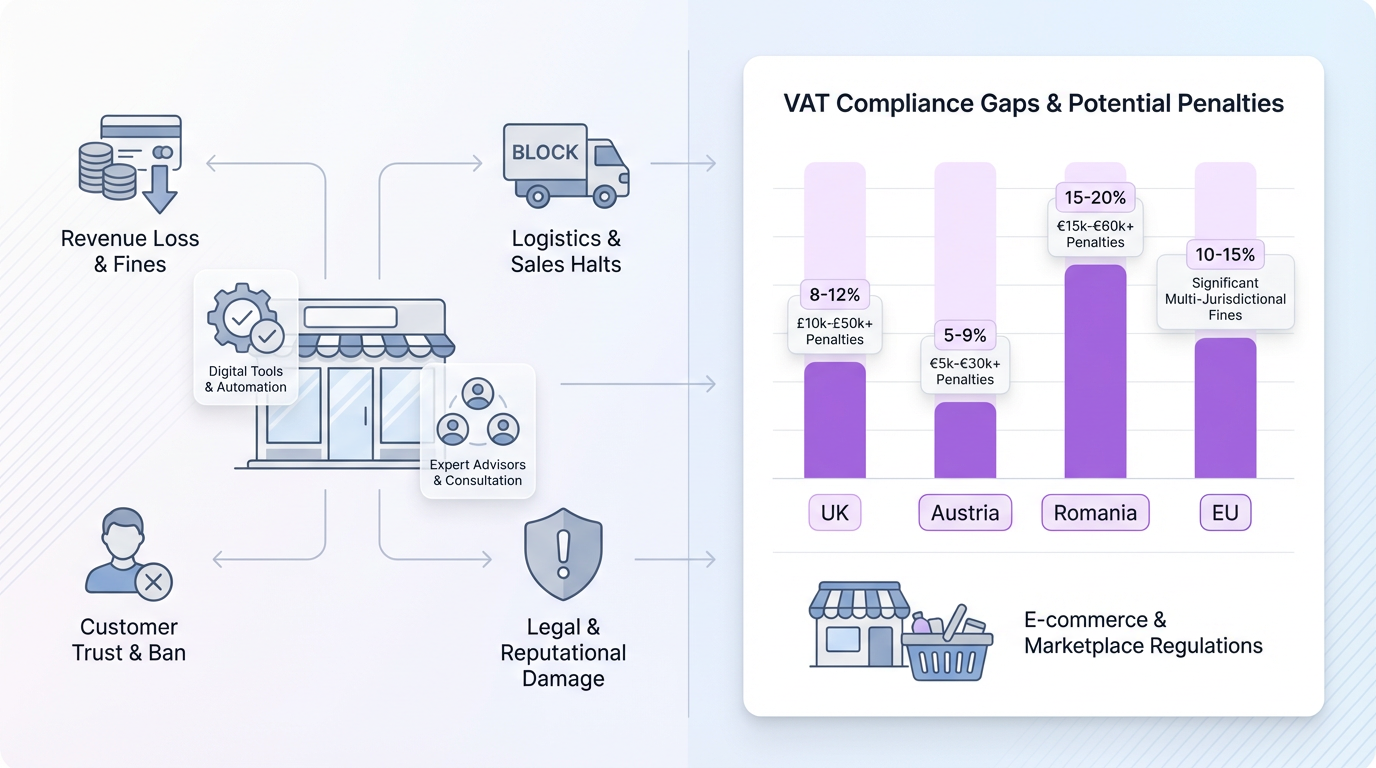
What Happens When Compliance Falls Short
The financial consequences of VAT non-compliance go well beyond a simple fine. They can derail expansion plans entirely.
-
Penalties and interest charges accumulate quickly, sometimes reaching 15-30% of the outstanding VAT amount depending on the jurisdiction
-
Suspended marketplace accounts on platforms like Amazon or eBay, which increasingly require proof of valid VAT registration before allowing sales
-
Blocked imports and exports at customs, creating supply chain disruptions that ripple through to customer experience
-
Reputational damage with local tax authorities, making future registrations and audits more adversarial
The variation across countries is stark. Romania recorded a 30% VAT compliance gap in 2023, while Austria's gap was just 1%. Selling into a high-gap country doesn't mean you can be lax. It means authorities there are under pressure to close the gap, and foreign sellers are often the easiest targets.
To understand the real-world consequences and penalties for errors, see VAT Compliance: How EU Businesses Lost €159M in Penalties.
The UK After Brexit
The UK presents its own compliance puzzle. Post-Brexit, it operates a fully independent VAT system. Businesses selling goods valued at or below £135 to UK consumers must register for UK VAT and charge it at the point of sale, not at the border.
The UK's VAT gap stood at 5.0% of theoretical VAT liability in the 2023-2024 tax year, equivalent to £8.9 billion. HMRC has invested heavily in digital compliance tools and data-matching capabilities, meaning errors get caught faster than ever.
For marketplace sellers, the UK's rules add another layer. Online marketplaces are deemed the supplier for VAT purposes in many scenarios, but sellers still need proper registrations and records. Getting this wrong can mean double taxation or, worse, trading without valid compliance documentation.
This is precisely where having a single provider that covers EU, UK, and non-EU jurisdictions becomes essential. Juggling separate advisors for each region introduces coordination risk and knowledge gaps between them.
What a True Worldwide VAT Compliance Partner Looks Like

Not every VAT provider can credibly claim global coverage. Here's what separates a genuine worldwide partner from a regional specialist with a few international add-ons.
-
Registration support across 100+ countries, not just the major European markets, but also the Middle East, Asia-Pacific, Latin America, and Africa
-
Local regulatory expertise in each jurisdiction, meaning they understand not just the rules but how local tax offices actually operate
-
Ongoing filing and reporting, because registration is only the first step; staying compliant month after month is the real challenge
-
A single point of contact who coordinates everything, rather than passing you between disconnected teams in different time zones
-
Consulting capability for complex scenarios like marketplace obligations, supply chain restructuring, or new market entry
For a review of leading specialist providers by region and business type, check Best VAT Registration Services in 2025: Top Providers Reviewed.
Why Marketplace Sellers Need Dedicated Guidance
Marketplace sellers face unique VAT challenges. Platforms like Amazon often handle VAT collection in certain scenarios, but not all. The seller remains responsible for understanding when the platform collects and when they must self-account.
For example, a seller using Fulfillment by Amazon (FBA) might have inventory stored in warehouses across Germany, France, Poland, and the Czech Republic. Each storage location can trigger a VAT registration obligation. If that seller also ships to Norway (outside the EU), yet another compliance regime applies.
This is the kind of situation where 1StopVAT adds genuine value. As a global VAT compliance provider with a team of over 40 certified tax specialists covering more than 100 countries, they serve as a single point of contact for registration, filing, and consulting. For marketplace sellers juggling multiple jurisdictions, having one provider that handles EU, UK, and non-EU obligations eliminates the dangerous gaps that emerge when separate advisors don't communicate.
The trend data supports why this matters now more than ever. The EU's VAT compliance gap climbed to €89.3 billion in 2022, representing 7% of theoretically expected VAT revenues, and the 2023 figure jumped even higher. Governments are responding with stricter enforcement, and sellers without solid compliance infrastructure are the most exposed.
The Role of Policy Gaps and Reduced Rates
Beyond compliance failures, there's another dimension businesses often overlook. The EU's VAT policy gap reached 50.5% in 2023, driven by reduced rates and exemptions, with Spain at 59.1% and Greece at 57.0% recording the highest levels.
What does this mean practically? Different product categories attract different VAT rates, and those rates vary wildly by country. A digital service taxed at 25% in Denmark might be taxed at 7% in another jurisdiction. Knowing which rate applies, and applying it correctly, requires deep local knowledge.
This is another reason why a worldwide provider with country-specific expertise matters more than a tool that simply calculates standard rates. The nuance is in the exceptions, and getting exceptions wrong triggers the same penalties as missing a filing entirely.
How to Evaluate Your Current VAT Provider
If you're already selling internationally, or planning to, ask these questions about your current setup:
-
Does your provider cover every country where you sell, store inventory, or ship from?
-
Can they handle both EU OSS filings and non-EU registrations through a single relationship?
-
Do they offer consulting for marketplace-specific scenarios, not just standard filings?
-
Are they tracking regulatory changes in each jurisdiction proactively, or do you find out about new rules after the deadline?
-
Is there a dedicated contact who understands your full cross-border picture?
If the answer to any of these is no, that's a compliance gap waiting to become a financial one.
Progress has been made in some areas. The EU VAT compliance gap dropped from €99 billion in 2020 to €61 billion in 2021, reflecting improved enforcement. But it bounced back sharply in subsequent years. The lesson: compliance gains are fragile, and businesses can't afford to let their guard down.
Conclusion
Worldwide tax compliance isn't a feature you bolt on later. It's a foundation you need before entering each new market. The risks of getting it wrong, from penalties to suspended accounts to blocked shipments, are too significant to leave to a patchwork of regional advisors.
The right VAT provider covers the EU's complex multi-country requirements, the UK's independent post-Brexit system, and the growing list of non-EU countries enforcing VAT on cross-border sellers. For marketplace sellers especially, dedicated guidance and centralized filings make the difference between confident expansion and costly surprises. Choosing a provider with genuine global reach is, ultimately, how you turn tax compliance from a barrier into a competitive advantage.