What This Article Covers
This article breaks down exactly how VAT works for ecommerce marketplaces, who's responsible for collecting and remitting tax, what sellers need to know about cross-border transactions, and how the EU's recent reforms have reshaped the landscape. By the end, you'll have a clear picture of marketplace VAT obligations, seller responsibilities, and the key compliance steps that prevent costly mistakes.
Why VAT Matters More Than Ever for Ecommerce Marketplaces
The ecommerce marketplace model has become the dominant force in global retail. By 2027, online marketplaces are projected to be the largest and fastest-growing retail channel globally, with the sector expected to be worth over $5 trillion. That scale brings enormous tax revenue into play, and governments aren't leaving it on the table.
For years, VAT collection on marketplace sales was inconsistent. Sellers, especially smaller ones shipping from overseas, often slipped through the cracks. The result? In 2023, total VAT revenue in the EU amounted to €1,223 billion, with a compliance gap estimated at €128 billion, representing 9.5% of the total tax liability. That gap pushed regulators to act, making platforms themselves liable for collecting and remitting VAT in many scenarios.
Consumer behavior reinforces this trend. In 2024, 63% of consumers preferred buying on marketplaces over brand-owned websites, which means more transactions flow through platforms than ever before. That concentration of sales activity is precisely why tax authorities now treat marketplaces as the collection point.
Understanding this backdrop is essential before getting into the specific rules, because ecommerce tax compliance isn't just a back-office headache. It's a structural feature of modern online selling.
How the EU's Deemed Supplier Model Works
The most significant shift in marketplace VAT came with the EU's July 2021 e-commerce VAT package. Under this framework, the marketplace itself becomes the "deemed supplier" in certain transactions. This means the platform is treated as if it purchased the goods from the seller and then resold them to the consumer, making the marketplace responsible for charging, collecting, and remitting VAT.
The deemed supplier rule kicks in under two conditions:
-
Distance sales of imported goods with a value up to €150, where the goods are shipped from outside the EU to an EU consumer.
-
Sales facilitated by the marketplace where the underlying seller is established outside the EU, regardless of the goods' value, if those goods are already located within the EU at the time of sale.
If neither condition applies, the seller retains the VAT obligation. This distinction matters enormously for compliance workflows, because it determines who files the return, who issues the invoice, and who bears the risk if something goes wrong.
What "Facilitation" Actually Means
Tax authorities define "facilitation" broadly. If a marketplace authorizes the charge to the customer, sets the terms of sale, or is involved in the ordering or delivery process, it's considered to facilitate the transaction. Most major platforms, think Amazon, eBay, Etsy, easily meet this threshold.
The success of this model is hard to ignore. In 2024, more than €33 billion in VAT revenues were collected via the EU's e-commerce VAT systems, confirming that the 2021 reforms dramatically improved collection rates. These numbers tell regulators the approach works, which means similar models are spreading to other jurisdictions.
With the deemed supplier framework firmly in place, the next question becomes: what do sellers themselves still need to handle?
Seller Responsibilities That Don't Disappear

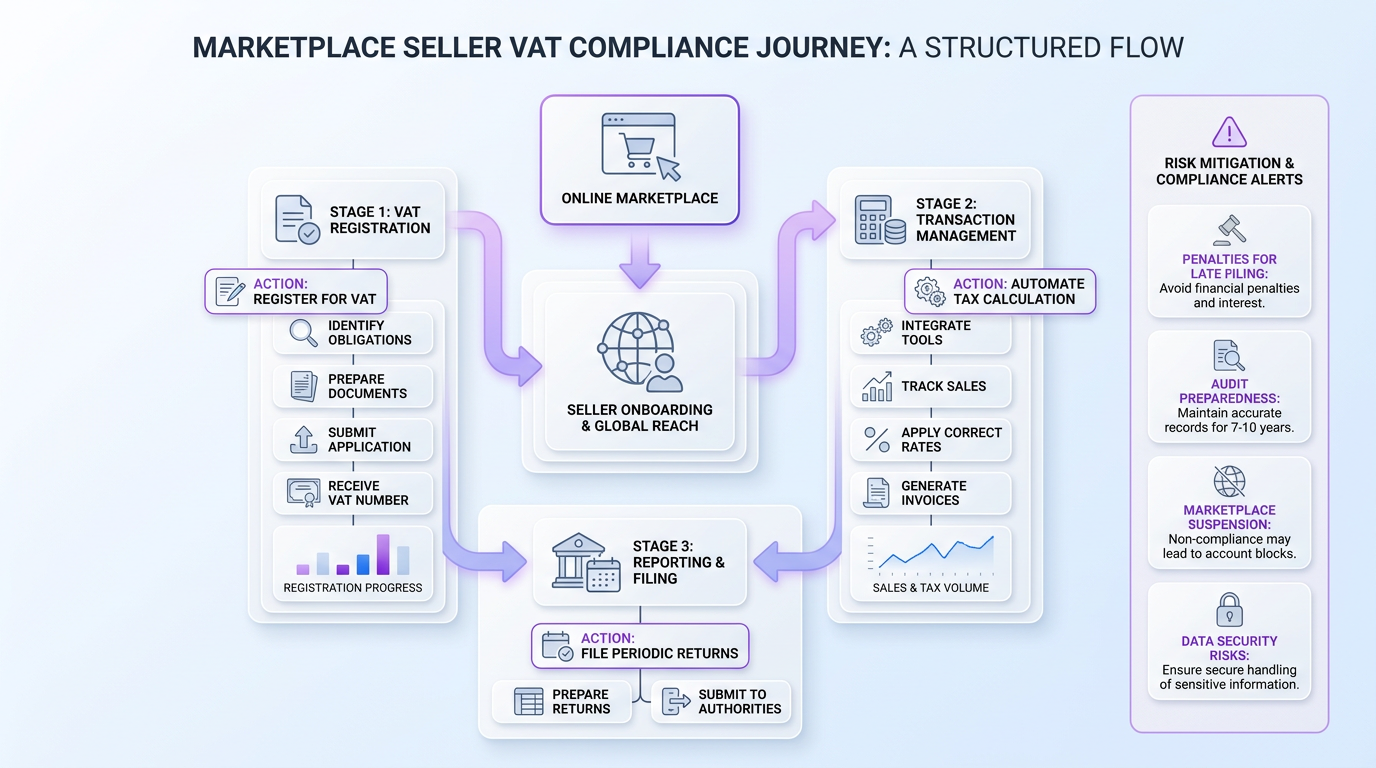
Even when a marketplace takes on VAT collection duties, sellers aren't completely off the hook. The deemed supplier model transfers the point-of-sale VAT obligation, but several compliance responsibilities remain firmly with the seller.
Here's what marketplace sellers still need to manage:
-
VAT registration: Sellers may still need VAT registrations in countries where they store inventory. If you use Amazon's FBA network and your goods sit in warehouses across Germany, France, and Poland, you likely need registrations in each country. For a deeper understanding of these registration triggers and obligations, see How to Register for VAT in the EU: Step-by-Step Guide.
-
Intra-EU stock movements: Transferring your own inventory between warehouses in different EU member states triggers a deemed supply. That's a reportable, taxable event for the seller, not the marketplace.
-
B2B sales: The deemed supplier rules generally apply to B2C transactions. If you sell to business customers through a marketplace, the standard VAT rules (including reverse charge mechanisms) often apply, and the seller handles the compliance.
-
Record-keeping: Regardless of who collects VAT at checkout, sellers must maintain detailed records of all transactions, including proof of where goods were located and where they were shipped.
A Common Mistake Sellers Make
Consider a US-based seller who stores inventory in a fulfillment center in the Netherlands and sells to consumers across the EU. The marketplace collects VAT on those B2C sales. But the seller still needs a Dutch VAT registration for the import of goods into the Netherlands and for the stock itself. Failing to register doesn't just create a compliance gap; it can lead to penalties, delayed shipments, and blocked marketplace accounts.
This layered structure, where platforms handle some obligations and sellers handle others, is exactly why ecommerce tax compliance demands careful attention. It's not enough to assume the marketplace "takes care of everything."
For more comprehensive compliance checklists and best practices throughout the VAT process, see Marketplace VAT Obligations for Online Sellers: What You Need to Know.
For sellers managing registrations and filings across multiple countries, working with a dedicated compliance partner simplifies the process considerably. 1StopVAT, for instance, provides VAT registration and filing services across 100+ countries through a single point of contact, helping marketplace sellers stay compliant without juggling separate advisors in each jurisdiction.
Cross-Border Online Marketplace VAT: Beyond the EU
The EU's approach has inspired similar frameworks elsewhere. The UK introduced its own marketplace VAT rules in January 2021, requiring platforms to collect VAT on goods imported into the UK with a value up to £135, and on goods sold by overseas sellers from UK inventory. Australia, New Zealand, and Norway have implemented comparable models, with varying thresholds and definitions.
Key differences to watch across jurisdictions:
-
Thresholds vary: The EU uses €150 for imported goods under the deemed supplier rule. The UK uses £135. Other countries set different limits.
-
Definitions of "marketplace" differ: Some jurisdictions define facilitation more narrowly, which can shift the obligation back to sellers in certain cases.
-
Filing requirements diverge: The EU offers the One-Stop Shop (OSS) and Import One-Stop Shop (IOSS) simplification schemes. Other countries may require full local registration with no simplified option.
For sellers tackling registrations, reporting, and compliance across borders, How Do I Stay VAT Compliant When Selling in Multiple Countries? provides checklists and actionable tips to navigate the complexity.
Real-World Example: Selling Into Multiple Markets
A mid-sized electronics seller based in China lists products on Amazon (EU), eBay (UK), and a local Norwegian marketplace. Under EU rules, Amazon collects VAT on imported goods up to €150. In the UK, eBay handles VAT on consignments up to £135. In Norway, the seller may need to register for VOEC (VAT on E-Commerce) if the marketplace doesn't handle the obligation. Three markets, three sets of rules, three potential registration requirements.
This is where online marketplace VAT gets genuinely complicated. Each country's rules interact differently with the platform's policies, and a seller's obligations shift depending on where inventory is stored, where the customer is located, and whether the platform qualifies as a deemed supplier in that jurisdiction.
For a more detailed breakdown of multi-jurisdictional VAT requirements and practical comparison of available compliance schemes - including when the OSS or IOSS can replace multiple national registrations - consult the VAT Tax Registration: Complete Step-by-Step Guide.
Navigating this patchwork is why many growing sellers turn to specialists like 1StopVAT, whose team of 40+ certified tax professionals provides tailored guidance and filing support across these varied regulatory environments.
Staying Compliant as Rules Continue to Evolve
Marketplace VAT rules aren't static. The EU is already working on "VAT in the Digital Age" (ViDA) proposals, which will expand platform obligations further, introduce real-time digital reporting, and tighten rules around deemed supplier transactions. For an in-depth explanation of the EU's digital-age reforms and how they’ll impact your processes, see VAT in the Digital Age: How Could it Affect Your Business?.
The UK is reviewing its own framework post-Brexit. And countries across Asia-Pacific are steadily introducing new marketplace collection models.
For sellers and platforms alike, the path forward involves:
-
Monitoring regulatory changes in every market where you sell or store goods.
-
Maintaining clean data, because accurate product classifications, customer locations, and transaction records are the foundation of compliance.
-
Choosing the right compliance support, whether in-house tax teams or external partners who specialize in cross-border ecommerce tax compliance.
For further reading on how external experts can help centralize and streamline your cross-border VAT filings, see Top VAT Firms for Online Marketplaces.
An ecommerce marketplace becomes responsible for collecting and remitting VAT under the EU's "deemed supplier" model when it facilitates sales of imported goods valued up to €150, or sales by non-EU sellers from EU-based inventory. Sellers retain obligations for VAT registration where they store goods, intra-EU stock movements, and B2B transactions.
The growth of marketplace commerce shows no signs of slowing. Mirakl-powered marketplace sales grew by 53% year-over-year during Cyber Week 2022, dramatically outperforming the 2% growth of overall ecommerce during the same period. As marketplaces capture more of the retail economy, VAT compliance will only become more central to how sellers and platforms operate.
Conclusion
VAT rules for ecommerce marketplaces have fundamentally reshaped how tax is collected on online sales, shifting critical responsibility onto platforms while leaving sellers with complex, non-obvious obligations. The deemed supplier model simplifies part of the process, but it doesn’t eliminate the need for VAT registrations, inventory tracking, and accurate reporting across multiple jurisdictions. For cross-border sellers, this is where compliance often breaks in practice. Different thresholds, country-specific rules, and evolving regulations create a fragmented landscape where even small oversights can lead to audits, penalties, or operational disruption.
Staying compliant today requires more than a basic understanding of VAT rules. It demands structured processes, reliable data, and a clear view of where your obligations actually arise. In a marketplace-driven economy, VAT compliance isn’t just a back-office task. It’s a critical part of protecting your revenue, maintaining platform access, and scaling your business without costly setbacks.