Overview
This guide walks you through exactly what Making Tax Digital for VAT means, who it applies to, and how to stay compliant step by step. You'll learn the specific requirements HMRC expects, which digital tools qualify, and how businesses like yours can turn this obligation into a genuine efficiency gain. Whether you're a sole trader, a growing e-commerce seller, or a multinational marketplace business, the path to compliance follows the same core logic.
What Is Making Tax Digital for VAT?
Making Tax Digital (MTD) for VAT is HMRC's initiative requiring VAT-registered businesses to keep digital records and submit VAT returns using compatible software. It's not optional. Since April 2022, every VAT-registered business, regardless of turnover, must comply.
The programme rolled out in two phases. The first, starting in April 2019, applied to businesses with taxable turnover above £85,000. The second phase, from April 2022, extended the mandate to all VAT-registered businesses, including those who voluntarily registered below the threshold.
The core idea is simple: digital record-keeping reduces errors, speeds up VAT return submission, and gives HMRC better visibility into tax data. The results back this up. By December 2021, nearly 1.6 million taxpayers had joined MTD for VAT, with more than 11 million returns successfully submitted. That's not a pilot programme. It's a full-scale shift in how UK tax works.
Understanding the mandate is only the first step. The real question is: what do you actually need to do? For a detailed guide on full digital compliance requirements and practical automation steps, see Making Tax Digital VAT: What It Means for Your Business.
Confirm Whether You're Required to Comply
Before setting up software or changing your processes, verify your obligations. The rules are straightforward, but the details matter.
You must comply with MTD for VAT if:
-
You are registered for VAT in the UK
-
Your VAT registration is active, whether mandatory or voluntary
-
You file VAT returns to HMRC
There are very limited exemptions, mostly for businesses where digital compliance is not reasonably practical due to age, disability, or remote location. If you don't qualify for an exemption, you must comply.
One common misconception is that businesses below the £85,000 VAT threshold are exempt. They were, until April 2022. Now, every VAT-registered business falls under MTD rules, full stop.
Once you've confirmed the mandate applies to you, the next step is getting your digital records in order. For a step-by-step compliance check and to understand the deadlines and risks, see VAT Return Deadlines: Dates, Rules & Penalties Explained.
Set Up MTD-Compatible Digital Records
HMRC doesn't prescribe a specific software product, but it does set clear rules about what your digital records must include. You can't simply scan paper invoices and call it digital.
Your records must capture:
-
Your business name, address, and VAT registration number
-
The VAT accounting scheme you use (standard, flat rate, cash accounting, etc.)
-
The VAT rate applied to each supply
-
The time, value, and rate of every supply made and received
-
Any adjustments or corrections to returns

What Counts as "Digital"?
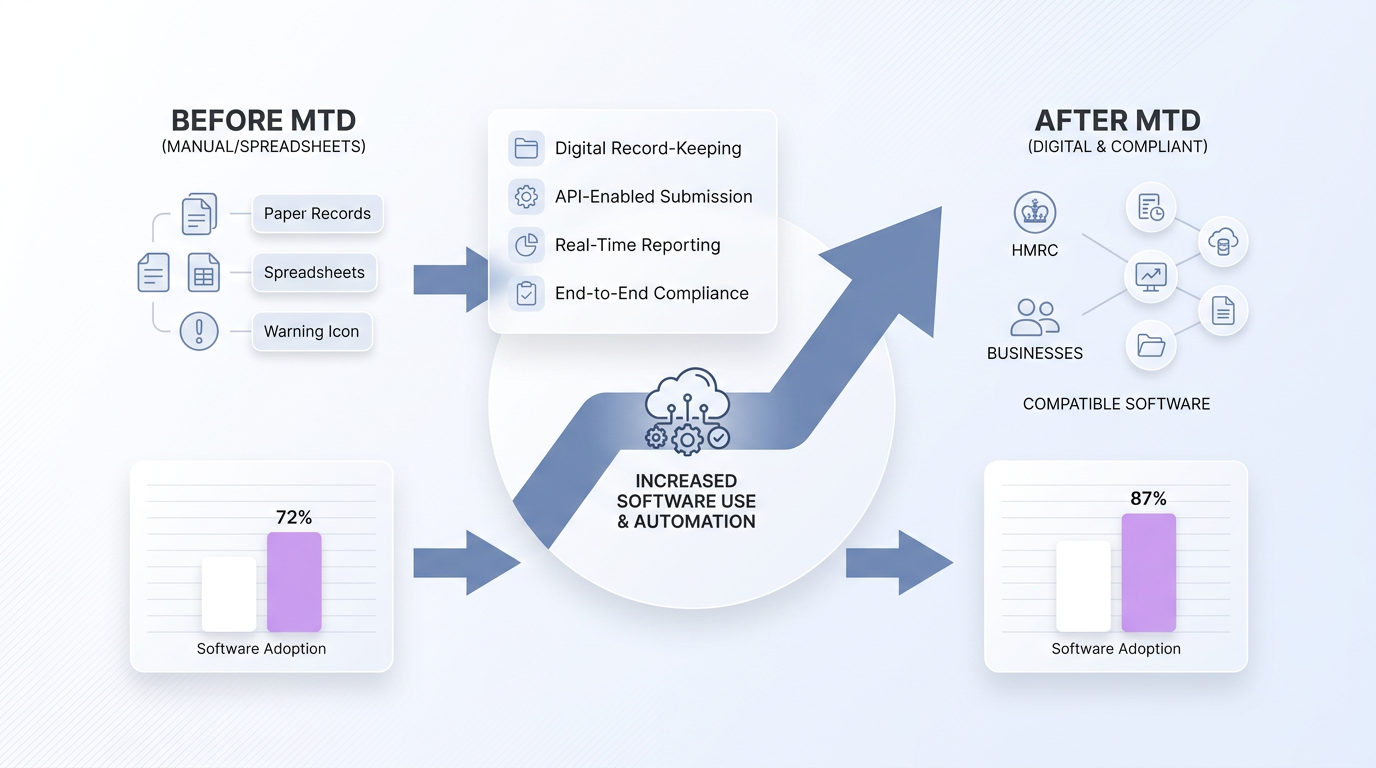
A spreadsheet can qualify, but only if it feeds data into compatible software that submits VAT returns directly to HMRC through its API. Manual re-entry from a spreadsheet into a submission tool breaks the "digital link" requirement and puts you out of compliance.
Before MTD, many businesses kept records on paper or in disconnected files. That's changed significantly. The proportion of businesses using software and/or apps in record-keeping increased from 72% before MTD to 87% after its introduction, showing a measurable shift in how VAT data is managed.
With your records structured properly, the next decision is choosing the right software to connect everything to HMRC. For practical advice on preparing records and ensuring accuracy, read Accurately Filling Out a VAT Return.
Choose HMRC-Recognised Software for VAT Return Submission
Not all accounting software qualifies. HMRC maintains a list of compatible software that can communicate with its systems through the MTD API.
Your chosen tool must:
-
Maintain digital records as outlined above
-
Submit VAT returns directly to HMRC
-
Preserve digital links between records and submission, with no manual re-keying
Popular options include Xero, QuickBooks, FreeAgent, and Sage, among others. Each handles MTD compliance differently, so evaluate based on your business size, complexity, and existing workflows.
For a practical walkthrough of choosing between MTD software and bridging tools - including automation tips and common pitfalls - see How to Submit VAT Online: A Step-by-Step Guide.
Bridging Software: A Middle Ground
If you prefer spreadsheets for day-to-day bookkeeping, bridging software lets you maintain that workflow while still meeting the digital link requirement. The bridging tool pulls data from your spreadsheet and submits it to HMRC in the required format.
This approach works for smaller businesses, but it adds a layer of complexity. For businesses operating across multiple countries or selling on marketplaces like Amazon or eBay, a more integrated approach is usually worth the investment.
For marketplace sellers managing VAT obligations across multiple jurisdictions, the complexity multiplies fast. This is where working with a dedicated VAT compliance provider like 1stopVAT can make a real difference. Their team of 40+ certified tax specialists handles VAT registration, filing, and compliance across 100+ countries, acting as a single point of contact so sellers can focus on growth rather than paperwork.
With your software selected and configured, you're ready to register for MTD itself.
Sign Up for MTD for VAT with HMRC
Registration is done through your Government Gateway account. If you're already VAT-registered but haven't signed up for MTD, you'll need to take this step before your next return is due.
Here's how:
-
Go to the HMRC MTD sign-up page on GOV.UK
-
Sign in with your Government Gateway credentials
-
Confirm your VAT registration details
-
Link your compatible software to your HMRC account
-
Submit your next VAT return through the software, not through your old VAT online account
One important note: once you sign up for MTD, you can no longer use the old HMRC VAT portal for submissions. Your software becomes the sole channel for HMRC digital tax filing.
Allow at least a few days before your filing deadline to complete sign-up, test your software connection, and troubleshoot any issues. Rushing this process on deadline day is a recipe for penalties.
Now that you're registered and connected, the ongoing work begins: filing returns correctly and consistently.
Submit VAT Returns and Maintain Compliance
Filing through MTD software is generally faster than the old portal. You prepare your return within the software, review the figures, and submit directly. HMRC receives the data instantly.
But compliance doesn't end at submission. To stay on the right side of HMRC:
-
Keep your digital records updated continuously, not just at quarter-end
-
Ensure every digital link in your data chain remains unbroken
-
Retain records for at least six years
-
Correct errors promptly, either on your next return (for errors under £10,000) or by contacting HMRC directly for larger amounts
-
Monitor HMRC correspondence through your software or Government Gateway
The Payoff Is Real
The time and cost benefits of full MTD compliance are well documented. In the 2022-2023 tax year, the total estimated time savings across all VAT businesses using fully functional MTD software ranged between 32 million and 49 million hours. Translated into financial terms, the value of that time saved was estimated to be between £603 million and £915 million.
These aren't theoretical projections. They reflect actual business experience. And at the individual level, approximately 69% of businesses reported experiencing at least one benefit from MTD, including faster preparation and submission of returns and increased confidence in tax accuracy.
For businesses selling internationally, particularly marketplace sellers operating across EU and non-EU countries, the compliance burden extends well beyond UK VAT. A provider like 1stopVAT can manage filings across jurisdictions, ensuring that MTD compliance is just one piece of a fully handled global VAT strategy. For detailed rules and compliance tips for marketplace sellers, read Marketplace VAT Obligations for Online Sellers: What You Need to Know.
What Making Tax Digital for VAT Means in Practice
Making Tax Digital for VAT requires every VAT-registered UK business to maintain digital records and submit VAT returns through HMRC-recognised software. Compliance involves signing up through Government Gateway, using compatible software with unbroken digital links, and filing returns electronically each quarter. The programme applies universally to all VAT-registered businesses as of April 2022.
Conclusion
Making Tax Digital for VAT is no longer optional, it’s the standard for how VAT compliance works in the UK. Businesses that adapt early don’t just avoid penalties - they reduce errors, streamline reporting, and gain clearer visibility over their financial data. The path to compliance is straightforward: digitise your records, implement HMRC-recognised software, and maintain consistent, accurate filings. But the real value comes from how well these systems are integrated into your day-to-day operations.
Businesses that treat MTD as more than a regulatory requirement turn it into a competitive advantage. With cleaner processes, faster submissions, and greater confidence in their numbers, VAT compliance becomes not just easier - but a foundation for more efficient, scalable growth.