What you will learn
In the next few minutes you will:
- See the mandatory data points every EU invoice must show.
- Understand how electronic invoicing works, why it is expanding, and when it will become mandatory.
- Learn the potential penalties for non-compliance and how they differ by member state.
- Get practical tips and real-life mini case studies to apply the rules in your own accounts receivable process.
- Discover when to call in dedicated EU billing compliance specialists and what value they add.
Let us start with the building blocks that every invoice must carry.
Mandatory invoice elements
Every EU member state follows the VAT Directive 2006/112/EC, but each country can add its own twists. The safest approach is to include all elements the Directive lists and then double-check local rules.
- Invoice date and a unique sequential number
- Supplier’s full legal name, address, and VAT ID
- Customer’s name, address, and VAT ID (when the customer is taxable)
- A clear description of goods or services
- Quantity or extent supplied
- Supply date if different from invoice date
- Net amount per VAT rate, total net amount, applicable VAT rate(s), and total VAT
- Price reductions such as discounts or rebates
- Currency if not in euro
- Intra-EU supply references, reverse charge notes, or special scheme wording where relevant
Mini case study: A French software publisher forgot to add the “self-billing” note required for the customer’s reverse charge in Germany. The German buyer refused payment until a corrected invoice arrived, delaying cash collection by three weeks.
Leaving any of these points out puts the supplier at risk of penalties and, worse, can block the customer’s right to deduct VAT. Summarizing: complete data equals smoother payments.
For a deep dive into the requirements and best practices for mandatory invoice fields across the EU, see the EU Electronic Invoicing Mandates and SAF-T: Ensuring Compliance Across Borders.
Electronic invoicing requirements
Paper is fading fast. Back in 2011, only 8.2 % of EU enterprises exchanged electronic invoices, and early estimates for 2013 placed e-invoice use at merely 4–15 % of all invoices. Fast-forward a decade: ViDA will make structured e-invoices and digital reporting the default across the Union by 2030.
What counts as an e-invoice?
- A structured file (XML, UBL, PEPPOL BIS) that can be automatically imported.
- Integrity, authenticity, and readability must be guaranteed from issuance to storage.
Why governments push e-invoicing
Mini case study: An Italian engineering firm switched to the national SDI e-invoicing platform. Processing time per invoice fell from eight minutes to under two, saving thousands of euros annually.
For a practical overview of how e-invoicing laws and technologies interact and why structured data is key, read Benefits of E-Invoicing for Your Business.
EU landscape today
Roughly 18 billion B2B and B2G invoices are sent each year, and about 3.24–5.4 billion of those go to public bodies. With ViDA, each member state must make its system interoperable by 2035, as agreed by the EU Council.
The takeaway: electronic invoicing is moving from optional to mandatory, and timelines differ by country. Always verify local go-live dates.
Stay current on regulation and deadlines by following Electronic Invoicing News: Most Recent Information in Europe.
Penalties for non-compliance
Penalties sit in national VAT acts. They vary but usually group into three buckets.
- Fixed fines: for example, Belgium can charge EUR 80 per missing invoice sequence number.
- Percentage fines: Spain may levy up to 1 % of the invoice value for errors in mandatory fields.
- Administrative actions: repeated breaches can trigger audits or suspension of VAT numbers.
Mini case study: A UK retailer selling into Poland misapplied the local VAT rate and faced a 30 % surcharge on the unpaid tax, plus interest. The root cause was outdated rate logic in its ERP.
While sums differ, authorities share one view: ignorance is no excuse. Putting robust EU billing compliance checks in place pays off quickly.
If you want to understand real-world risks and enforcement, review VAT Compliance: How EU Businesses Lost €159M in Penalties.
Preparing for ViDA and upcoming changes
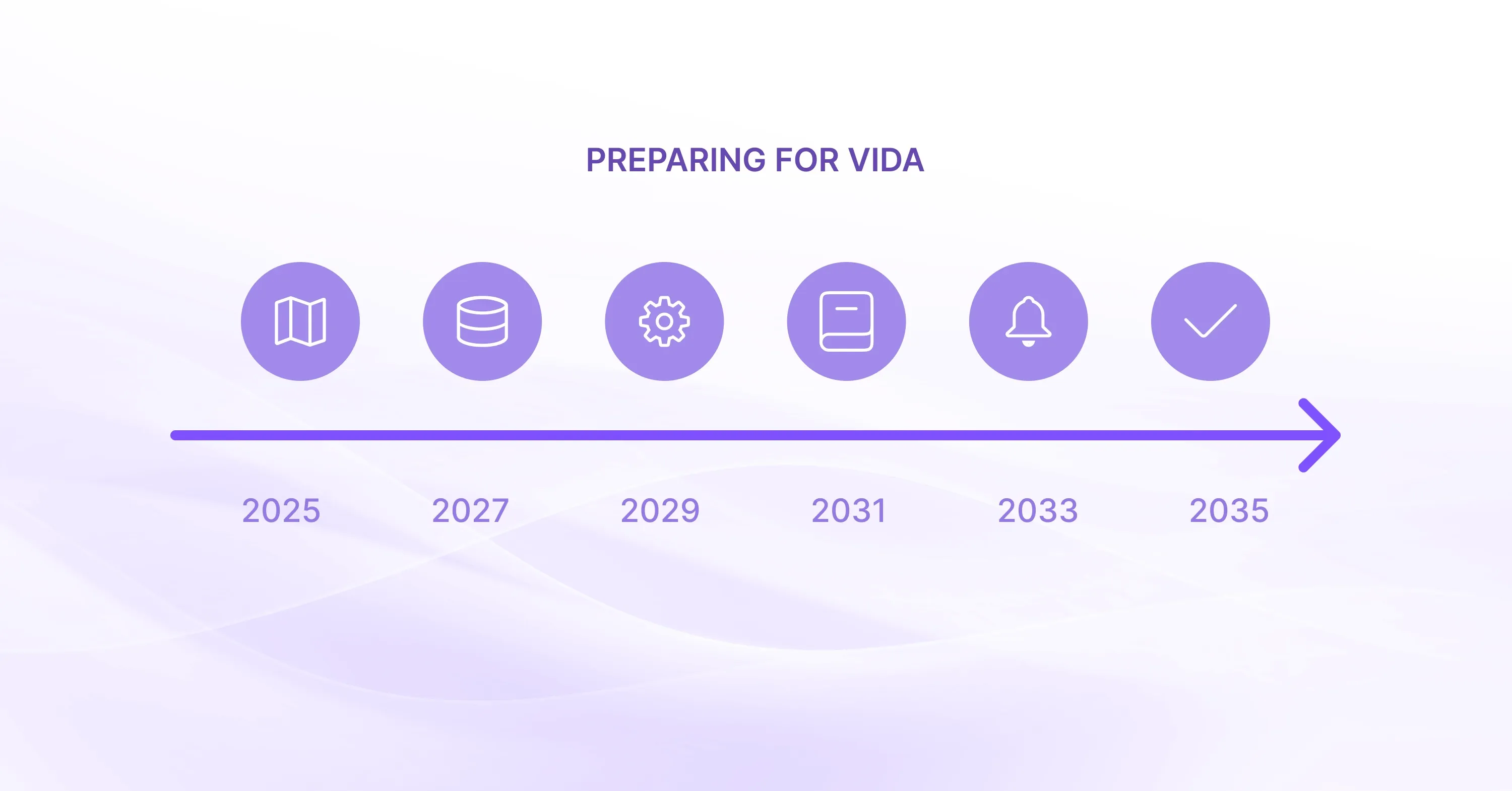
VAT in the Digital Age(ViDA) is a major VAT reform. The reform is based on the three-pillar approach. It covers the modernization of the Single VAT Registration (SVR) scheme; the E-Invoicing and Digital Reporting Requirements (DRR) mandate for B2B intra-EU transactions; and the transformation of the tax rules for the Platform Economy.
Short checklist:
- Map current invoicing flows: paper, PDF, structured.
- Identify data gaps: does your system store supply date or buyer VAT IDs for every sale?
- Follow national ViDA timelines: member states will roll out rules between 2025 and 2035, as VAT expert Mariana Príncipe notes about the staggered schedule.
- Upgrade ERP and billing tools to generate EN 16931-compliant files.
- Train staff on structured invoice validation and error handling.
- Put a monitoring calendar in place so every update from tax authorities is reviewed immediately.
Many companies choose external support to keep up with the moving pieces.
For a summary of ViDA’s business impact and guidance on what to expect, check out VAT in the Digital Age: How Could it Affect Your Business?.
Working with EU invoicing rules advisors
Specialised EU invoicing rules advisors bridge the gap between changing legislation and everyday accounting processes.
- Legislative radar: tracking every VAT decree, e-invoice schema tweak, and storage rule.
- Process design: aligning master data, accounts receivable, and accounts payable workflows with legal demands.
- Technology guidance: selecting certified service providers or PEPPOL access points.
- Cross-border coordination: translating rules into multiple languages and systems.
Global VAT compliance providers such as 1stopVAT pair automated tools with a team of 40+ certified tax specialists. Acting as a single point of contact across more than 100 countries, they help businesses register, file, and keep invoices compliant without juggling multiple local advisors.
For advice on how to evaluate and choose expert partners, including a breakdown of consultancy value versus in-house options, see VAT Compliance & Consultancy: Why Expert Advice Matters.
Key takeaway: the earlier advisors are involved, the smoother the transition to mandatory e-invoicing and the lower the risk of penalties.
What is an EU-compliant invoice ?
An EU-compliant invoice is a document, paper or electronic, that contains a unique sequential number, supplier and customer details, supply and invoice dates, accurate VAT breakdowns, and any legally required notes (such as reverse charge or margin scheme wording). From 2025 to 2035, structured e-invoices that adhere to EN 16931 will replace PDFs and paper across the Union under the VAT in the Digital Age reforms.
Conclusion
EU invoicing is shifting from static PDFs to structured, real-time data. Mandatory fields remain the backbone, but electronic formats and digital reporting are the future. Missing a field can cost money today; missing an electronic deadline could cost a market tomorrow. Whether you build in-house expertise or lean on trusted advisors, clarity, readiness, and agility will keep every invoice - and every payment - flowing.