Overview
A European VAT number is a key identifier for businesses conducting taxable activities within the European Union. It allows companies to trade across borders, apply the reverse charge mechanism in B2B transactions, and remain compliant with EU tax regulations.
In this article, you will learn:
-
What a European VAT number is and how its structure varies across EU Member States
-
Why VAT IDs are essential for cross-border trade and tax compliance
-
How to verify VAT numbers using the VIES system
-
How modern schemes like OSS and IOSS simplify VAT reporting for international sellers
-
The most common VAT compliance risks and mistakes businesses should avoid
By the end of this guide, you will have a clearer understanding of how European VAT numbers work and how to use them correctly in international trade.
Definition: European VAT Number
A European VAT number (Value Added Tax identification number) is a unique alphanumeric code assigned to businesses engaged in taxable activities within the European Union. It consists of a two-letter country code (e.g., DE, FR, IT) followed by a series of digits unique to the entity. This identifier is mandatory for cross-border trade, allowing companies to participate in the "reverse charge" mechanism and file consolidated tax returns. It serves as a primary tool for tax authorities to track economic activity and prevent fraud across Member States.
The Anatomy of a European VAT Number
Every VAT identification number tells a story about the business that holds it. While it may look like a random string of characters to the untrained eye, the format follows a strict logic determined by the European Commission and individual Member States. Understanding this structure is the first step toward recognizing valid credentials and ensuring your invoices meet legal standards.
A European VAT number always begins with a two-letter country code that identifies the Member State where the business is registered. This prefix is followed by a block of digits (and sometimes letters) unique to that specific entity. The length varies by country, ranging from as few as five characters to as many as twelve.
-
Austria: Starts with AT followed by U and 8 digits (e.g., ATU12345678)
-
Germany: Starts with DE followed by 9 digits (e.g., DE123456789)
-
Netherlands: Starts with NL followed by 9 digits, usually ending in B01 (e.g., NL123456789B01)
-
France: Starts with FR followed by a 2-digit key and the 9-digit SIREN number (e.g., FRXX123456789)
For an in-depth look at country-specific formats, logic, and ways to spot errors before they escalate, see VAT Identification Explained: What It Is & How to Use It.
The importance of this identifier cannot be overstated. In the European Union, Value Added Tax generates about one-fifth of total tax revenue, funding essential public services and infrastructure. Consequently, tax authorities monitor these numbers closely. If a business issues an invoice with an incorrect or invalid format, the receiving party may be denied the right to deduct that VAT, leading to financial penalties and strained business relationships.
Recognizing the correct format is only the beginning. Once you understand what a number should look like, you must understand how it functions within the broader tax system to facilitate trade between nations.
The Role of VAT IDs in Cross-Border Trade

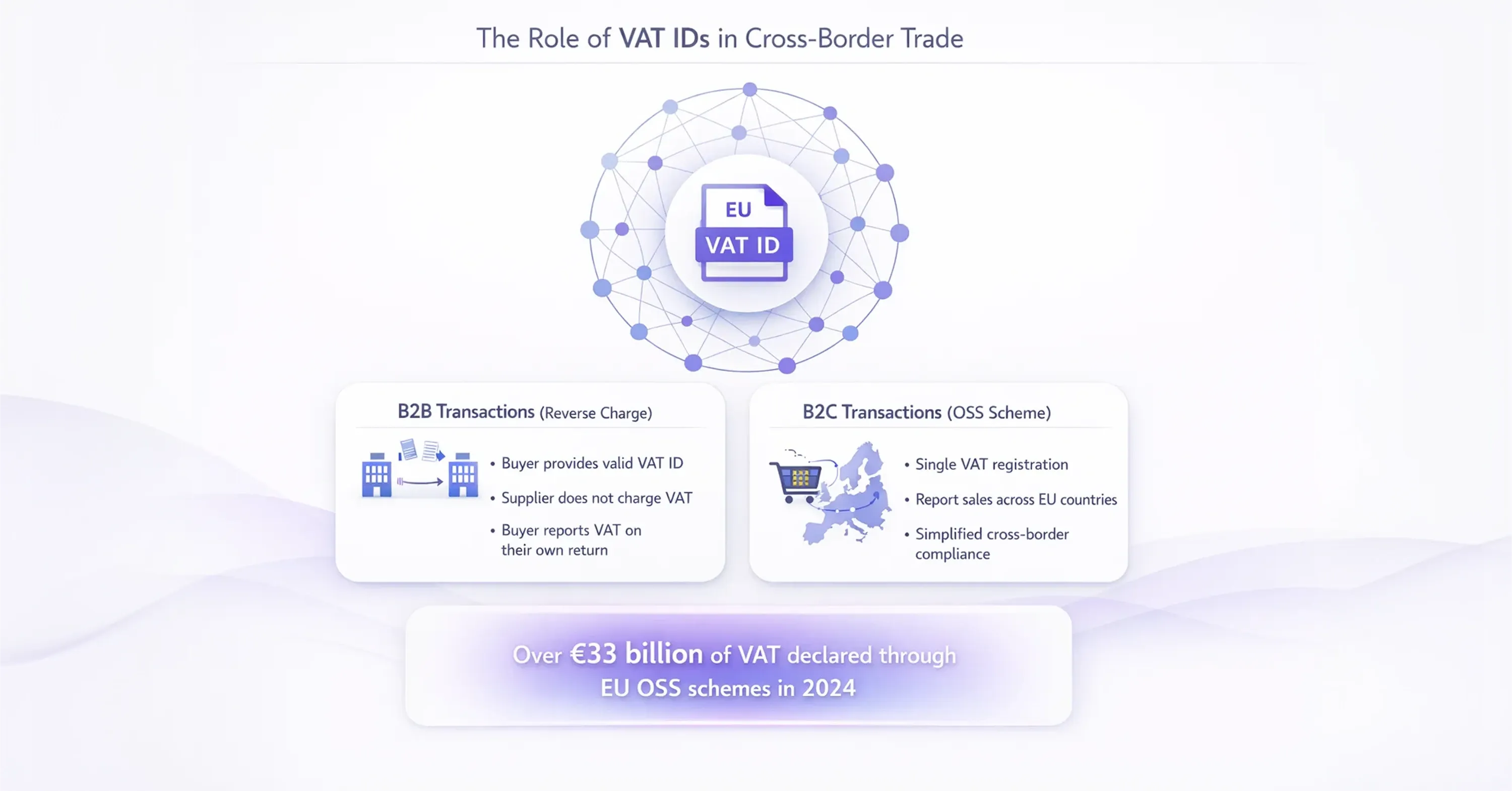
Possessing a valid EU VAT number is fundamentally about categorization. It signals to tax authorities whether a transaction is domestic, intra-Community (between two EU countries), or an export. This distinction dictates who is liable for collecting and paying the tax. For companies engaged in B2B (business-to-business) trade, the VAT number enables the "reverse charge" mechanism.
Under the reverse charge rules, a supplier does not charge VAT if the buyer provides a valid VAT number from another Member State. Instead, the buyer accounts for the VAT on their own return. This system prevents tax from cascading through the supply chain and simplifies cash flow for businesses. However, this privilege relies entirely on the validity of the buyer's registration.
The landscape for B2C (business-to-consumer) transactions has also evolved significantly. The introduction of the One Stop Shop (OSS) schemes has streamlined how companies declare sales to consumers across Europe. The volume of trade flowing through these systems is immense. In 2024 alone, EU businesses declared over €33 billion of VAT via the e-commerce One Stop Shop schemes. This centralized approach allows sellers to use a single identification number to report sales for the entire region, rather than registering in every country where a customer resides.
If you're interested in a walkthrough of OSS, IOSS, and their advantages over multiple registrations, see VAT Tax Registration: Complete Step-by-Step Guide. With such high volumes of money moving across borders, the risk of error or fraud increases. This makes the verification of your partner's tax status a non-negotiable step in any commercial agreement.
Verifying Partners Through the VIES System
Trust is essential in business, but verification is mandatory in tax compliance. The European Commission provides a centralized tool called the VAT Information Exchange System (VIES). This search engine allows anyone to check the validity of a VAT number issued by any Member State in real time.
When you enter a partner's European VAT ID into the VIES checker, the system queries the national database of the relevant country. If the number is valid, VIES returns the name and address associated with that registration. This confirmation serves as proof that you acted in "good faith" should the supplier later be found to be a missing trader or involved in fraud.
For step-by-step instructions, screenshots, and best practices when using VIES or national databases, consult How to Perform an EU VAT ID Check (VIES Guide).
The process for verification is straightforward:
-
Access the official VIES portal on the European Commission website.
-
Select the Member State of the trader you are checking.
-
Enter the VAT number without the country prefix.
-
Click "Verify" and save the result (timestamped screenshot or PDF) for your records.
This step is critical because tax fraud remains a massive drain on the EU economy. Estimates suggest that annual losses to missing-trader VAT fraud were roughly €13–33 billion between 2010 and 2023. By failing to verify a number, a business might inadvertently become part of a "carousel fraud" chain, where goods are imported VAT-free and sold with VAT that is never remitted to the government.
While VIES covers the 27 EU Member States and Northern Ireland (for goods), it does not cover non-EU countries. The United Kingdom, for instance, now operates its own independent register, requiring a different approach for verification. A practical overview of sourcing and confirming VAT IDs - including reliable methods for finding numbers on invoices, websites, or external registers - is explored in How to Find a VAT Number: Fast & Reliable Methods.
Non-EU Context: The UK and Global Sellers
Following Brexit, the United Kingdom is no longer part of the VIES system for services or domestic trade, though Northern Ireland retains a special status for goods under the protocol. For businesses trading with the UK, understanding the distinction between a "GB" VAT number and an EU VAT number is vital.
The UK market remains a powerhouse for consumption and trade. Data shows that UK total VAT receipts in 2024/25 were £171 billion, reflecting a robust commercial environment. A UK business will typically have a number starting with "GB" followed by nine digits. Verification of these numbers must be done through the UK government's specific online checker, as VIES will return an "invalid" result for GB codes.
For a deeper look at post-Brexit compliance and practical impacts on international sellers, visit End of Brexit Transition: 6 Main Changes for International Sellers.
The sheer density of the market is notable. The UK had 2,285,900 active VAT-registered traders in the 2024/25 period. For international companies selling into the UK, or UK companies selling into the EU, the requirement often involves holding multiple registrations. You might need a local registration in France to store goods there, a GB registration for sales in London, and an OSS registration for sales to consumers in Germany.
Navigating these dual regimes requires careful planning. Companies must track different thresholds, filing frequencies, and currency requirements. This complexity leads many organizations to seek specialized help to manage their portfolio of registrations.
Modern Compliance: OSS and IOSS Schemes
To reduce the administrative burden of holding multiple national VAT numbers, the EU introduced the One Stop Shop (OSS) and Import One Stop Shop (IOSS). These schemes allow businesses to register in just one Member State and declare all their pan-European sales via a single portal.
If you need a comprehensive comparison of EU VAT registration routes and what works best for your growth plan, see VAT in European Union: EU VAT Rules Explained for International Sellers.
The adoption of these simplified procedures has been rapid. By the end of 2024, over 170,000 traders had registered under the Union OSS, non-Union OSS, and Import OSS schemes. These systems are particularly valuable for e-commerce sellers importing low-value goods. In fact, VAT declared under the EU Import OSS scheme grew by 62% to €6.3 billion in 2024, proving that businesses prefer streamlined compliance over juggling dozens of local tax IDs.
However, "simplified" does not mean "simple." A business must still determine which scheme fits its model (Union vs. Non-Union), monitor turnover thresholds, and ensure data is aggregated correctly. Mismanagement here can lead to expulsion from the scheme, forcing the business back into the nightmare of registering in every single country where they have a customer.
For companies overwhelmed by the logistics of global expansion, 1StopVAT provides a comprehensive solution. Rather than relying on disparate local accountants, 1StopVAT offers a centralized team of certified tax specialists who manage registrations and filings across 100+ countries. Their approach combines necessary technology with human expertise to ensure that your use of OSS or local registrations aligns perfectly with current regulations.
Common Compliance Pitfalls and Solutions
Even with modern schemes like OSS, the "VAT Gap"—the difference between expected revenue and what is actually collected—remains a major issue for governments. The EU VAT compliance gap in 2022 was €89.3 billion, representing about 7% of total expected revenues. Authorities are closing this gap by enforcing stricter audits and penalties on businesses that make errors.
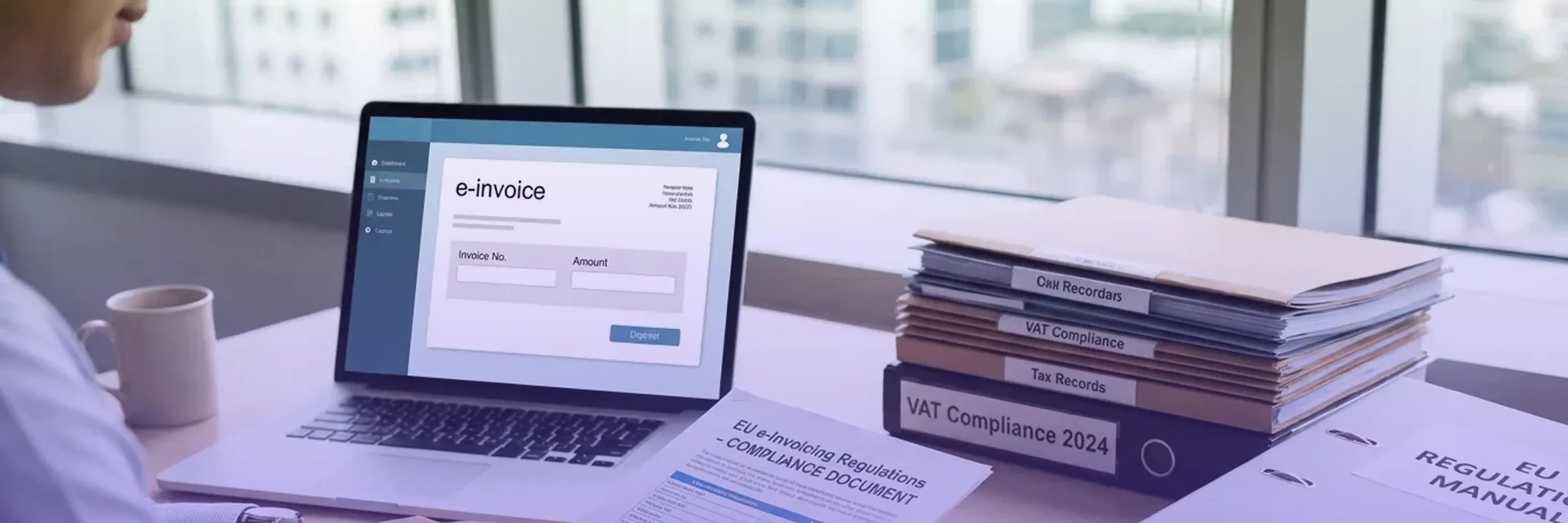
Electronic invoicing, digital recordkeeping, and knowing country-specific requirements have become crucial components of compliance. A detailed breakdown of pitfalls, including invoicing errors and missed deadlines—and how to proactively avoid them - is provided in How to Register for VAT in the EU: Step-by-Step Guide.
Common pitfalls include:
-
Incorrect Invoicing: Failing to quote the customer’s VAT number or using the wrong currency exchange rate.
-
Missing Deadlines: Each country has different filing dates (monthly, quarterly, or annual).
-
Ignoring Thresholds: Accidentally triggering a registration requirement in a new country by storing inventory there (e.g., using Amazon FBA).
The consequences of non-compliance range from heavy fines to the seizure of goods at the border. The complexity often arises when a business scales rapidly. A company might start selling only in Germany but suddenly find traction in Italy and Spain. Without a proactive strategy, they may unknowingly incur liabilities in those new jurisdictions.
For growing enterprises, partnering with a dedicated compliance firm is often safer than managing taxes in-house. 1StopVAT acts as a single point of contact for these expanding businesses, handling the intricate details of VAT registration and filing. Their team ensures that as you scale, your tax infrastructure scales with you, preventing the compliance gap from becoming a barrier to your success.
Conclusion
The European VAT number is more than just a requirement for paperwork; it is the passport for goods and services traveling across the EU single market. From the specific format of the ID to the daily necessity of verifying partners via VIES, understanding these elements protects your business from fraud and financial penalties.
As cross-border trade continues to grow, with billions of euros declared annually through streamlined systems like OSS, the mechanisms for compliance will likely become even more integrated. However, the fundamental responsibility remains with the trader to verify, report, and pay correctly. By maintaining rigorous verification standards and seeking expert support when operations become complex, businesses can navigate the European tax landscape with confidence and stability.