

Overview
YIn this guide, you will learn the definition and legal role of a VAT identification number (VAT ID), the real-world reasons companies cannot operate without a valid ID, and the standard format elements and country prefixes you are likely to encounter. It also explains practical tools for finding and verifying VAT IDs, highlights common pitfalls, and shows how to use your VAT identification correctly in contracts, e-commerce listings, and VAT returns. By the end, you will be able to recognise a valid VAT ID at a glance and know exactly when to quote it, helping protect both your compliance position and cash flow.
What Is a VAT Identification Number?
AA VAT identification number is a unique, country-specific code assigned by a tax authority to a business that is registered for Value Added Tax. It confirms that the company is authorised to charge VAT on taxable supplies, reclaim input VAT on eligible expenses, and participate in cross-border trade without being taxed twice on the same transaction. In practice, the VAT ID links all of a business’s VAT-related activities – invoicing, reporting, and payments – to a single official record in the national tax system, allowing authorities and trading partners to verify compliance quickly and accurately.
Understanding VAT Identification Numbers
Most taxes stay hidden, but VAT is visible on every sales invoice. Governments therefore require a public identifier so counterparties, customs, and tax offices can track who charges and remits the tax. That identifier is commonly called:
- VAT identification number (formal term in EU legislation)
- VAT ID (everyday shorthand)
- VAT registration number (in the UK and several non-EU states)
Although the labels vary, the function is identical: it links all your transactions to a single record inside the national VAT database.
A quick example brings the point home. A German software company sells a licence to a French customer. If the German supplier quotes its DE VAT ID, the buyer self-accounts for VAT under the reverse charge, and no German tax is due. Without the ID, the invoice is incorrect, and the supplier risks penalties plus back-tax.
That simple illustration shows why VAT identification is more than paperwork. It is your licence to trade internationally.
Wrapping up, remember that a VAT identification number is mandatory once turnover surpasses the local registration threshold or if you store goods abroad, yet some businesses register voluntarily to reclaim input VAT. The next section details why getting the ID early can be a strategic advantage.
Why Your VAT ID Matters
Receiving an ID may feel bureaucratic, but the economic stakes are high. VAT funds public budgets: the tax raises over €1 trillion every year across the EU. Tax authorities therefore watch compliance closely.
Businesses benefit from a valid VAT identification because it:
- Legally authorises them to add VAT to invoices, preventing under-charging
- Allows deduction of input VAT on costs, improving cash flow
- Signals to customers and marketplaces that the seller is compliant, increasing trust
- Unlocks reverse-charge mechanisms that avoid double taxation in B2B trade
- Enables access to special schemes such as the OSS or IOSS, which collected €24 billion of VAT via the Union OSS alone in 2024
Conversely, operating without the correct ID exposes you to assessments. The EU VAT compliance gap still stood at €128 billion in 2023, and authorities are tightening audits to close it.
To go deeper on the subject, see What is a VAT number and how to verify it – a guide that details the functions, formats, and compliance risks in multiple jurisdictions.
Smoothly moving from risk to structure, let us inspect what the code actually looks like.
How VAT Identification Numbers Are Structured
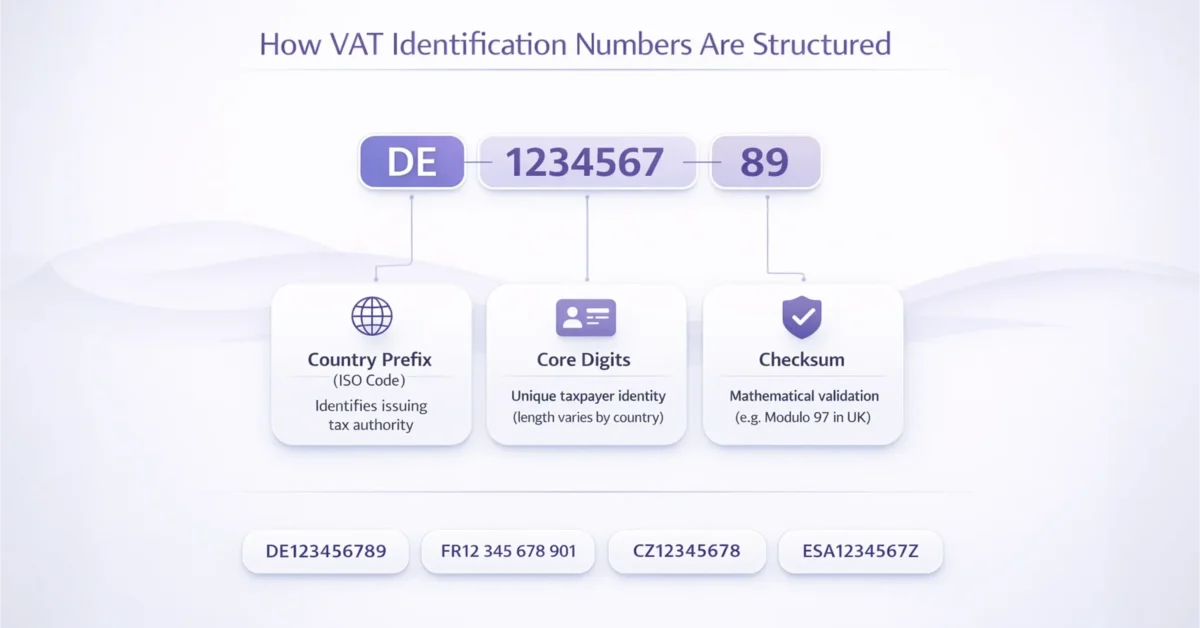
A VAT number is never random. Each element tells a story that computers and auditors can read instantly.
Country prefix
Every ID starts with a two-letter ISO country code, for example:
- DE for Germany
- FR for France
- GB for the United Kingdom
The prefix flags the tax authority that issued the number. It also determines which rules apply when you sell to other EU states.
Core digits or letters
After the prefix, you see between 2 and 12 characters. The length and pattern differ by country:
- Germany: 9 digits (DE123456789)
- France: 2 checksums plus 9 SIREN digits (FR12 345 678 901)
- Czech Republic: 8, 9, or 10 digits, depending on entity type
Some countries include letters inside the numeric string; Spain adds a letter at both the start and end (ESA1234567Z).
Checksum logic
Most tax authorities build a mathematical checksum into the ID. The checksum confirms the preceding digits were not mistyped. For instance, the UK’s HMRC uses modulo 97 calculations on the core digits. If the maths fails, the number is invalid even if it has the correct length.
Putting it together, the full VAT identification number functions as a miniature passport: prefix equals nationality, body equals identity, checksum equals authenticity.
Before leaving structure, note an important nuance: IDs issued under the EU One-Stop Shop carry the same local format, but you still submit OSS returns centrally. A provider such as 1StopVat can register your company in the OSS scheme while you keep only one VAT ID per region, reducing administrative overhead.
Now that you know the anatomy, the next logical step is learning where to find and verify these numbers.
Where to Find and Verify VAT IDs
Businesses frequently need to collect supplier or customer VAT IDs. Getting it wrong can cost money, so reliable sources are essential.
- Official tax correspondence: Look at the registration certificate sent by the tax authority.
- Online business registers: Many countries publish VAT IDs on public company profiles.
- VIES (VAT Information Exchange System): The European Commission’s free tool validates EU numbers in real time.
- National portals: The UK’s “Check a UK VAT number” service confirms GB numbers that are not in VIES post-Brexit.
- Third-party compliance firms: When operating across many jurisdictions, a specialist such as 1StopVat cross-checks IDs and registration statuses in over 100 countries, sparing finance teams the manual work.
For practical methods and visual step-by-step instructions, check How to Find a VAT Number: Fast & Reliable Methods, which details sources like invoices, websites, and online registers.
A Polish retailer buys stock from a Czech wholesaler. Before applying the zero-rate intra-community supply, the retailer enters the wholesaler’s CZ VAT ID into VIES. The system returns “valid,” so the retailer exports VAT-free and records the customer’s ID in the EC Sales List. Ten seconds of checking prevent a potential 23 percent VAT assessment.
Remember, validation should be documented. Download or screenshot the confirmation page. Auditors may request proof that you verified the ID on the transaction date.
With verification covered, let us explore the everyday situations when you must quote or request the number.
Using Your VAT Identification Number in Daily Business
Your VAT ID is not a trophy on the office wall; it is an active tool.
Invoicing and contracts
Always print your VAT identification on invoices, credit notes, and long-term service contracts. EU Directive 2010/45/EU makes it mandatory in B2B transactions across borders. If either party’s ID is missing, the buyer cannot reverse charge, and the seller might have to charge local VAT.
For advanced guidance on compliant sales documentation and common pitfalls, consider the Leading Advisors on EU Invoicing Rules: Stay Compliant resource.
Customs declarations
E-commerce sellers shipping DDP (Delivered Duty Paid) must include the importer’s VAT ID on electronic customs forms. Failure to do so can trigger payment of import VAT twice: once on import and again on the domestic sale.
VAT returns and OSS/IOSS filings
Input and output VAT are reported under your own ID. For businesses using the OSS, sales in all 27 EU states are filed under a single VAT identification number, which helped collect €88 billion since mid-2021. The ID appears on the OSS return and banking reference so Member States can allocate the tax correctly.
Marketplace accounts and payment processors
Platforms like Amazon or Shopify often suspend listings until a valid VAT ID is provided. This protects them from being classed as the “deemed supplier,” liable for uncollected tax. If you want an actionable summary of marketplace requirements and OSS registration thresholds, visit Marketplace VAT Obligations for Online Sellers: What You Need to Know.
Internal controls
Finance teams should:
- Match VAT IDs against legal entity names in the vendor master file
- Set flags that block invoice posting if the supplier’s ID is invalid
- Record the date and method of verification for audit readiness
Those processes reduce exposure to the EU compliance gap, which still totals 9.5 percent of theoretical VAT liability.
For a full playbook on automating VAT controls and minimizing late-night corrections, see VAT Reporting Made Simple: Best Practices for Businesses. By integrating your VAT identification into daily workflows, you avoid late-night corrections and costly penalties.
Conclusion
A VAT identification number is far more than a bureaucratic label; it is the passport that enables your business to charge, report, and reclaim one of the world’s largest sources of government revenue. Used correctly, it confirms your legitimacy to customers, marketplaces, customs authorities, and tax administrations while helping prevent rejected payments, penalties, and compliance risks. Understanding its structure, verifying it for every transaction, and displaying it consistently on official documents protects both your cash flow and your ability to trade across borders smoothly. When operations span multiple jurisdictions, a specialist partner such as 1StopVat can centralise registrations and compliance, allowing your team to focus on growth rather than complex tax administration.
Frequently asked questions
The VAT identification number is a type of TIN, but not all TINs are VAT numbers. A TIN can identify income tax liabilities, whereas a VAT ID specifically covers Value Added Tax obligations.
Yes, once their taxable turnover exceeds the national VAT threshold, sole traders must register and receive a VAT identification number. Many register voluntarily to reclaim input VAT on startup costs.
Processing time varies. In the UK it is usually two to four weeks, while in Italy it can extend to six weeks due to additional anti-fraud checks. Using a cross-border compliance provider can speed up document preparation.
No. Each legal entity receives its own unique number. Sharing or reusing another business’s VAT ID is illegal and can lead to fraud investigations.
Tax authorities may deny the buyer’s input VAT deduction and impose penalties on the seller for issuing an incorrect invoice. Always validate the number before booking the invoice.