Two people reviewing financial charts and graphs on paper with a laptop and calculator on the table

Digital Services VAT Compliance: What You Need to Know

Selling software, streaming media, or any other online service across borders? Value-Added Tax (VAT) rules now follow you wherever your customers click. Misstep once and penalties can snowball. This hands-on guide shows you how to master digital services VAT compliance without losing sleep.

Content authorBy Rūta ŠvobienėPublished onReading time7 min read

Overview

We will untangle VAT obligations for software-as-a-service (SaaS), apps, e-books, and other electronic services sold to consumers.

You will learn:

  • How VAT works for digital products and why SaaS VAT rules differ from physical goods
  • The €10,000 single EU threshold that triggers registration
  • How the One-Stop Shop (OSS) and Import OSS schemes simplify cross-border reporting
  • Mandatory invoice elements, record-keeping tactics, and filing timelines
  • Tips for avoiding common electronic service tax compliance errors and when to call in outside expertise

By the end, you will know your next concrete steps to stay compliant and keep revenue flowing.

Step 1: Grasp the VAT Basics for Digital Services

Every solid tax strategy starts with fundamentals. VAT is a consumption tax collected where the customer consumes the service, not where your company is based.

Digital services cover:

  • SaaS subscriptions, cloud storage, and platform fees
  • Streaming music and video, gaming add-ons, e-books
  • Downloadable software, mobile apps, and online courses

If you supply any of these to non-business customers in another country, VAT usually applies in that customer’s location. That principle sits at the heart of both EU and many non-EU regimes.

SaaS VAT rules depart from those for tangible goods. You rarely need a warehouse or customs broker, but you do need:

  • Correct place-of-supply determination through IP, billing address, or bank location
  • Local tax rates, which in the EU range from 17% to 27%
  • Evidence files proving the customer’s country for 10 years

Understanding these cornerstones now saves painful corrections later. For a deep dive on these essentials and region-specific cases, see VAT Compliance for SaaS and Digital Services in the EU.

Step 2: Check Thresholds and the Place-of-Supply Test

Before you rush to register, confirm whether your sales volume passes each jurisdiction’s threshold. In the EU, the VAT e-commerce reform set a €10,000 single threshold. Once your total annual B2C digital sales to all EU countries exceed that figure, you must charge VAT at the customer’s local rate.

Outside the EU, thresholds vary:

  • United Kingdom: no threshold, VAT applies from the first sale
  • Australia: AUD 75,000 in 12 months
  • New Zealand: NZD 60,000 in 12 months
  • Norway: NOK 50,000 in 12 months

In parallel, apply the place-of-supply test:

  1. Collect at least two pieces of non-conflicting evidence of customer location (IP, billing, bank).
  2. If evidence clashes, seek a third data point to break the tie.
  3. Archive all proof for audit review.

A clear understanding of thresholds and location rules lets you register on time and avoid late-filing surcharges.

Step 3: Register Through the EU OSS or IOSS

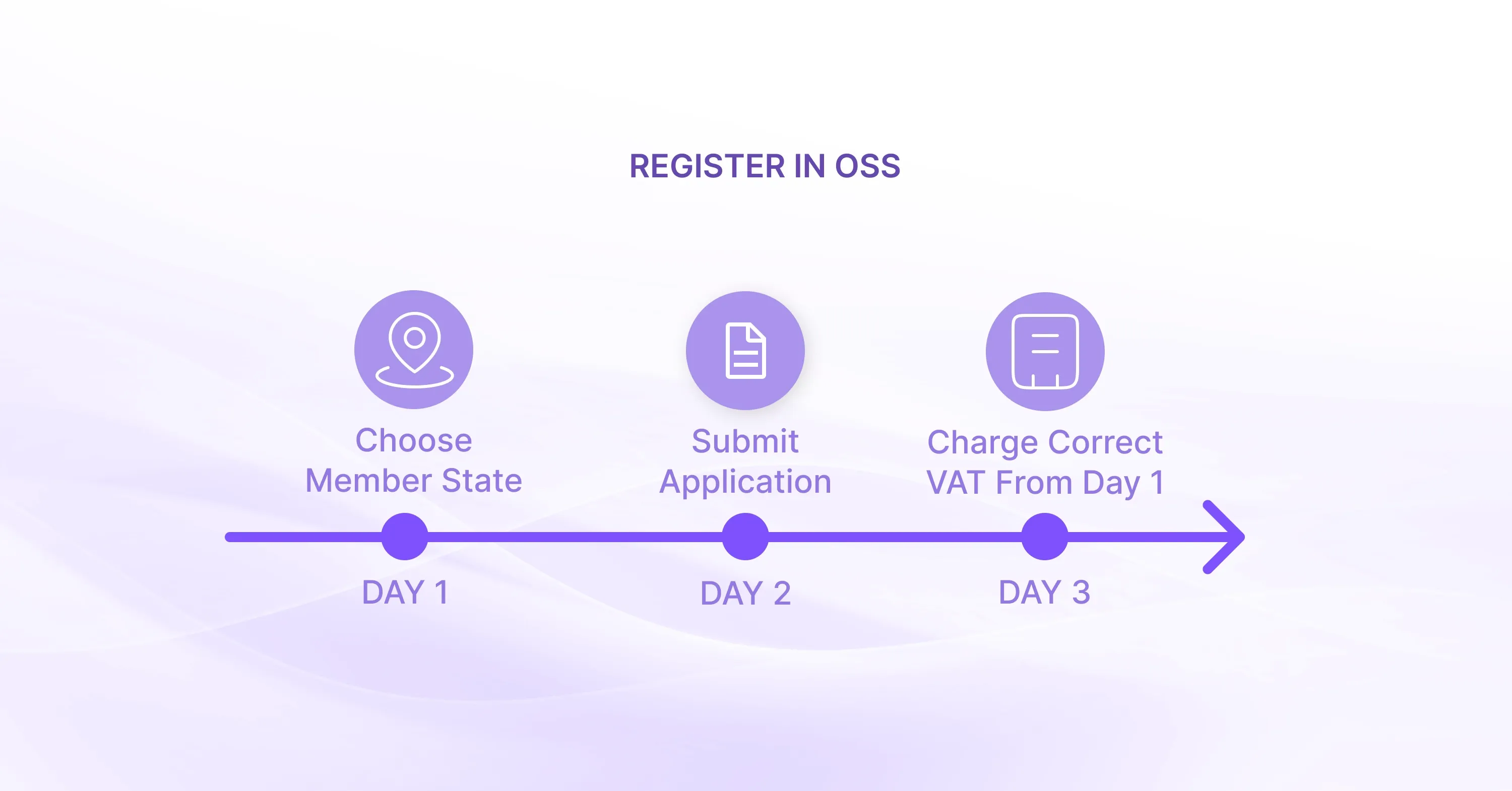
Four-step registration diagram with purple numbered steps and arrows Once you exceed the EU threshold or decide to charge VAT voluntarily, the OSS scheme becomes your best friend. You register once in a single EU Member State, file one quarterly return, and authorities distribute the tax to each country.

Key steps:

  • Choose a “Member State of identification,” usually your home base or a country where you have a fixed establishment.
  • Submit an electronic application on that state’s portal. Registration is typically approved within 10 days.
  • Collect and charge VAT at the correct rate on every B2C invoice from day 1 of registration.

Why bother? Member States collected over €33 billion in VAT through OSS/IOSS in 2024. More than 170,000 businesses now rely on the system, proving its value for SaaS providers that sell across borders. Explore how OSS/IOSS changes the practical steps for sellers with Marketplace VAT Obligations for Online Sellers: What You Need to Know.

Conclude this step by adding OSS filing dates - last day of the month after each quarter - to your finance calendar. For scenarios where expert help might improve efficiency or decision-making, read VAT Compliance & Consultancy: Why Expert Advice Matters.

Step 4: Issue Compliant Invoices

Most Member States don’t require digital service providers to issue structured tax invoices with mandatory content for B2C transactions. In most cases, providers of digital services issue a PDF or another form of e-sales receipt as proof of the transaction. This primarily serves as confirmation of the successful conclusion of the e-contract.

The EU VAT Directive mandates minimum content requirements for tax invoices and sales receipts. However, Member States may modify these requirements within the permitted framework. In some countries, e-invoicing may be mandatory for B2B transactions - and in certain cases, for B2C transactions as well.

Generic sales receipt content for EU B2C ESS sales:

  • Supplier’s full legal name, address, and VAT number
  • Customer information
  • Invoice date and sequential number
  • Description of the digital service supplied
  • VAT rate applied and the VAT amount
  • Total amount
  • OSS reference if issued under the special scheme

Finish each billing cycle by reconciling invoice totals with payment processor reports to quickly detect any rate miscalculations.

Step 5: File and Pay VAT Accurately

Electronic service tax compliance hinges on timely returns. Missing a deadline can bring interest and reputational damage.

Filing frequency and deadlines

  • OSS: quarterly, due by the end of the month following the reporting quarter
  • Union Member States outside OSS: monthly or quarterly
  • Non-EU countries:
  • Japan: monthly, quarterly, or yearly
  • South Africa: bimonthly or monthly

Learn more about digital filing, automation, and country-specific requirements in How to File VAT Returns Online: Streamlining Digital Submission.

Practical reporting tips

  • Automate data extraction from payment gateways into a VAT report template.
  • Double-check the currency conversion rate used on the day of supply.
  • Pay via SEPA or local tax authority’s portal to avoid bank fees.

EU Member States lost about €89 billion in VAT in 2022, roughly 7% of revenue. Closing that gap is a political priority, so expect stricter audits. Getting your returns right the first time keeps you off the radar.

Step 6: Maintain Records and Stay Audit Ready

Auditors can request transaction evidence up to ten years after the sale. Prepare now rather than scramble later.

  • Store invoices, payment receipts, and location evidence in a secure archive.
  • Use a consistent file naming convention: YYYY-MM client-name invoice-number.
  • Review VAT codes in your billing system quarterly to catch rate changes.
  • Document your place-of-supply logic and any manual overrides.

Keep an eye on rate updates and legislative changes. Globally, 101 countries now tax cross-border online sales. A quick internal checklist review every six months prevents surprises.

Step 7: Know When to Seek Expert Help

Rapid expansion can stretch an in-house finance team thin. A specialist firm such as 1stopVAT, with over 40 certified tax advisers covering 100-plus countries, can handle VAT registration, ongoing compliance, and complex advisory while you focus on product growth. Whether you need a second opinion on OSS filings or a full outsourced solution, external guidance often costs less than one major penalty.

For tips on weighing in-house work vs. outsourcing - and the specific value a VAT specialist can deliver - refer to VAT Compliance & Consultancy: Why Expert Advice Matters.

A final thought before moving on: Engage experts early if you plan to enter multiple new markets in one quarter, launch marketplace sales, or change your business model from licensing to subscription.

Digital services VAT compliance means charging the correct VAT rate where the customer is located, registering through schemes like the EU One-Stop Shop once you pass the €10 000 threshold, issuing invoices with mandatory details, filing returns on time, and storing records for up to ten years.

Conclusion

VAT rules for digital services evolve quickly, but a structured approach keeps you compliant. Confirm thresholds, register through schemes like OSS, issue accurate invoices, file on time, and archive everything. When resources tighten, consider partnering with experienced advisers such as 1stopVAT. Follow these steps and you can expand globally while keeping VAT headaches to a minimum.

No. Once your cross-border B2C digital sales exceed €10 000 annually, you can register in a single EU state and use the OSS scheme to report VAT due for all Member States.

The VAT rate is the standard rate of the customer’s country unless that nation offers a reduced rate for digital services. You must monitor rate changes and apply them from the effective date.

OSS returns are filed quarterly. The return and payment are due by the last day of the month following each quarter.

In some cases, yes. For low-value imported goods or services sold through EU marketplaces, the platform may be the deemed supplier. You then exclude those sales from your own OSS return but must keep evidence of the marketplace’s responsibility.

Keep invoices, payment confirmations, customer location evidence, VAT calculation logs, and correspondence with tax authorities for at least ten years. Digital backups with clear file naming help auditors trace each sale quickly.

Simple Compliance

Free consultation with 1StopVAT experts

You Might Also Like

Discover more insights and articles

A clean flat-lay image showing tax analysis documents, a calculator, and a tablet displaying financial charts, representing modern tax planning and financial reporting

Handling VAT for Digital Services: A Practical Guide

Selling digital products offers an incredible opportunity to scale a business globally without the logistics of shipping physical goods. However, once you cross borders, tax obligations follow you. Learninghow to handle VAT for digital servicesis no longer just a task for large corporations; it is a fundamental requirement for any creator, developer, or SaaS company selling internationally.

The rules for taxing electronic services differ significantly from physical goods, often shifting the tax liability from the seller's location to the customer's location. This guide provides a clear pathway through the regulations, helping you identify your obligations, register correctly, and manage ongoing compliance without disrupting your operations.

A professional workspace showing hands calculating taxes with a calculator, laptop, notebook, and printed tax documents, illustrating business tax planning and financial analysis

Steps to register for sales tax in the US

Every business that ships products or provides taxable services across state lines eventually hits the same wall: you must collect and remit sales tax or risk fines and retroactive assessments. The rules vary by state, but the registration sequence follows a recognizable pattern. This guide walks you through that sequence, flagging the biggest pitfalls and shortcuts, so you spend less time wrestling with bureaucracy and more time selling.

Running a company already devours time. U.S. taxpayers as a whole will spend**7.9 billion hours and $546 billion in compliance costs**this year. Following the steps below will keep your share of those hours from spiraling.

Business professional analyzing tax compliance and financial obligations through a magnifying glass with digital tax and accounting icons

Leading Advisors on EU Invoicing Rules: Stay Compliant

Businesses selling in Europe cannot afford invoicing errors. One missing field or late transmission can trigger penalties, audits, or even shipment holds at the border. That pressure explains why so many companies now turn to leading advisors on EU invoicing rules to interpret fast-moving legislation and design frictionless processes.

EU rules evolve quickly and differ country by country. This article explains what the directives actually demand, shows how advisors reduce risk, ranks the most trusted firms, illustrates typical mistakes, and ends with a hands-on checklist your finance team can start using today.

Business executives shaking hands during a corporate meeting, symbolizing partnership, trust, and business growth strategy

What is a VAT number and how to verify it

A mistyped VAT number looks like a small error but it can freeze cross-border shipments, delay refunds, and trigger tax audits. Understanding what a VAT number is, how it is structured, and how to verify it keeps sales flowing and penalties at bay.

A single narrative runs through this guide: by the time you reach the last paragraph, you will know exactly why VAT numbers matter, what they look like in different countries, and the fastest ways to confirm that any number you receive is valid.