Business professional reviewing VAT compliance documents and tax paperwork at a desk with a laptop displaying financial analytics and reporting dashboards

Ecommerce Seller VAT Compliance Guide

Selling across borders sounds exciting until the tax obligations start piling up. For every e-commerce seller expanding into new markets, VAT compliance is the invisible hurdle that can trigger fines, blocked shipments, and even marketplace account suspensions.

Content authorBy Donatas StasytisPublished onReading time9 min read

What This Guide Covers

This guide walks you through the core VAT compliance challenges facing online sellers and lays out the reporting obligations you need to meet. You'll learn how to determine where you're liable, what marketplace VAT rules mean for your business, and how to set up a reliable filing process. By the end, you'll have a clear, step-by-step path from confusion to compliance.

Understand Why VAT Compliance Matters for Online Sellers

Before tackling registration or filing, it helps to grasp why VAT is such a headache for ecommerce specifically. Unlike brick-and-mortar retail, online sales cross jurisdictions constantly, and each jurisdiction has its own rules, rates, and thresholds.

The EU alone collects roughly €1 trillion in VAT revenue annually, making it the single largest source of consumption tax income for member states. Governments are paying close attention to online business tax gaps, and enforcement is tightening fast.

Here's what makes ecommerce VAT different from traditional retail:

  • Multi-country exposure: A single Shopify or Amazon store can trigger obligations in dozens of countries simultaneously.

  • Frequent rule changes: The EU's 2021 OSS reform, the UK's post-Brexit VAT shift, and new digital services taxes across Southeast Asia all changed the landscape in just a few years.

  • Platform liability: Many marketplaces now collect VAT on your behalf, but that doesn't eliminate your own reporting duties.

Missing a filing deadline or registering late doesn't just cost money. In some EU states, late VAT registration penalties can reach €10,000 or more, depending on the duration of non-compliance. Understanding the stakes is the first step toward building a system that keeps you safe.

Determine Where You Have VAT Obligations

The biggest question every ecommerce seller faces is simple: where do I actually owe VAT? The answer depends on where your customers are, where your inventory is stored, and which country's threshold rules apply.

Threshold Rules and Distance Selling

In the EU, the introduction of the One Stop Shop (OSS) system set a unified €10,000 cross-border distance selling threshold. Once your total EU cross-border B2C sales exceed that amount, you must charge VAT at the rate of the customer's country. Before OSS, each member state had its own threshold, some as low as €35,000 and others as high as €100,000.

For a more comprehensive checklist to understand if you need to register, refer to the VAT Compliance Checklist for Startups and Small Businesses. This resource also explains how cross-border sales, inventory storage, and registration triggers vary by jurisdiction.

Outside the EU, thresholds vary wildly. The UK requires VAT registration once taxable turnover exceeds £90,000. Norway, Switzerland, and other non-EU European countries each maintain separate rules.

Inventory Storage Creates Obligations

If you use Fulfillment by Amazon (FBA) or a third-party logistics provider that stores your goods in another country, you likely have a VAT obligation there, regardless of sales volume. For example, a US-based seller storing inventory in a German warehouse must register for German VAT even if most sales go to French customers.

Key factors that trigger VAT registration:

  • Exceeding the distance selling threshold in a country

  • Storing inventory in a foreign warehouse

  • Importing goods into a country for resale

  • Selling digital services to consumers in certain jurisdictions

Mapping these triggers against your actual operations is essential. Without it, you're guessing, and guessing leads to gaps that tax authorities are increasingly good at finding.

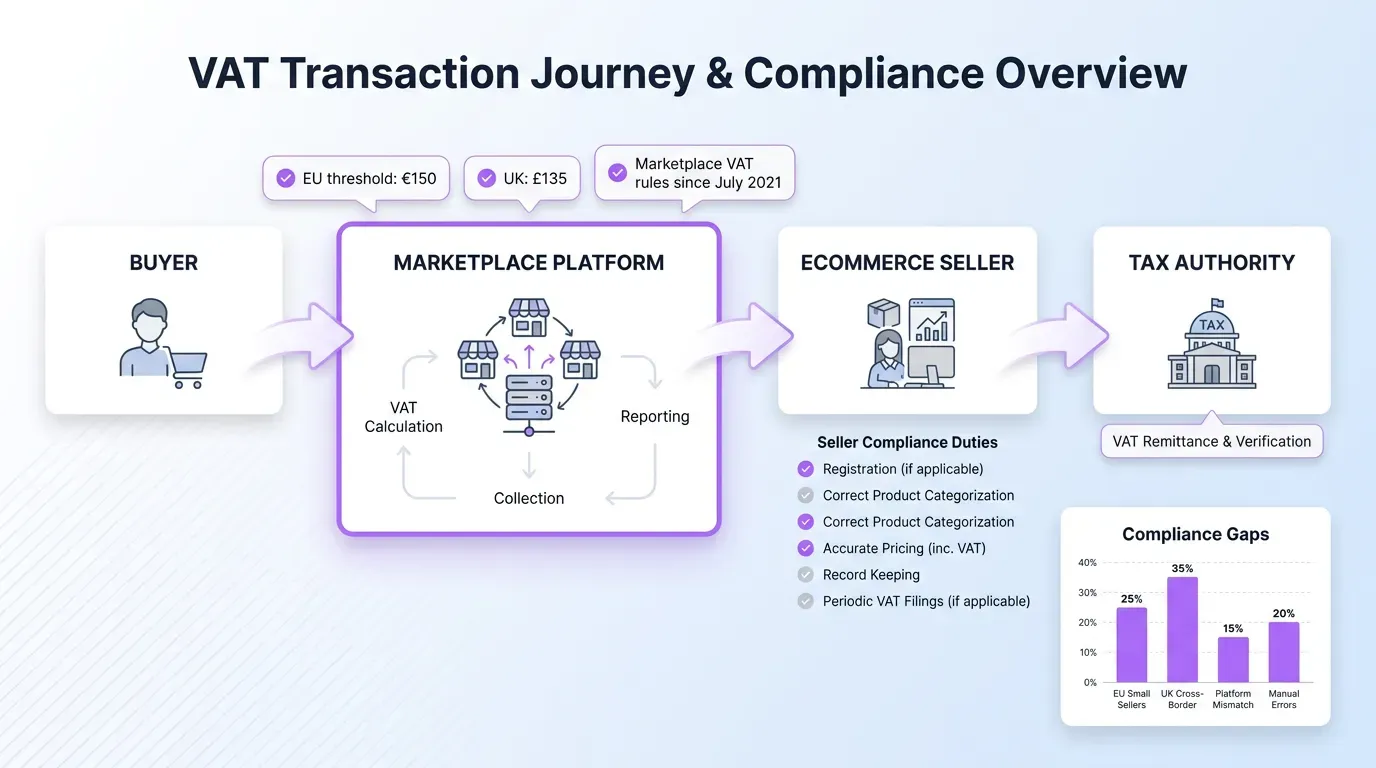
Navigate Marketplace VAT Rules

Modern SaaS infographic illustrating the VAT transaction journey from buyer to tax authority, with clear labels and compliance checklist.

Most ecommerce sellers rely on platforms like Amazon, eBay, or Etsy. These marketplaces have become de facto tax collectors in many regions, but the rules around their role are nuanced and sometimes misunderstood.

When the Marketplace Collects VAT for You

Since July 2021, EU marketplace VAT rules require platforms to collect and remit VAT on:

  • Sales of goods imported into the EU with a value up to €150

  • Sales by non-EU sellers to EU consumers, regardless of value

The UK has a similar deemed supplier model for goods valued up to £135. This means the marketplace charges VAT at checkout and sends it directly to the tax authority.

A full checklist of platform and seller obligations, plus more real-world scenarios, can be found at Marketplace VAT Obligations for Online Sellers: What You Need to Know.

What the Marketplace Doesn't Handle

Even when a platform collects VAT, the ecommerce seller still has obligations.

You may need to:

  • File nil or reduced VAT returns in countries where you're registered

  • Account for B2B transactions the marketplace doesn't cover

  • Report intra-community movements of stock between warehouses

  • Maintain records that reconcile marketplace reports with your own accounting

A common mistake is assuming that because Amazon collected VAT, there's nothing left to do. In reality, marketplace sellers in the EU still face compliance gaps when stock moves between countries or B2B sales occur outside the platform's collection scope.

This is where the complexity justifies expert support. 1stopVAT, for instance, acts as a single point of contact for marketplace sellers who need VAT registration and filing across multiple countries. With a team of over 40 certified tax specialists covering 100+ countries, they handle the cross-border reporting that platforms don't manage on your behalf.

Set Up Your VAT Registration Process

Once you've identified where you're liable, the next step is getting registered. Each country has its own process, and some are notoriously slow.

Registration Timelines and Requirements

  • Germany: Requires a fiscal representative for non-EU sellers; processing can take 8 to 12 weeks.

  • France: Online registration available; typically 4 to 6 weeks.

  • UK: HMRC processes applications in roughly 4 weeks, though delays are common.

  • Italy: Often requires a fiscal representative and can take 6 to 10 weeks.

Documents you'll generally need:

  • Certificate of incorporation or business registration

  • Proof of economic activity (invoices, contracts, marketplace seller account details)

  • Bank account information

  • Director or owner identification

  • Power of attorney if using a tax agent

For a detailed online process and to avoid the most common registration pitfalls, consult VAT Registration Online: Quick & Easy Setup Guide, which addresses both local and multi-country scenarios.

Starting the registration process early, ideally before you begin selling or storing goods in a new country, prevents the retroactive headaches that come with late registration.

Build a Consistent Online Business Tax Reporting Routine

Having a VAT number is only the beginning. The real ongoing work is accurate, timely reporting. Missing a filing deadline or submitting incorrect figures triggers penalties and, in some cases, interest charges that compound monthly.

Most EU countries require either monthly or quarterly VAT returns. Some, like Germany, require monthly preliminary returns plus an annual reconciliation. The UK operates on a quarterly cycle for most businesses.

A reliable reporting routine includes:

  • Reconciling marketplace settlement reports with your own records monthly

  • Tracking intra-EU stock movements and reporting them on EC Sales Lists or Intrastat declarations

  • Filing returns on time in every country where you hold a VAT number

  • Keeping digital records for the statutory retention period, usually 7 to 10 years

If you're selling on multiple channels or across several countries, managing VAT obligations internally can quickly get overwhelming. For efficient techniques and real-world checklists, see How Do I Stay VAT Compliant When Selling in Multiple Countries?.

How Multi-Country VAT Reporting Becomes Operationally Complex

Consider a UK-based seller using Amazon FBA with inventory stored in Germany, Poland, and the Czech Republic. Each quarter, they file a UK VAT return, three separate EU VAT returns, and an OSS return for cross-border sales handled outside Amazon's deemed supplier rules. That's five filings per quarter, each with different formats and deadlines. Without a structured process, errors are almost inevitable.

This is exactly the kind of multi-country complexity that firms like 1stopVAT are built to manage, combining automated tools with human expertise to keep filings accurate across every jurisdiction.

Prepare for Audits and Stay Compliant Long-Term

VAT compliance isn't a one-time project. Tax authorities are investing in data-matching tools that cross-reference marketplace data with seller filings. The EU's Transaction Network Analysis system is designed to detect VAT fraud patterns across borders in real time.

To stay audit-ready:

  • Maintain clear records that link every transaction to the correct VAT treatment

  • Keep copies of all marketplace reports, invoices, and shipping documents

  • Review your VAT positions whenever you add a new warehouse location or marketplace

  • Update registrations promptly if your business structure changes

Sellers who treat online business tax as an ongoing discipline rather than an annual chore are far less likely to face penalties or disruptions.

VAT compliance for ecommerce sellers involves registering in every country where you store goods or exceed sales thresholds, filing periodic returns that match marketplace and internal records, and maintaining documentation for 7 to 10 years to satisfy audit requirements.

Conclusion

VAT compliance for an ecommerce seller is no longer a side task that can be handled reactively once sales start growing. The moment your business expands across borders, stores inventory internationally, or sells through multiple marketplaces, tax compliance becomes part of your operational infrastructure. The challenge is not just registering for VAT or filing returns on time. It's maintaining visibility across every jurisdiction where obligations arise, reconciling marketplace data accurately, and adapting quickly as regulations evolve. Marketplace VAT rules may reduce part of the burden, but they rarely eliminate the seller's own reporting responsibilities entirely. The businesses that scale internationally successfully are usually the ones that treat online business tax as an ongoing operational discipline rather than a once-a-quarter administrative task. They build structured compliance processes early, before new countries, warehouses, and sales channels create complexity faster than internal teams can manage.

For ecommerce sellers operating across multiple jurisdictions, proactive VAT management is no longer just about avoiding penalties. It's about protecting cash flow, preventing marketplace disruptions, supporting international growth, and building a business that can scale sustainably without compliance becoming the bottleneck.

Yes, in most cases. While platforms like Amazon collect and remit VAT on certain transactions, you still need a VAT number in countries where you store inventory. You're also responsible for filing returns, reporting B2B sales, and tracking stock movements between warehouses.

Penalties vary by country. In Germany, late filing can result in surcharges of up to 10% of the VAT due. The UK charges a default surcharge that increases with repeated offenses. Interest on unpaid VAT typically accrues from the original deadline, not the date you discover the problem.

OSS simplifies reporting for cross-border B2C sales within the EU, but it doesn't cover situations where you store inventory in another member state. If you hold stock in Germany and France, for example, you still need local VAT registrations in both countries alongside any OSS filings.

Both regions use a deemed supplier model, but the thresholds and scope differ. The EU applies its rules to imported goods up to €150 and all sales by non-EU sellers. The UK's threshold is £135, and it applies to goods already in the UK at the point of sale as well as imports. The specific reporting formats and deadlines also differ between HMRC and EU member state authorities.

At minimum, review your VAT positions quarterly. Any time you add a new marketplace, open a warehouse in a new country, or see a significant change in sales volume, reassess immediately. Marketplace VAT rules and country-specific thresholds can change with little notice, so staying current is critical.

Simple Compliance

Free consultation with 1StopVAT experts

You Might Also Like

Discover more insights and articles

Business professional using an e-invoicing platform on a laptop beside VAT compliance records, tax documents, and regulatory filing folders in a modern office

How to Stay Compliant with EU E-Invoicing Regulations?

EU tax authorities collected €128 billion less in VAT than they were owed last year. Mandatory e-invoicing is their answer - and your deadline may already be closer than you think. Romania went live in 2024. Germany started in January 2025. Belgium follows in 2026. If your invoicing process still runs on PDFs and email, you're not just behind - you're at risk of invoice rejection, reporting penalties, and operational disruption across every EU market you operate in. This guide tells you exactly what's required, country by country, and how to get compliant before the deadline hits you.

Business professional reviewing a VAT registration guide and tax compliance documents at a modern office desk with laptop and paperwork

How to Register for a VAT Number: Full Guide

If you're selling goods or services across borders, there's one question you can't afford to ignore: do you need to register for a VAT number, and how do you actually get one? Missing this step can lead to fines, blocked shipments, and lost marketplace access.

Professional reviewing VAT-stamped compliance documents in an office with VAT regulations calendar in the background

How to Ensure VAT Compliance and Accuracy in Reporting?

Every year, billions in VAT revenue slip through the cracks. The causes range from honest mistakes on returns to sophisticated fraud schemes, and the consequences fall on businesses and governments alike. So how do you make sure your company isn't contributing to the problem?

Business professionals reviewing e-commerce VAT guidance documents alongside an online shopping dashboard during a tax compliance consultation

VAT Guide for Every E Commerce Seller: What You Need to Know

If you sell products online across borders, VAT is not optional knowledge. It's a compliance requirement that can result in penalties, blocked shipments, or marketplace removal if you get it wrong.