Business professional reviewing a VAT registration guide and tax compliance documents at a modern office desk with laptop and paperwork

How to Register for a VAT Number: Full Guide

If you're selling goods or services across borders, there's one question you can't afford to ignore: do you need to register for a VAT number, and how do you actually get one? Missing this step can lead to fines, blocked shipments, and lost marketplace access.

Content authorBy Donatas StasytisPublished onReading time9 min read

Overview

This guide walks you through everything involved when you register for a VAT number, from understanding whether you need one, to gathering the right documents, submitting your VAT registration application, and tracking it through to approval. Whether you're preparing to register for VAT number obligations in one country or across multiple jurisdictions, you'll learn exactly what each stage looks like, what common mistakes to avoid, and how to keep your VAT ID number valid once it's issued.

What Is a VAT Number and Why Does It Matter?

Before jumping into the registration process, it helps to understand what you're actually applying for. A VAT number, sometimes called a VAT ID number, is a unique identifier assigned to businesses that collect and remit value-added tax. Governments use it to track taxable transactions and ensure compliance.

A VAT number allows you to:

  • Legally sell goods and services in countries that require VAT collection

  • Reclaim VAT paid on business purchases (input tax)

  • Issue valid tax invoices to customers and partners

  • List products on marketplaces like Amazon, which increasingly require a VAT ID number for sellers in the EU and UK

Without one, you risk penalties, supply chain disruptions, and even being delisted from major sales platforms. The global VAT and sales tax compliance market reflects this growing complexity, with businesses increasingly investing in registration and compliance infrastructure as cross-border e-commerce continues to expand rapidly.

For a more detailed breakdown of registration’s strategic significance and practical steps, see the VAT Business Registration: Step-by-Step Guide for Companies.

Understanding the "why" behind VAT registration makes the "how" much simpler. So let's start at the beginning: figuring out whether you actually need to register.

Determine If You Need to Register for a VAT Number

Not every business needs a VAT number immediately. Your obligation depends on where you sell, how much you sell, and what you sell.

Key triggers for mandatory registration include:

  • Exceeding the domestic VAT threshold in a given country (for example, £90,000 in the UK or €10,000 for intra-EU distance selling under the EU One Stop Shop scheme)

  • Storing inventory in a foreign country, such as using Amazon FBA warehouses in Germany or France

  • Importing goods into a country where you have no established business

  • Selling digital services to consumers in another EU member state

Some businesses also choose voluntary registration even below the threshold. This lets them reclaim input VAT and appear more credible to B2B customers.

If you sell on multiple marketplaces across Europe, you might need several VAT ID numbers, one for each country where you hold stock or exceed local thresholds. The EU's OSS (One Stop Shop) scheme simplifies reporting for distance sales, but it doesn't eliminate registration requirements when you store goods locally.

Once you've confirmed you need to register, the next step is preparing your paperwork.

Gather the Required Documents

Every country has slightly different documentation requirements, but the core set is surprisingly consistent. Preparing everything upfront prevents delays that can stretch your timeline by weeks.

Typical documents needed for a VAT registration application:

  • Certificate of incorporation or business registration

  • Articles of association or equivalent founding documents

  • Proof of business activities in the target country (contracts, invoices, warehouse agreements)

  • ID and proof of address for company directors

  • Bank account details

  • A completed local VAT registration form

  • Power of attorney, if a tax representative or agent files on your behalf

Country-Specific Variations

Some jurisdictions add extra layers. Germany, for instance, requires a tax registration questionnaire (Fragebogen zur steuerlichen Erfassung) that runs several pages and asks detailed questions about projected turnover. Italy may require appointment of a fiscal representative for non-EU businesses. Poland often asks for translated and apostilled documents.

A practical example: a US-based e-commerce seller using fulfillment centers in both Germany and France would need two separate registration packages, each tailored to local requirements, with documents potentially translated into German and French respectively.

To learn how fiscal representation can impact your VAT setup, especially for non-EU companies, take a look at Understanding Fiscal Representation for Non-EU Businesses.

Having clean, complete documentation is the single biggest factor in avoiding processing delays. With your paperwork ready, you can move on to the actual submission.

Submit Your VAT Registration Application

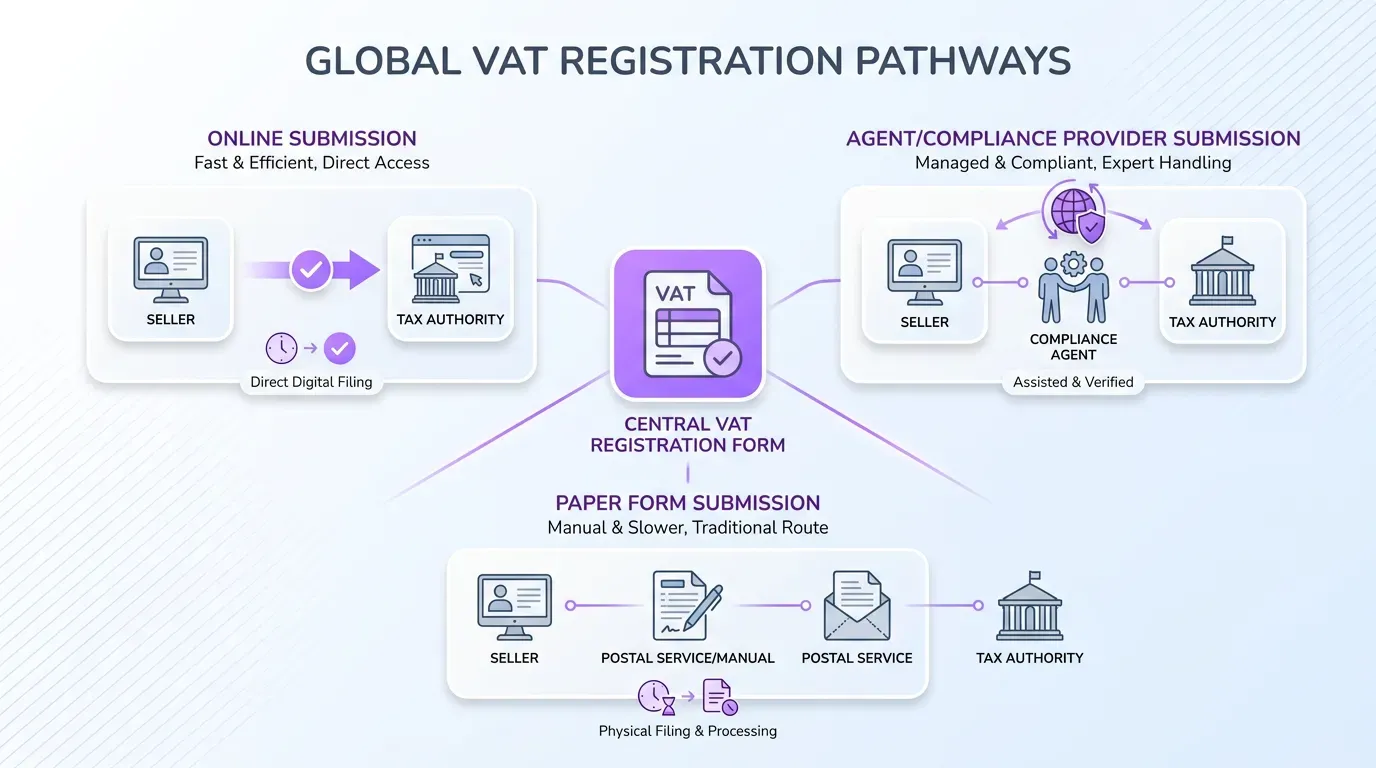
A compliance-themed infographic featuring a central VAT registration form icon, connected to three clusters for submission methods on a soft gradient backgro…

The submission process varies by country, but most tax authorities now accept online applications. Some still require paper forms or a combination of both.

General submission methods include:

  • Online portals (e.g., HMRC's Government Gateway in the UK, ELSTER in Germany, or the EU's OSS portal)

  • Paper applications mailed or delivered to the local tax office

  • Submissions through a licensed tax representative or fiscal agent

Filing Through a Tax Agent

Many international sellers use a tax agent or compliance provider rather than navigating foreign-language portals themselves. This is especially common for non-EU businesses that are required to appoint a fiscal representative in certain countries. The agent submits the VAT registration application on your behalf using a signed power of attorney.

For marketplace sellers managing VAT obligations across multiple countries, working with a dedicated compliance partner can save significant time. Who Handles Multi-Country VAT Registration and Reporting? explores how experienced advisers streamline cross-border setup, consolidate filings, and help avoid common pitfalls.

After submission, you enter the waiting phase, but there are things you can do to stay prepared.

Track Processing and Respond to Queries

Tax authorities don't always process applications silently. Expect follow-up questions, and be ready to respond quickly.

Typical processing timelines:

  • United Kingdom: 2 to 4 weeks for online applications, though HMRC has noted longer processing during peak periods

  • Germany: 4 to 8 weeks, sometimes longer if documents are incomplete

  • France: 2 to 6 weeks

  • Netherlands: 1 to 3 weeks for EU-based businesses

  • Italy: 3 to 6 weeks, with fiscal representative delays adding time

What Can Slow Things Down?

Incomplete forms are the top reason for delays. Missing signatures, incorrect company details, or untranslated documents will trigger requests for clarification. In some cases, the tax office may ask for additional proof that you're genuinely conducting business in their country.

Here's a real scenario: a UK-based seller registering in Spain submitted all required forms but forgot to include a Spanish translation of their articles of association. The Spanish tax authority paused the application for three weeks until the translation arrived.

The takeaway: check every document twice, respond to authority queries within 48 hours if possible, and keep digital copies of everything you submit.

Once your application clears, you'll receive your VAT ID number. But the process doesn't end there.

Activate and Verify Your VAT ID Number

When your registration is approved, the tax authority issues your VAT ID number. In the EU, this number follows a standard format: a two-letter country code followed by a series of digits (e.g., DE123456789 for Germany, FR12345678901 for France).

After receiving your number, you should:

  • Verify it on the EU VIES database to confirm it's active

  • Update your invoices, accounting software, and marketplace seller accounts

  • Inform your customers and partners of your new VAT details

  • Set calendar reminders for your first filing deadline

Your VAT ID number must appear on all tax invoices you issue. For marketplace sellers, platforms like Amazon will request your number and may validate it through VIES before allowing you to sell in certain regions.

Verification is also important for your business partners. B2B customers in the EU often need to confirm your VAT ID number is valid before applying the reverse charge mechanism on cross-border purchases. For a step-by-step approach, consider VAT No Lookup: How to Verify VAT Numbers Quickly.

With your number active, the real ongoing responsibility begins: filing returns and staying compliant.

Staying Compliant After Registration

Getting your VAT number is step one. Keeping it in good standing requires regular filings, accurate record-keeping, and awareness of changing rules. To build a strong post-registration routine and avoid errors, see VAT Reporting Made Simple: Best Practices for Businesses.

Ongoing obligations include:

  • Filing periodic VAT returns (monthly, quarterly, or annually, depending on the country)

  • Submitting Intrastat reports if you move goods between EU member states above reporting thresholds

  • Issuing compliant invoices with correct VAT rates

  • Maintaining records for the retention period required by local law (often 5 to 10 years)

Missing a filing deadline can trigger automatic penalties. In the UK, for instance, late VAT payments can trigger penalties starting at 2% of the outstanding amount from day 16, increasing further if unpaid beyond day 30. Repeated offenses increase the penalty rate.

For sellers operating across multiple markets, the compliance burden multiplies quickly. This is where having a reliable compliance partner like 1StopVAT makes a tangible difference, handling filings, deadline tracking, and local regulatory changes across every country where you hold a registration.

Expert insights

In practice, businesses rarely struggle with the VAT registration form itself. The real difficulties usually begin after expansion: storing inventory abroad, selling through marketplaces, or managing registrations across multiple countries with different local requirements.

Many international sellers underestimate how quickly these obligations appear, especially when scaling through Amazon FBA or cross-border ecommerce. This is why experienced VAT support becomes valuable not only during registration, but throughout the ongoing compliance process.

Conclusion

Knowing how to register for a VAT number doesn't have to be overwhelming. The process follows a clear path: confirm your obligation, prepare your documents, submit your VAT registration application to the relevant authority, track its progress, and then keep your VAT ID number active through timely filings. Each country adds its own quirks, but the underlying structure is consistent.

The businesses that handle VAT number registration smoothly are the ones that prepare thoroughly, respond to tax authorities quickly, and build compliance into their operations from day one. Whether you're registering in one country or ten, treating VAT as a core part of your international strategy — not an afterthought — will keep your business moving forward without costly interruptions.

Processing times vary by country. In the UK, expect 2 to 4 weeks. Germany typically takes 4 to 8 weeks, while the Netherlands can process applications in as little as 1 to 3 weeks. Delays usually stem from incomplete or incorrectly formatted documents.

Yes. Many countries allow non-resident businesses to register for VAT, especially if you store inventory there or sell to local consumers above the threshold. Some countries require you to appoint a fiscal representative or tax agent to handle the process on your behalf.

They refer to the same thing. "VAT number" and "VAT ID number" are used interchangeably. In some countries, you may also hear "tax identification number" or "TVA number" (in French-speaking regions). The format varies by country but serves the same purpose: identifying your business for tax transactions.

Not always. The EU's One Stop Shop (OSS) scheme allows you to report distance sales across the EU through a single registration in your home member state. However, if you store goods in multiple countries (e.g., through Amazon FBA), you'll likely need a separate VAT registration in each country where inventory is held. For more on when OSS/IOSS beats multiple registrations—and real case studies—see the [VAT Tax Registration: Complete Step-by-Step Guide](https://1stopvat.com/articles/vat-tax-registration-guide).

You may face backdated tax assessments, financial penalties, and interest charges. Marketplaces like Amazon may also suspend or remove your seller account. In serious cases, tax authorities can pursue legal action for tax evasion.

Simple Compliance

Free consultation with 1StopVAT experts

You Might Also Like

Discover more insights and articles