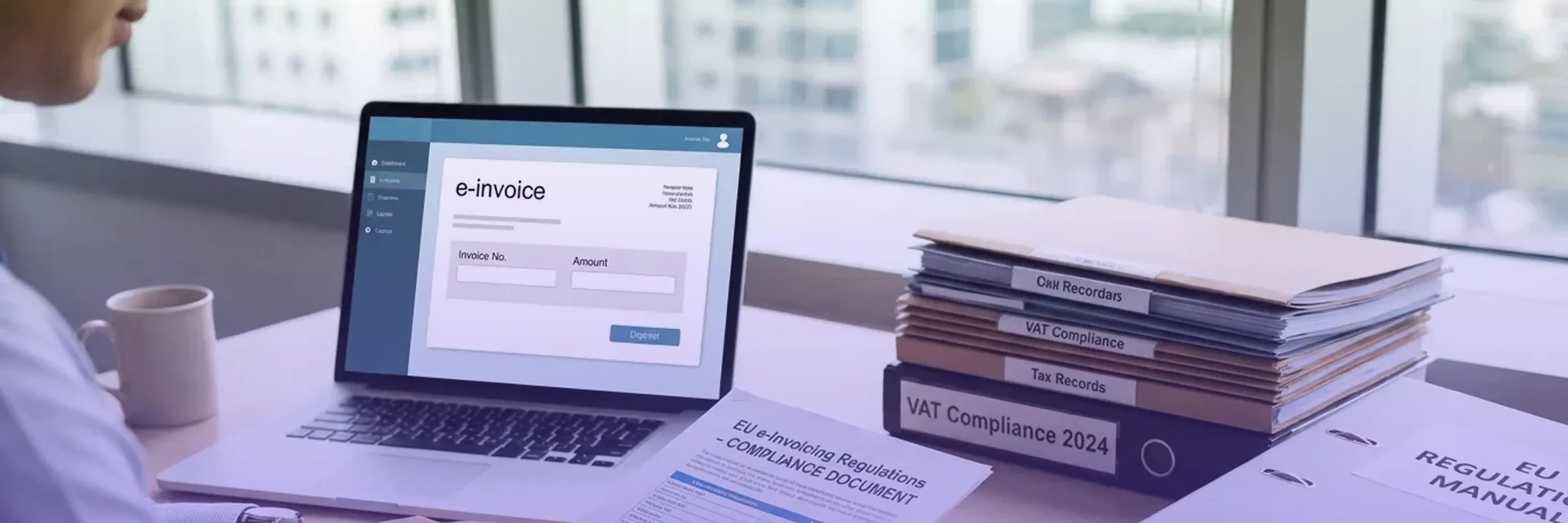
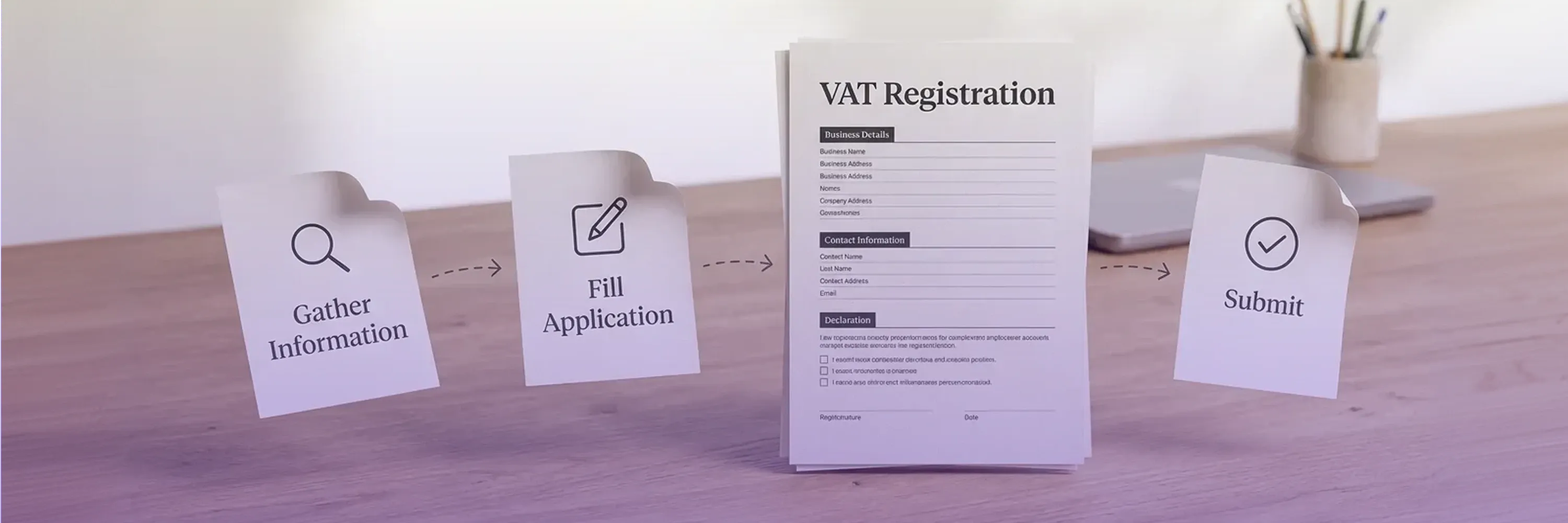
Business professional using an e-invoicing platform on a laptop beside VAT compliance records, tax documents, and regulatory filing folders in a modern office

How to Stay Compliant with EU E-Invoicing Regulations?

EU tax authorities collected €128 billion less in VAT than they were owed last year. Mandatory e-invoicing is their answer - and your deadline may already be closer than you think. Romania went live in 2024. Germany started in January 2025. Belgium follows in 2026. If your invoicing process still runs on PDFs and email, you're not just behind - you're at risk of invoice rejection, reporting penalties, and operational disruption across every EU market you operate in. This guide tells you exactly what's required, country by country, and how to get compliant before the deadline hits you.

Content authorBy Beata ČepėPublished onReading time9 min read

What EU E-Invoicing Actually Means (and Why It Matters Now)

Before you can comply with e-invoicing regulations, you need to understand what the EU means by "e-invoicing." It's not simply sending a PDF by email. In the EU framework, an e-invoice is a structured electronic document created, transmitted, and received in a machine-readable format like XML or UBL. The invoice data flows directly into accounting systems without manual entry.

This distinction matters because many businesses assume their current invoicing setup already qualifies. It usually doesn't.

The push toward standardized e-invoicing across the EU stems from a clear objective: closing the VAT gap. EU member states lose roughly €128 billion annually to uncollected VAT revenue. Mandatory e-invoicing gives tax authorities real-time or near-real-time visibility into transactions, making it far harder for VAT fraud to slip through.

The European Commission's VAT in the Digital Age (ViDA) initiative, formally proposed in late 2022 and agreed upon by EU finance ministers in November 2024, is the legislative engine behind this shift. ViDA introduces:

  • Mandatory structured e-invoicing for intra-EU B2B transactions

  • Digital Reporting Requirements (DRR) that transmit invoice data to tax authorities

  • A standardized European reporting format based on the EN 16931 standard

With ViDA now moving toward implementation, the regulatory landscape is no longer theoretical. It's a concrete timeline that businesses must plan around.

Know the Key Deadlines and Country-Specific Mandates

Understanding ViDA's EU-wide timeline is essential, but it's only half the picture. Individual member states are rolling out their own mandates, many of them ahead of the EU-wide schedule.

The ViDA Timeline

The ViDA framework sets two critical milestones:

  • July 1, 2030: Mandatory e-invoicing and digital reporting for intra-EU (cross-border) B2B transactions

  • 2028 onward: Member states gain the ability to impose domestic B2B e-invoicing mandates without needing special EU approval (a derogation)

These dates give businesses a window, but that window is narrower than it looks. Systems, processes, and vendor relationships all take time to adjust.

Countries Already Enforcing E-Invoicing

Several EU member states aren't waiting for ViDA's full rollout.

Their domestic mandates are already live or launching soon:

  • Italy: Mandatory since 2019 for all domestic B2B and B2C transactions, using the Sistema di Interscambio (SdI) platform. Italy remains the EU's most mature e-invoicing regime.

  • France: Mandatory e-invoicing and e-reporting will begin with a phased rollout, with large enterprises required to receive e-invoices from September 2026 and full mandatory issuance for all businesses by September 2027. For more on France’s regulations, see Electronic Invoicing and Reporting in France.

  • Germany: Mandatory B2B e-invoicing begins January 1, 2025, with a transition period allowing businesses to continue issuing paper or PDF invoices through 2026 (or 2027 for smaller businesses). However, all businesses must be able to receive structured e-invoices from January 2025.

  • Poland: The KSeF (National e-Invoicing System) becomes mandatory for larger businesses in February 2026 and for smaller enterprises by April 2026. For country-specific updates, see Poland Joins Other Countries in Making E-Invoicing Mandatory.

  • Romania: Mandatory B2B e-invoicing through the RO e-Factura system has been live since January 2024 for domestic transactions.

  • Belgium: Mandatory B2B e-invoicing takes effect January 1, 2026.

If your business operates in multiple EU countries, you're not dealing with one set of rules. You're dealing with several, each with its own format requirements, platforms, and go-live dates.

This overlapping patchwork of deadlines is exactly why compliance requires a structured, country-by-country approach rather than a single blanket solution. To stay informed, check regular Electronic Invoicing News: Most Recent Information in Europe.

Audit Your Current Invoicing Setup

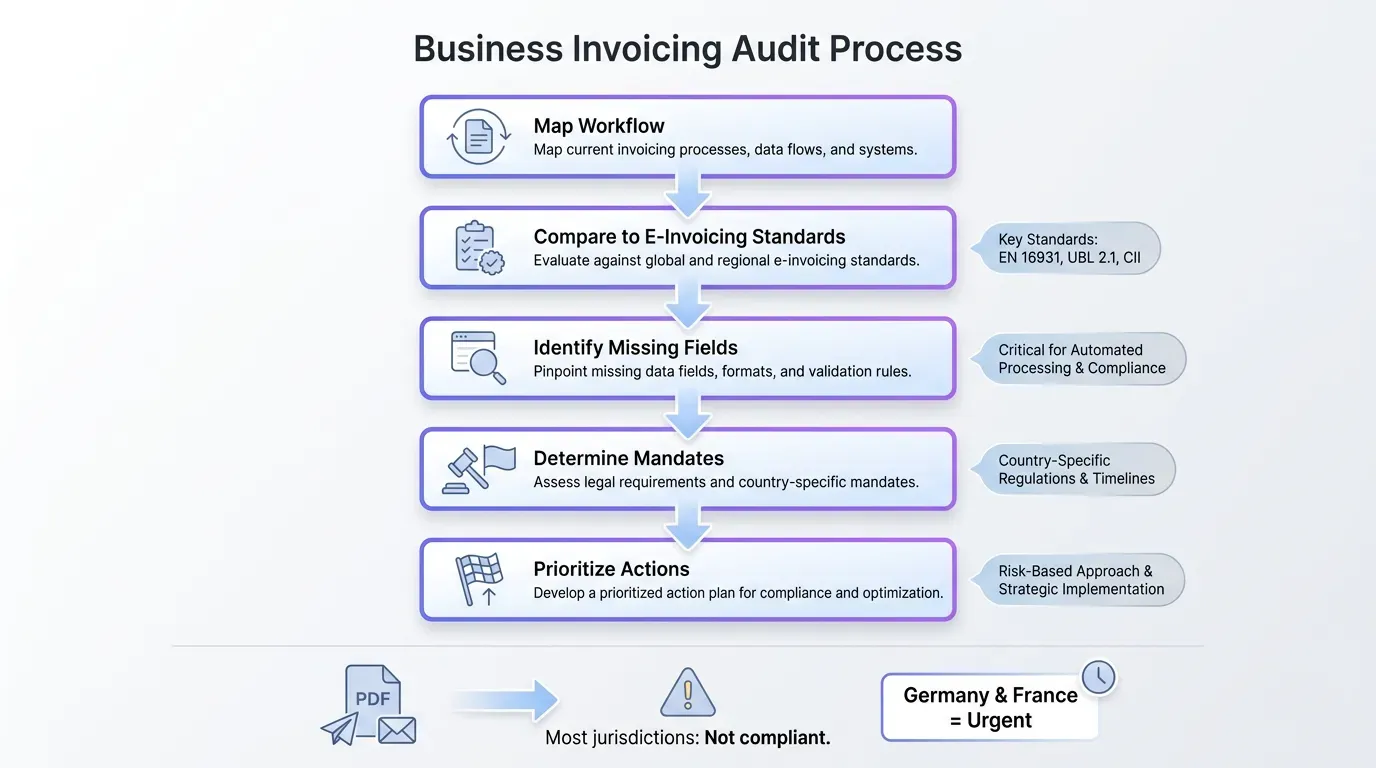
Modern tech infographic depicting a business invoicing audit flowchart with muted blue icons, annotations, and compliance warnings.

The first practical step is understanding where you stand today. Most businesses discover gaps once they compare their existing invoicing workflows against the structured e-invoicing standards now required.

Start by mapping out your current process:

  • What format are your invoices in? (PDF, Word, paper, structured XML?)

  • How are invoices transmitted? (Email, postal mail, EDI, an invoicing platform?)

  • Do your invoices contain all fields required under EN 16931, such as VAT identification numbers, tax category codes, and payment terms in structured data?

  • Which countries do you invoice into, and which local mandates apply?

A simple PDF attached to an email will not meet the requirements in most jurisdictions now implementing mandates. The invoice must be machine-readable, conforming to recognized standards like UBL 2.1 or CII (Cross-Industry Invoice).

This audit reveals the distance between where you are and where the regulations need you to be. It also helps you prioritize: if you're invoicing heavily into Germany and France, those countries' deadlines dictate your most urgent action items.

Align Your Systems with the EN 16931 Standard

Once you've completed your audit, the next step is ensuring your invoicing systems can produce and receive invoices in the correct structured format.

The EN 16931 standard is the EU's common semantic data model for e-invoices. It defines what data an e-invoice must contain and how that data is structured. Two syntax formats are accepted under this standard:

  • UBL (Universal Business Language) 2.1

  • CII (UN/CEFACT Cross-Industry Invoice)

Your ERP or accounting software needs to generate invoices in one of these formats. Many modern platforms already support them, but you'll likely need to configure templates, field mappings, and validation rules.

Connecting to Government Platforms

Several countries require invoices to pass through a government-operated or certified exchange platform. For example:

  • Italy's SdI acts as the central clearinghouse for all invoices

  • Poland's KSeF will serve a similar function

  • France's PPF (Portail Public de Facturation) and certified PDPs (Partner Dematerialization Platforms) will handle invoice routing and reporting

You'll need to establish connections to each relevant platform, either directly through API integrations or through a service provider that handles transmission on your behalf.

This is where the technical requirements can become complex, especially for businesses selling across multiple EU markets simultaneously.

Businesses already dealing with e-invoicing rollouts across countries like Germany, France, Poland, and Italy often discover that the real challenge is not understanding the regulations themselves, but adapting operational workflows, ERP configurations, and reporting processes to different local requirements.

For a technical guide, see E-Invoice Technical Implementation: What Should You Know?.

Build a Compliance Calendar and Monitor Changes

E-invoicing regulations across the EU are still evolving. Deadlines shift, technical specifications get updated, and new countries announce mandates. A static compliance strategy won't work.

Build a living compliance calendar that tracks:

  • Country-specific go-live dates for mandatory e-invoicing

  • Transition periods and grace periods (like Germany's phased approach through 2027)

  • Format and platform updates from tax authorities

  • ViDA legislative milestones as they progress through EU institutions

Assign ownership internally. Someone in your finance or tax team needs to monitor regulatory updates from national tax authorities and the European Commission regularly.

For businesses operating in many EU markets, this monitoring burden grows quickly. A marketplace seller listing products in Germany, France, Italy, and Poland, for example, faces four different e-invoicing regimes with different timelines, formats, and reporting obligations.

This is where most businesses start making expensive mistakes - trying to manage four different e-invoicing regimes with internal resources that weren't built for this. 1StopVAT works with businesses that operate across multiple EU markets and can't afford compliance gaps. Their team monitors regulatory changes across 100+ countries in real time, so when Poland moves its KSeF deadline or France updates its PDP requirements, your invoicing process adjusts - before it breaks. For marketplace sellers managing VAT registration, compliance filings, and e-invoicing across jurisdictions simultaneously, that's not a convenience.

Test, Validate, and Go Live Before Deadlines Hit

Don't wait until a mandate's effective date to switch systems. Most countries offer pre-mandate testing periods, and using them is critical.

Run parallel invoicing during your transition phase:

  • Issue invoices in both your old format and the new structured format

  • Validate e-invoices against the EN 16931 schema before transmitting

  • Test connections to government platforms using sandbox or pilot environments

  • Verify that your trading partners can receive and process your e-invoices

A common real-world issue: a German wholesaler discovered during testing that its ERP system was omitting the buyer's VAT registration number from the structured XML output. That single missing field caused every test invoice to be rejected by the validation service. Catching this months before the mandate saved significant disruption.

Early testing also gives your accounting and finance teams time to adjust workflows. E-invoicing changes how invoice disputes, credit notes, and corrections are handled, and staff need to understand the new processes before they're mandatory.

To stay compliant with EU e-invoicing regulations, businesses must issue invoices in structured electronic formats (UBL or CII) conforming to the EN 16931 standard, connect to required government platforms in each EU country where they operate, and meet country-specific deadlines ranging from 2024 (Romania) to 2030 (ViDA's EU-wide cross-border mandate).

Common E-Invoicing Challenges Businesses Encounter During Implementation

In practice, many businesses discover that e-invoicing compliance issues rarely come from misunderstanding the legislation itself. The bigger challenge is adapting internal workflows, ERP configurations, approval chains, and reporting processes to meet different country-specific technical requirements at the same time.

For example, companies rolling out e-invoicing across Germany, France, Poland, and Italy often face inconsistencies between local platform requirements, invoice validation rules, and structured XML field mappings. Even small configuration gaps, such as missing VAT identifiers or incompatible invoice syntax, can lead to invoice rejection and reporting delays.

Conclusion

The businesses that will struggle most with EU e-invoicing aren't the ones who don't understand the regulations. They're the ones who understood them too late to adapt their systems, retrain their teams, and fix the configuration gaps before the first rejected invoice. Every country on this list has a deadline. Several of them have already passed.

If you're operating across EU markets and haven't mapped your current invoicing setup against the requirements above, that's the first thing to do today - not next quarter. Audit your formats, check your ERP output, confirm which government platforms apply to each market you invoice into.

If you want a clear picture of where your compliance stands and what needs to change, talk to the 1StopVAT team. They cover 100+ countries and can help you identify gaps before they become compliance issues.

EU e-invoicing refers to the creation, transmission, and receipt of invoices in a structured, machine-readable electronic format, typically UBL 2.1 or CII, as defined by the EN 16931 standard. A PDF sent by email does not qualify as an e-invoice under EU regulations.

Timelines vary by country. Italy has required it since 2019, Romania since January 2024, and Germany since January 2025 (for receiving). France, Poland, and Belgium have mandates taking effect in 2026. The EU-wide ViDA mandate for cross-border B2B transactions is set for July 1, 2030.

Most current EU mandates focus on B2B transactions. Italy is a notable exception, where e-invoicing covers B2C as well. The ViDA framework primarily targets B2B cross-border transactions, but individual member states may extend requirements to B2C domestically.

Non-compliance can result in financial penalties, rejected invoices, delays in VAT recovery, and increased scrutiny during tax audits. In countries like Italy, failure to use the SdI platform for invoicing can trigger fines ranging from 90% to 180% of the VAT amount on the invoice.

Yes. Providers like 1StopVAT offer dedicated guidance for businesses, including marketplace sellers, helping them manage VAT registration, filings, and compliance with e-invoicing standards across multiple EU jurisdictions through a single point of contact.

Simple Compliance

Free consultation with 1StopVAT experts

You Might Also Like

Discover more insights and articles