

Overview
Selling through online marketplaces like Amazon, Etsy, and eBay can simplify cross-border growth, but it also creates complex VAT obligations that many sellers underestimate. Between deemed supplier rules, OSS and IOSS schemes, inventory held in multiple countries, and evolving EU reforms, marketplace VAT is no longer something businesses can manage with generic tax support. This article explains why VAT compliance for marketplace sellers has become so challenging, what to look for in a specialist VAT firm, and how the right partner can help reduce risk, avoid costly mistakes, and support international expansion with confidence.
Why Marketplace VAT Keeps Getting More Complicated
Online selling has grown fast. 22.9% of EU enterprises conducted online sales in 2022, up from 19.4% in 2021. Of those 2021 sellers, 8.6% sold specifically via an e-commerce marketplace. That growth has drawn more regulatory attention, and with it, more obligations for sellers.
The core issue is deceptively simple: when a consumer buys a product through a marketplace, who is the “seller” for VAT purposes? In many cases, the marketplace itself is now deemed the supplier. Under EU rules introduced in July 2021, platforms facilitating certain sales are required to collect and remit VAT on behalf of their sellers. But this doesn’t cover every scenario.
- If you sell goods stored in an EU country and the marketplace facilitates the sale to a consumer in another EU state, the platform often handles VAT collection.
- If you sell directly from outside the EU and the consignment value is under €150, the marketplace typically collects import VAT.
- But if the goods are above that threshold, or the transaction doesn’t meet the “deemed supplier” criteria, the obligation swings back to you.
This split responsibility creates real confusion. A seller on the same platform can owe VAT in one transaction and not in the next, depending on the value, the warehouse location, and the buyer’s country. That’s exactly why marketplace sellers need VAT firms that understand these distinctions at a granular level.
For deeper guidance on marketplace VAT obligations and detailed compliance checklists, see Marketplace VAT Obligations for Online Sellers: What You Need to Know.
The EU’s Expanding Framework and What It Means for Sellers
Since the 2021 e-commerce VAT reforms, the One-Stop Shop (OSS) and Import One-Stop Shop (IOSS) have become central to cross-border compliance. The numbers tell the story of just how significant these schemes have become.
Member States collected €20 billion in VAT revenues in 2022 via the expanded OSS and IOSS. Of that, over €17 billion came through the Union OSS for intra-EU online sales, and €2.5 billion from low-value import goods.
By 2024, those figures had surged. EU businesses declared over €33 billion in VAT through OSS and IOSS schemes, with €24 billion via the Union OSS, €2.8 billion via the non-Union OSS, and €6.3 billion via the Import OSS. Cumulatively, nearly €88 billion in VAT has been collected under these schemes since mid-2021.
The registration numbers reflect this momentum. Almost 130,000 companies had registered for OSS by end-2022, and that figure grew to over 170,000 by end-2024.
For marketplace sellers, this means the compliance infrastructure is expanding rapidly. But using OSS correctly, knowing when the marketplace has already accounted for VAT, and understanding when you still need to file separately requires expertise that most general accountants simply don’t have. For an overview of EU VAT rules and schemes, don’t miss VAT in European Union: EU VAT Rules Explained for International Sellers.
What Happens When Compliance Slips
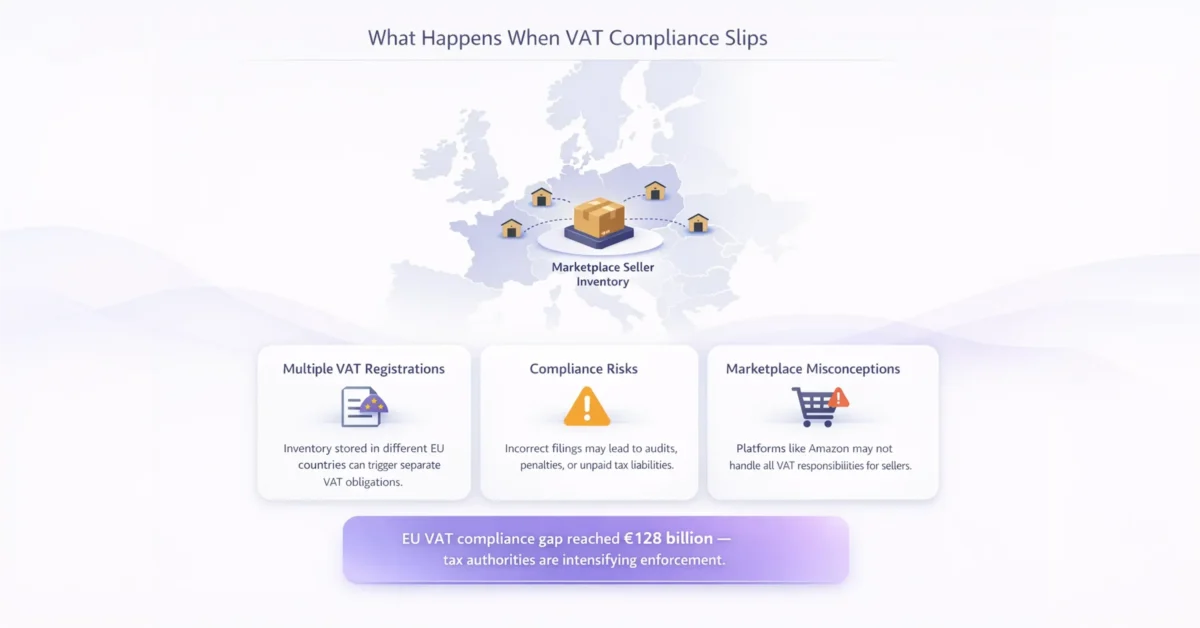
The consequences of getting marketplace VAT wrong aren’t theoretical. The EU’s VAT compliance gap stood at €128 billion in 2023, representing 9.5% of the total VAT base. While that gap has narrowed from 11.1% in 2019 to 9.5% in 2023, it’s still substantial. In real terms, EU Member States lost about €89 billion in VAT revenues in 2022, down from about €121 billion in 2018.
Tax authorities are closing in on the remaining gaps, and marketplace sellers are firmly in their sights. A small seller based in the UK using Amazon’s Fulfilled by Amazon (FBA) program might have inventory stored in warehouses across Germany, France, Poland, and the Czech Republic. Each storage location can trigger a VAT registration requirement. If that seller assumes Amazon handles everything, they could end up with unpaid VAT liabilities in multiple countries.
To see the real-world consequences – including penalties, audits, and account suspension risks – consult Amazon – Challenges of VAT Compliance for Merchants and Suspension of Accounts and VAT Compliance: How EU Businesses Lost €159M in Penalties.
This is precisely the kind of situation where a specialized VAT firm earns its fee. It’s not about generic bookkeeping; it’s about understanding where inventory sits, which transactions the marketplace covers, and where the seller still has direct obligations.
What to Look for in a VAT Firm for Marketplace Sellers
Not all tax advisors are equipped for marketplace VAT. Here’s what separates the firms that can genuinely help from those that can’t.
Multi-Country Registration and Filing Expertise
Marketplace sellers often need VAT registrations in several countries simultaneously. A firm worth hiring should handle:
- VAT registration in multiple jurisdictions from a single engagement
- Periodic filing in each country, aligned with local deadlines and formats
- Monitoring of threshold changes that could trigger new obligations
Understanding of Deemed Supplier Rules
The “deemed supplier” concept is the single most important piece of marketplace VAT regulation. Your firm needs to know exactly when a platform like Amazon or eBay becomes the supplier of record, and when that responsibility reverts to you. This isn’t static: it depends on seller location, goods value, and fulfillment structure.
Real Advisory, Not Just Filing
Filing returns is necessary but not sufficient. The right firm provides consulting on questions like: Should you use OSS or register locally? What happens if you move inventory to a new warehouse? How does a marketplace’s VAT collection affect your input VAT recovery?
For instance, consider a US-based seller who ships goods to Amazon’s European fulfillment network. They might need IOSS registration for low-value imports, separate VAT registrations in countries where stock is held, and guidance on how Amazon’s deemed supplier status affects their reporting. A qualified firm handles all of this as a connected set of obligations, not isolated tasks.
For a comparison of top consultants and advice on what to look for as an e-commerce seller, check out Leading VAT Consultants for E-commerce: Who to Trust and Finding the Right VAT Consultant for E-commerce.
A Single Point of Contact Across Jurisdictions
Dealing with a different advisor in each country is a recipe for miscommunication. The best firms centralize your compliance. 1StopVAT, for example, operates as a single point of contact with a team of over 40 certified tax specialists covering 100+ countries. For marketplace sellers juggling registrations and filings across the EU, that kind of centralized, expert-driven service removes a major layer of complexity. Rather than relying on fragmented advice, sellers get consistent guidance tailored to their specific marketplace setup.
The Road Ahead: Digital-Age VAT Reforms
The regulatory landscape is still shifting. The EU’s “VAT in the Digital Age” (ViDA) package, agreed by the Council in November 2024, will further extend deemed supplier obligations and expand OSS functionality. As Hungarian Finance Minister Mihály Varga noted, the package is “a cornerstone for the digital transition and a significant step in improving the competitiveness of the EU”.
To understand ViDA and what upcoming reforms could mean for your business, visit VAT in the Digital Age: How Could it Affect Your Business?.
For marketplace sellers, ViDA means more obligations flowing through platforms, but also more complexity in determining what you still owe independently. Firms that stay ahead of these regulatory changes will be essential partners.
Getting this right now, before the next wave of reforms takes effect, puts sellers in a stronger position. Whether you’re a small brand selling through Etsy or a mid-size operation running multi-country FBA, working with a VAT firm that specializes in marketplace obligations is no longer optional. It’s a core part of operating internationally.
Сonclusion
Marketplace VAT is no longer a back-office detail sellers can afford to overlook. As platforms, tax authorities, and EU regulations continue to tighten the rules around cross-border e-commerce, even a single misunderstanding about who owes VAT can trigger registrations, reporting failures, penalties, or blocked growth. The challenge is not just keeping up with changing rules, but knowing how those rules apply to your specific marketplace model, inventory setup, and transaction flow.
That is why the right VAT firm matters. Sellers need more than return filing. They need a partner that understands deemed supplier rules, multi-country registrations, OSS and IOSS reporting, and the operational realities of selling through marketplaces like Amazon, Etsy, and eBay. With e-commerce VAT reporting through OSS and IOSS now generating more than €33 billion annually across the EU, compliance is becoming more visible, more digital, and more strictly enforced. Businesses that act early and build the right compliance structure will be in a far stronger position to scale internationally with less risk and more confidence.
Frequently asked questions
It depends on the transaction. Under EU rules, marketplaces are “deemed suppliers” in certain cases, meaning they collect and remit VAT. This typically applies when a non-EU seller uses the platform to sell to EU consumers, or when goods valued under €150 are imported. For other transactions, the seller retains the VAT obligation. The split depends on factors like goods value, seller location, and fulfillment method.
Often, yes. Even when a marketplace handles VAT collection on your sales, you may still need VAT registrations in countries where you store inventory. For example, using Amazon FBA across multiple EU warehouses can create registration obligations in each storage country, regardless of who collects VAT at the point of sale.
The OSS is an EU-wide system that lets sellers report and pay VAT for cross-border B2C sales through a single registration in one EU member state, rather than registering in every country where they sell. It simplifies compliance significantly, but it doesn’t replace local registrations triggered by inventory storage. A specialized VAT firm can advise on whether OSS alone is sufficient or if additional registrations are needed.
The VAT in the Digital Age package will expand deemed supplier rules, meaning more transactions will be handled by platforms directly. It will also broaden the scope of OSS. However, the transition period introduces new compliance questions. Sellers should work with knowledgeable advisors to prepare for these changes before they take effect.
Non-compliance can result in back-tax assessments, penalties, and interest charges across multiple countries. Tax authorities are increasingly sharing data across borders, and marketplaces themselves may suspend seller accounts that lack valid VAT numbers. The financial and operational risks make proactive compliance far cheaper than dealing with enforcement actions.