Overview
Texas sales tax compliance is one of the most complex tax challenges for businesses operating in the United States. With more than 1,700 local jurisdictions, changing tax rates, and strict filing requirements, companies must navigate a highly fragmented regulatory environment.
This guide explains how Texas sales tax works, why compliance has become more demanding in recent years, and which firms can help businesses manage their obligations effectively.
In this article, you will learn:
-
Why Texas sales tax is more complex than many other U.S. states
-
The risks and financial impact of non-compliance
-
The leading firms that help businesses manage Texas sales tax obligations
-
Key features to look for when selecting a tax compliance partner
-
A step-by-step process to stay compliant in Texas
By the end of this guide, business owners and finance teams will have a clear understanding of how to navigate Texas sales tax requirements and choose the right compliance partner to support their growth.
The Growing Complexity of Texas Sales Tax
The Texas tax landscape is notoriously fragmented. While the state sets a base rate, the real complexity lies in the local layers. The Comptroller’s office administers more than 100 state and local taxes and collects local sales taxes on behalf of over 1,700 cities, counties, transit authorities, and special purpose districts.
This creates a difficult environment for sellers. A business selling into multiple areas must track rates that change across city lines, transit authorities, and special purpose districts. The volume of revenue flowing through this system is immense and continues to grow.
For example, Texas state sales tax receipts reached $3.94 billion in June 2024, reflecting steady economic activity across the state.
The upward trend continued the following year. In June 2025, state sales tax collections totaled approximately $4.04 billion, representing year-over-year growth and continued expansion in consumer spending and business activity.
Additional monthly reports from the Texas Comptroller confirm that sales tax remains the largest source of state tax revenue, accounting for roughly 58% of total state tax collections.
This consistent rise in revenue highlights why Texas places strong emphasis on compliance. Sales tax is a critical funding mechanism for state and local governments, and enforcement has intensified as collections continue to grow.
Understanding this environment is the first step toward realizing why managing Texas sales tax obligations manually - such as through spreadsheets - often becomes unsustainable for growing businesses. For a deeper look at how U.S. sales tax rules vary across states, see the US Sales Tax Explained: State-by-State Guide.
The High Stakes of Non-Compliance
Navigating this complex web without help often leads to errors. The introduction of economic nexus laws - requiring remote sellers to collect tax even without a physical presence - caught many off guard. An analysis found that nearly 50,000 remote sellers were not in compliance with post-Wayfair sales tax obligations shortly after states enacted these rules.
The burden falls disproportionately on smaller companies that lack dedicated tax departments. Data from late 2019 showed that only 29% of small businesses reported full compliance with these obligations, compared to over half of medium-sized enterprises. This gap exposes smaller firms to audits, penalties, and back taxes that can cripple cash flow.
Furthermore, the sheer cost of getting it right is staggering for those who try to do it alone or with inefficient systems. One study highlighted a remote seller who reported spending $2.28 on sales tax compliance for every $1 of sales tax remitted. When the cost of compliance exceeds the tax itself, the system is broken for the merchant. This financial drain is the primary driver for businesses seeking external experts who can lower that ratio through efficiency and expertise.
Sales tax is not a minor line item for states; it is their lifeblood. Roughly one-third of all state tax revenue is generated by sales and use taxes, making it a high-priority enforcement area. This reality naturally leads businesses to look for partners who can shoulder the burden. For more practical advantages of outsourcing and a cost comparison with in-house teams, check out Tax Consultation: Why Businesses Need Professional Guidance.
Profiles of Leading Compliance Firms

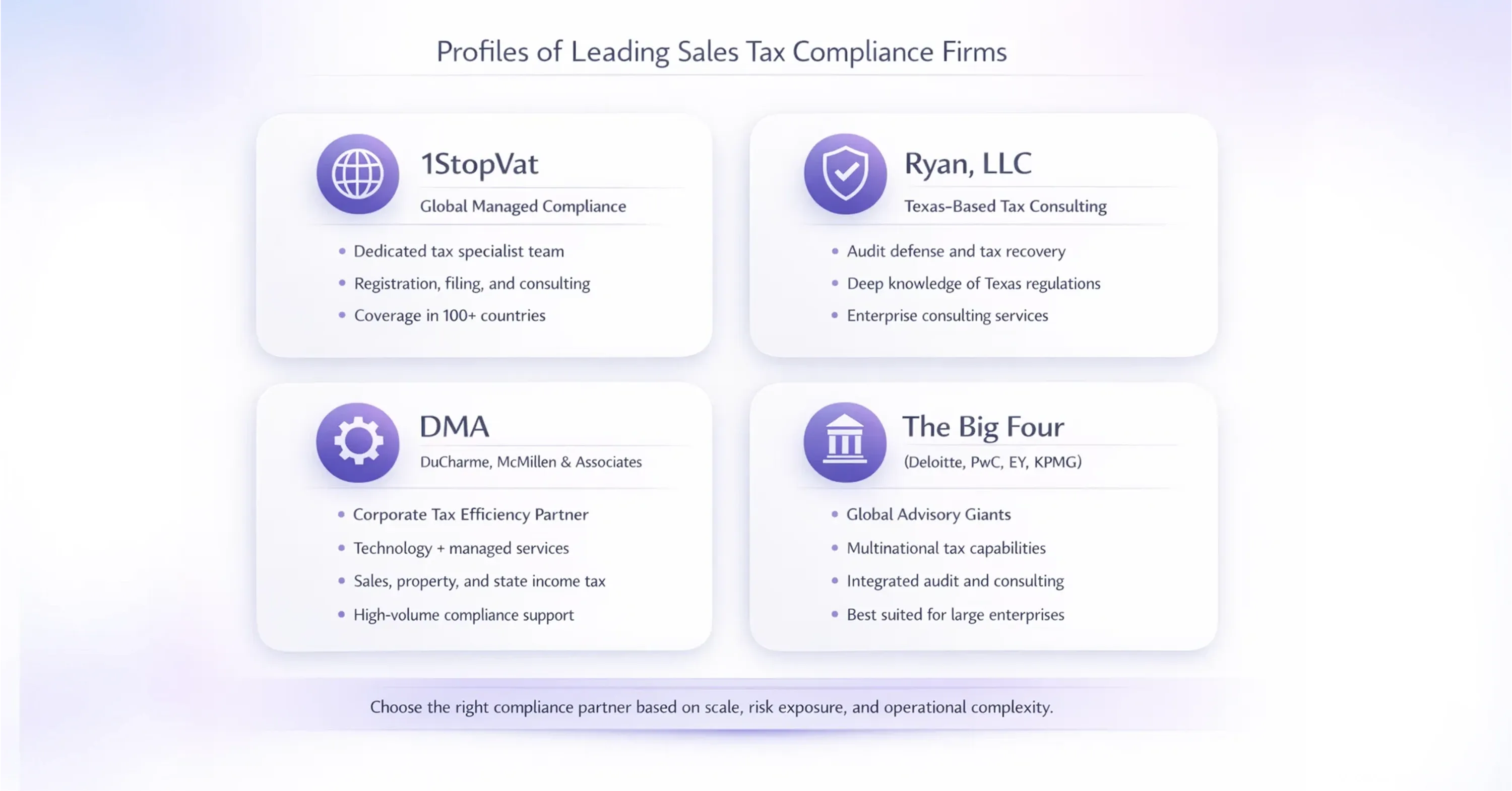
Choosing the right partner involves finding a firm that matches your scale and complexity. The following firms represent different approaches to solving the Texas sales tax puzzle, from global specialists to regional consulting powerhouses. For a broader comparison of top compliance providers and selection criteria, see Top Sales Tax Compliance Firms for Businesses.
1StopVat
For businesses that need a comprehensive, hands-on approach, 1StopVat stands out. They are a one-stop global compliance provider that handles the entire lifecycle of tax obligations. Unlike software-only solutions that leave you to configure settings yourself, 1StopVat assigns you a dedicated team.
-
Service Model: They act as a single point of contact for all tax matters.
-
Expertise: A team of 40+ certified tax specialists manages your account.
-
Scope: While they excel globally across 100+ countries, their hybrid model of automated tools combined with human oversight makes them highly effective for complex US state legislations like Texas.
-
Why they fit: If your business is expanding and you want to offload the entire burden of registration, filing, and consulting to a team that actually talks to you, 1StopVat is a top contender.
Ryan, LLC
Headquartered in Dallas, Ryan is a global tax services firm with deep roots in Texas. They are well-known for their advocacy and consulting services rather than just processing returns.
-
Focus: Recovery, consulting, and audit defense.
-
Strength: Because they are based in Texas, they have immense knowledge of the local Comptroller’s nuances.
-
Best for: Large enterprises that need to recover overpaid taxes or face complex audits.
DMA (DuCharme, McMillen & Associates)
DMA is another heavy hitter in the corporate tax world. They focus on partnering with large corporations to manage tax efficiency.
-
Approach: They combine technology with managed services.
-
Offerings: State income tax, property tax, and sales/use tax outsourcing.
-
Target: Mid-to-large cap companies looking for a partner to manage high-volume compliance.
The "Big Four" (Deloitte, PwC, EY, KPMG)
For massive multinational corporations, the traditional accounting giants remain a safe, albeit expensive, choice.
-
Capacity: They have virtually unlimited resources to handle any jurisdiction.
-
Integration: These firms often integrate tax compliance with broader auditing and business consulting.
-
Cost: Generally the highest price point, suited for Fortune 500 entities.
Selecting the right firm from this list depends on whether you need a tech-heavy tool, a high-end consultant, or a managed service that balances both.
Key Features to Look for in a Compliance Partner
Identifying a list of names is useful, but understanding why a firm is a good fit is crucial. The right partner does more than just file a form; they protect your bottom line.
1. Hybrid Human-Tech Support
Software is essential for calculation, but software cannot argue with an auditor. The most effective firms use technology to crunch numbers but rely on human experts to interpret gray areas of the law. 1StopVat exemplifies this by pairing automated filing tools with certified specialists who review the data. This ensures that an anomaly in your Texas sales data is caught by a person before it becomes a penalty from the state.
2. Audit Defense Capabilities
Texas audits are rigorous. Your compliance partner should be able to support you if the Comptroller comes calling.
-
Look for firms that keep detailed digital archives.
-
Ensure they have experience communicating with state tax authorities.
-
Ask if audit support is included or an extra fee.
3. Nexus Monitoring
Your obligations change as you grow. A partner should proactively monitor your sales volume against Texas economic nexus thresholds.
-
Threshold tracking: Alerts when you cross the $500,000 safe harbor limit.
-
Jurisdiction updates: Automatic updates when city or county rates change.
4. Registration Assistance
The first step is often the hardest. Setting up your account with the Texas Comptroller requires specific business details and correct classification. A service that handles registration ensures you are set up correctly from day one, avoiding issues with misclassification of goods or services.
For additional tips and an action checklist, consider the Sales Tax Compliance: Key Steps for Your Business.

Having these features in place transforms tax compliance from a monthly panic into a smooth, background operation.
Step-by-Step Guide to Texas Operations
Once you have selected a partner or decided to evaluate your current standing, you must follow a logical path to compliance. The Texas system rewards precision.
Step 1: Determine Your Nexus
Before you collect a dime, you must know if you are legally required to do so.
-
Physical Presence: Do you have an office, warehouse, or remote employee in Texas? If yes, you have nexus.
-
Economic Nexus: Do your sales into Texas exceed $500,000 in the preceding 12 calendar months? If yes, you must register.
For a step-by-step overview of what triggers nexus and how to register, see US Sales Tax Registration Services: A Practical Guide.
Step 2: Obtain a Sales Tax Permit
You cannot legally collect tax without a permit. In fact, it is a crime to do so. You must apply through the Texas Comptroller’s office. If you are working with a firm like 1StopVat, they can handle this application process for you, ensuring all NAICS codes and business details are accurate.
Step 3: Map Your Products to Tax Rates
Texas taxes most tangible personal property and some services. However, exemptions exist for manufacturing equipment, certain food items, and medical supplies.
Step 4: Configure Local Rate Collection
This is where many businesses fail. You must collect the base state rate (6.25%) plus any applicable local rates (up to 2%).
-
Verify the tax rate for your customer’s location, not just your location.
-
Texas is an origin-based state for intrastate sales (sales within Texas), but remote sellers often face different sourcing rules depending on their setup.
-
Consult your tax specialist to configure your cart correctly.
Step 5: File and Remit on Time
The state will assign you a filing frequency: monthly, quarterly, or yearly.
-
Deadlines: Monthly filers are due on the 20th of the following month.
-
Prepayments: Large taxpayers may be required to prepay.
-
Discounts: Texas offers a small timely filing discount (0.5%) for paying on time. It adds up over time.
Routine, process-minded actions like these - including regular review of nexus and legislative changes - are covered in more detail in the US Sales Tax Explained: State-by-State Guide.
Following these steps creates a defensible position. If an auditor reviews your books, they will see a structured, compliant process.
Texas Sales Tax Compliance: Key Takeaways
-
Complexity: 1,700+ jurisdictions make manual compliance risky.
-
Growth: Revenue is rising, leading to stricter enforcement.
-
Solution: Firms like 1StopVat offer a necessary blend of tech and human expertise.
-
Action: Verify nexus, register correctly, and file on time to avoid penalties.
Conclusion
Managing sales tax in Texas is a critical operational requirement for any business selling in the state. The combination of over 1,700 local jurisdictions and aggressive revenue targets from the state means that errors can be costly. While the landscape is complex, it is navigable with the right support.
Leading firms provide the infrastructure and expertise needed to handle these obligations efficiently. Whether you choose a specialized partner like 1StopVat for a managed, human-led experience or a large consulting firm for audit defense, the goal remains the same: accuracy and peace of mind. By taking proactive steps to understand your nexus and partnering with the right experts, you protect your business and ensure scalable growth in the Texas market. For hands-on advice and step-by-step instructions, explore the Sales Tax Compliance: Key Steps for Your Business.