What VAT is and why it matters
Value-added tax is a consumption tax charged at every stage of the supply chain, with each business in the chain collecting VAT on its sales and reclaiming the VAT it paid on its purchases. The final consumer carries the cost, while the business acts as the collection point for the tax authority. That mechanism is what separates VAT from a US-style sales tax, which is charged only at the final point of sale, and from income tax, which is levied on profits rather than transactions. Registration for VAT becomes a legal step once a business crosses turnover thresholds or trades across borders in certain ways. More than 170 countries use a VAT or goods and services tax system, so the rules you meet at home will likely follow you abroad.
Who needs registration for VAT
The most common trigger is a turnover threshold. In the United Kingdom, a business must register when taxable turnover passes £90,000 in any rolling 12-month period, a level set on 1 April 2024. Across the European Union, intra-Community distance sellers and suppliers of digital services to consumers in other member states must register once their cross-border B2C sales pass an EU-wide threshold of €10,000 per year. Outside Europe, the trigger varies widely. Singapore sets its GST registration line at SGD 1 million, while Australia uses AUD 75,000.
Some activities pull a business into the system regardless of turnover. Importing goods, holding stock in another country, selling on a marketplace that requires a local tax number, or supplying certain financial and construction services can all force the issue. Because thresholds and exemptions differ by jurisdiction, confirm the current figure with your local tax authority before you decide.
Voluntary registration for VAT is also worth considering. Small businesses below the threshold sometimes opt in so they can reclaim input VAT on equipment and stock, or to look more established to corporate clients who expect a VAT number on every invoice. The trade-off is the extra admin and the duty to charge VAT on every taxable sale from day one.
A short checklist to decide whether this guide applies to you:
-
Your taxable turnover is at or near the local threshold, or you expect it to cross within 30 days.
-
You sell goods or digital services across borders to private customers in the EU or UK.
-
You import goods or sell through marketplaces that demand a local tax ID, with overseas stock covered by the same check.
-
You want to reclaim input VAT and accept the reporting duties that come with it.
If any of these fit, keep reading. The rest of the guide walks through registration for VAT step by step.
Documents and info to prepare
Most rejections happen because applicants start the form without the right paperwork in front of them. Tax authorities cross-check what you type against company registries and banking records, so even a small mismatch can stall the file; customs data can create the same problem. Gather everything in one folder before you open the portal. It saves the painful experience of timing out mid-application and starting again.
Business and owner details
The identifying information sits at the top of every VAT application process. You need the legal business name exactly as it appears in the commercial register and the date the business started trading; add the trading name if it differs and state the business structure in the local terms. Director and beneficial owner details are required, with national identification numbers and home addresses needed for verification.
Sole traders provide a personal tax identification number and proof of self-employment. Limited companies provide the company registration number and articles of association, with details of every director and shareholder above a defined ownership percentage. The tax authority will compare your entries to the public company register. If the registered office on your application doesn't match the one held by Companies House or its local equivalent, expect a request for clarification before registration for VAT can proceed to VAT number registration.
Financial and activity records
The second block of the form is financial. Tax authorities want to see your expected turnover for the next 12 months and a written description of what you sell and to whom, with your business bank account details supplied alongside them. They use this to confirm eligibility, decide which VAT scheme fits, and flag activities that need extra scrutiny, such as financial services or property.
Keep recent invoices and signed contracts ready as supporting evidence, with supplier agreements in the same folder. If you're registering because a single large contract will push you over the threshold, attach that contract. If you're already trading, attach a sample sales ledger covering the last three months. Authorities approve files faster when the numbers in the form line up with documents you can point to.
Step-by-step VAT application process

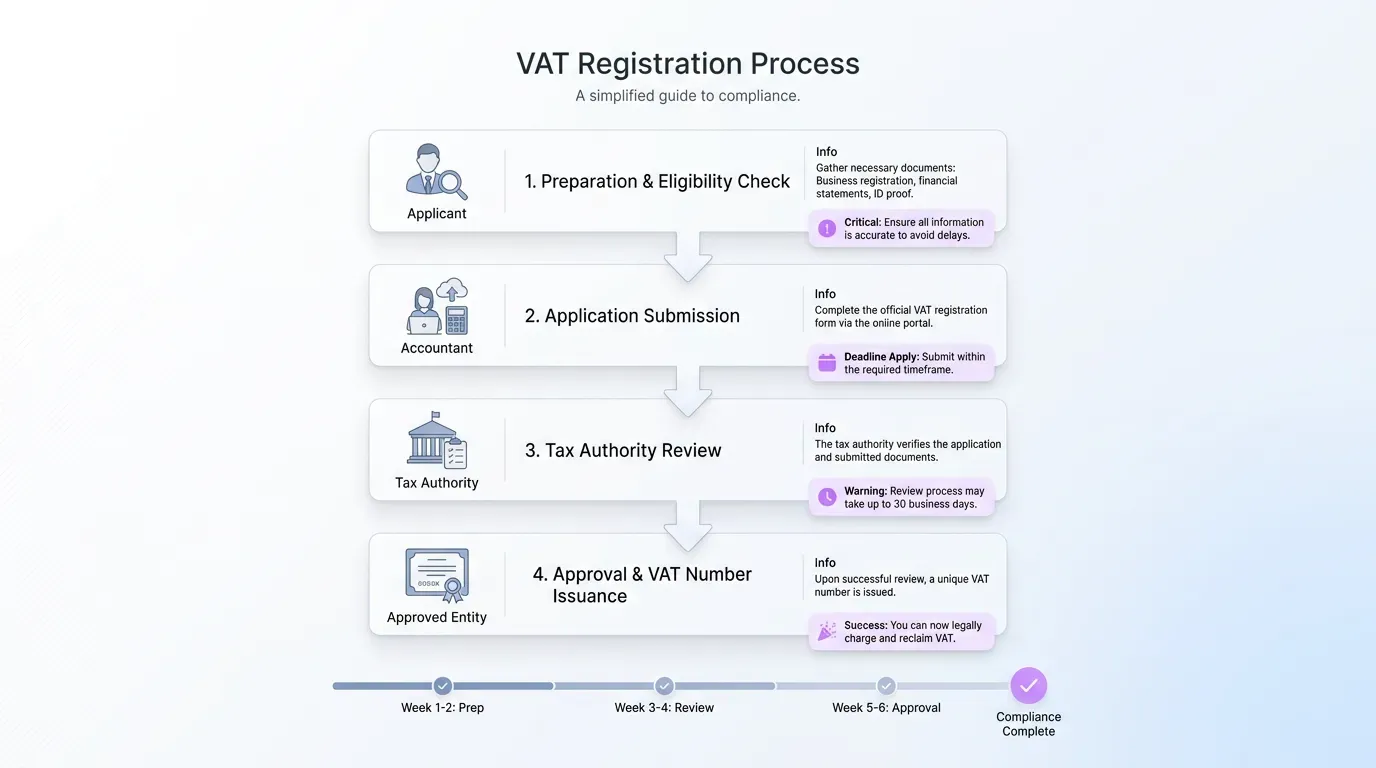
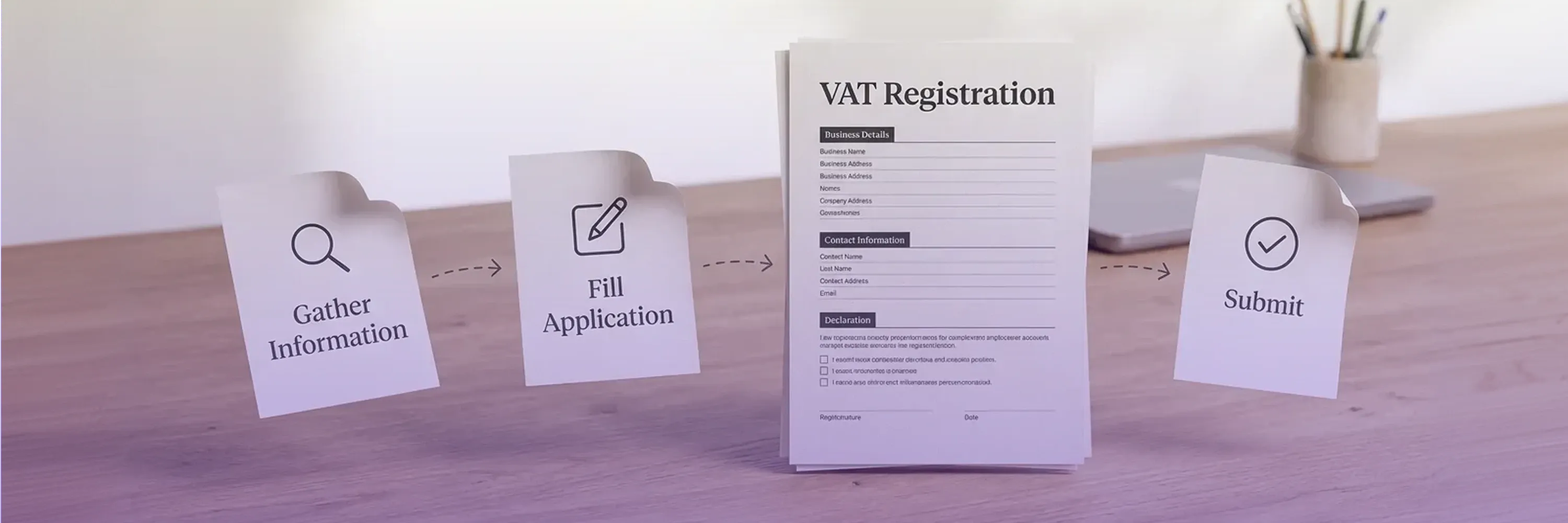
Registration for VAT is online in nearly every country that operates a modern tax system. The structure is similar everywhere: create an account, complete a form, attach evidence, submit, and wait. What follows is the typical flow, with the common stumbling blocks called out.
Create your tax account
Start on your tax authority's portal. In the UK, this is the Government Gateway used by HMRC. In Ireland this is ROS; in Germany this is ELSTER. You'll be asked for an email address and identity documents such as a passport or national ID. Verification can take a few minutes or a few days. The country determines the timeline.
Store the login details in a password manager. The same account is used later for filing returns and paying VAT, so losing access creates real problems. If you work with an accountant, set them up as an authorised agent rather than sharing your own credentials.
Complete the VAT application form
Once inside, choose the option to register for VAT and work through the sections in order.
Expect questions on:
-
Business identification, with the legal name and registration number; add the trading name if it differs.
-
Activity codes, the local equivalent of a NACE or SIC code, that describe what the business does.
-
Expected taxable turnover for the next 12 months.
-
The effective date of registration for VAT, which is either the date you crossed the threshold or a forward-looking date for voluntary registration.
-
Bank account details for VAT refunds.
-
Information on related businesses and any prior VAT numbers, with group registration details where relevant.
The activity code field trips up more applicants than any other. Pick the code that reflects your main revenue source rather than a secondary line of business. Use a realistic turnover estimate because assessors compare it to your bank inflows and bounced applications often start with round numbers. If the form offers a flat-rate or cash accounting scheme, read the eligibility rules before ticking the box.
Submit and track your VAT number registration
After submission, the portal issues an acknowledgement reference. HMRC, for example, asks applicants not to chase the status until 40 working days have passed. Other authorities are faster: the Netherlands issues a VAT number within two weeks for straightforward applications, while Germany takes six to eight weeks because of additional anti-fraud checks.
If the authority asks for more information, respond through the portal rather than by email. Upload the requested document with a short note about what it shows, then confirm receipt. A partial rejection is rarely the end of the road. It signals one specific gap, and once that gap is closed, registration for VAT continues from where it stopped. A full rejection is rare and means the applicant didn't qualify because the trading activity is exempt or the entity isn't yet incorporated.
While you wait, you can continue trading. You cannot yet show a VAT number on invoices, but you can raise prices to cover the VAT that will eventually be due and reissue corrected invoices once the number arrives.
After you receive your VAT number
The VAT number registration certificate lands by post or as a downloadable PDF in your tax account. Read it carefully. It confirms the details of your registration for VAT: your number, the effective date of registration, the filing frequency, and the date your first return is due.
The immediate tasks are practical:
-
Update invoice templates to show the VAT number and the VAT amount on each line at the VAT rate applied.
-
Add the number to your website footer and any marketplace seller profiles, and update your terms of service too.
-
Configure accounting software (Xero, QuickBooks, Sage, or whatever you use) to apply the right rates and produce a return in the format your authority accepts.
-
Reissue any invoices raised between your effective date of registration and the date the number arrived so they show the VAT that was always due.
Displaying the number correctly matters. EU customers will check it against the VIES database before paying, and a missing or invalid number can hold up settlement. The certificate marks the beginning of compliance.
Ongoing duties and common mistakes
A VAT-registered business has recurring duties: charge the correct rate on every taxable sale and file returns on time, with records that prove both. In the UK you must keep VAT records for at least 6 years, or 10 years if you use the One Stop Shop. The EU One Stop Shop also requires records to be held for 10 years from the end of the year of the transaction.
The mistakes that catch new registrants are predictable. Missing a return deadline is the most expensive. HMRC's points-based regime issues a £200 penalty once a business reaches the threshold for its filing frequency, plus a further £200 for each subsequent late submission. Misclassifying zero-rated and exempt items is the second trap, because the two look similar but behave differently when you reclaim input VAT. Treating reverse-charge supplies as standard-rated, or the other way around, distorts the return and triggers correction notices.
A few habits keep most businesses out of trouble:
-
Reconcile sales and purchase ledgers monthly rather than scrambling at quarter-end.
-
Use Making Tax Digital-compatible software in the UK, or the equivalent e-invoicing platform in countries that mandate one.
-
Set calendar reminders for the return deadline and the payment deadline, which can differ by a few days.
-
Engage a VAT adviser whenever you start selling into a new country or change your business model.
Paul Riley, Director of Tax Administration at HMRC, framed the points regime this way when it launched: "Our aim is to help customers get things right before monetary penalties are applied; a points-based system for late VAT returns will not punish the occasional error." The system is forgiving of one slip and unforgiving of repeated ones.
Next steps and final tips
Registration for VAT is administrative work. Confirm whether you must register or want to register voluntarily, collect your documents, set up the tax account, fill in the form, and respond quickly to any follow-up questions. Bookmark this guide and prepare your folder before you begin the application when your numbers and paperwork agree.
If your situation involves multiple countries or marketplace sales, especially when an activity sits on the edge of an exemption, talk to an accountant or call your local tax authority before submitting. A 30-minute conversation is cheaper than a corrected return.
1stopVAT handles registration for VAT and ongoing compliance across more than 100 jurisdictions, with return filing covered for international businesses. If your VAT application process touches more than one country or you'd like a second pair of eyes on your VAT number registration before you submit, reach out to our team for a consultation.