Who handles multi-state sales tax registration?

Content authorBy Beata ČepėPublished onReading time13 min read
Corporate team meeting around a conference table reviewing a large map of the United States with laptops and business analytics dashboards.

Multi-state sales tax registration in the US is handled by four types of parties: in-house finance teams, certified public accountants (CPAs) or tax attorneys, automated tax software vendors, and dedicated indirect tax compliance providers. Most growing remote sellers outsource the work to a managed provider once nexus spreads beyond two or three states.

What does multi-state sales tax registration actually involve?

Multi-state sales tax registration means obtaining a sales tax permit in every US state where a business has nexus, then maintaining filings and remittances under each state's distinct rules, with exemption certificate records kept as part of the same compliance file. It is a recurring operational obligation.

Each state runs its own revenue department, its own permit application, its own filing calendar, and its own taxability rules for products and services. A seller registered in Illinois files differently than one registered in Washington, even when selling the same SKU. Marketplace facilitator laws and local sourcing rules sit on top of all that. Exemption certificate handling adds another layer.

The US is the only OECD member without a national value added tax, according to the OECD's Consumption Tax Trends 2024, which leaves 45 separate state-level sales tax systems and thousands of local add-ons. That fragmentation is why "registration" means standing up and maintaining a compliance footprint in every taxing jurisdiction touched by a business.

Why is multi-state registration so hard to handle alone?

Most growing sellers can't manage multi-state registration internally because they're dealing with 45 state sales tax regimes, thousands of local jurisdictions, varying economic nexus thresholds, and post-Wayfair enforcement that creates real penalty exposure. The work scales faster than headcount.

The US Supreme Court's 2018 decision in South Dakota v. Wayfair ended the physical presence rule and let states tax remote sellers based on economic activity alone. Within a year, 33 states had passed economic nexus laws, and every state with a sales tax has one today. A seller can cross the line in a state without ever stepping foot there.

That shift turned registration from a footprint question into a revenue question. Finance teams who used to track warehouses now have to track state-level sales by product type across marketplace channels and react before the next filing deadline.

How do economic nexus thresholds differ by state?

No, thresholds aren't uniform. Most states use $100,000 in sales or 200 transactions, but the variations matter. California sets the dollar bar at $500,000, and Texas and New York do the same, while smaller states stay at $100,000. A few states have dropped the transaction count entirely.

In February 2025, New Jersey and Utah removed the 200-transaction trigger and joined a growing list of states that now rely on revenue alone. That change matters for low-ticket sellers who used to trip nexus on volume before ever hitting meaningful revenue. The trend says states are tuning their rules to protect smaller out-of-state sellers from administrative overload while still capturing the larger ones.

What penalties follow late or missed registration?

Late registration triggers back taxes for every taxable sale made after nexus was established, plus interest and failure-to-file penalties; in many states, corporate officers face personal liability. The combined cost regularly exceeds the unremitted tax itself.

A UK government-funded export advisory program from the East Midlands Combined County Authority warns that fines and interest average 30% of the sales tax due for non-compliant exporters into the US. States also pursue responsible officers personally when a business dissolves with unpaid trust fund taxes. The practical takeaway is that delayed registration converts a manageable compliance cost into a balance sheet liability that boards and acquirers will price into any future transaction.

How often do registration rules change?

State sales tax rules change every legislative session. Thresholds shift and the taxability of digital goods is rewritten as marketplace facilitator rules expand to new categories. A registration handler has to monitor every state to keep filings accurate.

In 2025 alone, Louisiana ended mail delivery of sales tax returns, and Alaska revised its remote seller threshold after Illinois issued new SaaS taxability rulings. None of these were headline news outside tax circles, but each one changed how a registered seller has to file. Internal teams without a dedicated indirect tax function lose track of these updates because the work isn't continuous enough to justify a full-time hire.

Who can handle multi-state sales tax registration?

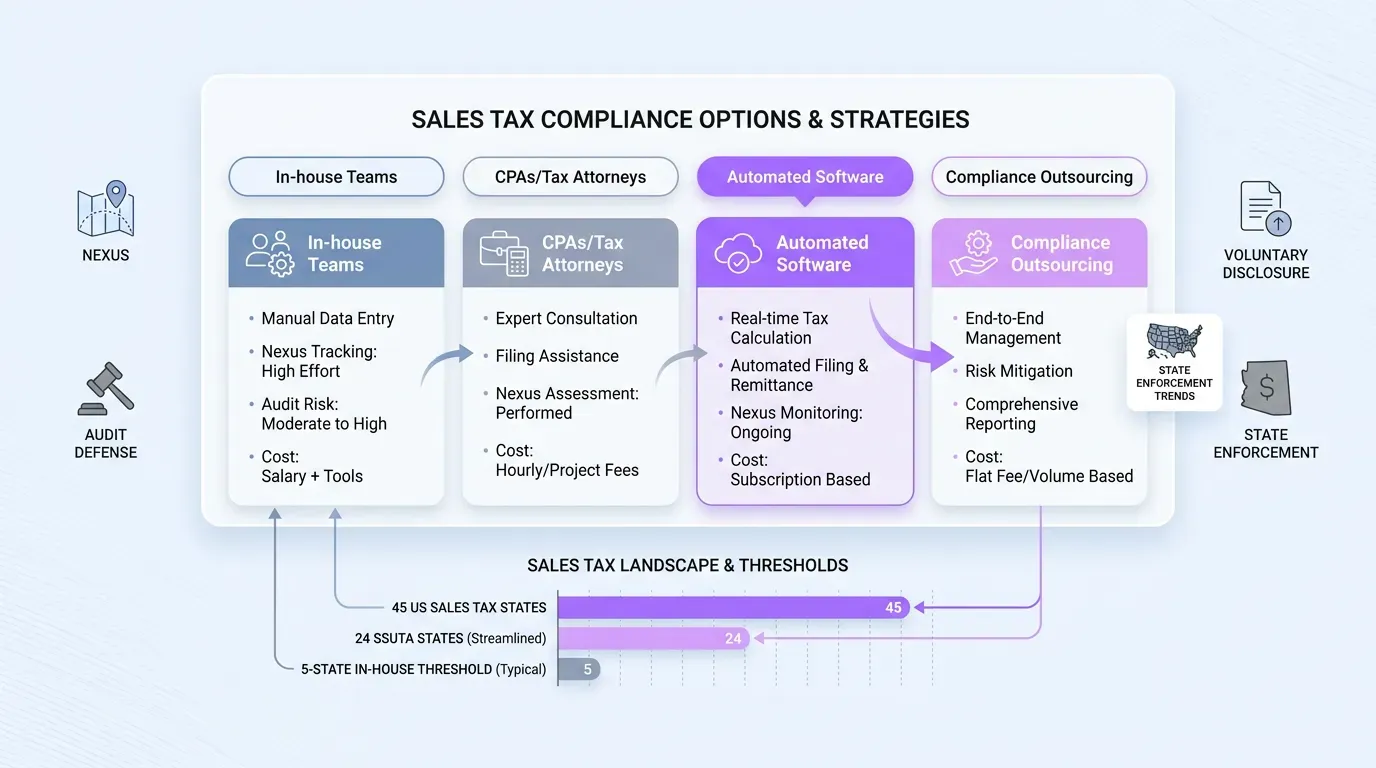
SaaS infographic comparing sales tax compliance options with a central panel, icons, and a minimalist bar chart on a soft gradient background.

Four types of parties handle multi-state sales tax registration in practice: the business itself through its in-house finance team, CPAs or tax attorneys, automated tax software vendors with registration add-ons, and dedicated indirect tax compliance providers. Each fits a different stage of growth.

The choice comes down to state scope and digital products, with international obligations alongside US ones treated as a separate constraint.

Here is how the four options compare in plain terms:

  • In-house teams work for a couple of states and stable product catalogs

  • CPAs and tax attorneys add legal judgment but rarely run ongoing filings at scale

  • Automated software handles calculation and filing well, with registration as an add-on

  • Dedicated providers cover registration, filings, nexus monitoring, and notices end to end

The rest of this section walks through each option so you can match it to your situation.

Can the in-house finance team do it?

Yes, an in-house finance team can register a business in one or two states and run the filings from a spreadsheet. The model breaks down once nexus reaches five or more states because filing cadences and notice volumes start to compete with every other accounting task while exemption certificate handling adds to the workload.

A 2017 GAO report cited by the OECD found that voluntary use tax compliance from out-of-state purchases is extremely low, which is exactly why states have pushed enforcement onto sellers. Internal teams keeping up with that enforcement need software tied to a sales tax calendar, with at least one person who knows what a managed compliance agreement is. Most growing finance teams don't have that bandwidth.

Do CPAs and tax attorneys register clients?

Many CPAs and tax attorneys register clients, but few specialize in indirect tax across all 45 sales tax states. The strong ones offer judgment on voluntary disclosure agreements and audit defense. Nexus studies belong in the same advice. The weaker ones quietly outsource the operational work or charge hourly rates that scale poorly against monthly filings.

The Council on State Taxation's senior tax counsel Fred Nicely told Bloomberg Tax in its 2019 state survey that state tax determinations have "so many nuances, grey areas, and unknowns" that compliance can't be reduced to a calculation engine. That's a fair argument for keeping a CPA in the loop on hard questions. It is a poor argument for paying one to file 30 routine returns a month.

What about the Streamlined Sales Tax program?

Yes, sellers can self-register through the Streamlined Sales Tax program in the member states using a single online portal. The catch is that the program excludes large non-member economies such as California and Texas, with Florida outside the program as well.

The OECD reported that as of August 2024, more than half of the 45 sales tax states are SSUTA members, with 24 currently participating. Sellers who register through the program get a single application and the option of a state-paid Certified Service Provider for filings. For a seller with nexus concentrated in member states, that's a real shortcut. For anyone selling into the big non-member states, SSUTA covers only part of the picture and still has to be paired with direct registrations elsewhere.

How do automated tax software tools fit in?

Automated tax software platforms like Avalara and TaxJar offer registration as a paid add-on; Vertex works in the same category, but the core product is rate calculation and filing automation instead of end-to-end compliance management. Software handles the math reliably and breaks when state notices or audit letters land in your inbox; registration corrections create the same problem.

Deloitte's National Multistate Tax Leader Valerie Dickerson said after the Wayfair ruling that companies "may have to revise their business models, their IT systems and their internal processes," according to a 2018 Deloitte statement on the decision. Software covers the IT and process side. By itself, it leaves the seller to decide where to register and when to pursue a voluntary disclosure agreement, with Texas comptroller notices handled outside the tool. That gap is why most software users still pair the platform with either a CPA or a managed provider.

What do dedicated compliance providers do?

Dedicated indirect tax compliance providers register the business in each state, file ongoing returns, monitor nexus across jurisdictions, handle state notices, and serve as a single point of accountability staffed by human tax specialists. The model is built around recurring obligations.

Harley Duncan of KPMG's state and local tax group said in a 2018 KPMG statement on Wayfair that physical presence was no longer a prerequisite for collection, and that shift put sellers into "uncharted territory." Providers like 1stopVAT exist to map that territory continuously. The reason this matters is straightforward: when a seller's nexus changes mid-year, the provider acts on the change, while software waits for the seller to update a setting.

Which option fits which type of business?

The right handler depends on the seller's nexus footprint, transaction volume, product mix, and international expansion plans. Domestic sellers with light nexus can manage with software. Sellers in 10 or more states, or those crossing borders, benefit from a managed compliance partner.

The Bloomberg Tax survey found that the number of states with economic nexus more than doubled within a year of the Wayfair decision, and the total jumped to 33 states by May 2019. The pace of that expansion is what makes any "set it and forget it" approach risky. A business that fits the software profile this quarter can outgrow it next quarter without realizing it. Reviewing handler fit annually, against current nexus data and growth plans, keeps the compliance model aligned with where the business actually sits.

When is software alone enough?

Software alone is enough for purely domestic sellers with stable nexus in fewer than five states and a single product category, with a finance team comfortable reading state notices. The numbers stay manageable and the software's filing automation does the heavy lifting.

The OECD's 2018 simplified registration report noted only 3,777 sellers had registered under SSUTA's simplified regime as of late 2017, a thin uptake that suggests most growing sellers don't stop at the lightweight option. If the catalog is stable and the states are few, software keeps overhead low when the team has bandwidth, without buying capacity nobody uses.

When do you need a managed service?

A managed service becomes necessary once a business crosses nexus in 10 or more states, sells digital products with shifting taxability, faces state notices regularly, or expands outside the US. At that point, the volume of recurring work exceeds what a finance team can carry without hiring.

The Wayfair ruling expanded sales tax obligations rapidly across the country, and as the OECD noted in its 2024 Consumption Tax Trends, every one of the 45 states with sales taxes has adopted remote seller collection rules. A managed provider absorbs that scope as a service line. The implication for finance leaders is practical: at the 10-state mark, the cost of a managed service is less than the salary of the half-FTE you would otherwise hire to keep up.

How does US sales tax connect to global VAT and GST?

US sales tax connects to global VAT and GST through the same underlying obligation: registration where you sell and collection at the right rate, followed by remittance to the local authority. Businesses selling internationally face parallel obligations under EU and UK VAT and Canadian and Australian GST, with similar regimes across the rest of the world.

The OECD reports that VAT has been implemented in 175 countries worldwide and now operates in 37 of the 38 OECD member countries, with the United States as the lone exception. A US-based seller shipping to Germany hits EU VAT rules. A European seller hitting California's $500,000 threshold owes US sales tax. The two systems collide constantly for cross-border e-commerce, and a registration strategy that ignores one side leaves the other exposed.

Why split US and international compliance across vendors?

Splitting US and international compliance across separate vendors creates blind spots and duplicated data entry, and it slows responses to nexus triggers in either region. It also produces two reporting cadences that finance teams have to reconcile manually.

When a seller crosses the EU's distance selling threshold in the same quarter it crosses Texas's $500,000 threshold, a single provider catches both. Two providers each catch one. The OECD's Consumption Tax Trends 2024 shows VAT raising about a fifth of total tax revenue across the OECD, which is why authorities globally have invested heavily in enforcement against non-resident sellers. Splitting compliance across providers raises the probability that one of those enforcement letters lands before the seller knew the threshold was approaching.

What does unified indirect tax compliance look like?

Unified indirect tax compliance means one provider managing US state registrations, EU One Stop Shop (OSS) filings, UK VAT, Canadian and Australian GST, and other regimes through a single account team and reporting cadence. The seller sees one dashboard and one point of contact, with a consolidated calendar behind both.

The Bhutan GST launch in 2026 added another jurisdiction to the global map, according to VATabout's 2026 indirect tax review, while Liberia is preparing to replace its GST with a VAT system in 2027. New regimes appear every year. A unified model means new-country expansion gets added to an existing service line, which avoids a fresh vendor search and keeps cross-border growth from stalling on compliance setup.

How 1stopVAT handles multi-state registration and global compliance

If you've read this far, you already know that the operational choice is who runs the registration process. 1stopVAT is built for businesses that need US sales tax registration and international VAT and GST compliance handled by one accountable partner.

Here is what the service covers in practical terms:

  1. Sales tax registration across all US states starting at $250 per state

  2. Ongoing return filings from $99 per return, including state notice handling

  3. Continuous nexus monitoring across more than 12,000 US local jurisdictions

  4. VAT and GST registration and filings in 100+ countries, including the EU OSS, UK VAT, and Canadian and Australian GST

The team has 40+ certified tax specialists working across US sales tax and international indirect tax, so US-only sellers get the same depth of support as cross-border ones. If your business is approaching nexus in new states or expanding into Europe, talk to 1stopVAT for a scoping call and a fixed-price proposal aligned to your current footprint; the same process applies if you are already juggling two compliance vendors.

You need business identity details and state-specific sales data before filing a registration. The application usually asks who owns the company, when taxable sales began, what the company sells, and how much revenue came from that state. Use the nexus date as the starting point for filing obligations.

Plan for registration to take days or weeks, because each state reviews applications on its own timetable. Online permits can arrive quickly, while accounts that require extra identity checks take longer. Start before the first filing deadline so the business can collect tax and file on time.

You shouldn't collect sales tax in a state before you have the required permit. The safer approach is to register as soon as nexus starts, then begin collection once the account is active. If sales already occurred, ask a tax adviser whether back returns or disclosure are needed.

Close a permit only after the business no longer has a collection duty in that state and all final returns are filed. Leaving an unused account open can trigger missing-return notices even when no tax is due. Keep closure confirmation with the state compliance file.

Sales tax registration doesn't automatically create income tax nexus, because income tax and sales tax use different legal tests. It can still flag the business to a state tax agency. If sales are large enough to require registration, review income tax nexus with a CPA or state tax adviser.

Simple Compliance

Free consultation with 1StopVAT experts

You Might Also Like

Discover more insights and articles

Stack of financial documents and tax paperwork on a desk beside a laptop and calculator in a modern office with city skyline view.

Import Duty Rates Explained: What Businesses Pay on Imports

This article explains how import duty rates work and what determines the amount a business pays when goods cross a border. It walks through classification, valuation, trade agreements, added taxes, and a full customs duty calculation so finance teams can plan landed costs with confidence.

Minimal business infographic illustrating the VAT registration process with steps for gathering information, filling out an application, completing a VAT registration form, and submitting documents.

VAT Registration Explained: How to Get Started

This article is a practical walkthrough of how to register a business for value-added tax from the first eligibility check to the day you submit your first return. It covers thresholds, paperwork, the online application, and the duties that follow once your VAT number arrives.

Business professional using an e-invoicing platform on a laptop beside VAT compliance records, tax documents, and regulatory filing folders in a modern office

How to Stay Compliant with EU E-Invoicing Regulations?

EU tax authorities collected €128 billion less in VAT than they were owed last year. Mandatory e-invoicing is their answer - and your deadline may already be closer than you think. Romania went live in 2024. Germany started in January 2025. Belgium follows in 2026. If your invoicing process still runs on PDFs and email, you're not just behind - you're at risk of invoice rejection, reporting penalties, and operational disruption across every EU market you operate in. This guide tells you exactly what's required, country by country, and how to get compliant before the deadline hits you.

Business professional reviewing a VAT registration guide and tax compliance documents at a modern office desk with laptop and paperwork

How to Register for a VAT Number: Full Guide

If you're selling goods or services across borders, there's one question you can't afford to ignore: do you need to register for a VAT number, and how do you actually get one? Missing this step can lead to fines, blocked shipments, and lost marketplace access.