

Overview
Reclaiming VAT is a critical yet often underutilized opportunity for businesses operating domestically or across borders. While the rules can appear complex, the underlying principle is straightforward: VAT should not be a cost to registered businesses. Understanding how to recover input tax efficiently can significantly improve cash flow and protect margins.
This article explains the fundamentals of VAT recovery, outlines eligibility requirements, clarifies which expenses qualify, and walks through the step-by-step claim process. It also highlights common pitfalls and cross-border considerations to help businesses approach VAT reclaim as a structured, compliant financial practice rather than an administrative burden.
Understanding the Fundamentals of VAT Recovery
Value Added Tax (VAT) is a consumption tax charged on goods and services, but it is not intended to be a cost for most businesses. The fundamental principle of the VAT system is that the end consumer pays the tax. Businesses merely act as unpaid tax collectors for the government. Consequently, most tax authorities allow registered businesses to offset the VAT they pay on purchases (input tax) against the VAT they charge on sales (output tax).
When your input tax exceeds your output tax, or when you incur expenses in a jurisdiction where you do not have sales, you are typically entitled to a refund. This mechanism prevents the “cascading effect” of tax being levied on tax. However, the gap between what should be collected and what is actually collected remains significant. In fact, Member States lost around €61 billion in VAT in 2021, highlighting the sheer scale of the administrative and compliance challenges involved.
Recovering these funds requires strict adherence to rules that vary by country. The system relies on evidence. Without the correct documentation, authorities will reject claims to prevent fraud. Understanding this baseline – that VAT recovery is a right but one that must be proven – is the first step toward a successful claim.
If you need a detailed comparison between domestic VAT refunds and cross-border reclaims – plus explanations of EU directives—see the VAT Refunds & Reclaims: How to Recover Input VAT Costs.
This foundational knowledge sets the stage for the practical application of these rules. Before you can file a claim, you must determine if your specific business situation and expenses meet the strict criteria set by tax authorities.
What Is VAT Reclaim?
VAT Reclaim is the statutory process by which a registered business recovers the Value Added Tax paid on goods and services used for commercial activities. This ensures that VAT remains a tax on end consumers rather than a cost to businesses. The process involves submitting valid tax invoices to the relevant domestic or foreign tax authority, proving that the expenses were essential for business operations and fall within eligible categories.
Assessing Your VAT Reclaim Eligibility
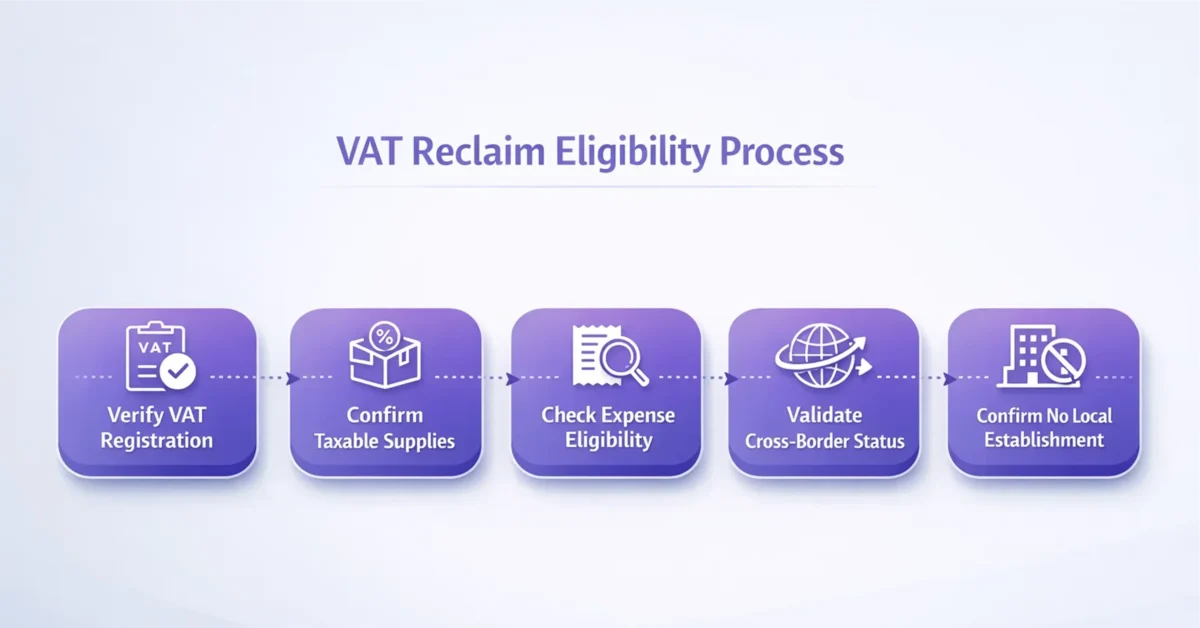
Not every business and not every expense qualifies for a refund. The first hurdle in the recovery process is establishing your status as a taxable person. Generally, this means your business must be registered for VAT in its home country and must be making taxable supplies. If your business activity is fully exempt from VAT (such as certain financial or medical services), you usually cannot recover the VAT you incur.
For companies operating internationally, the rules for VAT reclaim eligibility become more specific. You must typically prove that you are a business entity in your country of residence to reclaim tax paid in another country. This is often done by providing a Certificate of Taxable Status. Furthermore, the VAT you are trying to reclaim must be connected to your business activities. Personal expenses or costs related to non-business activities are strictly disqualified.
Key eligibility markers include:
- Registration Status – You must have a valid VAT number or tax ID in your home country.
- Nature of Business – Your company must use the purchased goods or services to generate taxable income.
- No Local Registration – For cross-border refunds (like the EU electronic refund scheme), you typically must not be registered for VAT in the country where you are claiming the refund, nor have a fixed establishment there.
If you meet these criteria, you are technically in a position to claim. However, eligibility is not a blanket approval for all spending. The next logical step is to sift through your ledgers to identify exactly which receipts will pass scrutiny and which ones will trigger a rejection.
For a practical checklist for cross-border reclaim eligibility (including documentation and process tips), read VAT Refunds & Reclaims: How to Recover Input VAT Costs.
Identifying Eligible Expenses for Reclaiming VAT
Once you have confirmed your business status, the focus shifts to specific transactions. Tax authorities are notoriously precise about what constitutes a deductible expense. While the broad rule is that the expense must be “for business purposes,” different jurisdictions apply this rule differently.
Commonly eligible expenses often involve travel and logistics. For example, a logistics company moving goods through Europe or a sales team attending a trade show in London will incur significant VAT on fuel, accommodation, and tolls. These are prime targets for recovery. The volume of these transactions is immense; for context, UK businesses paid a total of £171 billion in VAT in 2024–25, a significant portion of which represents B2B transactions that are theoretically recoverable.
Typical categories for VAT recovery include:
- Accommodation and Lodging – Hotel bills incurred by employees during business trips.
- Transportation – Fuel, road tolls, and public transport costs related to commercial activity.
- Conferences and Trade Shows – Entry fees and booth rental costs often carry high VAT rates.
- Professional Services – Legal or consulting fees incurred in a foreign jurisdiction.
- Training and Education – Costs for courses or seminars attended by staff.
However, there are notable exclusions. Most countries block VAT recovery on expenses that have a “private enjoyment” element. Client entertainment is the most common example. If you take a client to dinner, the VAT on that meal is frequently non-recoverable, even if business was discussed. Similarly, purchasing cars for mixed business and personal use often comes with a 50% restriction or a total block on VAT recovery depending on the country.
Understanding what you can claim is only useful if you know how to process those claims across different borders. Domestic recovery is usually handled in your standard return, but foreign VAT recovery introduces a new layer of complexity involving different tax offices and portals.
For a full walkthrough of which cross-border expenses qualify (including exceptions by country), visit the section “Which Expenses Qualify for Cross-Border VAT Recovery?” in VAT Refunds & Reclaims: How to Recover Input VAT Costs.
Navigating Cross-Border VAT Recovery
The complexity of reclaiming VAT spikes when your business purchases goods or services in a country where it is not established. For European businesses, this is handled through the electronic cross-border refund system (Directive 2008/9/EC). You submit the claim through your own country’s tax portal, which then forwards it to the country of refund.
For non-EU businesses claiming in the EU (13th Directive), the process is manual and paper-based, often requiring the appointment of a fiscal representative. This fragmentation creates a compliance burden. Despite the administrative hurdles, the systems are working; EU Member States collected over €17 billion in VAT via the expanded OSS portal for intra-EU sales, showing that cross-border mechanisms are heavily utilized.
Managing these obligations often requires more than just a spreadsheet. Dealing with tax authorities in 20 different languages and navigating varying deadlines can overwhelm internal finance teams. This is where a partner like 1stopVAT becomes valuable. By acting as a single point of contact for global VAT compliance, they combine certified tax specialists with technology to ensure claims are filed correctly across 100+ countries, removing the friction of dealing with multiple foreign tax offices.
For step-by-step process advice, including digital vs. paper filing and timelines for both EU and non-EU claims, see How to File VAT Returns Online: Streamlining Digital Submission.
With the jurisdiction and eligibility sorted, the final piece of the puzzle is the execution. The actual process of filing the claim requires precision, perfect timing, and impeccable record-keeping.
The Step-by-Step Claim Process
Executing a successful VAT reclaim involves a disciplined workflow. Tax authorities will look for reasons to reject a claim, so the burden of proof rests entirely on your business. A systematic approach ensures that when you hit “submit,” you can be confident of a refund rather than an audit.
Step 1: Gather and Audit Invoices
The invoice is the most critical document in the process. A credit card slip or a booking confirmation is rarely sufficient. You need a valid tax invoice.
- Ensure the invoice serves as a valid tax document.
- Verify it includes the supplier’s VAT number and address.
- Check that your business name and address are spelled correctly.
- Confirm the VAT amount is stated separately from the gross amount.
Step 2: Prepare the Data for Submission
Once you have your physical or digital invoices, they need to be tabulated. For domestic claims, this goes into your standard VAT return (Box 4 in the UK, for example). For foreign claims, you must categorize expenses according to the refunding country’s specific codes (e.g., distinguishing between fuel and accommodation codes).
- Scan all original invoices as many portals require digital attachments.
- Convert foreign currencies to the reporting currency using the exchange rate on the invoice date (often the European Central Bank rate).
- Double-check that the total claim meets the minimum threshold (often €50 or €400 depending on the filing frequency).
Step 3: Submission and Follow-up
Submit the claim through the appropriate portal. For EU refunds, this must be done by September 30th of the following year. Once submitted, the status will change to “received” or “under review.”
- Monitor the portal for queries. Tax authorities often ask for additional invoices or clarification on the business nature of an expense.
- Respond to queries immediately. Missing a response deadline can invalidate the entire claim.
A smooth process relies on avoiding unforced errors. Even with a perfect process, small mistakes can cause delays or rejections. Being aware of these common pitfalls is the best defense against lost revenue.
Need a more granular process workflow, including invoice quality checklists and validation steps? See How to Submit VAT Online: A Step-by-Step Guide for a thorough breakdown.
Common Pitfalls and How to Avoid Them
The difference between a refund check and a rejection letter often comes down to detail. One of the most frequent errors is missing the hard deadline. Unlike some domestic tax filings where you might pay a small fine for lateness, foreign VAT refund deadlines are typically absolute. If you miss the September 30th cutoff for EU claims, the money is lost forever.
Another major issue is the quality of documentation. Submitting simplified invoices (like restaurant receipts) where a full VAT invoice is required will lead to immediate disqualification of that expense. It is vital to train staff to ask for a “VAT invoice” at the point of purchase, rather than just accepting a card terminal receipt.
Finally, businesses often fail to distinguish between recoverable and non-recoverable VAT rates. Some countries allow 100% recovery on fuel, while others may only allow 50%. Claiming 100% when only partial recovery is permitted can trigger penalties. Improvements in compliance are visible, as the UK’s VAT gap was estimated at £8.1 billion in 2022–23, a significant reduction from previous years, suggesting that businesses and authorities are getting better at managing these liabilities accurately.
Explore more error-avoidance strategies, and see the top mistakes businesses make in VAT reclaims in the VAT Filing & Returns: A Complete Guide for Businesses.
Conclusion
Successfully reclaiming VAT is a vital component of financial efficiency for any modern business. While the rules surrounding VAT reclaim eligibility and cross-border recovery can seem dense, breaking them down into clear steps – assessing your status, gathering valid documentation, and meeting strict deadlines – makes the task manageable. By treating VAT recovery as a standard operational process rather than an afterthought, your business can safeguard its bottom line and ensure that you never pay more tax than is legally required.
For further insights and best practices – including leveraging digital solutions to streamline filing and prevent compliance errors – be sure to visit VAT Refunds & Reclaims: How to Recover Input VAT Costs, How to File VAT Returns Online: Streamlining Digital Submission, and How to Submit VAT Online: A Step-by-Step Guide.
Frequently asked questions
For businesses established in the EU claiming VAT from another EU country (under the 8th Directive), the deadline is strictly September 30th of the calendar year following the refund period. For non-EU businesses (13th Directive), deadlines vary by country, but many are set for June 30th of the following year.
VAT on hotel accommodation for business trips is generally recoverable in most countries. However, VAT on restaurant meals and client entertainment is frequently blocked or restricted. You must check the specific deductibility rules of the country where the expense was incurred.
Yes, valid VAT invoices are mandatory. A credit card receipt or order confirmation is insufficient. The invoice must clearly state the supplier’s VAT number, the tax amount, the date, and your company’s full details. Digital scans are acceptable for online submissions, but you should retain originals in case of an audit.
If a claim is rejected, the tax authority will provide a reason, such as invalid invoices or ineligible expenses. You usually have a right to appeal within a specific timeframe (often one month). It is crucial to address the specific reason for rejection, such as providing a corrected invoice or clarifying the business purpose of the expense.
1stopVAT simplifies the process by handling the complex administrative work involved in global VAT compliance. Their team of certified specialists manages filings across 100+ countries, ensuring you meet diverse local rules and deadlines without needing to hire local experts in every jurisdiction.