Import Duty Rates Explained: What Businesses Pay on Imports

Content authorBy Donatas StasytisPublished onReading time11 min read
Stack of financial documents and tax paperwork on a desk beside a laptop and calculator in a modern office with city skyline view.

This article explains how import duty rates work and what determines the amount a business pays when goods cross a border. It walks through classification, valuation, trade agreements, added taxes, and a full customs duty calculation so finance teams can plan landed costs with confidence.

What import duties actually are

Import duty is a tax a government charges on goods entering its customs territory, and import duty rates are the percentages or fixed amounts that determine how much an importer owes. Duty is paid to the customs authority at the time of clearance, before the goods are released for sale or use. It is separate from Value Added Tax (VAT) and Goods and Services Tax (GST), which apply to consumption inside the country.

Governments charge duty for two reasons. The first is revenue, since border collections are easier to administer than chasing thousands of domestic transactions. The second is trade policy, because higher import duty rates on certain goods protect local producers from cheaper imports.

On a customs bill, duty is one line among several. You'll see merchandise processing or handling fees and VAT or GST charged on the duty-inclusive value, with excise added for specific goods like alcohol or fuel. Treating duty as the whole import cost is a common mistake that distorts pricing decisions.

How import duty rates are set

Each country publishes import duty rates in a tariff schedule based on the Harmonized System (HS), an international classification framework developed by the World Customs Organization. The HS is used by more than 200 economies and covers around 5,000 six-digit commodity groups.

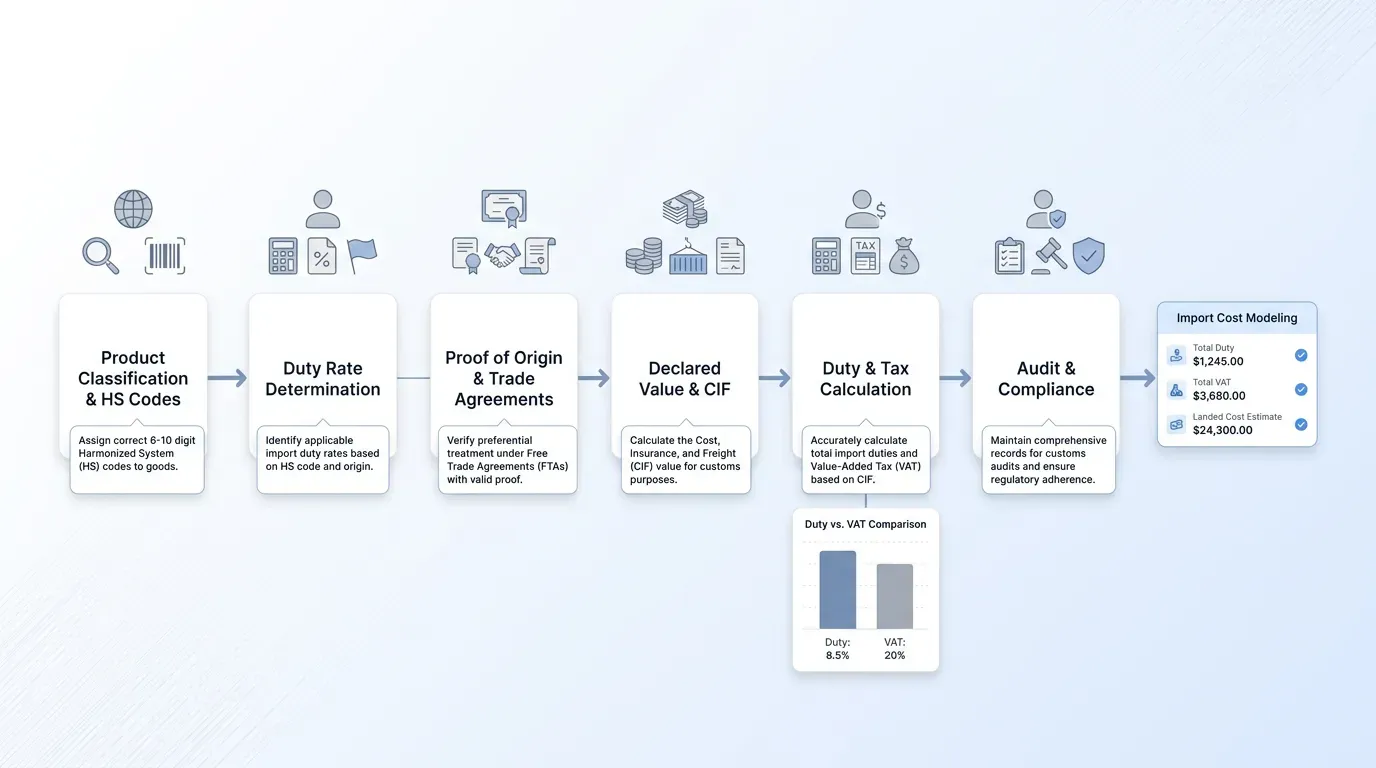
Three variables shape the rate that actually applies to a shipment. Product classification fixes the baseline rate from the schedule. Country of origin determines whether preferential treatment under a free trade agreement is available. Declared customs value sets the base on which any percentage rate is calculated.

Import duty rates themselves come in different formats:

  • Ad valorem rates, expressed as a percentage of customs value (for example, 5%)

  • Specific rates, charged as a flat amount per unit or kilogram

  • Compound rates, which combine both, such as 4% plus $0.20 per kilogram

The simple average tariff applied by World Trade Organization (WTO) members on a most-favored-nation basis fell from 13.2% to 7.4% between 1996 and 2021. That global average hides wide variation across products and countries, which is why import tax rules require you to check the exact line in the schedule for precise figures.

Factors that change what you pay

A clean SaaS UI illustration showing a horizontal process flow for import cost calculation with labeled steps and minimalist icons.

Two businesses importing the same product end up with very different bills. The variables below explain why, and each one is something you can audit and improve.

Product classification and HS codes

The HS code assigned to a product directly determines its duty rate. The first six digits are consistent across countries, and national authorities add further digits for granularity. The European Union's Combined Nomenclature uses eight digits, while the United States uses ten under the Harmonized Tariff Schedule.

Misclassification is one of the most frequent causes of overpayment and penalties. European auditors flagged tariff classification errors as a primary source of customs fraud and revenue loss and identified deliberate misclassification, undervaluation and false origin as the main fiscal customs fraud types. In the UK, civil penalties for serious classification errors can apply when duty or import VAT exceeds £10,000.

A short example shows how much the code matters. A women's knit blouse imported into the UK falls under chapter 61, which sits in the 12% tariff bucket under the LVI proposals. A similar woven blouse falls under chapter 62, also 12%, but a polyester scarf lands in chapter 50 silks or chapter 55 man-made fibres with very different import duty rates. One word in the product description can shift the code and the bill.

Country of origin and trade agreements

Where goods are manufactured affects the rate as much as what they are. Preferential trade agreements lower or eliminate duty on qualifying goods that meet the agreement's rules of origin. Under the United States-Mexico-Canada Agreement (USMCA), qualifying goods move duty-free between the three countries. The Comprehensive Economic and Trade Agreement (CETA) made 98% of tariff lines duty-free at entry into force, and that share rose to 99% by January 2024. The EU-Japan Economic Partnership Agreement eliminated 99% of EU tariff lines and 97% of Japan's at entry into force.

To claim the lower rate, you need proof of origin in the form of a certificate or self-declaration from the exporter that meets the agreement's documentation rules. Without it, customs applies the most-favored-nation rate by default. The EU's overall MFN average for all goods sits at 5.2% in 2023, while the US average was 4.8%, so the gap between preferential and standard treatment is the difference between a thin margin and a profitable one.

Customs duty calculation and declared value

Customs duty calculation starts with the declared customs value. For most countries this is the Cost, Insurance and Freight (CIF) value, which is the price paid for the goods plus insurance and freight to the border. The duty rate from the tariff schedule is then applied to that base.

A simple worked example: a 5% duty rate on a $10,000 CIF shipment produces $500 in duty. If the rate were 12%, the same shipment would owe $1,200. The percentage looks small until you multiply it across a year of containers.

Undervaluing goods to reduce duty is illegal and audited heavily. The EU's anti-fraud office identifies mis-declaration of value as one of the main fiscal customs fraud types, alongside misclassification and false origin. Customs authorities cross-check declared values against transactional databases, so the short-term saving rarely survives a post-clearance audit.

Additional taxes and import tax rules

Duty is rarely the only charge. Import tax rules in most countries add VAT or GST, plus processing or handling fees on top of the duty, with excise added on certain categories. These charges are calculated separately on the duty-inclusive value, which compounds the cost.

UK guidance is explicit on this point. When goods enter Northern Ireland and are deemed at risk of onward movement, VAT is calculated on the customs value including any duties due. The same logic applies in most EU member states and many other jurisdictions. A 20% VAT rate applied to a duty-inclusive value adds meaningfully more than 20% of the original goods price.

The practical effect: when you compare landed costs across suppliers or routes, you must model the full border charge because VAT or GST and any country-specific fees change the total. Looking at the duty line alone hides up to two-thirds of the import tax rules that determine your final cost.

A simple duty calculation example

Walk through a realistic scenario for customs duty calculation. A UK retailer imports 1,000 units of a cotton t-shirt from a supplier in Bangladesh. At $8 per unit, the invoice totals $8,000; freight to the UK port is $1,200 and insurance is $300.

Step 1: confirm the HS code. Cotton t-shirts fall under HS heading 6109. The retailer checks the UK Global Tariff and finds a duty rate of 12% applies to non-preferential origins.

Step 2: calculate the CIF customs value.

  • Goods: 1,000 × $8 = $8,000

  • Freight: $1,200

  • Insurance: $300

  • CIF value: $9,500

Step 3: apply the duty rate. 12% of $9,500 = $1,140 in import duty.

Step 4: calculate VAT. UK standard VAT is 20%, charged on the CIF value plus duty. That base is $9,500 + $1,140 = $10,640. VAT due is $2,128.

Step 5: total landed tax cost. Duty of $1,140 plus VAT of $2,128 equals $3,268 in border charges on a $9,500 shipment. The full landed cost, before domestic logistics, is $12,768. If the same shirts came from a country with a UK preference agreement and the documents were in order, the duty line would drop to zero and pull total border charges down to $1,900 in VAT only.

Ways to reduce duty costs legally

Legitimate duty reduction relies on structure and sourcing. The most common approaches are visible to customs and built into the trade system itself.

  • Source from countries with favorable trade agreements and ensure suppliers can issue valid origin documentation

  • Use bonded warehouses or foreign-trade zones to defer duty until goods enter domestic commerce, or eliminate it entirely on re-exports

  • File duty drawback claims to recover duty paid on goods that are later exported or destroyed

  • Apply tariff engineering by designing or finishing products so they qualify for a lower-duty classification, provided the classification is technically correct

Foreign-trade zones illustrate the scale of these programs. The US FTZ network now includes more than 1,300 active operations across all 50 states and Puerto Rico; those operations supported around 543,000 jobs in 2024. Goods stored in a zone sit outside US customs territory for duty purposes until they're withdrawn for domestic consumption, which gives manufacturers cash-flow benefits and the option to re-export without ever paying duty.

Duty drawback works differently. An importer pays duty on entry, then claims a refund on the portion of those goods that are re-exported or used in exported finished products. The EU-Japan EPA explicitly permits duty drawback on non-originating materials used to produce a product exported under preferential tariff, which means manufacturers serving multiple markets can structure flows to recover duty on the export portion.

The line between tariff engineering and evasion sits at the truthfulness of the declaration. Redesigning a product so it genuinely fits a lower HS heading is legal. Declaring a product as something it isn't, to get a lower rate, is fraud and triggers penalties and interest, with possible loss of trusted-trader status.

Where to find accurate rate information

Official sources are the only reliable place for current import duty rates. Each major customs authority publishes a searchable tariff database, and the WTO maintains a multilateral tariff portal that consolidates schedules across members. US Customs and Border Protection notes that it makes the final determination of the correct duty rate, not the importer, and offers binding rulings for products where classification is uncertain.

Reliable starting points include:

  • Your national customs authority's online tariff database (for example, the UK Global Tariff or the EU's TARIC)

  • The WTO's tariff download facility and World Tariff Profiles report

  • A licensed customs broker who can confirm classification and applicable preferences for your specific shipment

Third-party estimates and outdated spreadsheets cause real losses. The HS itself updates on a five-year cycle; the current version was introduced in January 2022, and national schedules change more frequently in response to trade remedies and political decisions. If you're quoting a customer or signing a supply contract on the basis of an old duty figure, the gap between assumed and actual import duty rates can erase the margin on the order.

When the value of the shipment is high or the classification is genuinely uncertain, a binding ruling from customs is worth the time it takes. It locks in the classification and rate for future imports of the same product, which removes audit risk from your forecasting.

Next steps for your business

Understanding customs duty calculation protects your margins and your pricing decisions. The same product carries different import duty rates when its HS classification and origin change; the customs value also changes the amount due, so a per-shipment review of each variable pays back quickly.

Three concrete actions are worth scheduling this quarter. Audit your current HS codes against the latest national tariff and confirm each one with a licensed broker. Review your supplier countries for trade agreement opportunities and check whether your existing suppliers can issue valid proof of origin. Add duty and VAT to your pricing model from day one, with processing fees included before clearance.

If you sell across borders, the duty layer connects directly to the VAT and GST obligations that follow inside each destination market. 1stopVAT helps international companies, including e-commerce businesses and finance teams, manage VAT registration and ongoing compliance across more than 100 jurisdictions, with reporting included in that work. For guidance on aligning your import tax rules and indirect tax position with the realities of current import duty rates, reach out to our team for a consultation.

Keep the commercial invoice, packing list, freight and insurance bills, customs entry, proof of origin, and classification notes. Store broker instructions and emails that explain valuation or product details. Retention periods differ by country, so use the longest period required in any market where you import.

Incoterms decide which party pays transport, insurance, and clearance costs, but they don’t replace customs valuation rules. Under CIF, freight and insurance to the border are already included. Under EXW or FOB, the importer usually adds those costs before calculating duty.

You can usually recover import VAT if you’re VAT registered and the goods are used for taxable business activity. You need the customs import document and a valid VAT entry in your accounts. Import duty isn’t usually recoverable unless a drawback, re-export, or relief scheme applies.

Yes, get a binding ruling when the product is high value, imported repeatedly, or hard to classify. The ruling gives customs’ formal decision on the product code, which helps you apply the correct import duty rates. Include product specifications, materials, intended use, and samples if customs asks for them.

Use a VAT specialist when imports trigger VAT registration, filing, or reporting duties in another country. 1StopVAT supports VAT registration and ongoing compliance across international markets. This can help finance teams keep import records, VAT returns, and local reporting aligned after customs clearance.

Simple Compliance

Free consultation with 1StopVAT experts

You Might Also Like

Discover more insights and articles

Corporate team meeting around a conference table reviewing a large map of the United States with laptops and business analytics dashboards.

Who handles multi-state sales tax registration?

Multi-state sales tax registration in the US is handled by four types of parties: in-house finance teams, certified public accountants (CPAs) or tax attorneys, automated tax software vendors, and dedicated indirect tax compliance providers. Most growing remote sellers outsource the work to a managed provider once nexus spreads beyond two or three states.

Minimal business infographic illustrating the VAT registration process with steps for gathering information, filling out an application, completing a VAT registration form, and submitting documents.

VAT Registration Explained: How to Get Started

This article is a practical walkthrough of how to register a business for value-added tax from the first eligibility check to the day you submit your first return. It covers thresholds, paperwork, the online application, and the duties that follow once your VAT number arrives.

Business professional using an e-invoicing platform on a laptop beside VAT compliance records, tax documents, and regulatory filing folders in a modern office

How to Stay Compliant with EU E-Invoicing Regulations?

EU tax authorities collected €128 billion less in VAT than they were owed last year. Mandatory e-invoicing is their answer - and your deadline may already be closer than you think. Romania went live in 2024. Germany started in January 2025. Belgium follows in 2026. If your invoicing process still runs on PDFs and email, you're not just behind - you're at risk of invoice rejection, reporting penalties, and operational disruption across every EU market you operate in. This guide tells you exactly what's required, country by country, and how to get compliant before the deadline hits you.

Business professional reviewing a VAT registration guide and tax compliance documents at a modern office desk with laptop and paperwork

How to Register for a VAT Number: Full Guide

If you're selling goods or services across borders, there's one question you can't afford to ignore: do you need to register for a VAT number, and how do you actually get one? Missing this step can lead to fines, blocked shipments, and lost marketplace access.