

Why Multi-Country VAT Gets Complicated Fast
Most businesses that come to us don’t have a VAT strategy problem. They have a sequencing problem. VAT registration in Germany came first – because Amazon thresholds forced it. Then France. Then Italy. By the time they contact us, they’re managing five or six jurisdictions through five or six different local accountants, and nobody has the full picture.
The complexity isn’t just about volume. It’s about variation. Consider a few of the differences that stack up quickly:
- Registration requirements vary by country. Some require a fiscal representative; others don’t. Some accept digital applications; others still rely on paper forms and notarized documents.
- Filing frequencies differ. Monthly in one country, quarterly in another, annually somewhere else.
- VAT rates and exemptions shift depending on the product category. A digital service taxed at 23% in Poland might carry a 21% rate in the Netherlands.
- Language barriers create real friction. Tax correspondence from local authorities often arrives only in the local language.
The global VAT/GST compliance landscape now spans more than 170 countries, and each one has developed its own interpretation of indirect tax rules. Even within the EU, where harmonization was the original goal, member states maintain significant local differences in VAT treatment.
For a marketplace seller shipping goods from a warehouse in the Czech Republic to customers in France, Spain, and Sweden, the compliance burden isn’t theoretical. It’s a daily operational reality.
For further tips on handling registration requirements and practical compliance checklists, see VAT services for US companies: How to Stay Compliant When Selling Internationally.
The Real Risk of Using Multiple Providers
When complexity grows, many businesses respond by hiring separate local accountants or tax agents in each country. It seems logical: who knows German VAT better than a German tax firm? Who understands Italian filings better than an Italian accountant?
In practice, this approach creates more problems than it solves.
Fragmented Communication and Accountability
With three or four providers handling different countries, there’s no single person who sees the full picture. Each provider manages their slice and assumes someone else is handling the rest. When a filing deadline in Spain overlaps with a registration renewal in Poland, nobody connects the dots.
This fragmentation leads to common failures:
- Missed deadlines because no one coordinated a shared compliance calendar
- Duplicate data requests, with each provider asking for the same invoices in different formats
- Conflicting advice, where one provider’s interpretation contradicts another’s
We’ve seen this exact situation unfold with UK-based marketplace sellers entering the EU after Brexit. One client – selling across four EU markets – received four different answers from four local accountants about whether distance selling thresholds still applied to their business model. None of the advisors knew what the others had said. The seller couldn’t make a confident decision for months. That’s not a knowledge gap. That’s a structural failure of the multi-provider setup. Without a unified view, the seller can’t make confident decisions.
Inconsistent Quality and Escalating Costs
Each local provider bills separately, often with different fee structures. Some charge per filing, others by the hour, and a few bundle services in ways that make comparison nearly impossible. The total cost of managing VAT across six countries through six providers can easily exceed what a single, coordinated partner would charge.
Quality also varies. A diligent tax agent in the Netherlands doesn’t guarantee the same standard from a small firm handling your Portuguese filings. When over 60 % of businesses report that managing tax compliance across jurisdictions is a significant challenge, the provider mix is often a root cause.
To see benchmarks and comparisons between leading providers -and why some setups fail businesses – see Best Cross-Border Tax Compliance Firms: Global VAT Experts.
The transition from fragmented to unified management isn’t just about convenience. It’s about reducing the surface area for errors that carry real financial penalties.
What a Single VAT Compliance Partner Actually Does
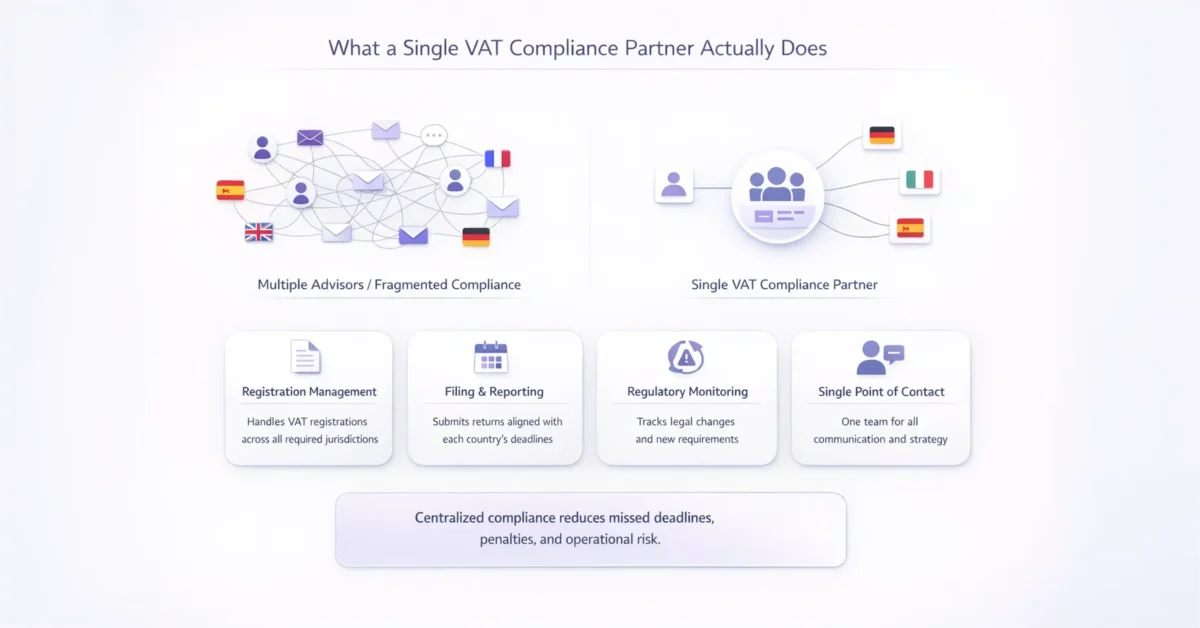
A centralized compliance partner takes ownership of the entire VAT lifecycle across all your markets. Instead of coordinating between five inboxes and five different advisors, you work with one team that understands your business holistically.
Here’s what that looks like in practice:
- Registration management across every required jurisdiction, including fiscal representation where mandated
- Ongoing filing and reporting, aligned to each country’s specific deadlines and formats
- Monitoring of regulatory changes, so you’re not caught off guard when a country introduces new e-invoicing mandates or adjusts rates
- Consolidated communication, giving you a single point of contact for questions, updates, and strategic planning
Real-World Impact on Marketplace Sellers
Marketplace sellers face unique pressure. Platforms like Amazon and eBay increasingly require proof of valid VAT registration before granting selling privileges in certain countries. A delay in registration or a lapsed filing can mean lost access to an entire market.
We’ve worked with U.S.-based sellers who came to us after exactly this sequence: fulfillment centers in Germany, France, and Italy, each managed by a separate local firm. The Italian filing slipped. Germany and France were fine. Italy was invisible until it wasn’t – and by the time it surfaced, the seller was facing penalties of up to 240% of the unpaid tax and a suspended Amazon listing. A single partner monitoring all three countries would have flagged the Italian deadline before it became a crisis.
How Centralized Compliance Reduces Risk
The risk reduction isn’t abstract. It shows up in fewer penalty notices, fewer missed deadlines, and fewer hours spent reconciling conflicting advice from multiple advisors. When one team manages everything, they can cross-reference your transaction data across countries, identify inconsistencies early, and ensure that your VAT positions are defensible if an audit arises.
This is where firms like 1StopVAT fit naturally into the picture. As a single point of contact with a team of 40+ certified tax specialists covering 100+ countries, 1StopVAT manages VAT registration, compliance, filing, and consulting for businesses selling internationally. For marketplace sellers specifically, having dedicated guidance and filings handled by one coordinated team removes the guesswork and the gaps that multi-provider setups inevitably create.
Key Factors When Choosing a Multi-Country VAT Partner
Not all compliance providers are built the same – and having worked across 100+ countries, we’ve seen exactly where the gaps tend to appear. When evaluating who should handle your multi-country VAT, a few criteria matter more than others.
- Country coverage: Can they handle all your current markets and the ones you plan to enter next year? Switching providers mid-expansion is disruptive.
- Specialist expertise: Tax rules for digital services differ from those for physical goods. Your partner should understand your specific business model.
- Regulatory monitoring: VAT rules change frequently. The EU alone has introduced major reforms through its “VAT in the Digital Age” initiative, affecting e-invoicing, platform liability, and registration rules.
- Transparent pricing: A clear fee structure across all countries prevents surprise invoices and budget overruns.
- Responsiveness: When a tax authority sends a letter in Portuguese demanding a response within 10 days, your partner needs to act quickly.
For a step-by-step guide to mapping your VAT footprint and comparing potential advisors, see Finding the Right VAT Consultant for E-commerce.
Questions to Ask Before Signing
Before committing to any provider, these questions help separate capable partners from those who’ll leave gaps:
- Do you handle both registration and ongoing filings, or only one?
- How do you track and communicate regulatory changes in each country?
- Can you provide a single dashboard or report covering all jurisdictions?
- What happens if a tax authority contacts me directly?
The answers reveal whether the provider truly operates as a unified partner or simply acts as a broker connecting you to local agents, which circles back to the fragmentation problem.
Who Handles Multi-Country VAT?
Multi-country VAT registration and reporting is handled by specialized compliance providers who manage the full VAT lifecycle across multiple jurisdictions. These partners take responsibility for registering businesses with local tax authorities, preparing and submitting periodic VAT returns, and monitoring regulatory changes in each country. Businesses benefit most when they work with a single provider rather than separate local agents, reducing the risk of missed deadlines, conflicting advice, and penalties.
Bringing It All Together
Multi-country VAT registration and reporting is one of those challenges that looks manageable at first and becomes overwhelming quickly. The difference between businesses that stay compliant and those that accumulate penalties often comes down to a single decision: whether to piece together a network of local providers or work with one partner who sees the full picture.
A centralized approach doesn’t just simplify administration. It creates consistency, reduces risk, and frees you to focus on growth instead of chasing deadlines across half a dozen tax portals. The countries you sell in will keep adding complexity. The question is whether your compliance setup can keep pace.
Conclusion
Managing VAT across multiple countries is not just an administrative task. It is an ongoing operational challenge that becomes harder with every new market you enter. Different registration rules, local filing requirements, language barriers, and changing regulations make it difficult to stay compliant when responsibility is split across disconnected providers.
That is why businesses selling internationally benefit most from working with a single partner that can manage VAT registration and reporting across all jurisdictions in one coordinated system. A centralized approach reduces the risk of missed deadlines, conflicting guidance, and costly penalties while giving your team greater visibility and control. Instead of juggling local agents country by country, you gain one clear compliance strategy that can scale with your business.
For companies expanding across borders, the right VAT partner does more than file returns. They help create the structure, consistency, and accountability needed to support long-term growth.
Frequently asked questions
Each country sets its own VAT rates, registration requirements, filing frequencies, and reporting formats. Even within the EU, significant local differences exist. Managing these variations across five or more countries simultaneously creates operational complexity that grows with every new market.
Penalties vary by jurisdiction but can be severe. Late filings may trigger financial penalties, interest on unpaid tax, and in some cases, suspension of your selling privileges on marketplace platforms that require valid VAT registration.
You can, but this approach often leads to fragmented communication, inconsistent quality, and higher total costs. No single person has visibility across all your obligations, which increases the risk of errors and missed deadlines.
1StopVAT acts as a single point of contact, managing VAT registration, compliance, and filing across 100+ countries. Their team of certified tax specialists provides dedicated guidance tailored to marketplace sellers, eliminating the need to coordinate between multiple local providers.
Frequently. Countries regularly adjust rates, introduce new e-invoicing mandates, and update reporting requirements. The EU’s ongoing “VAT in the Digital Age” reforms alone are reshaping compliance obligations for businesses selling across member states.