Financial analysis workspace with investment charts, stacked coins, calculator, and open notebook representing budgeting, accounting, and business planning.

Top Advisory Firms for VAT Calculation: Ensure Accurate Tax

A single VAT miscalculation can erase an entire quarter’s profit, yet many finance teams still depend on spreadsheets and fragmented processes. In today’s environment, accurate VAT calculation is a control function - not a back-office task - requiring precise rule interpretation and flawless execution at scale. This article revisits VAT fundamentals, highlights complex calculation risks, and ranks advisory firms with proven VAT accuracy expertise.

Content authorBy Beata ČepėPublished onReading time8 min read

What You Will Learn

First, we recap the core VAT concepts and why the stakes keep rising for businesses of all sizes. Next, we walk through tricky situations - multiple rates, e-commerce, cross-border supplies - that often derail in-house accounting teams. Finally, we review five leading advisory firms, the software tools they lean on, and the decision filters you can use to match an adviser to your exact risk profile. Real-world examples tie each point together so you can see the practical impact.

Why Accurate VAT Calculation Matters Now

VAT is no minor levy. The UK alone collected £171 billion in VAT during 2024–25, up 2 percent on the prior year. When a single tax supplies more than one-seventh of government revenue in the EU, as VAT generated 15.7 percent of total receipts in 2023, regulators notice every shortfall.

That scrutiny is justified. Businesses left roughly £8.9 billion uncollected in the UK’s 5 percent VAT gap for 2023–24 and €89 billion across the EU in 2022. Those numbers translate directly into tax audits, surcharges, and reputational damage.

If your finance team is juggling more than one VAT rate, selling into multiple jurisdictions, or onboarding new sales channels like marketplaces, specialist guidance becomes indispensable.

VAT Basics Every Decision-Maker Should Revisit

Before you engage an adviser, make sure the leadership team refreshes the fundamentals. This ensures the questions you ask any prospective firm are informed and specific.

  • Taxable person: The entity that must register once it exceeds the registration threshold.

  • Supply of goods vs services: Classification determines place-of-supply rules.

  • Output vs input VAT: The difference equals the liability you remit or reclaim.

  • Standard, reduced, super-reduced, and zero rates: A single product can move between these categories due to packaging changes or promotional bundles.

  • Filing cycle: Monthly, quarterly, or annual depending on jurisdiction and turnover.

A common oversight arises when a company shifts from domestic sales to cross-border e-commerce. Example: A UK retailer adds France and Germany to its shipping destinations. The moment distance-selling thresholds under the EU One-Stop Shop (OSS) regime are breached, the retailer must charge local VAT, not UK VAT, and file a separate OSS return. Missing that trigger event can snowball into a multi-year assessment.

Understanding these basics positions you to evaluate whether an advisory firm truly grasps your pain points or is pitching generic compliance checklists.

Complex VAT Scenarios That Trip Up In-House Teams

Even seasoned controllers struggle once real-world complexity appears. Four scenarios stand out.

  1. Multiple VAT rates on a single invoice

    • A food producer sells cakes. Plain cakes are zero-rated, iced cakes carry the standard rate. Packing them in one promotional box creates mixed-rate complications.

    • Invoices must split the consideration accordingly or risk underpaying output VAT.

  2. Cross-border digital services

    • SaaS companies must apply “use and enjoyment” rules. A UK-based server hosting French users may shift the place of supply to France, demanding French VAT registration.
  3. Triangulation deals

    • An Italian wholesaler buys goods in Germany and directs shipment to a customer in Spain without the stock ever entering Italy. Correct use of reverse-charge simplification avoids double VAT, but mis-sequencing invoice dates ruins the relief.
  4. E-commerce OSS/IOSS thresholds

These cases illustrate why external expertise pays for itself: an adviser sees dozens of similar fact patterns every month and knows the correct treatment instantly.

Top 5 Advisory Firms for VAT Calculation Accuracy

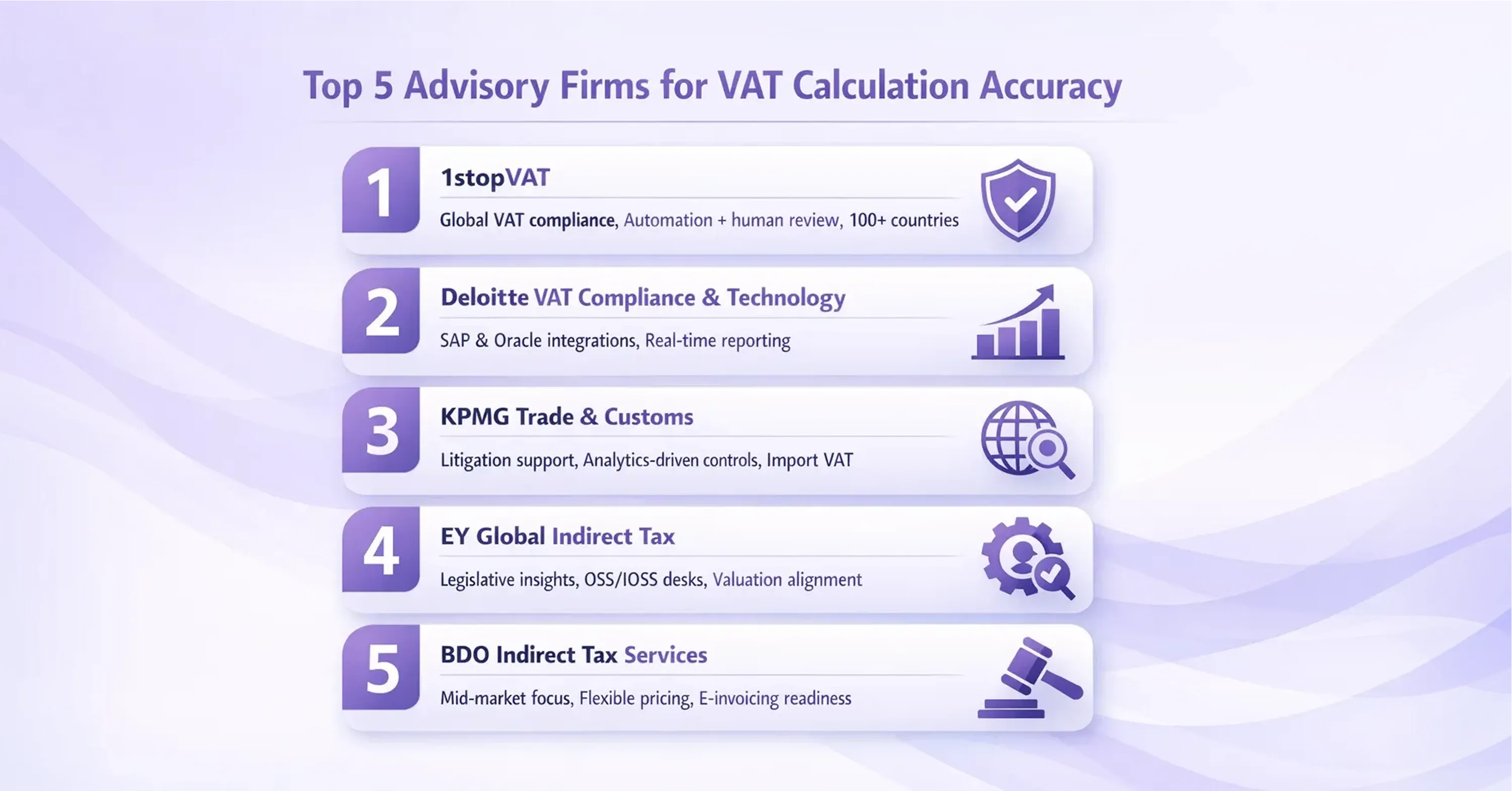
Infographic listing the top VAT advisory firms for calculation accuracy, highlighting global tax compliance, technology integration, and indirect tax consulting services

Below are five firms that repeatedly surface in market analyses and client testimonials for their deep VAT capabilities. Order reflects market perception rather than a formal ranking metric.

1. 1stopVAT

1stopVAT is a one-stop global VAT compliance provider with 40-plus certified specialists who combine automated checks with human review. Acting as a single contact point for VAT registration, ongoing filings, and ad-hoc consulting across 100+ countries, the firm is well suited to e-commerce sellers scaling rapidly but lacking internal tax bandwidth.

To dive deeper into how firms like 1stopVAT compare and the unique advantages of well-matched tax advisers, see the Top VAT consultants 2025.

2. Deloitte VAT Compliance & Technology

Deloitte pairs technical specialists with proprietary compliance portals that integrate with SAP and Oracle.

  • Offers managed filings in 120 countries.

  • Strong in real-time reporting mandates like Spain SII and Hungary RTIR.

3. KPMG Trade & Customs

Known for litigation support, KPMG helps clients contest assessments and design preventive controls.

  • “Indicator” data analytics flag anomalies before submission.

  • Advises on Brexit-related import VAT relief.

4. EY Global Indirect Tax

EY stands out for policy lobbying insight. When VAT legislation changes, its alerts arrive first.

  • Dedicated OSS/IOSS registration desks.

  • Deep transfer-pricing alignment between customs and VAT valuations.

5. BDO Indirect Tax Services

Mid-market champion with flexible fee structures.

  • Outsourced VAT returns starting at single-jurisdiction packages.

  • E-invoicing readiness programs for Latin America.

Each of these advisers uses technology differently, yet human expertise remains the core value. The right match depends on your transaction volume, industry quirks, and appetite for outsourcing.

Software Tools Trusted by Leading Advisers

While none of the firms above sell automation directly, they rely on solid software stacks to ensure data quality.

  • ERP VAT engines: SAP Document and Reporting Compliance, Oracle Fusion Tax.

  • Accounting add-ons: Xero “Making Tax Digital” bridge, QuickBooks VAT codes.

  • Reconciliation tools: Alteryx workflows and Power BI dashboards to compare sales and VAT returns.

  • Secure document exchange: ShareFile, OneDrive with ISO-certified encryption.

Tax Technology Tools – VAT Compliance Automation provides in-depth analysis on automating VAT control, from automated rate updates to digital archiving and audit trails.

1stopVAT integrates with major e-commerce platforms and ERPs, pulling transaction data automatically yet leaving final review to certified tax advisers. This blend of automation and human oversight reduces manual keystrokes but keeps responsibility with qualified professionals.

Technology therefore amplifies - not replaces - advisory insight. When you interview a potential firm, ask how it validates imported data and what audit trails it keeps.

How to Choose the Right VAT Adviser

Begin with a gap analysis of your current processes:

  1. Map every sales channel against the VAT registrations you hold.

  2. Identify jurisdictions where you exceed turnover thresholds or hold stock without registration.

  3. Quantify error rates in prior filings (e.g., HMRC adjustments, credit notes issued).

Then evaluate advisers using four filters.

  • Geographic coverage: Do they file in every country you sell into?

  • Industry experience: VAT on digital services versus physical goods varies widely.

  • Technology stack: Will their platform integrate with your ERP?

  • Service model: Full outsourcing, co-sourcing, or advisory only?

For step-by-step guidance and further criteria on vetting candidates, review Top Tax Consultants for Online Businesses.

A mid-size retailer recently switched from a domestic accountant to a global adviser after discovering unclaimed input VAT on EU warehouse fees. The new adviser recouped £220,000 within two quarters, funding the entire engagement.

Taking time to align service scope with internal capability prevents overpaying for unnecessary bells and whistles or under-buying and facing compliance gaps.

Four Steps to Accurate VAT Calculation

Accurate VAT hinges on a repeatable process:

  1. Capture the correct tax rate for every SKU and jurisdiction.

  2. Validate customer location and supply chain movement to nail place-of-supply rules.

  3. Reconcile output and input VAT monthly, flagging anomalies instantly.

  4. Submit digital returns through government portals, attaching audit files where required.

For hands-on calculation tips, check How to Use a VAT Tax Calculator for Accurate Invoices.

Follow these steps, supported by a qualified adviser, and VAT errors fall to near zero.

Conclusion

VAT is the single largest indirect tax in most economies, and regulators track every pound and euro. Complexities multiply once you sell cross-border, combine different product rates, or join the booming e-commerce market. By revisiting the basics, understanding where in-house processes break, and partnering with a top advisory firm that matches your profile - be it a Big Four, a nimble mid-tier, or a focused specialist like 1stopVAT - you can file accurate returns, reclaim every eligible credit, and turn VAT from a compliance headache into a controlled, predictable process.

If you're seeking a broader overview or want to dig into the benefits and pitfalls of consultants versus internal teams, see the full primer on VAT Compliance & Consultancy: Why Expert Advice Matters.

For additional insights on minimizing common VAT errors and penalties, explore practical advice in Determining VAT: mistakes to avoid. Finally, if cross-border sales are a cornerstone of your operation, Best Cross-Border Tax Compliance Firms: Global VAT Experts provides an in-depth comparison to help you select the right international partner.

You must register as soon as your distance‐selling turnover exceeds the €10,000 EU-wide OSS threshold, or immediately if you hold stock in that member state. Delay leads to retrospective liability and penalties.

Yes. A chilled takeaway pizza may be zero-rated for groceries but standard-rated when heated for immediate consumption. Recording the supply correctly on the invoice prevents under-declaration.

ERP tax codes rely on accurate master data and correct logic. Advisers review those settings, monitor legislative changes, and defend positions during audits, providing a layer of assurance software alone cannot.

Late filings trigger automatic surcharges, interest on unpaid tax, and heightened audit risk. Repeated lateness can lead to loss of simplifications such as postponed import VAT accounting.

VAT calculations should be reviewed at least monthly, even if filings are submitted quarterly. Regular reviews help detect rate misapplications, incorrect place-of-supply logic, and reconciliation gaps early — before they accumulate into material liabilities or trigger audits.

Simple Compliance

Free consultation with 1StopVAT experts

You Might Also Like

Discover more insights and articles

Business professionals analyzing financial reports and performance charts during a team meeting with documents, tablet, and calculator on the desk.

VAT Tax Refund Explained: How to Get Your VAT Back

Buying goods abroad or incurring cross-border business expenses often means paying value added tax at the point of sale. The question on every traveler’s or finance manager’s mind is simple: can I recover that money? This article unpacks the answer in plain language. A VAT refund may look straightforward, yet it hinges on clear eligibility rules, precise paperwork, tight deadlines, and plenty of room for error. By the end, you will know exactly who qualifies, what purchases count, how to file, how long the process takes, and the pitfalls that derail many claims.

Business professional analyzing AI-driven search performance and growth metrics on a digital dashboard in a modern office.

Online VAT Registration: Step-by-Step Guide for Businesses

Is your business ready to charge and reclaim VAT but you are unsure how to get the paperwork done? This guide breaks down the entire online VAT registration process into practical steps so you can move from “do I have to register?” to “VAT number issued” without guesswork. Online registration has been mandatory in the UK since 13 November 2023. That means every trader, from e-commerce start-ups to established manufacturers, must now submit the application digitally. The good news: once you know the workflow, the process is predictable and usually takes less than 20 minutes of actual typing.

Business professional analyzing AI-driven search performance and growth metrics on a digital dashboard in a modern office.

Best Services for VAT Vendor Search: Find Reliable Suppliers

Sourcing new suppliers is a critical growth step for any business, but it carries hidden financial risks if you fail to validate their tax status. Working with a non-compliant vendor can lead to rejected input tax claims, hefty fines, and inadvertent involvement in supply chain fraud.

This guide outlines how to protect your procurement process by choosing the right verification methods. You will learn why validation is financially vital, which tools and services provide the most accurate data, and how to implement a step-by-step check for every new partner. We will also cover how to blend these checks into your daily purchasing workflow to ensure safety without slowing down business.

Two business executives analyze financial reports together in a modern office, focusing on data-driven decision-making and performance evaluation

VAT vs GST Registration: Key Differences Explained

VAT and GST look similar at first glance, yet they are applied, reported, and even named differently around the world. If your firm sells in multiple jurisdictions, misunderstanding one letter in the acronym can trigger late-registration penalties, denied input tax credits, or both.

Below is a streamlined comparison that shows how the two systems diverge and what that means for day-to-day compliance.