Business professionals analyzing financial reports and performance charts during a team meeting with documents, tablet, and calculator on the desk.

VAT Tax Refund Explained: How to Get Your VAT Back

Buying goods abroad or incurring cross-border business expenses often means paying value added tax at the point of sale. The question on every traveler’s or finance manager’s mind is simple: can I recover that money? This article unpacks the answer in plain language. A VAT refund may look straightforward, yet it hinges on clear eligibility rules, precise paperwork, tight deadlines, and plenty of room for error. By the end, you will know exactly who qualifies, what purchases count, how to file, how long the process takes, and the pitfalls that derail many claims.

Content authorBy Beata ČepėPublished onReading time9 min read

What You Will Learn and Why It Matters

First, we outline the qualifying criteria for tourists, businesses, and foreign governments. Next, we walk through the types of expenses that can be refunded, from conference fees to souvenir electronics. Then comes a hands-on guide to preparing and submitting a claim. We wrap up with typical processing timelines, common mistakes, and expert tips to ensure the cash actually lands back in your bank account.

Along the journey, you will see short real-world examples that illustrate how rules apply in practice, plus citations to the official sources shaping those rules. Let us start with the obvious: do you even meet the threshold for reclaiming VAT?

Who Qualifies for a VAT Refund?

Many people assume everyone can get a refund. Not true. Eligibility depends on your status, where the purchase occurs, and how the item is used.

Most countries place claimants into three broad buckets:

  • Tourists who are not residents of the country where the purchase is made

  • Foreign businesses with no local VAT registration but with legitimate business expenses in the country

  • International organizations, foreign embassies, and certain charities as defined in local regulations

For a thorough summary of eligibility for both tourists and international businesses - including the impact of the EU 8th and 13th Directives - refer to the VAT Refunds & Reclaims: How to Recover Input VAT Costs guide.

Individuals: Tourists and Shoppers

Short-term visitors normally qualify when they:

  • Leave the country within a specific time frame, often 90 days

  • Export the goods unused or with minimal use

  • Spend above a minimum purchase threshold, for example €175 in France

Example: An Australian tourist buys a camera in Berlin, gets his receipt stamped by customs on departure, then submits the documentation to a German refund operator. The VAT on the camera is repaid to his credit card within six weeks.

Leaving this section, remember that residency, export, and minimum spend govern tourist refunds. The next paragraphs show how the criteria shift for businesses.

Businesses: Foreign Companies Without Local VAT Registration

A company established in the United States sending staff to a Dutch trade show can often reclaim Dutch VAT on:

  • Stand rental fees

  • Hotel bills

  • Local taxi fares

However, it must be established outside the EU, have no Dutch VAT number, and submit the claim through its domestic tax portal if an EU company, or via a paper process if non-EU. More than 70% of rejected claims reported by European Commission data stem from missing proof of business purpose, underlining the need for detailed invoices.

Diplomats and Certain Non-Profits

Embassies and accredited missions enjoy relief on most local purchases. Rules vary widely, so these entities rely on special exemption cards issued by the host country.

Key takeaway: if you do not fit one of the three categories above, the VAT reclaim path is closed. If you do, the next question is, “Which purchases qualify?” Let’s move on.

Which Purchases Are Eligible for VAT Reimbursement?

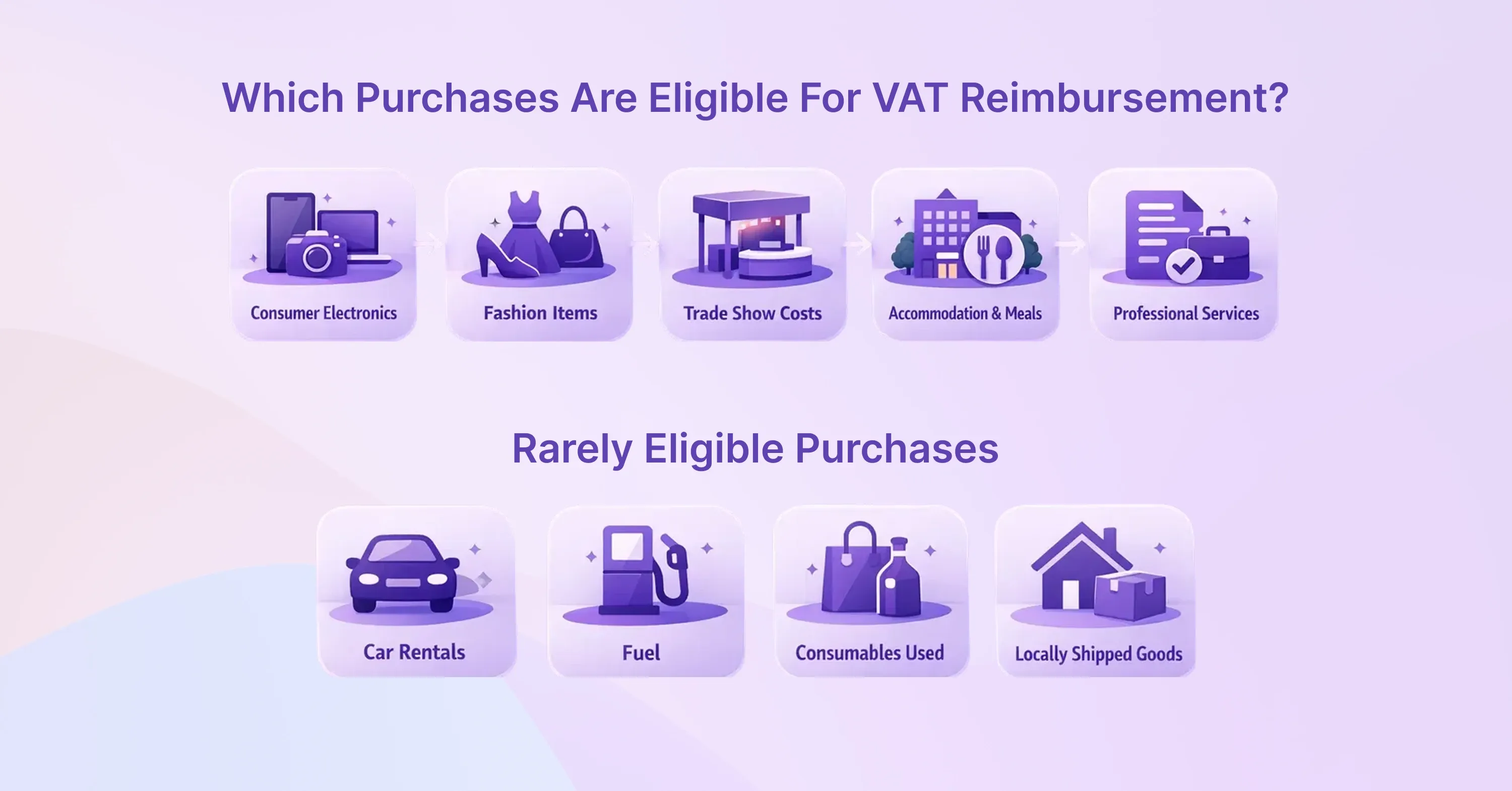
Infographic showing which business purchases are eligible for VAT reimbursement, including electronics, trade show costs, accommodation, and professional services versus rarely eligible expenses.

Not every receipt in your wallet or expense report qualifies. Tax authorities focus on two concepts: the nature of the goods or services and their export or business use.

Travelers can reclaim VAT on goods that leave the country intact, while businesses focus on expenses directly tied to taxable operations. Below are the most common refundable categories.

  • Consumer electronics: phones, laptops, cameras

  • Fashion items: clothing, shoes, accessories

  • Trade show costs: booth rental, display materials

  • Accommodation and meals: often reimbursable in the EU, rarely in Asia

  • Professional services: local legal or consulting fees

For further clarification on which expenses qualify for cross-border VAT recovery - including local restrictions and practical tips - see VAT Refunds & Reclaims: How to Recover Input VAT Costs.

Example: A Canadian marketing agency contracts a Parisian graphic designer to create an event logo. The designer charges French VAT. The Canadian firm can claim that VAT back because the service was consumed for business purposes outside France.

Purchases That Rarely Qualify

  • Car rentals used inside the country

  • Fuel

  • Consumables already used before departure

  • Goods shipped to a local address for local use

Wrapping up this section, remember that eligibility turns on export and business nexus. The mechanics of making those facts visible lie in the paperwork, which we tackle next.

Step-by-Step: How to Submit a VAT Refund Claim

Before submitting anything, confirm the country-specific procedure. That said, most jurisdictions follow a familiar sequence.

1. Collect All Documentation Early

A complete claim folder typically includes:

  • Original tax invoices showing supplier VAT number, your details, and VAT amount

  • Proof of payment (credit card slips or bank statements)

  • Customs export validation for goods taken out of the country

  • Power of attorney if a third party files on your behalf

Missing invoices account for 45% of denied tourist refunds as per Global Blue statistics. Scan and store every document before you lose it.

Comprehensive, fail-safe documentation is your greatest asset. Tips for assembling bullet-proof paperwork and additional guidance can be found in VAT Refunds & Reclaims: How to Recover Input VAT Costs.

2. Complete the Refund Form

Each tax authority issues its own form, but expect fields for:

  • Claimant identification

  • Purchase details per invoice

  • Banking information for reimbursement

  • Declaration of eligibility

Electronic portals are common in the EU 13th Directive process. Non-EU businesses must still mail paper claims to some countries, such as Switzerland.

For an in-depth, actionable walkthrough on choosing and using digital VAT refund filing portals, visit How to File VAT Returns Online: Streamlining Digital Submission.

3. Submit and Track Your Claim

  • Submit within the statutory deadline, often nine months after the calendar year of purchase for businesses, and three months from purchase for tourists.

  • Keep shipment tracking or portal confirmation screen captures.

  • Diary follow-up dates: tax offices can request clarifications within four months.

Example: A US software firm attending a Stockholm conference mailed its Swedish claim in March. The Swedish Tax Agency asked for an explanation of “software demo devices” two months later. Because the firm responded within ten days, the agency approved the refund in early July.

Having filed, you naturally ask, “When will the money arrive?” The next section explains standard timelines.

Timelines: From Submission to Payment

Processing times differ by claimant type and country, but patterns emerge.

  • Tourist refunds via private operators: instant to eight weeks

  • Tourist refunds filed directly to customs: eight to 16 weeks

  • Business 8th Directive (EU companies claiming in the EU): four months, extendable to eight if information requests arise

  • Business 13th Directive (non-EU companies): six to nine months on average

Finland pays 95% of claims within four months yet Italy frequently exceeds seven months. Build these lags into cash-flow forecasts.

For granular details on statutory deadlines, what starts the clock, and special rules by country, consult VAT Refunds & Reclaims: How to Recover Input VAT Costs.

If no decision arrives within the statutory window, you may earn statutory interest. Always check local law, as interest rates vary from 0.5% to 8%.

With a sense of timing, let us safeguard your claim by steering around the errors that cause most rejections.

Common Errors and How to Avoid Them

Even seasoned finance teams stumble over repeating mistakes. Awareness is your best defense.

  • Missing or illegible invoices: request duplicates immediately

  • Wrong claimant name: the invoice must match the entity seeking refund

  • Deadline breaches: submit early, calendar recurring reminders

  • Inadequate proof of export: customs stamp or shipping documents required

  • Claiming blocked items such as fuel or vehicles

Example: A Brazilian design studio tried to reclaim German VAT on a car rental used for sightseeing after a trade fair. The claim was rejected because German law blocks refunds on passenger vehicles.

To build stronger internal controls around VAT claims, review tips on automation and the most common rejection traps in VAT Refunds & Reclaims: How to Recover Input VAT Costs. Also, see VAT Filing & Returns: A Complete Guide for Businesses for prevention of penalties and errors in cross-border filings.

Avoiding these pitfalls drastically boosts approval odds, but documentation can still overwhelm small teams. That is why some businesses turn to dedicated VAT compliance providers like 1stopVAT. Acting as a single point of contact across 100+ countries, their tax specialists gather invoices, prepare claims, and track submissions so companies can focus on growth instead of paperwork.

VAT Refund in 60 Words

A VAT refund lets eligible non-resident individuals or foreign businesses recover the value added tax paid on goods or services purchased in another country, provided the items are exported or used for business abroad. To get the money back, claimants must collect original invoices, secure customs validation where required, submit a refund form within statutory deadlines, and respond quickly to any tax authority queries.

Conclusion

A VAT tax refund is achievable when you know the rules: confirm eligibility, keep airtight documentation, meet deadlines, and target refundable expenses only. Tourists walk away with cheaper souvenirs, while companies enhance bottom lines by trimming indirect tax costs. Whether you manage claims yourself or enlist specialists like 1stopVAT, the roadmap above ensures you never leave recoverable VAT on the table.

No. VAT refunds aim to relieve non-residents from tax on consumption outside the country. Residents already pay and reclaim VAT through their regular tax returns if registered.

Not necessarily. Customs officers only need to verify the goods before exit. If the items are in checked baggage, present them before check-in at the customs desk.

Private operators deduct a fee, typically between 20% and 40% of the VAT amount, from the refund. Filing directly with the tax authority avoids that cost but takes longer.

Many countries accept electronic export records, for example the French PABLO kiosks, yet some still insist on physical stamps. Check the departure airport’s procedures in advance.

You can appeal within the timeframe specified in the rejection notice, supply missing documents, or correct errors. Some jurisdictions allow a simplified re-submission instead of a full appeal.

Simple Compliance

Free consultation with 1StopVAT experts

You Might Also Like

Discover more insights and articles

Desk with tax refund documents, approval stamps, calculator, and laptop displaying financial records in an accounting workspace

Claiming VAT Back: Complete Guide for Businesses & Travelers

Paying Value Added Tax (VAT) is a standard part of purchasing goods and services abroad, but leaving that money with foreign tax authorities isn't mandatory. Whether you represent a company managing international expenses or a tourist returning home with holiday purchases, significant refunds often go unclaimed simply because the process seems difficult.

Financial analysis workspace with investment charts, stacked coins, calculator, and open notebook representing budgeting, accounting, and business planning.

Top Advisory Firms for VAT Calculation: Ensure Accurate Tax

A single VAT miscalculation can erase an entire quarter’s profit, yet many finance teams still depend on spreadsheets and fragmented processes. In today’s environment, accurate VAT calculation is a control function - not a back-office task - requiring precise rule interpretation and flawless execution at scale. This article revisits VAT fundamentals, highlights complex calculation risks, and ranks advisory firms with proven VAT accuracy expertise.

Business professional analyzing AI-driven search performance and growth metrics on a digital dashboard in a modern office.

Online VAT Registration: Step-by-Step Guide for Businesses

Is your business ready to charge and reclaim VAT but you are unsure how to get the paperwork done? This guide breaks down the entire online VAT registration process into practical steps so you can move from “do I have to register?” to “VAT number issued” without guesswork. Online registration has been mandatory in the UK since 13 November 2023. That means every trader, from e-commerce start-ups to established manufacturers, must now submit the application digitally. The good news: once you know the workflow, the process is predictable and usually takes less than 20 minutes of actual typing.

Business professional analyzing AI-driven search performance and growth metrics on a digital dashboard in a modern office.

Best Services for VAT Vendor Search: Find Reliable Suppliers

Sourcing new suppliers is a critical growth step for any business, but it carries hidden financial risks if you fail to validate their tax status. Working with a non-compliant vendor can lead to rejected input tax claims, hefty fines, and inadvertent involvement in supply chain fraud.

This guide outlines how to protect your procurement process by choosing the right verification methods. You will learn why validation is financially vital, which tools and services provide the most accurate data, and how to implement a step-by-step check for every new partner. We will also cover how to blend these checks into your daily purchasing workflow to ensure safety without slowing down business.