What you will learn
This guide starts with the basics of New York sales tax, then explains why and when a business should bring in professional help. You will see the core services NY tax experts provide, step-by-step tips for vetting advisers, and real examples that show the rules in action. By the end, you will know exactly how to choose an expert and put the engagement to work for both online and brick-and-mortar sales streams.
In short, a New York sales tax consultant is a licensed professional who helps businesses collect, report, and remit state and local sales tax, resolve audits, and plan for future compliance in all 62 New York counties.
Understand the basics before you hire
Even the best NYC sales tax specialists cannot help if you do not know what problem you are solving. Begin with a quick refresher.
Sales tax structure in New York
New York State levies a 4% base rate. Counties and cities can add local rates, taking totals as high as 8.875 % in New York City.
Why does this matter? Low reliance at the state level means auditors focus on efficiency. Yet a 2024 audit revealed that investigators skipped adequate searches in 69% of delinquent cases. Translation: mistakes slip through, but the state will still pursue easy-to-prove errors.
Why Small Classification Errors Lead to Costly Audits
A Manhattan clothing store misclassifies a layaway sale as a wholesale transaction. The underreported tax gets flagged three years later during a desk audit, adding late interest on every missed quarter. A consultant could have corrected the coding within weeks, saving thousands.
By understanding rates, audit trends, and the long look-back periods, you will see where professional help fits. For a thorough breakdown of sales tax obligations, compliance tips, and practical state-to-state comparisons, see Sales Tax Compliance: Key Steps for Your Business.
Know when your business needs a consultant
Bringing in NY tax experts too late costs more than hiring them early. Use the checkpoints below to decide.
-
New nexus: You cross $500.000 in annual New York sales and 100 transactions, triggering economic nexus.
-
Expansion: Opening a kiosk in Queens adds a new local rate.
-
Online marketplace shifts: Platforms such as Etsy start collecting for you, but exemptions and refunds remain on you.
-
Audit notice: A “desk audit” letter or a field visit request arrives.
-
System changes: Migrating from one POS or ERP to another creates mapping gaps.
-
M&A: Buying a competitor inherits their tax liabilities.
When Assumed Exemptions Stop Applying
A Midtown SaaS provider assumes its subscription is tax-exempt. Revenue tops $1 million, and the state rules portions of the license taxable. The firm engages a consultant before the audit and files a voluntary disclosure to limit penalties.
When one or more triggers apply, it is time to seek specialized advice. For a clear summary on identifying nexus and audit triggers, read US Sales Tax Explained: State-by-State Guide.
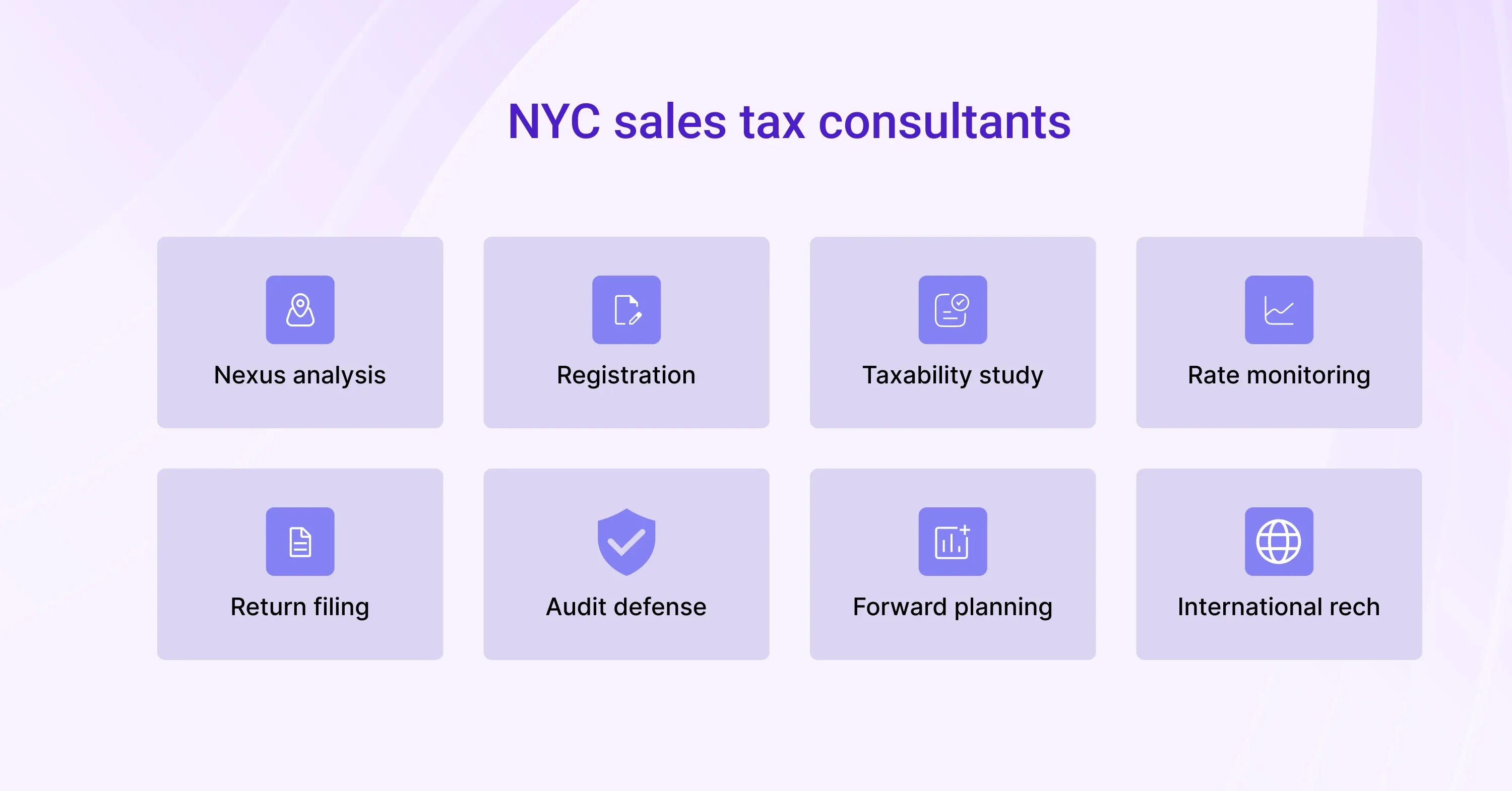
Services top NYC sales tax specialists provide

A good adviser offers far more than quarterly filings. Expect a menu like this.
-
Nexus analysis: Determine whether your activities create state or city liabilities.
-
Registration: Obtain certificate of authority numbers for every jurisdiction.
-
Taxability studies: Review products and services line by line, then map items to proper codes.
-
Rate and rule monitoring: Track rule changes across 62 counties.
-
Return preparation and filing: Ensure on-time e-file submissions and electronic payments.
-
Audit defense: Handle information requests, negotiate assessments, and pursue refunds.
-
Forward planning: Align tax strategy with new markets and product launches.
Some firms, such as 1stopVAT, extend these core services internationally, combining New York compliance with VAT registration across 100-plus countries so you keep a single point of contact while you scale. For a comparison of top compliance providers (and what to look for as your business grows), check Top Sales Tax Compliance Firms for Businesses.
Evaluate credentials and fit
Choosing the right consultant is like hiring a CFO: experience and trust matter. Start with the essentials.
-
Licenses: Confirm CPA or attorney status for senior advisers.
-
Industry focus: Retail, software, restaurant, or manufacturing niches carry different exemptions.
-
Volume handled: Ask how many New York returns they file each month.
-
Technology fluency: While you are not buying automation, advisers should integrate with your POS, ERP, and marketplaces.
-
Audit track record: Request anonymized success stories and average penalty reductions.
-
Communication style: Weekly check-ins or dashboard reports?
Dig deeper through targeted questions.
Questions to ask during interviews
-
“Which local rate changes have you handled in the last six months?”
-
“How do you approach mixed-use exemptions, like curbside food delivery?”
-
“What is your process for sales tax holiday mapping?”
For practical advice on shortlisting, vetting, and engaging online business tax experts, see Top Tax Consultants for Online Businesses.
End each interview with a short post-meeting summary email. This captures proposed scope, fees, and timelines, and shows how responsive the consultant is.
Compare fee structures and engagement models
Pricing varies less than you might think, but hidden costs lurk.
-
Hourly: $200–$500 per hour for senior staff, suited for one-off rulings.
-
Monthly retainer: $1 000–$3 000 covering filings, access to a help desk, and periodic reviews.
-
Project-based: Fixed bid for tasks such as voluntary disclosure or nexus study.
-
Success fee: Percentage of refunds recovered during reverse audits.
Understand Fees, Savings, and What You Really Pay
A Long Island electronics importer negotiates a $2,000 flat fee for nexus analysis plus a 10% share of any overpaid tax refunds. The consultant identifies $30,000 in overpayments, earning $3,000. The client nets $27,000.
Always request an engagement letter that caps incidental charges like courier fees or travel. For a full breakdown of consulting models, in-house vs. outsourced solutions, and sample fee structures, explore Tax Consultation: Why Businesses Need Professional Guidance.
Implement and review with your consultant
Your work is not done after you sign the contract. Smooth onboarding drives savings.
-
Share data: POS exports, sales reports, exemption certificates, and prior returns.
-
Establish timelines: Filing calendars, audit deadlines, and deliverable dates.
-
Test changes: Update tax codes in a sandbox environment before going live.
-
Monitor KPIs: Late notices received, reconciled variances, refund amounts, and penalty savings.
-
Schedule annual strategy reviews: Factor in new sales channels or product lines.
Conclusion
Choosing the right New York sales tax consultant starts with knowing your exposure, then matching specialized services to your business model, budget, and growth plans. By following the steps above - understanding the rules, identifying triggers, vetting credentials, comparing fees, and committing to ongoing reviews - you will turn a complex compliance burden into a manageable routine. The payoff is clear books, happier customers, and peace of mind as you expand across New York and beyond.