

The Financial Risks of Non-Compliant Vendors
Many businesses assume that a valid-looking invoice is enough to claim back VAT, but tax authorities place the burden of proof squarely on the buyer. If your supplier is missing, deregistered, or fraudulent, your business is often the one left paying the bill. The scale of this issue is massive across Europe. In 2022, EU Member States lost around €89 billion in VAT revenues due to non-compliance and fraud.
This gap is not just about clerical errors. A significant portion involves criminal activity like Missing Trader Intra-Community (MTIC) fraud. Estimates suggest that EU Member States lost between €13 billion and €33 billion per year to cross-border VAT fraud over the last decade. When you engage a vendor without thorough checks, you risk becoming a link in a fraudulent chain, which can trigger aggressive audits and reputational damage.
The situation is equally serious in the United Kingdom. While compliance is generally high, HMRC estimated the UK VAT gap for 2024–25 at 6.2%, amounting to approximately £11.4 billion. This uptick from previous years signals that tax authorities will likely increase scrutiny on input tax claims. Ensuring your vendor list is clean is the first line of defense against these systemic risks.
Understanding these high stakes makes it clear why relying on a simple Google search is insufficient. You need robust tools to confirm that the entity you are paying is legitimate and in good standing with tax authorities. For further details and real-world case studies, consider the step-by-step insights in How to Find and Verify VAT Vendors.
Critical Features to Look for in Search Services
Choosing the right service for VAT vendor search depends on the volume of your suppliers and the geography of your trade. A freelancer hiring one local contractor has different needs than a multinational corporation sourcing raw materials from ten different EU countries.
When evaluating verification tools, prioritize these capabilities:
- Real-Time Data Access: Tax statuses change daily. A vendor valid yesterday might be deregistered today. Ensure your tool queries live government databases rather than cached lists.
- Bulk Processing: If you have hundreds of suppliers, typing ID numbers one by one is impossible. Look for batch-checking features.
- Name and Address Validation: A valid VAT number is useless if it belongs to a different company. The best services match the ID to the specific business name and address.
- Multi-Jurisdiction Coverage: For cross-border trade, you need a tool that bridges different national databases, such as the EU’s VIES system and the UK’s API.
Accuracy is paramount because the tax landscape is shifting. The EU is moving toward stricter controls, with leaders noting that the overall EU VAT compliance gap in 2022 was €89.3 billion. This pressure means businesses must be precise.
Once you know what features matter, the next step is identifying the specific platforms and providers that deliver this data effectively. You can find a practical comparison in Best VAT Number Verification Services for Businesses.
Top Services and Methods for Vendor Validation
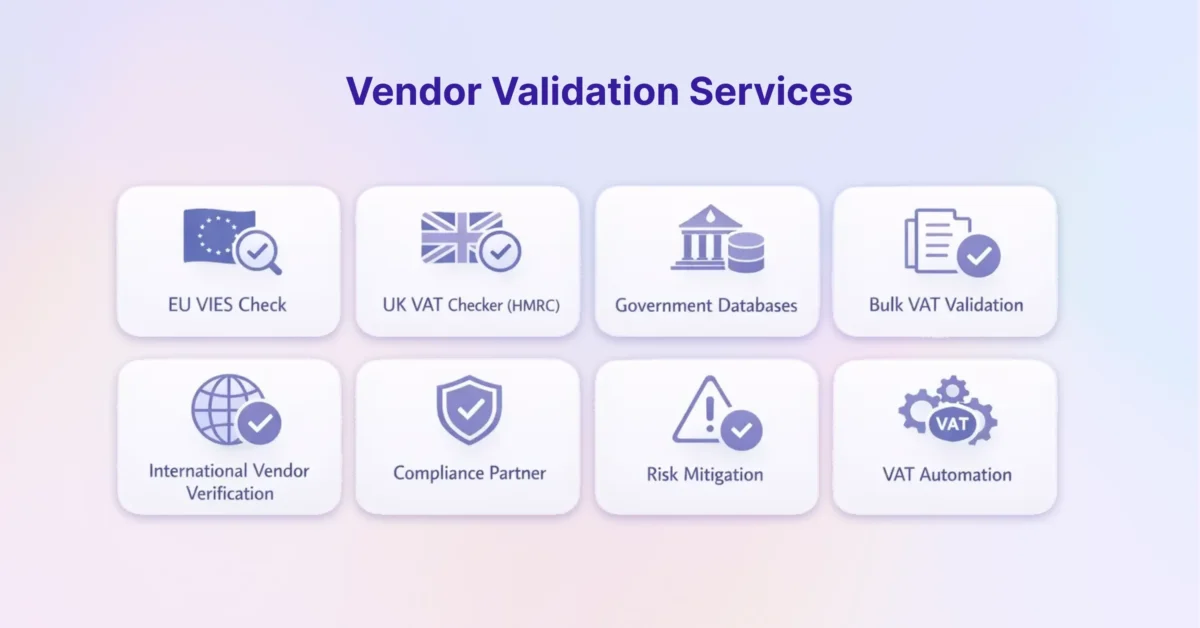
There is no single “best” service for everyone; the right choice depends on whether you need a quick, free check or a comprehensive compliance partner. Broadly, options fall into government-provided tools and specialized commercial services.
Official Government Databases
For ad-hoc checks, official portals are the primary source of truth. They are free but often lack advanced features like bulk validation or historical tracking.
- EU VIES (VAT Information Exchange System): This is the standard engine for checking EU VAT numbers. It pulls data directly from national databases. It is essential for verifying zero-rated cross-border supplies within the EU. If you’re unfamiliar with the process, see How to Perform an EU VAT ID Check (VIES Guide) for a complete walkthrough.
- HMRC VAT Checker (UK): With total UK VAT receipts reaching £171 billion in 2024–25, the UK government maintains a robust digital checker. It allows you to verify if a UK VAT number is valid and view the name and address associated with it. For a technical comparison with commercial solutions, consult the section on government and paid APIs in Best VAT Number Verification Services for Businesses.
Comprehensive Compliance Partners
For businesses scaling internationally, checking a number is only one part of the puzzle. You may need a partner that handles the broader context of VAT obligations.
- 1stopVAT: This firm operates as a one-stop global VAT compliance provider. Unlike simple lookup tools, 1stopVAT offers a mix of automated checks and human expertise. Their team of 40+ certified tax specialists can assist with validating vendor networks across 100+ countries, ensuring that your procurement strategy aligns with local tax laws. This approach is valuable for companies that need a single point of contact for both vendor verification and their own filing obligations.
For guidance on compliance automation, read Tax Technology Tools – VAT Compliance Automation.
Using these services gives you the raw data. However, having the data is not enough; you must apply it correctly within a structured verification process to truly mitigate risk.
Step-by-Step Guide to Verifying a New Vendor
Verification should be a standard operating procedure, not an afterthought. By following a rigid validation protocol, you create an audit trail that proves you acted in good faith if a supplier later commits fraud.
Follow these steps for every new commercial relationship:
- Request the Certificate: Ask the vendor for a copy of their VAT registration certificate. Do not rely solely on the number printed on the invoice. For certificate review criteria and documentation best practices, see VAT Certificate Verification: Ensuring Compliance.
- Perform the Syntax Check: Every country has a specific format (e.g., GB123456789 or FR12345678901). Ensure the number matches the standard length and alphanumeric structure for that jurisdiction.
- Validate Against the Database: Use VIES, the HMRC checker, or a partner like 1stopVAT to ping the official database.
- Cross-Reference Details: Confirm that the company name and address returned by the database match the details on the contract and invoice exactly.
- Tip: If the database shows “Consulting Ltd” but you are paying “Consulting Group,” pause and clarify.
- Save the Proof: Take a screenshot of the “Valid” result or save the timestamped validation token. This is your evidence for tax authorities.
This process is vital because the volume of traders is vast. In the UK alone, there were 2,330,400 VAT-registered traders in 2024–25, with over 200,000 new registrations and deregistrations occurring annually. The turnover in the market is high, meaning a valid status today does not guarantee one tomorrow.
For additional tips and troubleshooting common validation issues, refer to How to Verify a VAT Number: A Simple Guide.
After establishing a verification protocol, the final challenge is ensuring your procurement team follows it consistently without creating bottlenecks.
Integrating Checks into B2B Procurement
The best services for VAT vendor search are only effective if they are used consistently. Procurement managers often face pressure to onboard suppliers quickly to keep operations moving. To balance speed with security, integration is key.
Embed verification into these stages of your workflow:
- Vendor Onboarding Forms: require a valid VAT number and a recent validation screenshot before a vendor record can be created in your ERP system.
- Periodic Re-verification: Do not assume a vendor remains compliant forever. Schedule quarterly or annual bulk checks of your entire master vendor file.
- Contractual Clauses: Include terms that require the supplier to notify you immediately if their VAT status changes or if they are deregistered.
Adapting to modern digital standards is also becoming mandatory. For instance, the EU’s “VAT in the Digital Age” proposal aims to update VAT systems to reflect the digitalisation of economies, which will eventually make real-time reporting the norm. Preparing your internal data now ensures you are ready for these regulatory shifts.
For a deeper dive into reporting and automation, see VAT Reporting Made Simple: Best Practices for Businesses.
VAT Vendor Search Services
Tools and platforms used to verify the validity of a supplier’s Value Added Tax (VAT) identification number. These services query official government databases (like VIES in the EU or HMRC in the UK) to confirm a business’s registration status, ensuring that the buyer can legitimately reclaim input tax and avoid complicity in tax fraud.
Conclusion
Finding the best services for VAT vendor search is about more than just ticking a compliance box; it is about securing your bottom line against fraud and error. By leveraging official databases like VIES and partnering with comprehensive providers like 1stopVAT for complex needs, you can build a resilient supply chain. Implement rigorous checks during onboarding and maintain regular audits to ensure your business remains safe, compliant, and ready for growth.
For a practical, checklist-driven guide to the entire process, revisit How to Find and Verify VAT Vendors.
Frequently asked questions
Verifying a VAT number ensures that the business you are trading with is registered and compliant with tax authorities. If you claim input tax on an invoice from a non-existent or deregistered supplier, tax authorities will reject your claim, leading to financial loss and potential penalties. It also helps protect your business from being implicated in supply chain fraud.
VIES is excellent for cross-border trade within the EU, but it has limitations. It does not cover non-EU countries, and domestic checks within certain member states sometimes require local portals. Additionally, VIES can experience downtime. For global coverage or bulk checking needs, a commercial compliance service is often more efficient.
You should check new suppliers immediately upon onboarding. for existing partners, it is wise to perform a bulk re-verification at least once a year or before signing significant new contracts. Tax statuses can change due to deregistration or insolvency, so relying on a check from three years ago is risky.
If a number appears invalid, double-check the syntax and ensure you have not made a typing error. If it is still invalid, contact the supplier immediately. Do not pay any invoices including VAT until the issue is resolved. They may have recently deregistered or provided the wrong legal entity’s number.
VAT status can change at any time. Best practice is to re-verify vendors annually, and quarterly for cross-border or high-risk suppliers. Regular checks help protect input VAT claims and demonstrate due diligence during audits.