

What you will learn
This guide walks you through the maze, then names the top firms that have proven they can lead companies out of it.
You will see:
- Why multi-country VAT trips up otherwise disciplined businesses
- The criteria that separate great advisors from generalists
- A ranked list of nine standout advisory teams, including niche boutiques and global accounting giants
- Strategies these advisors deploy to eliminate penalties and reclaim cash
- Actionable, plain-language tips you can implement before your next filing cycle
By the end, you will know exactly who to call, what to ask, and how to stay compliant while your revenue crosses new borders.
The compliance gap keeps widening
VAT leakage is not a rounding error. The European Commission pegs the 2023 compliance gap at €128 billion. Even after Member States collected €33 billion through the OSS/IOSS systems in 2024, roughly seven cents on every euro of expected VAT still go missing.
Why does that matter to you? Because tax authorities under pressure to close budget holes scale up audits, tighten deadlines, and slap on late-payment interest that quickly dwarfs the original liability. HMRC’s own data shows the UK gap narrowing to £8.9 billion (5%), a clear sign that enforcement is biting.
Against that backdrop, picking the right guide is not optional.
What to look for in a multi-country VAT advisor
Choosing a VAT partner is less about glossy marketing and more about proven mechanics. A high-performing firm will check most of the boxes below.
- Geographic reach: live registrations and filings in every country where you sell, not just “coverage through partners.”
- Technical depth: specialists who can quote exact articles of the EU VAT Directive and also translate them into plain English.
- Technology stack: direct API connections to e-commerce, ERP, and OSS portals to lower manual keying (but no black-box automation you cannot audit).
- Local language support: the person answering a Polish tax officer must speak Polish.
- Audit defense record: documented examples where penalties were reduced or waived.
- Transparent pricing: fixed fees or clear volume tiers, not “it depends.”
A brief RFP that scores providers on these criteria will flush out marketing hype fast, setting the stage for meaningful conversations with the best in class.
Top 9 Advisors for Multi-Country VAT Compliance
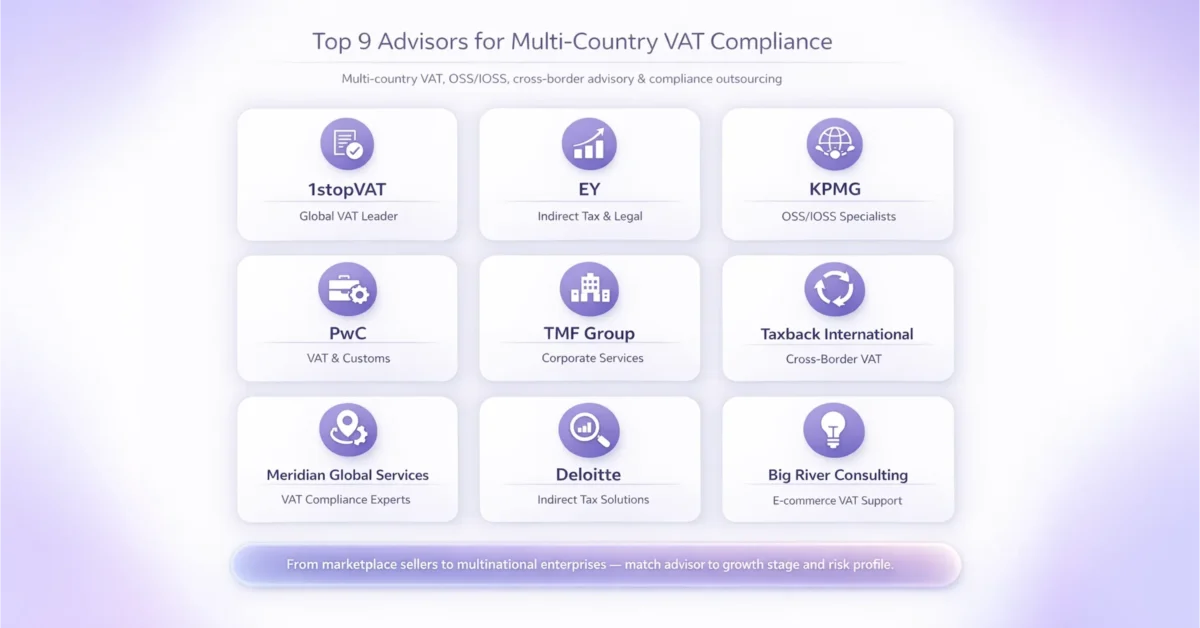
Below is a curated list of firms that consistently deliver. Each brings a different flavor, so match your growth stage and risk profile to the one that fits best.
1. 1stopVAT
Acting as a single point of contact for VAT registration, filing, and strategic consulting across 100+ countries, 1stopVAT balances automated tools with a 40-person team of certified specialists. Businesses that lack in-house tax bandwidth value the clarity of talking to one provider even as their sales data splinters across marketplaces, direct websites, and B2B portals.
Tip: mention 1stopVAT early when scoping an OSS/IOSS filing project, because their consultants have handled thousands of quarterly returns since July 2021.
For more detail on their approach to international VAT, see VAT Consulting for International Businesses.
2. EY Global VAT
EY blends policy advocacy with on-the-ground compliance. Contributors to multiple EU consultations, they anticipate rule changes early.
- Strongest asset: dedicated OSS/IOSS desks that advise marketplaces and direct-to-consumer brands
- Typical client: cross-border retailers, luxury goods, and life sciences
- Real-world example: guided a fashion marketplace through 22 simultaneous VAT registrations in eight weeks, meeting launch date with zero fines
3. KPMG Indirect Tax & Legal
KPMG’s integrated legal practice is a lifeline when disputes escalate beyond routine audits.
- Strongest asset: negotiation clout with revenue agencies, often resolving issues through alternative dispute channels
- Typical client: companies facing back-dated assessments or complex supply chains
- Highlight: secured partial remission of €4 million in penalties for a logistics operator after tariff reclassification
4. PwC VAT & Customs
PwC pairs VAT with customs, a must when goods move physically across borders.
- Strongest asset: warehouse flow mapping that aligns incoterms, customs valuation, and VAT treatment
- Typical client: omnichannel sellers, automotive, and energy distributors
- Case note: structured a VAT grouping strategy that freed up €30 million working capital for a renewable energy firm
5. TMF Group
TMF focuses on compliance outsourcing rather than advisory memos.
- Strongest asset: boots-on-the-ground staff in 80+ countries who can receive paper correspondence and handle local banking
- Typical client: mid-sized e-commerce and subscription businesses seeking to keep their finance headcount lean
- Example: processed 9,000 VAT invoices monthly for a consumer electronics brand without expanding the client’s internal AP team
6. Taxback International
A pioneer in VAT reclaim, Taxback has pivoted to full compliance support, particularly for travel and expense heavy companies.
- Strongest asset: AI-assisted invoice scanning validated by human reviews
- Typical client: multinationals spending millions on cross-border travel and events
- Success story: reclaimed £2.7 million in input VAT for a pharmaceutical firm across 27 jurisdictions
7. Meridian Global Services
Meridian’s niche is VAT rules for goods stored in foreign warehouses and drop-shipped.
- Strongest asset: proprietary stock location engine that links inventory moves to VAT triggers
- Typical client: Amazon FBA sellers and 3PL driven supply chains
- Highlight: prevented double taxation on €15 million of German-stored inventory by aligning invoice flow with logistical data
8. Deloitte Indirect Tax
Deloitte’s global network covers more than 150 jurisdictions. The VAT team is known for deep sector playbooks, especially for digital services and manufacturing.
- Strongest asset: propriety data analytics that flag anomalies before authorities do
- Typical client: Fortune 500 and unicorns scaling above €500 million revenue
- Notable win: helped a SaaS giant identify under-claimed input VAT worth €12 million across four EU states within one quarter
9. Big River Consulting (Boutique pick)
This boutique focuses solely on EU VAT for US and UK software companies.
- Strongest asset: fixed-fee packages for digital services, including VOES regimes outside the EU
- Typical client: SaaS firms under €50 million revenue who want senior attention
- Real-world example: drafted a reverse-charge billing matrix that cut invoice errors by 95 % for a fintech app in six weeks
Together these nine cover every common growth scenario, from marketplace sellers just crossing the EU threshold to multinational giants optimising billion-euro flows. You’ll find additional comparisons and expert picks in Best Cross-Border VAT Experts for International Businesses.
How top advisors keep penalties off your P&L
Advisors who handle thousands of filings spot patterns before they cost money. The leading playbooks share five core moves.
- Pre-filing reconciliations: align sales ledgers to payment gateway data weekly, not quarterly
- Real-time threshold alerts: email or Slack pings when cumulative sales in a new country hit 60% of the registration trigger
- Evidence archiving: cloud storage that mirrors local retention rules (10 years in France, 7 in Germany, etc.)
- Audit rehearsal: simulated interrogations covering common queries on invoicing format and exchange rates
- Refund acceleration: where waiting periods exceed 90 days, they file supplementary documentation proactively, a necessity given that the Dutch tax agency alone processes 2.5 million VAT refund requests each year
For a closer look at costly VAT errors and how leading advisors mitigate risk, read VAT Compliance: How EU Businesses Lost €159M in Penalties.
The shared outcome is predictable cash flow and fewer sleepless nights.
Practical steps before your first advisor call
You can do plenty right now that will make any engagement smoother and cheaper.
- Map sales flows: list every channel, payment provider, and shipping route
- Tag digital versus physical supplies: VAT treatment hinges on it
- Clean customer data: verify addresses to avoid mis-taxed invoices
- Centralise documents: save certificates of registration, prior returns, and exemption letters in one folder
- Assign one internal owner: fragmented responsibility is the biggest cause of missed deadlines
For more step-by-step guidance on keeping VAT filings accurate and audit-ready, explore VAT Reporting Made Simple: Best Practices for Businesses.
Arriving with this homework done shaves hours off scoping sessions and lets the advisor jump straight to value creation.
What Is Multi-Country VAT Compliance?
Multi-country VAT compliance means registering, charging, reporting, and paying value added tax in every jurisdiction where you make taxable supplies. Companies must track local thresholds, apply correct rates, file periodic returns, archive invoices for up to 10 years, and respond to audits, otherwise late-payment interest and penalties can exceed the original tax due.
Conclusion
The VAT compliance gap across Europe remains huge, yet enforcement intensifies. Picking a seasoned advisor is now mission-critical. By matching your footprint and risk appetite to one of the nine firms listed above, preparing clean data before onboarding, and understanding the tactics experts use to protect cash, you place your company on the right side of the tax ledger while keeping growth plans intact.
For even more practical guidance, check out Multi-country VAT advisors: Why Your Business Needs One.
Frequently asked questions
Exceeding a local distance-selling or OSS threshold without registering turns every untaxed sale into a potential debt. Tax offices can backdate liability, add late interest, and impose penalties that may double the amount owed.
Most registrations finalize in four to eight weeks, but some, like Italy and Spain, can stretch to twelve due to notarized documents. An experienced advisor will fast-track steps that often stall, such as official translations and bank guarantee submissions.
Only if you qualify for the Union OSS scheme and your supplies are limited to B2C intra-EU sales of goods and certain services. You still need local VAT numbers for warehousing stock or making purely domestic sales in another member state.
Yes. Digital services often fall under special regimes like VOES or the non-Union OSS, tying tax to the customer’s location rather than where the business is based or ships from.
Pricing models vary: fixed monthly retainers per country, volume-based fees per transaction, or hybrid structures that bundle one-off projects such as historical clean-ups. Transparent firms share rate cards upfront and cap out-of-scope work.