

What You Will Learn
You will see why VAT has become a make-or-break compliance area, especially after the EU’s 2021 reforms that generated €1.9 billion in extra VAT revenues in just six months. We will outline the most common VAT headaches, profile seven trusted advisory firms, and give a checklist for choosing the right partner. By the end, you will know exactly where to turn and what to ask before signing an engagement letter.
Why E-commerce Sellers Need VAT Help
The web erased borders for customers, not for tax authorities. Every B2C sale can create an obligation to register, charge, file, and remit VAT in another country.
- The EU now uses a single €10 000 cross-border threshold, so even micro-sellers fall into multi-state VAT in months, not years.
- More than 8 000 traders registered for the Import One-Stop Shop (IOSS) within months of launch, proof that distance selling triggers obligations quickly.
- Online sales keep rising: UK website sales hit £459.2 billion in 2021, and 22.9 % of EU businesses sold online in 2022, per Eurostat.
Keeping up with these fast-moving rules while running marketing, logistics, and customer service is rarely feasible for in-house teams alone.
Sellers who outsource VAT gain immediate access to local knowledge, representation before tax offices, and systems to keep filings on time. For more on the peace of mind and competitive edge that expert help offers, see VAT Compliance & Consultancy: Why Expert Advice Matters. That frees founders to focus on conversions rather than codes.
Common VAT Pain Points for Online Sellers
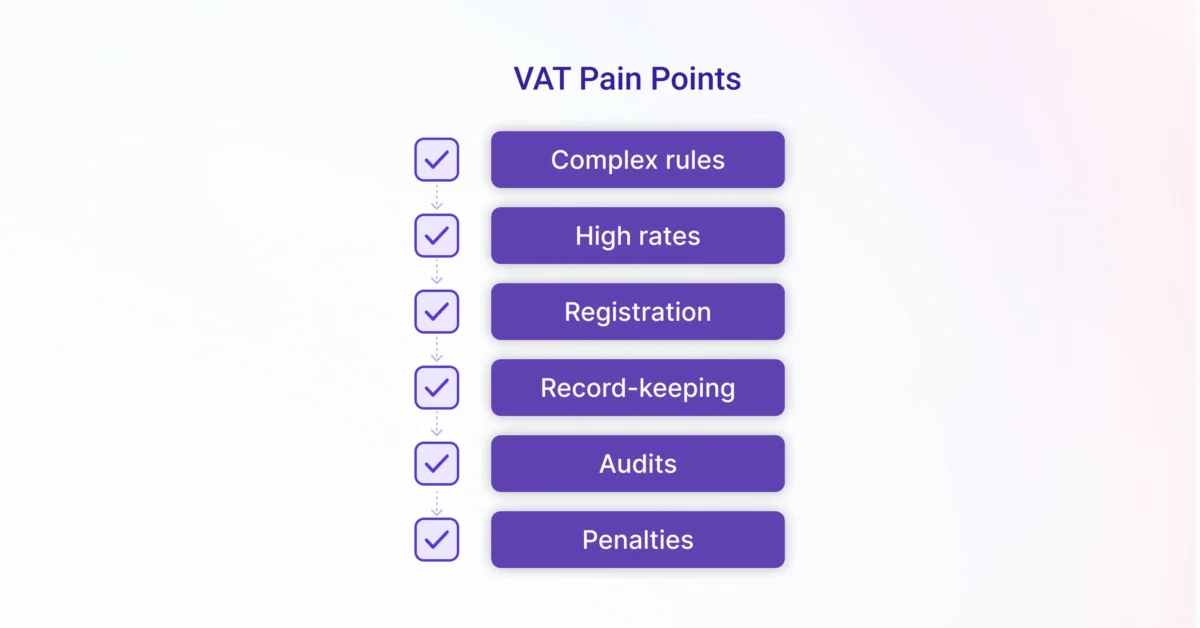
It helps to see where consultants add value. Below are the usual roadblocks.
- Registration catch-22
- Identifying which country triggers first
- Securing local fiscal reps where mandatory
- Rate complexity
- Correctly applying standard vs. reduced or zero rates
- Monitoring mid-year rate changes
- Marketplace obligations
- Platforms like Amazon may become the deemed supplier, shifting who remits VAT
- IOSS and OSS portals
- Deciding when to use them and reconciling filings with separate domestic returns
- Import VAT and customs
- Calculating VAT on CIF vs. FOB values
- Managing low-value consignment relief removal that raised €690 million on parcels under €22
- Audit readiness
- Retaining digital transaction records for 10 years
- Responding to multi-jurisdiction queries
Consultants specializing in e-commerce confront these pain points daily. Practical tools and checklists for streamlining VAT reporting across markets can be found in the Sales Tax Registration and Compliance Guide for Global Sellers, so their playbooks shorten the learning curve and lower the risk of penalties.
7 Leading VAT Consultants for E-commerce Sellers
1. 1stopVAT
- Acts as a single point of contact for VAT registration, ongoing compliance, and advisory across 100+ countries.
- Combines automated tools with a 40+ strong team of certified tax professionals, ideal for sellers scaling quickly.
- Strength: fast onboarding and clear pricing for marketplaces and DTC brands.
For a deeper look at how experts like 1stopVAT support international businesses, see VAT Consulting for International Businesses.
2. Deloitte Indirect Tax
- Big Four breadth with dedicated e-commerce desks in major EU hubs.
- Offers strategic supply-chain redesign alongside compliance.
- Best for multinationals needing ERP integration and rulings.
3. EY Global Trade & VAT
- Strong on customs, excise, and VAT interplay.
- Provides real-time dashboarding for filings across jurisdictions.
- Useful for sellers with mixed product categories and complex exemptions.
4. KPMG Indirect Tax Network
- Local offices in 140 countries coordinate VAT, GST, and sales tax.
- Regularly publishes up-to-date rate guides.
- Great for brands expanding beyond Europe to Asia-Pacific.
5. Mazars International VAT Desk
- Mid-tier firm with competitive fees and partner-led service.
- Known for practical advice on IOSS and OSS registrations.
- Ideal for SMEs needing hands-on guidance rather than large-firm structures.
For a primer on one-stop shop VAT schemes, visit One-Stop Shop Schemes – Brief Overview.
6. PwC Indirect Tax & Customs
- Offers end-to-end compliance outsourcing, from registrations to SAF-T data extraction.
- Deep relationships with tax authorities expedite complex queries.
- Suited to enterprise sellers migrating from legacy ERP to cloud platforms.
7. SimplyVAT.com
- Boutique agency that focuses exclusively on e-commerce VAT.
- Provides educational resources and live support for Amazon and Shopify sellers.
- Attractive for startups needing cost-effective yet specialist help.
Each of these firms can register you, file periodic returns, liaise with tax offices, and advise on supply-chain tweaks to keep VAT efficient. Shortlist two or three that match your size, budget, and tech stack, then run the selection process below.
How to Choose the Right Expert
Start with a discovery call and run this checklist.
- Coverage: Do they support every market you sell into today and plan to enter tomorrow?
- Industry focus: Ask how many pure-play e-commerce clients they serve and request anonymized case studies.
- Technology fit: Check whether their filing platform integrates with your store, ERP, or marketplace reports.
- Pricing clarity: Insist on a line-by-line quote: registrations, filings, fiscal rep fees, and ad-hoc consulting hours.
- Responsiveness: Gauge email response times during the sales cycle; they rarely improve after onboarding.
- Regulatory insight: Have they advised on reforms such as the OSS expansion that collected €17 billion in 2022? Knowledge of the latest rules is vital.
- Audit support: Verify who will represent you if authorities query your filings.
- Contract exit terms: Look for 30-day notice rather than annual auto-renewals.
A consultant that scores highly on these points will likely save you more in penalties and internal time than their annual fee. For detailed strategies on avoiding VAT errors and penalties, review Determining VAT: mistakes to avoid.
The relationship is ongoing, not transactional. Choose a partner whose communication style and systems align with your team today and your roadmap tomorrow.
What Does a VAT Consultant Do?
A VAT consultant for e-commerce helps online sellers register in each country that requires it, determine the correct VAT rates, prepare and file periodic returns through portals like OSS or IOSS, respond to tax authority queries, and advise on supply-chain structuring to reduce costs and risks.
Conclusion
VAT is now a headline cost for online sellers, not a footnote. With cross-border thresholds so low and revenues from the new EU rules up by 26% year on year, authorities have every incentive to audit. Leaning on specialists such as 1stopVAT, a global one-stop provider, or any of the other firms profiled above will keep your store compliant, your margins protected, and your energy focused on growth rather than government forms. For additional insights on international indirect tax solutions, don’t miss the Global Sales Tax Solutions & VAT Compliance Guide.
Frequently asked questions
Marketplaces may collect and remit VAT on certain transactions, but distance-selling thresholds, imports, and off-marketplace sales still create obligations. A consultant checks whether you must register, ensures filings align with marketplace reports, and prevents double taxation.
Fees vary, but many firms charge a one-off registration fee of €300–€800 per country and recurring compliance fees of €50–€150 per monthly return. Advisory projects are usually billed hourly. Always ask for a detailed quote to avoid surprises.
Yes. Most leading VAT consultants offer voluntary disclosure services. They quantify exposure, prepare corrective filings, and negotiate reduced penalties where local law allows. Acting quickly limits interest charges.
Expect to provide sales and refund reports (by SKU, country, and date), shipping documents, marketplace statements, and company registration details. Accurate, timely data lets your consultant file returns correctly and on time.
Prices vary by scope and country. Small sellers may pay €200–€500 per year per country, while multi-market e-commerce brands typically spend €2,000–€5,000+ annually for full compliance and advisory support.