What Are GST and QST? A Quick Overview
Before you can calculate anything, you need to understand the two layers of sales tax that apply in Quebec. Unlike most other Canadian provinces that use a single Harmonized Sales Tax (HST), Quebec keeps its federal and provincial taxes separate. That distinction matters because it affects how you calculate, collect, and remit each one.
GST (Goods and Services Tax) is the federal consumption tax applied across all of Canada. Since January 1, 2008, the GST rate has been 5%. It's administered federally, but Quebec businesses register for it through Revenu Québec rather than the Canada Revenue Agency.
QST (Québec Sales Tax) is the province's own consumption tax. Since January 1, 2013, the QST rate has been 9.975%. Together, a purchase in Quebec faces a combined 14.975% in sales taxes: 5% GST plus 9.975% QST.
Here's the key detail many people miss: both GST and QST are calculated on the selling price before tax. Quebec stopped applying QST on the GST-included amount back in 2013. That simplification means you apply both rates to the same base price, which makes the Quebec sales tax calculator formula cleaner than it used to be.
Understanding this foundation is essential. Now let's put it into a working formula.
How to Calculate GST and QST: The Step-by-Step Formula
The actual math behind a GST QST calculator is straightforward once you know the structure. Here's the process broken into clear steps.
Step 1: Determine Your Taxable Sale Price
Start with the price of your good or service before any tax. This is your base amount. If you're selling a product for $200.00, that's your starting figure. Keep in mind that some goods and services are exempt or zero-rated (think basic groceries, certain medical devices, or prescription drugs). If your product is fully taxable, proceed to the next step.
Step 2: Calculate the GST
Multiply the base price by 0.05 (which is 5%).
For a $200.00 sale:
- GST = $200.00 × 0.05 = $10.00
Step 3: Calculate the QST
Multiply the same base price by 0.09975 (which is 9.975%).
For that same $200.00 sale:
- QST = $200.00 × 0.09975 = $19.95
Step 4: Add Both Taxes to the Base Price
Now combine everything:
-
Base price: $200.00
-
GST: $10.00
-
QST: $19.95
-
Total: $229.95
That's it. The combined tax on this sale is $29.95, which works out to exactly 14.975% of the original price.
Here's a quick-reference summary you can use for any amount:
-
GST = Sale Price × 0.05
-
QST = Sale Price × 0.09975
-
Total Tax = Sale Price × 0.14975
-
Total with Tax = Sale Price × 1.14975
For a Montreal-based freelance graphic designer charging $1,500 for a branding project, the GST would be $75.00 and the QST would be $149.63, bringing the client's invoice total to $1,724.63. Simple, repeatable math.
With the formula in hand, let's look at a scenario many sellers overlook: working backwards from a tax-included price.

How to Reverse-Calculate GST and QST from a Total
Sometimes you need to extract the tax from a total that already includes GST and QST. This is common in retail settings where shelf prices are shown tax-included, or when you're reconciling receipts.
The reverse formula uses the combined rate as a divisor:
-
Pre-tax price = Total ÷ 1.14975
-
GST = Pre-tax price × 0.05
-
QST = Pre-tax price × 0.09975
A Practical Example
Say a customer pays $114.98 for a jacket. To find the breakdown:
-
Pre-tax price = $114.98 ÷ 1.14975 = $100.01 (rounded)
-
GST = $100.01 × 0.05 = $5.00
-
QST = $100.01 × 0.09975 = $9.98
You can verify: $100.01 + $5.00 + $9.98 = $114.99 (the one-cent variance is due to rounding, which is normal and expected in tax calculations).
This reverse calculation is especially useful for businesses that need to report net revenue separately from tax collected. Getting comfortable with both directions of the formula saves time during filing periods.
Of course, knowing the formula is only part of the picture. You also need to know when to apply it, and what qualifies for these GST/QST rates in the first place.
For more on practical calculation and automation, a Sales and Tax Calculator: Total Price Calculation Guide offers deeper strategies for handling discounts, exempt items, and real-world modifiers.
Which Goods and Services Are Taxable in Quebec?
Not everything sold in Quebec attracts both taxes. The tax treatment falls into three categories, and misclassifying a product can lead to costly errors on your returns.
-
Fully taxable (14.975%): Most goods and services, including electronics, clothing, restaurant meals, professional services, and software subscriptions.
-
Zero-rated (0%): These are technically taxable but at a rate of 0%. Examples include basic groceries (milk, bread, fresh vegetables), prescription drugs, and medical devices. Sellers of zero-rated supplies can still claim input tax credits.
-
Exempt: Certain supplies are exempt from both GST and QST entirely. These include most health and dental services, childcare, residential rent, and many financial services. Unlike zero-rated goods, exempt suppliers generally cannot claim input tax credits.
A small bakery in Quebec City selling fresh bread (zero-rated) alongside pastries and coffee (fully taxable) needs to track each category separately. The bread goes out at 0% tax, while every croissant and espresso gets the full 14.975% treatment. Mixing these up on invoices is one of the most common mistakes in Quebec sales tax compliance.
To get a broader understanding of taxability across different markets and exemptions, the Sales Tax Exempt Explained: Who Qualifies and How to Apply dives into eligibility and best-practice documentation.
This classification system leads naturally to another question: what about businesses outside Quebec selling into the province?
GST/QST Obligations for Non-Resident Sellers

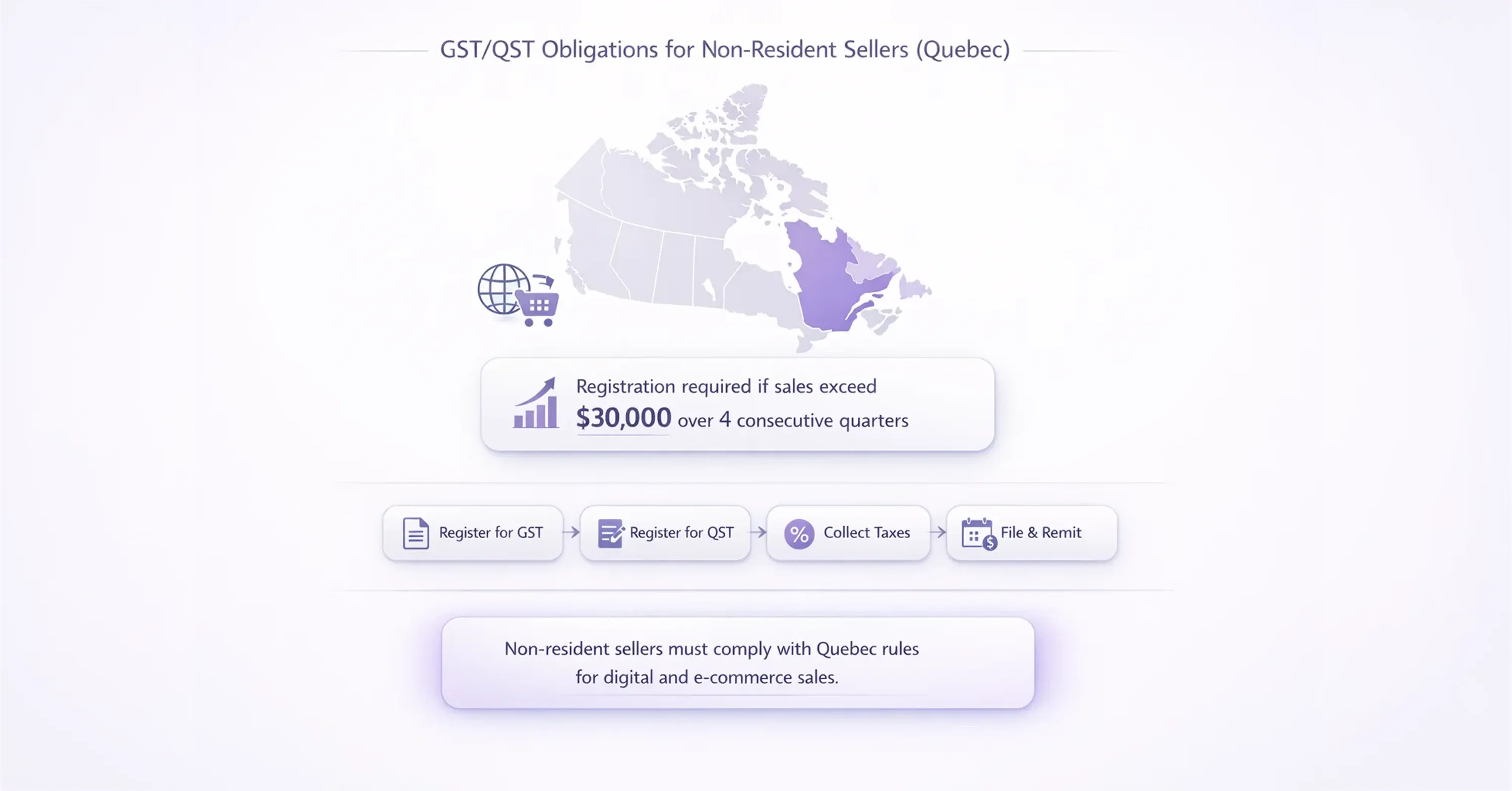
Quebec has been aggressive about extending tax collection requirements to out-of-province and international sellers. The province requires certain non-resident sellers and digital platform operators to register and collect QST on taxable goods and services sold to Quebec consumers. This applies to e-commerce businesses, SaaS providers, and marketplace sellers reaching Quebec customers.
If you're a non-resident seller exceeding $30,000 in taxable supplies in Quebec over four consecutive calendar quarters, you're generally required to register. The registration process involves:
-
Applying for a GST number (through Revenu Québec for Quebec-specific registration)
-
Applying for a QST number
-
Collecting both taxes on taxable sales to Quebec customers
-
Filing periodic returns and remitting the amounts collected
For marketplace sellers navigating these obligations across multiple jurisdictions, the complexity multiplies quickly. To stay up-to-date with cross-border rules and digital sales tax changes, see Selling to Canada? Here‘s What You Must Know About Changes In Country‘s Digital Sales Taxation.
Globally, consumption taxes like GST and QST play a significant role in government revenue. Across OECD nations, consumption tax revenues averaged 6.9% of GDP and 20.9% of total tax revenue in 2020. That context underscores why jurisdictions like Quebec continue tightening collection requirements for remote sellers.
For more, Canada – Cross-Border B2C Supply of Digital Services provides real-world scenarios for software and SaaS obligations.
Common Mistakes to Avoid When Using a Quebec Sales Tax Calculator
Even with the right formula, errors creep in. Here are the pitfalls that trip up businesses most often.
-
Applying QST on top of GST: This was how Quebec calculated QST before 2013. The old "tax-on-tax" method is no longer valid. Both taxes now apply to the pre-tax price only.
-
Forgetting to separate exempt and taxable items: Bundling exempt and taxable products on one invoice without distinguishing them creates audit headaches.
-
Rounding errors on bulk transactions: Always round each tax amount to the nearest cent per line item, not at the invoice total level.
-
Missing filing deadlines: Late remittances incur penalties and interest from Revenu Québec. Most businesses file monthly or quarterly depending on revenue thresholds.
A restaurant owner who mistakenly charges QST on a takeout order of basic groceries (zero-rated) will need to correct the error and potentially issue refunds. Small oversights like this add up when multiplied across hundreds of transactions.
If you want to dig deeper into typical errors and filing strategies, check the Sales Tax Compliance: Key Steps for Your Business article for a checklist on remittances, deadlines, and reporting.
Staying accurate with your GST/QST rates and keeping clean records are the two most effective ways to avoid issues during audits.
Conclusion
Calculating GST and QST does not have to be difficult once you understand the structure behind Quebec sales taxes. For most taxable sales, you apply 5% GST and 9.975% QST to the sale price, for a combined rate of 14.975%. The formula is simple, but applying it correctly every time is what keeps your business compliant.
The real challenge is not just doing the math. It is knowing when tax applies, classifying goods and services properly, handling tax-included pricing correctly, and keeping accurate records for filing and reporting. A reliable GST QST calculator makes the calculation easier, but strong internal processes are what help prevent errors.
If you know the rates, apply them consistently, and stay on top of filing obligations, Quebec sales tax becomes far more manageable. The goal is not only to calculate the right amount once, but to build a system that works every time.