Overview
Choosing a VAT registration provider is about more than getting a tax number. It directly affects how quickly your business can enter a new market, start selling legally, invoice customers, and stay compliant. For e-commerce sellers and international businesses, delays in registration can quickly turn into lost revenue and operational setbacks.
This article explains realistic VAT registration timelines, the most common causes of delay, and what makes one provider faster and more reliable than another. It also helps readers understand how to evaluate VAT partners and why providers like 1StopVAT can help reduce friction and speed up expansion.
Why VAT Registration Speed Matters More Than You Think
Cross-border VAT obligations are growing fast, and so is the volume of businesses registering. In the UK alone, 2,330,400 businesses were VAT-registered in the 2024/25 tax year, with 234,000 new registrations processed alongside 218,000 de-registrations. Across the EU, VAT generates over €1 trillion in revenue annually, roughly one-fifth of all taxes collected. These numbers reflect how central VAT compliance is to doing business in Europe.
For e-commerce sellers, the stakes are concrete. If you sell on Amazon Germany and your VAT number isn't active, Amazon may suspend your listing. If you store inventory in Poland and haven't registered there, you're accumulating penalties before you've made your first sale. Speed directly affects revenue.
Yet the registration process itself is far from instant. Timelines vary dramatically depending on the country, the completeness of your application, and whether you're using a provider that actually knows how to navigate each local tax authority. Understanding those variables is the first step toward choosing the right partner.
Typical VAT Registration Timelines by Country
Not every tax authority moves at the same pace. Here's a realistic snapshot of what sellers encounter:
-
Germany: 6 to 12 weeks, sometimes longer for non-EU businesses. The Bundeszentralamt für Steuern requires extensive documentation, and communication often happens via post.
-
France: 4 to 8 weeks, though applications with missing fiscal representative details can sit for months.
-
UK: 4 to 6 weeks on average, but HMRC has experienced significant backlogs that push some applications past 10 weeks.
-
Italy: 2 to 4 weeks, one of the faster EU countries, provided the codice fiscale step is handled upfront.
-
Poland: 2 to 6 weeks, with processing accelerated when the applicant has a local fiscal representative.
For a more detailed breakdown of timelines and practical strategies for fast-tracking your application, see Fast-Track VAT Registration: How to Register Quickly and Easily.
What "Fast" Actually Means in Practice
A provider claiming "fast registration" without context isn't telling you much. The real measure is how close they get to the minimum processing time in each jurisdiction. If Germany's tax office takes a minimum of six weeks, a provider that consistently delivers in seven weeks is performing well. One that takes fourteen weeks likely submitted an incomplete application or failed to follow up.
The difference between the fastest and slowest outcomes almost always comes down to preparation, local knowledge, and how actively the provider communicates with the tax authority on your behalf. That's where the gap between providers widens considerably.
Where Delays Actually Come From
Most registration delays aren't caused by slow tax authorities. They're caused by errors, omissions, and communication breakdowns before and during the application process.
Incomplete or Incorrect Documentation
Tax offices reject or stall applications for predictable reasons:
-
Missing proof of economic activity in the country
-
Incorrect company formation documents or translations
-
Unsigned power-of-attorney forms
-
Wrong format for identification numbers or addresses
A single missing document can add four to six weeks to any timeline, because the tax authority sends a request, the seller scrambles to gather the document, and the application goes back to the end of the queue.
To avoid these common pitfalls and get real-world examples of avoidable delays, see Expedited VAT Registration: Checklist for Fast EU Entry.
No Local Presence or Representative
Many EU countries require non-EU businesses to appoint a fiscal representative. If your provider doesn't have a local team or established representative in the country where you're registering, they'll need to arrange one, and that alone can add weeks.
Lack of Follow-Up With Tax Authorities
Some tax offices don't provide status updates unless you ask. In Germany, for example, applications can sit unprocessed if nobody follows up. Providers without local-language capability or established relationships with tax offices often can't check on progress until the seller complains, and by then, weeks have already been lost.
These delays compound. For a seller registering in three or four countries simultaneously, poor coordination means the entire expansion timeline shifts by months.
What Makes a VAT Registration Provider Genuinely Fast

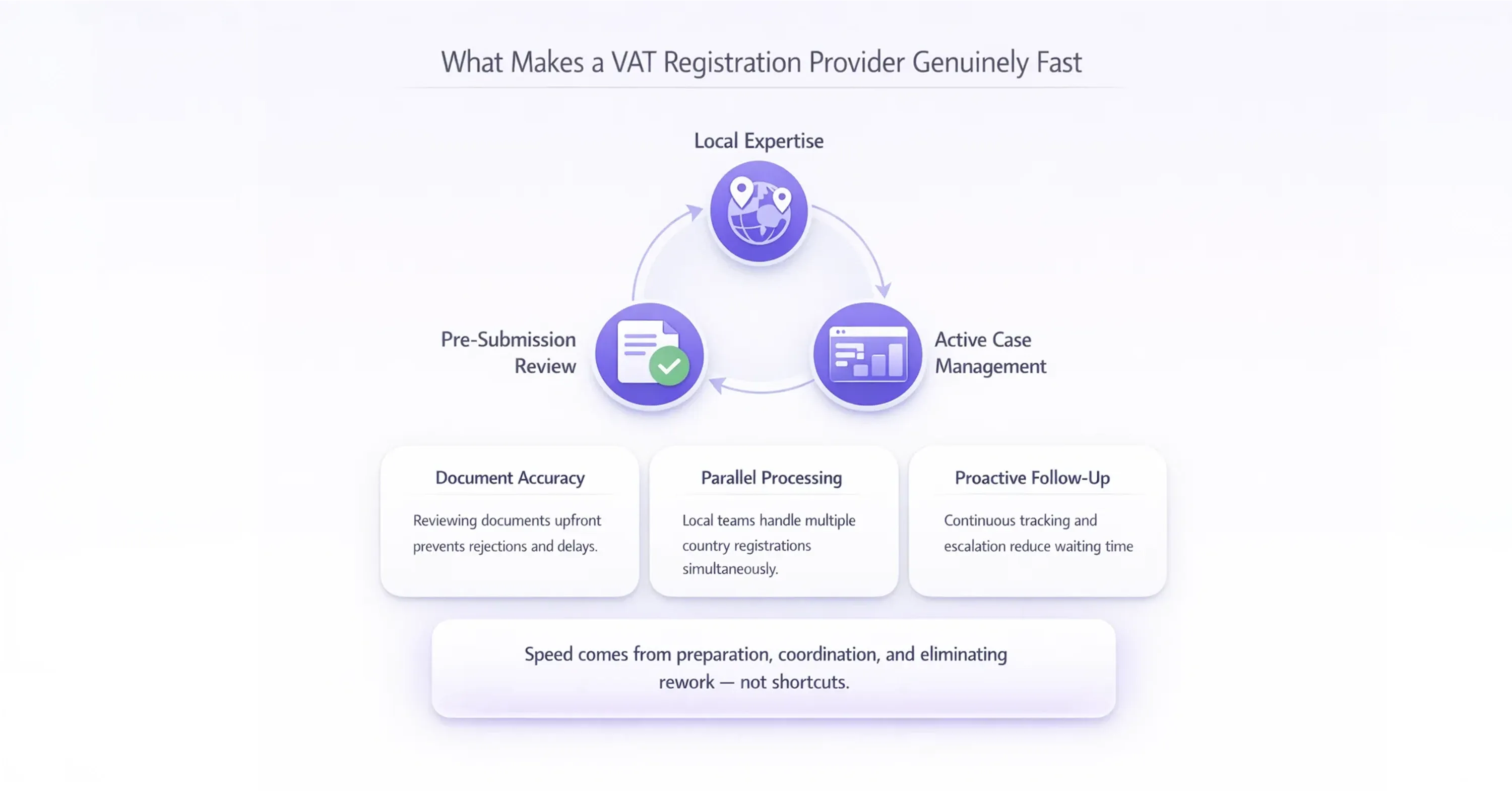
Speed in VAT registration isn't about shortcuts. It's about eliminating the friction that causes delays in the first place. The providers that move fastest are usually the ones with the strongest processes behind the scenes. They know which documents each tax authority expects, how to prepare applications correctly the first time, and when to follow up before a file goes stale. Instead of rushing the process, they reduce the back-and-forth that slows everything down. In practice, faster registration comes from better preparation, tighter coordination, and the ability to resolve issues before they turn into weeks of unnecessary waiting.
Pre-Submission Document Review
The fastest providers review every document before submission, checking for completeness, formatting, and country-specific requirements. This sounds basic, but it's the single biggest factor in avoiding rejections.
Dedicated Local Teams
Having specialists on the ground in each country matters enormously. A tax agent in Warsaw who regularly interacts with the Polish tax office can anticipate what additional documentation might be requested and include it proactively. The same applies in Germany, France, Spain, and every other market with its own procedural quirks.
For instance, if you're interested in how leading providers compare on speed, coverage, and compliance support, check out the Best VAT Registration Services in 2025: Top Providers Reviewed.
For example, a UK-based marketplace seller expanding to Germany, France, and the Czech Republic might expect a three-month process. With a provider that has dedicated local teams in each country, all three registrations can run in parallel, with each team managing its respective tax authority and resolving issues in real time. Without that structure, the seller is stuck waiting for one country to finish before the next one even begins.
Active Case Management
A good provider doesn't submit your application and wait. They track the status, follow up at appropriate intervals, and escalate when something stalls. This kind of hands-on management shaves weeks off the process, particularly in countries like Germany where bureaucratic inertia is common.
This is where a provider like 1StopVAT stands out. With a team of over 40 certified tax specialists covering more than 100 countries, 1StopVAT pairs marketplace sellers with dedicated local experts who manage the entire registration process, from document preparation through tax authority communication and follow-up. For sellers juggling multiple markets, having a single point of contact that coordinates parallel registrations across jurisdictions removes the operational burden that causes most delays.
For best practices on how to complete each stage of the VAT application and integrate it with your accounting processes, refer to How to Register for VAT: A Complete Guide.
The E-Commerce Factor: OSS and When You Still Need Local Registration
The EU's One-Stop Shop (OSS) system has simplified VAT for many cross-border sellers, and EU Member States collected more than €17 billion in VAT via the expanded e-commerce OSS portal in 2022. Revenue collected through OSS systems rose by 26% in 2022 compared to 2021, reflecting rapid adoption. Meanwhile, €2.5 billion in VAT on imports of e-commerce goods was collected via the Import OSS scheme in the same period.
But OSS doesn't eliminate the need for local VAT registration in every scenario:
-
If you store goods in a country (e.g., using Amazon FBA warehouses in Poland or the Czech Republic), you still need a local VAT number.
-
If you import goods into an EU country, local registration may be required.
-
If your business model involves B2B sales, OSS may not cover those transactions.
If you want to learn more about when OSS applies and how to strategically leverage it, see VAT in European Union: EU VAT Rules Explained for International Sellers.
Understanding when OSS applies, and when it doesn't, is critical. A fast registration provider should be able to advise you upfront, so you don't waste time registering where OSS already covers you, and don't miss registrations where it doesn't.
How to Evaluate a Provider Before You Commit
Before choosing a VAT registration partner, ask these specific questions:
-
What is your average registration timeline in [specific country]? Vague answers like "a few weeks" are a red flag.
-
Do you have local staff or representatives in the country? If they're outsourcing to a third party, timelines are harder to control.
-
How do you handle follow-ups with tax authorities? You want proactive tracking, not reactive scrambling.
-
Can you manage parallel registrations across multiple countries? This is essential for sellers expanding to several markets at once.
-
What happens if the application is rejected or delayed? A clear escalation process signals experience.
For more context and a direct comparison of leading providers, see Best VAT registration companies: Top Picks.
The number of VAT-registered businesses keeps climbing. 2.73 million VAT-registered businesses operated in the UK as of March 2025, a 0.4% increase from the prior year. As more businesses enter these markets, tax offices face growing workloads, and the advantage goes to sellers whose providers know how to move efficiently through the system.
Conclusion
When speed matters, VAT registration stops being a back-office task and becomes a growth-critical business decision. Every delay affects your ability to launch in new markets, start selling legally, recover input VAT, and keep marketplace operations running without disruption. That is why choosing the right provider is not just about cost or coverage. It is about how efficiently they can move your business from obligation to activation.
The fastest VAT registration providers are not the ones making vague promises. They are the ones with proven local expertise, rigorous document checks, active communication with tax authorities, and the ability to manage multiple registrations in parallel without losing momentum. In practice, that is what separates a smooth market entry from weeks or months of avoidable delays.
For businesses expanding across Europe and beyond, speed and accuracy must go together. A provider that understands both can help you register faster, avoid costly mistakes, and scale internationally with far less operational friction. If your goal is to enter new markets without getting stuck in compliance bottlenecks, working with an experienced partner like 1StopVAT can make the difference between waiting to grow and being ready to move.