Vehicle purchase agreement document with car keys and pen on desk during car buying process.

Auto Tax Calculator: How to Estimate Vehicle Taxes

Buying a vehicle is exciting, until the tax bill arrives. Whether you're purchasing your first car or adding to a fleet, the final price you pay almost always includes taxes that vary wildly depending on where you live, what you drive, and how you buy it. Knowing how to estimate those taxes before you sign the paperwork can save you from an unpleasant surprise.

Content authorBy Rūta ŠvobienėPublished onReading time11 min read

Overview

An auto tax calculator helps you estimate the real cost of buying a vehicle before you finalize the deal. This article explains how vehicle taxes are calculated, which charges may apply, and what factors can increase or reduce the total amount you owe. It covers sales tax or VAT, registration and title fees, emissions-based charges, trade-in credits, EV incentives, and cross-border purchases so you can build a more accurate vehicle tax estimate.

By the end, you'll understand how to calculate vehicle taxes step by step, avoid common mistakes, and use an auto tax calculator more effectively whether you're buying a new car, a used vehicle, or managing more complex international transactions.

In practice, buyers usually turn to an auto tax calculator when the final cost starts to feel unclear. A private buyer may want to compare the real cost of two similar vehicles in different states, while a small business owner may need to estimate taxes and registration fees before adding a vehicle to a fleet. In both cases, the calculator is most useful when it reflects the rules that actually apply to the transaction, not just the sticker price.

Why Vehicle Taxes Matter More Than You Think

Vehicle-related taxes are a massive revenue source for governments worldwide. In Europe alone, major markets collect roughly €383.7 billion per year in taxes on motor vehicles. That figure includes registration fees, annual duties, fuel levies, and VAT on the purchase itself.

For individual buyers, these taxes can add thousands to the sticker price. A $35,000 sedan might carry $2,000 to $4,000 in combined sales tax, registration fees, and title charges depending on your state or country. In practical terms, that means a buyer comparing two similar cars may discover that the “cheaper” option is not actually cheaper once local taxes and fees are added. Fleet operators and business buyers face the same issue at scale, where even small miscalculations can materially affect budget planning.

The good news is that once you understand the main components, using an auto tax calculator becomes much more straightforward. The key is knowing which taxes apply, what value is taxable, and which local fees or surcharges may affect the final amount. Let's break down the process step by step.

Identify the Taxes That Apply to Your Purchase

Not every vehicle purchase triggers the same taxes. The first step in building your car tax estimate is identifying which levies apply to your specific situation.

Most vehicle purchases involve some combination of the following:

  • Sales tax or VAT: charged as a percentage of the purchase price, varying by jurisdiction

  • Registration or title fees: flat or tiered charges imposed when you register the vehicle

  • Excise duty or road tax: an annual or one-time charge based on emissions, engine size, or vehicle weight

  • Import duty: applies when purchasing a vehicle from another country

  • Luxury or gas-guzzler surcharges: additional taxes on high-value or high-emission vehicles

For example, a buyer in Texas pays 6.25% state sales tax on a used car's purchase price, plus county fees. A buyer in the UK pays Vehicle Excise Duty (VED) based on CO2 emissions, with different first-year rates for petrol, diesel, and electric models.

Understanding which taxes apply to your purchase is the foundation of any accurate vehicle tax estimate. Without that clarity, every number that follows may be off, especially if your jurisdiction applies special rules for exemptions, private sales, imports, or vehicle type.

Determine the Taxable Value of the Vehicle

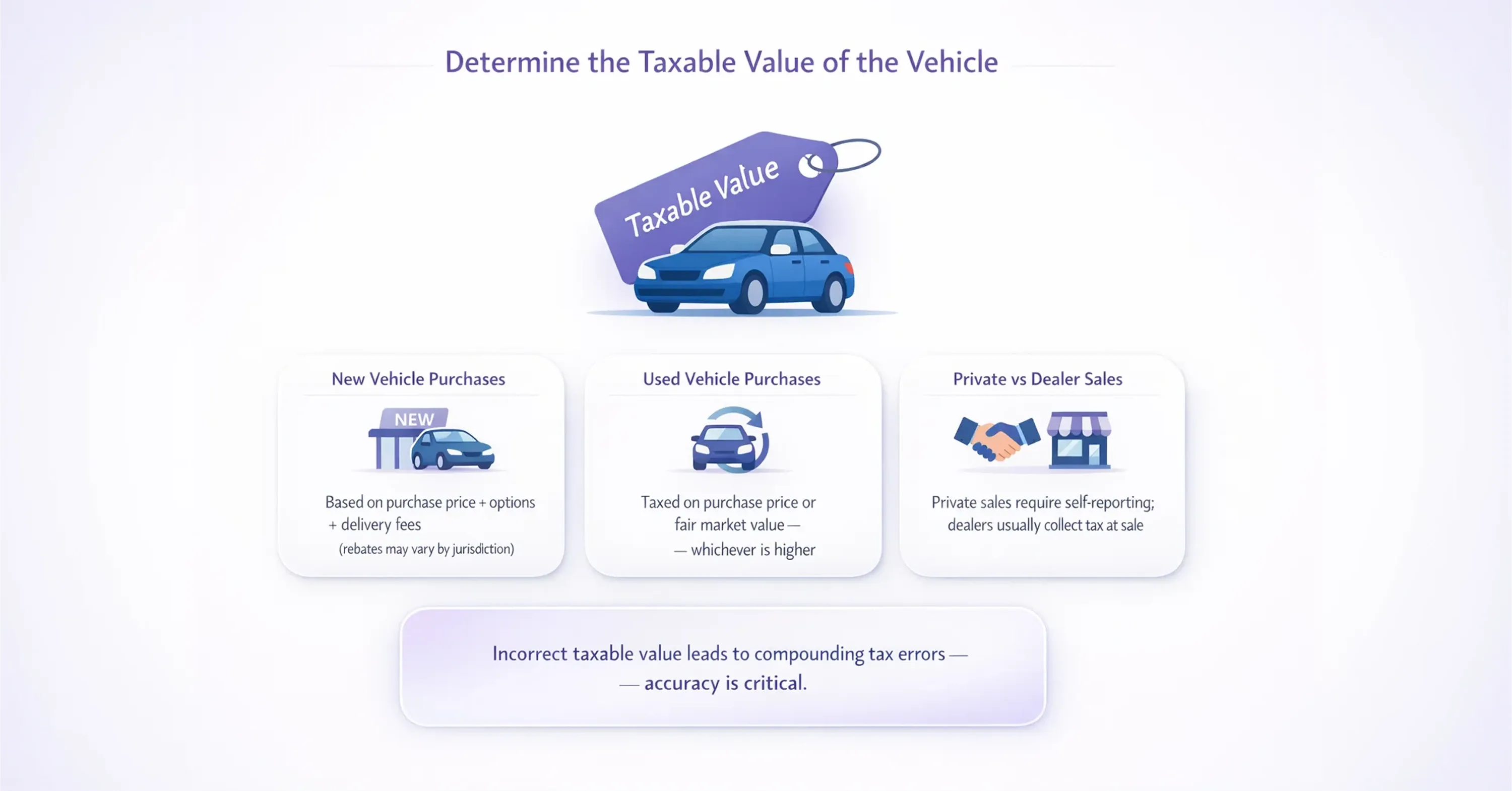
Infographic explaining how to determine vehicle taxable value for new, used, and private car sales.

Once you know which taxes apply, you need to establish the base amount those taxes are calculated on. This sounds simple, but it varies depending on where and how you buy.

New Vehicle Purchases

For new cars, the taxable value is typically the agreed purchase price, including any dealer-installed options or delivery charges. Some jurisdictions exclude manufacturer rebates from the taxable amount; others don't.

Used Vehicle Purchases

Used car taxes often depend on the sale price or the vehicle's fair market value, whichever is higher. States like California use the purchase price, while others reference a book value to prevent underreporting. If you buy a used SUV for $18,000 but the state values it at $21,000, you may owe tax on the higher figure.

Private Sales vs. Dealer Sales

Private-party transactions sometimes carry lower tax rates, but you're still responsible for paying the applicable tax when you register the vehicle. Dealer sales usually include tax collection at the point of sale, which simplifies the process.

Pinning down the correct taxable value is essential. Get this wrong, and every percentage you apply afterward compounds the error.

Apply the Correct Tax Rates

With your taxable value in hand, the next step is applying the right rates. This is where an auto tax calculator earns its keep, because rates differ dramatically across regions.

Sales Tax and VAT Rates

In the United States, combined state and local sales tax on vehicles ranges from 0% (Montana, Oregon) to over 10% in parts of Louisiana and Tennessee. In Europe, VAT rates on vehicle purchases range from 17% in Luxembourg to 27% in Hungary.

Here's a simplified example:

  • Vehicle price: $30,000

  • State sales tax: 7%

  • Estimated sales tax: $2,100

If your county adds another 1.5%, the total tax rate climbs to 8.5%, and your bill becomes $2,550. That $450 difference matters. For tips on accurate rate lookup and calculation, see US Sales Tax Explained: State-by-State Guide.

Emissions-Based Taxes

Many countries now tie vehicle taxes to CO2 output. The UK's VED system is a clear example. First-year rates for high-emission vehicles can exceed £2,000, while zero-emission cars pay significantly less. The UK's 2024 Autumn Budget reinforced this approach by raising VED revenues through freezing the lowest first-year rate for zero-emission cars through 2030 while increasing rates for others, yielding about £415 million in 2026-27.

This emissions-linked structure is spreading. France, Germany, and several other EU nations have similar systems, making a vehicle tax calculator that accounts for CO2 ratings increasingly important.

Factor In Registration and Title Fees

Beyond sales tax, most jurisdictions charge flat or weight-based fees to register and title a vehicle. These aren't technically "taxes" in every legal sense, but they add to your total cost and should be part of your estimate.

Common registration-related charges include:

  • Title fee: a one-time charge, often $15 to $75 in the US

  • Registration fee: annual or biennial, sometimes based on vehicle weight or value

  • Plate fee: for new plates or transfers

  • Inspection or emissions testing fee: required in many states and countries before registration

In the UK, registration compliance is taken seriously. A 2024 parliamentary answer confirmed a 98.7% licensing compliance rate, implying roughly 498,000 unlicensed vehicles and a 1.3% evasion rate in 2023. Separate government data showed the VED evasion rate "in traffic" was estimated at 1.3% that same year, while the rate in the licensed vehicle stock stood at 1.2%. These numbers show that enforcement is tight and accurate tax estimation keeps you on the right side of compliance.

Adding registration costs to your car tax estimate gives you the most realistic picture of what you'll owe at the point of purchase - and for a practical resource on tax registration, see Steps to register for sales tax in the US.

Account for Special Circumstances

Standard calculations cover most buyers, but certain situations change the math. This step is about catching the variables a basic vehicle tax calculator might miss.

Trade-Ins and Credits

Many US states allow you to deduct the trade-in value from the purchase price before calculating sales tax. For example, if a buyer replaces an older car with a $40,000 truck and receives $12,000 for the trade-in, the taxable amount may fall to $28,000 in states that allow this deduction. That can meaningfully reduce the total bill, but not all states apply the rule the same way, so verifying local treatment is essential.

Electric and Zero-Emission Vehicles

EV incentives are shifting quickly. In 2023, the UK saw 1,015,000 licensed zero-emission vehicles on its roads, representing 2.5% of all vehicles, alongside a 16% rise in new registrations over 2022. Governments are adjusting tax policy in response, sometimes offering lower rates now while planning higher ones later.

If you want to dig into international nuances or want to know more about US companies and international compliance, VAT services for US companies: How to Stay Compliant When Selling Internationally can help. In the US, federal EV tax credits of up to $7,500 reduce effective cost but don't always reduce the sales tax base. Check whether credits apply before or after tax in your jurisdiction.

Cross-Border and International Purchases

Buying a vehicle abroad introduces import duties, customs VAT, and potentially different emissions standards that trigger surcharges. For marketplace sellers dealing in vehicles or automotive parts across borders, the VAT implications multiply fast. This is where working with a specialized compliance partner like 1StopVAT becomes genuinely useful. Their team of certified tax specialists helps businesses navigate VAT registration and filing obligations across 100+ countries, turning what could be a compliance headache into a structured, manageable process. You can also get practical strategies from Cross-Border Tax Compliance: Tips for Global Businesses.

Run Your Final Estimate

Now it's time to pull everything together.


Here's a practical framework for your final car tax estimate:

  1. Start with the vehicle's taxable value (purchase price or fair market value)

  2. Subtract any trade-in credit if your jurisdiction allows it

  3. Multiply by the combined sales tax or VAT rate

  4. Add registration, title, and plate fees

  5. Add any emissions-based surcharges or excise duties

  6. Subtract applicable credits or incentives

For a $32,000 new car in a state with 8% combined sales tax, a $500 registration package, and no trade-in, the estimate looks like this:

  • Sales tax: $32,000 × 0.08 = $2,560

  • Registration and fees: $500

  • Total estimated taxes and fees: $3,060

That figure could shift by hundreds of dollars depending on local add-ons, so always verify with your state's DMV or revenue department.

How an Auto Tax Calculator Saves You Time

An auto tax calculator automates the steps above by pulling in jurisdiction-specific rates, fee schedules, and incentive data. The best tools let you input the vehicle price, your location, and the vehicle type, then return a detailed breakdown in seconds. This is especially valuable when comparing vehicles across different price points or buying from out of state, where tax rules may differ from your home jurisdiction.

For businesses selling internationally, the complexity scales further. Cross-border VAT, import duties, and local registration taxes all require careful handling. Providers like 1StopVAT offer dedicated guidance and filing support for marketplace sellers, ensuring compliance across multiple countries without requiring separate advisors in each market. To understand more about international digital solutions, explore How to Use a VAT Tax Calculator for Accurate Invoices.

Conclusion

A vehicle’s sticker price is only part of what you actually pay. The real cost includes sales tax or VAT, registration fees, title charges, and in many cases emissions-based or import-related taxes that can quickly add up. That is why using an auto tax calculator before you buy is not just helpful, but essential. It gives you a clearer view of the full financial picture, helps you compare options more accurately, and reduces the risk of unexpected costs at registration or checkout.

The core process is simple: identify the taxes that apply, confirm the correct taxable value, apply the right rates, and include every mandatory fee. Once you do that, your car tax estimate becomes far more reliable and much easier to plan around. Whether you are buying a personal vehicle, managing multiple purchases, or dealing with cross-border transactions, the same rule applies: the better your estimate, the better your decision. Start with the numbers, verify the local rules, and make sure the total cost of ownership makes sense before you commit.

Most reputable auto tax calculator tools are accurate for basic estimates, pulling from current state and federal rate databases. However, they may not capture every local surcharge or recent rate change. Always cross-check the final figure with your local DMV or tax authority before budgeting.

Yes, in most US states and many other countries. You typically pay the tax when you register the vehicle. The taxable amount is usually the purchase price or the vehicle's assessed market value, whichever is greater.

Not entirely. Many jurisdictions offer reduced rates or temporary exemptions, but EV-specific fees are becoming more common as governments offset lost fuel tax revenue. The UK, for example, is gradually bringing zero-emission vehicles into the VED structure starting from 2025.

Sales tax is a one-time charge applied to the purchase price at the point of sale. Excise tax, often called road tax or vehicle excise duty, is typically an annual charge based on vehicle characteristics like emissions or weight. Both contribute to your total cost of ownership.

Yes. Common strategies include taking advantage of trade-in credits, purchasing in a lower-tax jurisdiction (where legally allowed), choosing low-emission vehicles that qualify for incentives, and timing your purchase around rate changes. Always verify that any approach complies with your local regulations.

Simple Compliance

Free consultation with 1StopVAT experts

You Might Also Like

Discover more insights and articles

Laptop displaying VAT registration dashboard with international flags including EU, Germany, UK, and USA, representing global tax compliance and cross-border business operations.

Which Company Can Register VAT for My Business Fastest?

Every week you spend waiting for a VAT number is a week you can't legally sell, invoice, or reclaim tax in that market. For marketplace sellers expanding across borders, the question isn't whether to register, it's how quickly you can get it done without errors that cause even longer delays. This article breaks down realistic VAT registration timelines across key markets, explains exactly where and why delays happen, and helps you evaluate what separates a fast, reliable registration provider from one that leaves you stuck in a queue.

Business professional reviewing financial report and invoice while analyzing data on laptop dashboard, representing accounting, bookkeeping, and financial analysis.

Reverse Tax Calculator: How to Work Back from Final Price

You're staring at a receipt, an invoice, or a product listing, and all you see is the final number. But how much of that price is actually tax? If you've ever needed to separate the pre-tax amount from a tax-inclusive total, you're not alone. This guide walks you through exactly how a reverse tax calculator works, step by step. You'll learn the core formula behind VAT reverse calculation, see real-world examples with different tax rates, and understand why getting this right matters for pricing, accounting, and cross-border compliance. Whether you sell on marketplaces or simply want to decode your grocery bill, this is the only breakdown you need.

Laptop displaying secure ecommerce checkout page with online payment details, order summary, and total cost on a desk with calculator, receipt, and office items.

Tax Price Calculator: Calculate Final Price with Tax

Every time you sell a product, send an invoice, or list an item on an online marketplace, one number matters more than any other: the final price your customer actually pays. Get the tax calculation wrong, and you either absorb a loss or confuse (and possibly lose) the buyer. This guide walks you through exactly how a tax price calculator works, breaks the math into clear steps, and shows you how to arrive at the correct tax-inclusive price every single time.

Laptop displaying EU VAT compliance dashboard with tax reports, European Union flag, and map in the background.

Who Offers Affordable VAT Registration Services in Europe?

If you sell across European borders, you already know the sting: VAT registration fees that quietly eat into your margins before you've shipped a single unit. The real question isn't whether you need VAT compliance, but who can deliver it without draining your budget.