Overview
A reverse tax calculator helps you work backward from a tax-inclusive price to find the original pre-tax amount and the exact tax portion included in the total. This is essential for businesses that need accurate bookkeeping, pricing analysis, invoicing, and VAT reporting, especially when operating across markets where taxes are included in displayed prices. In this guide, you'll learn the core reverse tax formula, see step-by-step examples with different VAT rates, understand the most common calculation mistakes, and discover why reverse tax calculation matters for cross-border compliance as much as for day-to-day pricing accuracy.
Reverse Tax Calculator Definition
A reverse tax calculator helps determine the original pre-tax (net) price when you only know the final tax-inclusive (gross) amount. It works by dividing the total price by 1 plus the applicable tax rate expressed as a decimal, allowing you to separate the net value from the tax portion included in the sale.
For example, if a product costs €240 including 20% VAT, the pre-tax price is €200 because €240 ÷ 1.20 = €200. The remaining €40 is the VAT amount. This kind of calculation is especially useful for bookkeeping, invoicing, pricing analysis, and VAT reporting in markets where taxes are already included in the displayed price.
Why Tax-Inclusive Pricing Requires Reverse Calculation
Most consumers never think twice about the number on a price tag. But behind every tax-inclusive price sits a hidden split: the net amount that goes to the seller and the tax portion that goes to the government. For businesses, knowing that split isn't optional. It's essential for bookkeeping, tax filings, and margin analysis.
The reason reverse calculation exists is straightforward. In many jurisdictions, the law requires sellers to display a final price that already includes VAT and all other taxes. The EU's Price Indication Directive, for example, mandates that any final price shown to consumers must include VAT and all other taxes. That means the customer sees one clean number, but the seller still needs to account for the tax component separately.
This isn't a niche concern. VAT alone raises over €1 trillion annually in the EU, roughly 20% of total public revenues. Every euro of that trillion was originally embedded in a tax-inclusive price that someone, somewhere, had to reverse-calculate to report correctly.
Understanding the "why" behind the math makes the formula itself much easier to remember. So let's get into it.
The Core Formula Behind Every Reverse Tax Calculator
At its heart, a reverse tax calculator does one thing: it divides the gross (tax-inclusive) price by a factor that accounts for the tax rate. Here's the formula you need:
Pre-Tax Price = Tax-Inclusive Price ÷ (1 + Tax Rate)
That's it. The entire concept rests on this single equation. If your tax rate is 20%, you divide by 1.20. If it's 10%, you divide by 1.10.
To isolate just the tax amount, you subtract:
Tax Amount = Tax-Inclusive Price − Pre-Tax Price
A quick summary of the steps:
-
Start with the total price the customer pays
-
Convert the tax rate from a percentage to a decimal (e.g., 25% becomes 0.25)
-
Add 1 to that decimal to get your divisor (1.25 in this case)
-
Divide the total price by the divisor to find the net price
-
Subtract the net price from the total to find the tax portion
This formula works universally, whether you're dealing with VAT in France, GST in Australia, or sales tax in a U.S. state that quotes tax-inclusive prices. The logic doesn't change; only the rate does.
For more depth on how this calculator applies to a variety of retail scenarios, including both U.S. and international contexts, see the Retail Tax Calculator: How to Compute Sales Tax Fast.
Now that the formula is clear, let's see it in action with concrete numbers.
Step-by-Step Examples of VAT Reverse Calculation
Example 1: Standard EU VAT at 20%
Imagine you sell a product on an online marketplace for €120.00, and the applicable VAT rate is 20%.
-
Tax-Inclusive Price: €120.00
-
Divisor: 1 + 0.20 = 1.20
-
Pre-Tax Price: €120.00 ÷ 1.20 = €100.00
-
VAT Amount: €120.00 − €100.00 = €20.00
Clean and simple. But notice something important: the VAT is €20.00, which is 20% of the net price (€100.00), not 20% of the gross price. This is a common mistake people make when they try to just multiply the total by the tax rate.
Example 2: Reduced Rate at 10%
A bookshop in Austria sells a title for €22.00 including the reduced 10% VAT rate.
-
Tax-Inclusive Price: €22.00
-
Divisor: 1.10
-
Pre-Tax Price: €22.00 ÷ 1.10 = €20.00
-
VAT Amount: €22.00 − €20.00 = €2.00
Example 3: Higher Rate at 25%
A SaaS company charges a Swedish customer €250.00 for an annual subscription, with Sweden's 25% VAT baked in.
In each case, the pattern is identical. Change the rate, change the divisor, get your answer. This consistency is exactly what makes the reverse tax calculator so reliable across different countries and tax regimes.
With the math handled, there's a bigger question worth addressing: why does it matter which way you display prices in the first place?
How Tax-Inclusive Pricing Affects Buyer Behavior and Your Bottom Line

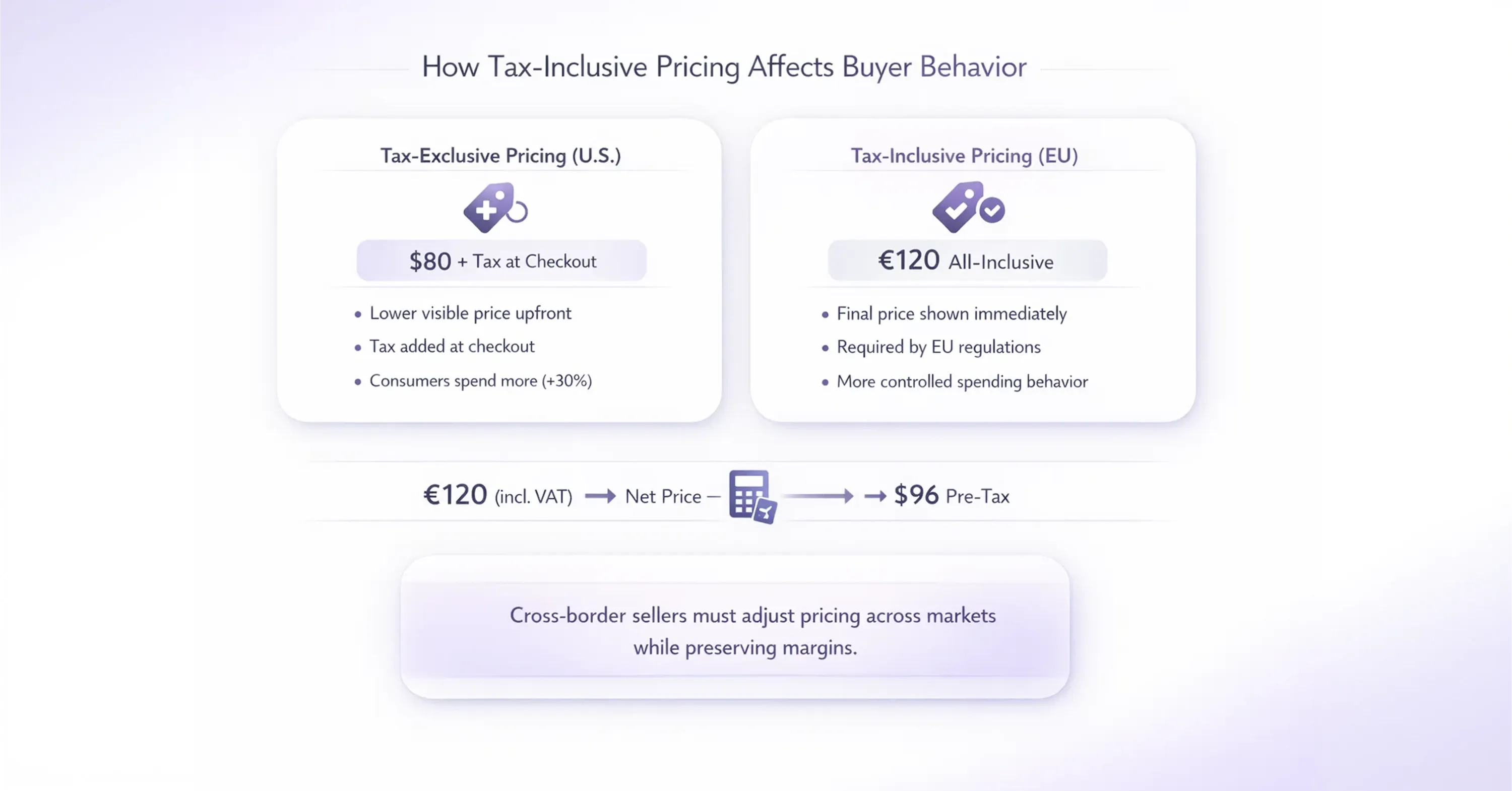
The way you present prices isn't just a legal checkbox. It directly influences how much people spend. Research from the Federal Reserve Board found that consumers facing tax-exclusive pricing spent about 30% more than those facing tax-inclusive pricing. When shoppers see a lower sticker price and only encounter tax at checkout, they tend to buy more freely.
That's a significant behavioral gap. For marketplace sellers operating across borders, this creates a real tension:
-
EU regulations require tax-inclusive display prices
-
U.S. marketplaces typically show prices before tax
-
Sellers need to reverse-calculate to set competitive prices in each market while maintaining margins
If you're selling at €120 inclusive in France but want to list the same product on a U.S. platform, you need to extract the net price first, then decide on your pre-tax listing price for the American audience. The reverse tax calculator becomes your bridge between these two pricing worlds.
This gets especially complicated when you sell across multiple EU countries, each with its own VAT rate. Since July 2021, a single EUR 10,000 annual threshold applies to all sales to EU consumers, meaning even modest cross-border volumes can trigger VAT registration obligations in destination countries. Suddenly, you're not just reverse-calculating one rate. You're juggling rates for Germany (19%), France (20%), Sweden (25%), and more.
If you're moving into cross-border selling and need a roadmap for multi-jurisdictional compliance, check the Sales Tax Registration and Compliance Guide for Global Sellers.
This is where the math alone stops being enough and compliance expertise becomes critical.
Avoiding Common Mistakes in Reverse Tax Calculations
Even with a simple formula, errors creep in. Here are the pitfalls that trip up sellers and accountants most often.
Mistake 1: Multiplying Instead of Dividing
The most frequent error is calculating tax by multiplying the gross price by the tax rate. If someone takes €120 × 0.20, they get €24, which is wrong. The correct VAT on a €120 inclusive price at 20% is €20. Always divide the inclusive price; never multiply it.
Mistake 2: Using the Wrong Tax Rate
Products and services often fall under different VAT rate categories within the same country. Food, books, and children's clothing frequently qualify for reduced rates. Applying the standard rate when a reduced rate applies means you'll overstate your tax liability and understate your net revenue.
Mistake 3: Ignoring Rounding Rules
Tax authorities have specific rounding expectations. In most EU countries, VAT amounts should be rounded to two decimal places. On high-volume transactions, even a one-cent rounding error per line item can snowball into reporting discrepancies. Always round at the line-item level, not on the total.
Mistake 4: Forgetting Currency Conversion Timing
For cross-border sellers, the exchange rate on the date of supply matters. Reverse-calculating in the wrong currency or using a stale exchange rate will produce an incorrect net figure. Check your local rules for which rate to apply and when.
Want a checklist of common VAT errors and how to prevent them? Visit Determining VAT: mistakes to avoid.
Keeping these mistakes in mind protects your filings and your margins. But when you're managing VAT across dozens of countries, the sheer volume of calculations and rate lookups can overwhelm even careful teams.
Scaling Reverse Tax Calculations Across Borders
For a single transaction, the formula is quick mental math. For a business selling thousands of units across multiple EU member states, it becomes a compliance challenge.
Each country has its own standard rate, reduced rates, and exemptions. You need to:
-
Identify the correct rate for each product category in each destination country
-
Apply the reverse calculation to every tax-inclusive transaction
-
Record both the net amount and the tax portion for each jurisdiction
-
File returns on time in every country where you're registered
If your business needs practical advice and provider comparisons for staying compliant abroad, see Best VAT Registration Services in 2025: Top Providers Reviewed.
This is precisely why marketplace sellers increasingly rely on specialists. 1StopVAT, for instance, acts as a single point of contact for VAT registration, compliance, and filing across 100+ countries. Their team of 40+ certified tax specialists handles the complexity of multi-country obligations, so sellers can focus on growth instead of chasing rate tables. For anyone juggling VAT reverse calculations across borders, having dedicated guidance on filings and registration removes a significant burden. For a summary of advisory options, see Top Advisors for Multi-Country VAT Compliance.
Whether you handle it internally or work with a compliance partner, the underlying math stays the same. The formula never changes. What changes is the scale and the stakes.
Conclusion
Working backward from a tax-inclusive price is simple in theory, but it matters enormously in practice. Once you know the formula, finding the pre-tax amount and tax portion becomes straightforward. The real value lies in applying that calculation accurately every time, using the correct rate, avoiding rounding mistakes, and keeping your records clean.
For one-off purchases, reverse tax calculation is a useful way to understand what you're really paying before tax. For businesses, it is far more than a basic formula. It supports accurate pricing, protects profit margins, improves bookkeeping, and helps ensure compliant VAT reporting across different markets.
In a tax-inclusive pricing environment, a reverse tax calculator is not just a handy tool. It is a practical essential for anyone who needs to understand how much of a final price is true revenue and how much must be set aside for tax.