GST compliance concept illustration showing business professional with laptop, global tax security, and digital reporting icons.

Goods and Services Tax (GST) Explained: A Complete Guide

Are you a finance leader losing sleep over goods services tax (GST) compliance? Rest assured, there's a way to keep your cash flowing and skip audits.

Content authorBy Rūta ŠvobienėPublished onReading time8 min read

What you will learn

Today, you’ll get a plain walkthrough of the goods and services tax (GST) from a baseline definition to day-to-day compliance. We’ll cover the countries that apply GST, how it differs from VAT, the upside for businesses, and a step-by-step look at GST registration, collection, and filing.

So, today you’ll know exactly what to do and when to ask for expert advice from your trusted partners.

Goods Services Tax (GST) is a multi-stage consumption tax levied on the value added at each point in a supply chain. Businesses charge GST on sales, claim credits on purchases, then remit the net amount to the tax authority, making the tax ultimately borne by the final consumer.

GST at a glance: why it matters now

Today, mastering GST is more critical than ever:

These numbers indicate why CFOs should treat GST as a core compliance area that predetermines cash flow, pricing, and risks.

1. What is GST, and how does it work

GST is a destination-based, creditable tax that applies to most goods and services sold for domestic consumption.

  • The supplier adds GST (output tax) to the invoice price.
  • The customer, if registered, claims the same amount as input credit.
  • Only the value added at each stage becomes taxable, preventing pyramiding.

GST vs. VAT

The mechanics are largely the same. Many economies use the terms interchangeably, yet:

  • VAT is the term preferred in Europe and the UK.
  • GST is applied across the Asia-Pacific, Australia, Canada, and India.
  • Some GST regimes allow more granular rate-setting or state-level components, e.g., India’s CGST/SGST split.

For a deeper dive into GST differences, including registration, rate-setting, and filing rules, consult the official guidelines published by tax authorities in each jurisdiction.

Key benefits for businesses:

  • Simpler tax structure: one levy replaces a plethora of cascading sales taxes
  • Easier credit recovery to lower embedded tax cost
  • Transparent pricing for cross-border supply chains.

2. Where in the world is GST applied

GST covers more than 170 jurisdictions. For multinational finance teams, the hotspots are:

  • Asia-Pacific: India, Australia, New Zealand, Singapore, Malaysia, Indonesia, the Philippines.

  • Americas: Canada’s federal GST plus provincial variants (HST/QST), Chile’s IVA.

  • Africa and the Middle East: South Africa’s VAT model, the UAE, and Saudi Arabia.

  • Other GST adopters: Fiji, Papua New Guinea, and the Bahamas.

Canada requires registration once taxable supplies exceed CAD 30,000 in four consecutive quarters, while India mandates registration above INR 40 lakh, equal to USD 48,000, or for anyone selling online goods.

Read more about digital-age requirements, including updates in places like Singapore

3. GST vs. VAT: practical implications for CFOs

While the core concept of a single, unified tax on goods and services is straightforward, the devil is often in the details. It's in these subtle nuances that are challenging for most businesses:

  • Specific rules for different industries
  • Varied tax rates
  • Complex eligibility criteria for exemptions and credits. 

Understanding these finer points will ensure you're compliant, optimize your tax position, and avoid costly flaws:

Failure to capture these details results in denied credits and assessments. The UK reported 2.72 million businesses registered for VAT/PAYE in March 2024; nonetheless, it had lost £8.1 billion in VAT due to a 4.9 % gap

Here’s our VAT Compliance Checklist for Startups and Small Businesses

4. Step-by-step GST compliance process

We will now guide you through the entire GST lifecycle: registration, calculation, filing, and payment.

4.1 Determine nexus and thresholds

  • Map where your company has inventory, warehouses, or delivers digital content
  • Compare yearly taxable turnover against each jurisdiction’s threshold
  • For e-commerce, check marketplace rules: some platforms may collect GST on your behalf.

Since thresholds differ widely, finance teams should review local GST rules in every jurisdiction where they operate.

4.2 GST registration

For a company, navigating the GST landscape begins with a critical first step: registration. It's a foundational requirement that, when handled correctly, sets the stage for seamless tax management.

1. Gather legal entity documents, bank details, and proof of business address. 2. Complete the online application on the tax portal (e.g., Canada’s CRA, Singapore’s IRAS). 3. Receive a GST number to display on invoices.

Delays result in extra liabilities, so start 4–6 weeks ahead of launch. 1stopVAT experts handle multi-country registrations

4.3 Charge the correct rate

One of the most crucial aspects of GST compliance is applying the correct rate to your goods and services. 

Charging the wrong rate can lead to under- or over-collection of tax, resulting in penalties or a loss of revenue. While a unified tax system simplifies things, different goods and services still fall under various tax slabs.

  • Classify products or services: standard, reduced, zero, or exempt.
  • Set tax codes in ERP/commerce systems.
  • Validate customer GST numbers (where reverse charge may apply) through government databases.

4.4 Collect and record

Properly collecting and meticulously recording GST is the bedrock of compliance. Without a robust system in place, businesses risk facing penalties, losing out on valuable input tax credits (ITCs), and creating significant headaches during audits. 

The process starts with accurate invoicing and extends to maintaining a detailed, accessible ledger of all GST-related transactions:

  • Issue tax invoices within statutory time limits
  • Keep digital copies for 5–10 years, depending on the country
  • Use separate ledger accounts for output and input GST.

4.5 Claim input credits

A major benefit of a GST system is the ability to claim input tax credits (ITCs). This mechanism allows businesses to deduct the tax they paid on their business purchases (inputs) from the tax they collected on their sales (outputs), effectively preventing the cascading effect of taxes. 

Correctly claiming these credits is crucial for optimizing cash flow and reducing your overall tax liability.

  • Match vendor invoices to purchase orders
  • Ensure supplier GST numbers and tax amounts are correct
  • Perform three-way matching to avoid claiming on invalid documents.

Here are more tips on GST input credit recovery and audits - see EY’s Worldwide VAT, GST and Sales Tax Guide 2025 for details. Note: since tax systems vary, the eligibility, documentation and audit scope for GST input credits may differ between countries and over time.

4.6 GST filing and payment

Successfully managing GST compliance culminates in the final, non-negotiable step: filing your returns and making the required payment. This process synthesizes all the information you've diligently collected—from your sales and purchases to your input tax credits - into a single, official submission to the tax authority. Most regimes demand monthly or quarterly returns.

Typical fields:

  • Total taxable sales, exempt sales, and exports.
  • Output GST collected
  • Input GST eligible
  • Net amount payable or refundable.

Automate the extraction of these figures to prevent manual errors. File on time to avoid late fees, which can reach 10% of the tax due in some countries.

4.7 Reconcile and audit-proof

GST reconciliation is the crucial final step that makes your GST records audit-proof. It's the process of matching the data in your internal books of accounts with the information on the government's GST portal. 

This ensures everything is consistent, allowing you to identify and fix any discrepancies before a tax officer does:

  • Reconcile GST control accounts to the general ledger each period
  • Retain audit trails of calculations
  • Prepare for periodic desk or field audits.

5. Common GST challenges and how to solve them
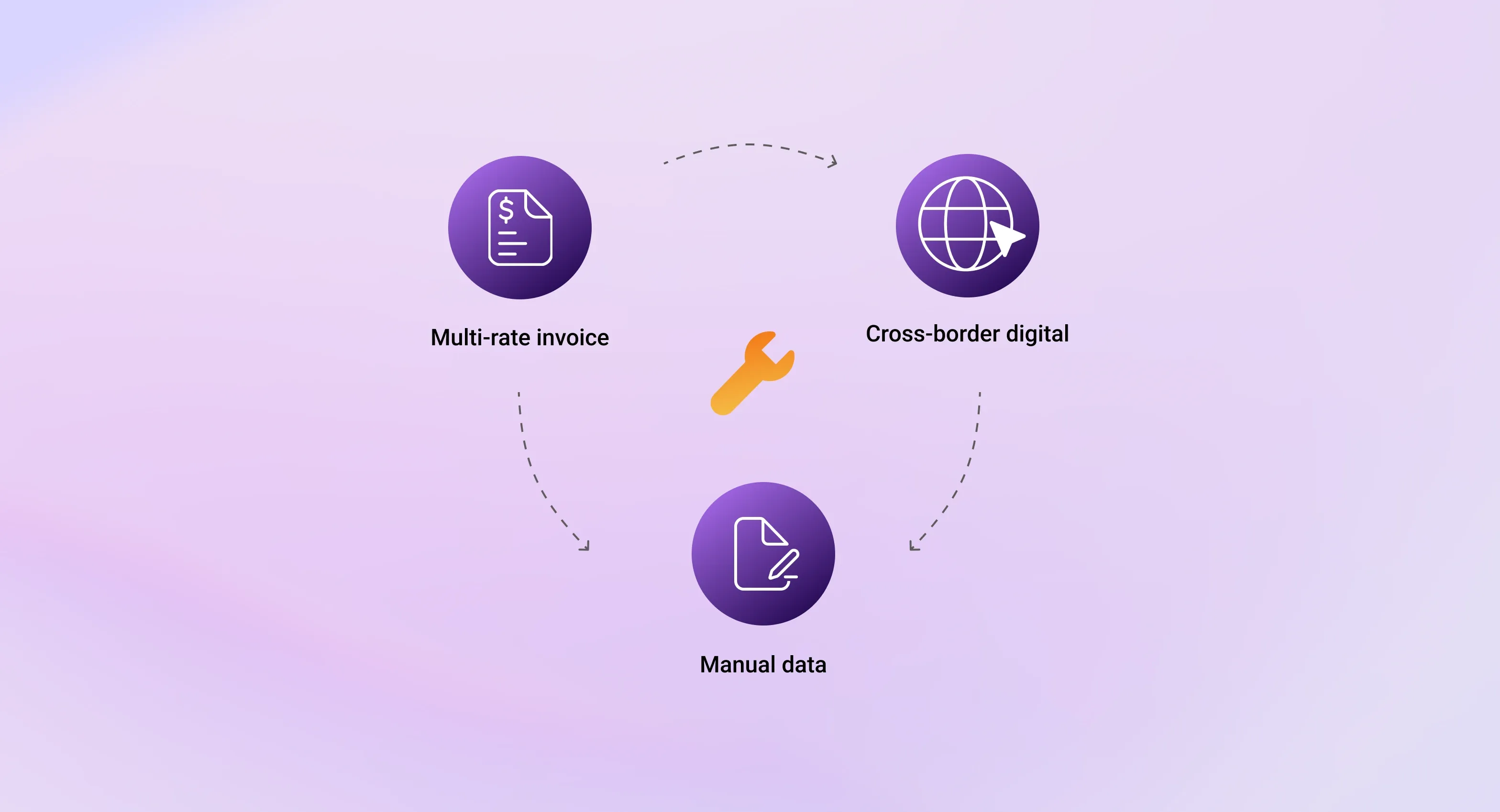
Illustration of common GST compliance challenges including multi-rate invoices, cross-border digital supplies, and manual data collection.

Businesses commonly face challenges with GST compliance due to a combination of intricate regulations, technical issues, and human error.  Fortunately, most of these problems can be solved with a proactive approach and the strategic use of technology.

5.1 Multiple tax rates on a single invoice

When an invoice contains items with different GST rates, businesses classify the supply as either a composite supply or a mixed supply to determine the correct tax treatment. 

Incorrectly classifying these can lead to underpayment of tax and subsequent penalties:

  • Split items and show each rate separately
  • Configure ERP to default the correct rate per SKU.

5.2 Cross-border digital supplies

Navigating GST for cross-border digital supplies can be complex, as it involves both the supplier's location and the consumer's location. 

The key challenge lies in determining where the tax should be levied, who is responsible for collecting it, and what rate applies:

  • Identify customer location using two-piece evidence (IP and billing address)
  • Register under simplified schemes for non-residents where available.

5.3 Manual data collection for GST filing

Despite the advent of technology, many businesses still rely on manual data collection for GST filing, which is a major source of errors, delays, and penalties. 

A conventional approach, often involving spreadsheets and offline tools, might seem manageable for a low volume of transactions, but it quickly becomes a high-risk liability as a business grows:

  • Integrate sales platforms, payment gateways, and accounting software.
  • Implement validation rules to catch missing GST numbers.

Is your team spending more time on GST compliance than on growth?  Don't let complex regulations be a roadblock to your ambitions. 

Partner with trusted advisors for multi-country filings and remittances

Conclusion

Managing goods services tax (GST) doesn’t need to be overwhelming. By following the right steps - registration, correct rate application, input credits, and timely filing - you safeguard cash flow, reduce compliance risks, and keep your business audit-ready for long-term growth.


Standard-rated goods attract the full GST rate. Zero-rated supplies are taxable but at 0 %, letting businesses claim credits on related purchases. Exempt supplies are outside the GST system altogether, so no credits are available for input tax.

Yes, most countries set a registration threshold based on annual turnover. If your business revenue exceeds this limit, GST registration becomes mandatory. Even smaller businesses may need to register if they sell online or across borders.

Absolutely. One of the key benefits of the goods services tax system is the ability to claim input credits on purchases. By offsetting the GST you paid on inputs against the GST you collect on sales, you reduce tax costs and protect cash flow.

Once your taxable turnover in a jurisdiction exceeds that country’s registration threshold or you sell digital services that mandate non-resident registration, you must obtain a GST number before making further sales.

Filing frequency depends on local rules and turnover. Many countries require monthly returns for larger taxpayers and quarterly or annual returns for small businesses. Always check the notice on your GST certificate.

Simple Compliance

Free consultation with 1StopVAT experts

You Might Also Like

Discover more insights and articles

A clean flat-lay image showing tax analysis documents, a calculator, and a tablet displaying financial charts, representing modern tax planning and financial reporting

Handling VAT for Digital Services: A Practical Guide

Selling digital products offers an incredible opportunity to scale a business globally without the logistics of shipping physical goods. However, once you cross borders, tax obligations follow you. Learninghow to handle VAT for digital servicesis no longer just a task for large corporations; it is a fundamental requirement for any creator, developer, or SaaS company selling internationally.

The rules for taxing electronic services differ significantly from physical goods, often shifting the tax liability from the seller's location to the customer's location. This guide provides a clear pathway through the regulations, helping you identify your obligations, register correctly, and manage ongoing compliance without disrupting your operations.

A professional workspace showing hands calculating taxes with a calculator, laptop, notebook, and printed tax documents, illustrating business tax planning and financial analysis

Steps to register for sales tax in the US

Every business that ships products or provides taxable services across state lines eventually hits the same wall: you must collect and remit sales tax or risk fines and retroactive assessments. The rules vary by state, but the registration sequence follows a recognizable pattern. This guide walks you through that sequence, flagging the biggest pitfalls and shortcuts, so you spend less time wrestling with bureaucracy and more time selling.

Running a company already devours time. U.S. taxpayers as a whole will spend**7.9 billion hours and $546 billion in compliance costs**this year. Following the steps below will keep your share of those hours from spiraling.

Business professional analyzing tax compliance and financial obligations through a magnifying glass with digital tax and accounting icons

Leading Advisors on EU Invoicing Rules: Stay Compliant

Businesses selling in Europe cannot afford invoicing errors. One missing field or late transmission can trigger penalties, audits, or even shipment holds at the border. That pressure explains why so many companies now turn to leading advisors on EU invoicing rules to interpret fast-moving legislation and design frictionless processes.

EU rules evolve quickly and differ country by country. This article explains what the directives actually demand, shows how advisors reduce risk, ranks the most trusted firms, illustrates typical mistakes, and ends with a hands-on checklist your finance team can start using today.

Business executives shaking hands during a corporate meeting, symbolizing partnership, trust, and business growth strategy

What is a VAT number and how to verify it

A mistyped VAT number looks like a small error but it can freeze cross-border shipments, delay refunds, and trigger tax audits. Understanding what a VAT number is, how it is structured, and how to verify it keeps sales flowing and penalties at bay.

A single narrative runs through this guide: by the time you reach the last paragraph, you will know exactly why VAT numbers matter, what they look like in different countries, and the fastest ways to confirm that any number you receive is valid.