Image representing the content card

EU VAT Registration: A Complete Guide for Businesses

Selling across the EU without a VAT number risks delays, blocked payouts, and fines. The good news? Once you grasp the essentials of EU VAT registration for businesses, getting compliant is much easier. Below are the key steps and documents you need to keep sales running smoothly.

Content authorBy Beata ČepėPublished onReading time7 min read

What this guide covers

We start with the big picture: why the EU cares about VAT and how much revenue is at stake. Next come step-by-step instructions for registering, including choosing a Member State, gathering documents, and using online portals. You will also see typical processing times, common pitfalls, and a snapshot of national thresholds. By the end, you will know how to set up European VAT and keep every filing error-free.

1. Confirm that you need an EU VAT number

Many firms register too late or in the wrong country. Spend a minute on these checks first.

  • Cross-border sales: If you sell goods into any EU Member State from abroad, you almost always need VAT registration in that destination or through the One-Stop Shop (OSS).
  • Domestic sales: Non-resident companies storing stock inside an EU country must register locally even with zero sales.
  • Thresholds for local businesses: Resident sellers can wait until their annual turnover hits the national limit, for example GBP 90,000 in the UK (post-Brexit still relevant for Northern Ireland movements).

Missing registration carries real cost. Member States lost €89 billion in VAT revenue in 2022, roughly 7 % of all expected VAT. Auditors are keen to close that gap, so start on the right foot.

For benchmark country thresholds and an actionable checklist tailored to new businesses, see the VAT Compliance Checklist for Startups and Small Businesses.

When this first check is crystal clear, move to choosing the correct scheme.

2. Pick the right registration route

Some companies only need a single EU VAT number. Others benefit from the simplified e-commerce schemes. Deciding now prevents double work later.

Classic local registration

This is required when:

  • You hold inventory inside an EU country.
  • You run B2B services where reverse charge rules do not apply.
  • You breach the local annual sales threshold as an EU-established firm.

Process: Apply directly with the tax office of each country involved.

Union OSS (One-Stop Shop)

Perfect for EU or non-EU businesses shipping B2C goods from one EU warehouse to customers in other Member States.

  • Register in only one “Member State of identification.”
  • File one quarterly return covering all intra-EU B2C sales.
  • Pay VAT to that Member State, which forwards it to the others.

For a more detailed comparison between standard local VAT, OSS, and IOSS—including practical implications for online sellers - see VAT in European Union: EU VAT Rules Explained for International Sellers.

In 2022 traders declared over €17 billion in VAT via the Union OSS.

Import OSS (IOSS)

Use this for low-value goods (≤ €150) shipped from outside the EU directly to consumers.

  • Charge VAT at checkout, then declare via monthly IOSS returns.
  • Cuts customs delays because the parcel arrives VAT-paid.

By 2024 companies had reported €6.3 billion through IOSS.

Ending this step with certainty saves you from juggling multiple Member States when one OSS account would have done the job.

3. Gather the required documentation

Each tax authority asks for proof that your business exists and is trading. Prepare these items before logging in to any portal.

  • Certificate of incorporation or extract from a business registry
  • Articles of association
  • Passport or ID of the legal representative
  • Proof of bank account in the EU or SEPA zone
  • Power of attorney if using a tax agent
  • Contracts or invoices showing intended EU activity

For practical examples and pro tips to avoid incomplete filings, see Expedited VAT Registration: Checklist for Fast EU Entry.

Scan every document, then create PDF files under 5 MB each. This simple prep prevents upload errors halfway through your application.

Once the paperwork is tidy, you can tackle the forms.

4. Submit the application online

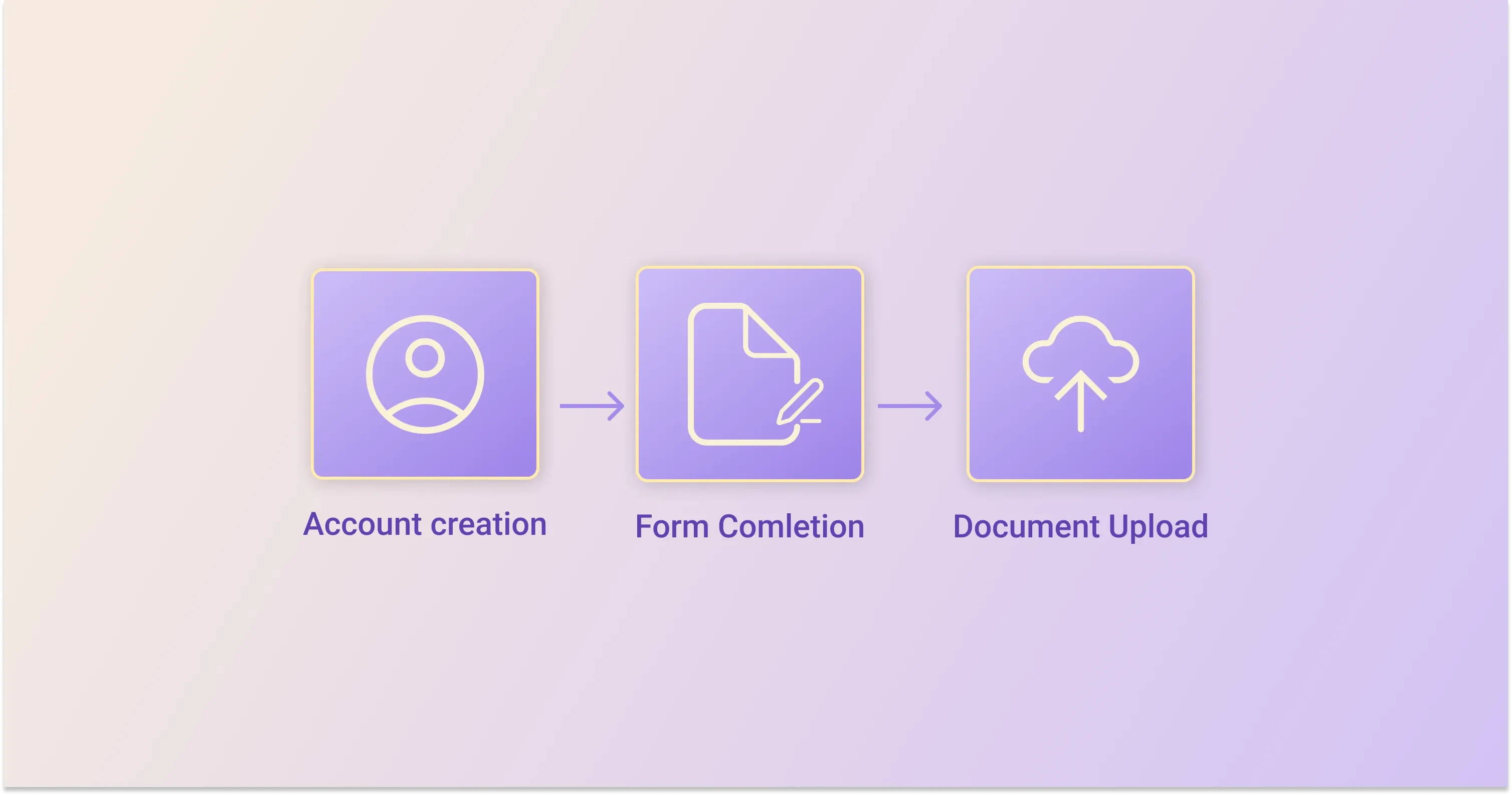
A three-step visual process showing account creation, form completion, and document upload with icons and arrows on a soft gradient background Most Member States now accept electronic applications. Portals vary, yet the workflow is similar.

4.1 Create an account

  • Go to the national tax portal, for example France’s impots.gouv.fr or Spain’s sede.agenciatributaria.gob.es.
  • Fill in email, phone, and choose credentials.
  • Activate via the link sent to your inbox.

4.2 Complete the VAT form

Typical fields include:

  • Legal name and trade name
  • Activity code (NACE)
  • Estimated annual turnover in the EU
  • Warehousing locations
  • OSS selection if applicable

Use plain numbers with no commas to avoid validation errors.

4.3 Upload documents and submit

Attach your PDFs, click submit, and download the receipt. Processing can take anywhere from 3 days in Estonia to 8 weeks in Italy.

If the tax office requests extra info, respond within the deadline stated in the email. Silence is viewed as abandonment.

After submission, most portals show status updates. When the number is approved, print the certificate for your records.

5. Understand country-specific thresholds and rates

Even with an OSS number, you may still need local VAT registration in certain EU countries. Keep these key thresholds and VAT rates in mind:

Germany

  • Local threshold for resident businesses: €25,000
  • Standard VAT rate: 19%

France

  • Local thresholds: €37.500 for services / €85,000 for goods
  • Standard VAT rate: 20%

Netherlands

  • Local threshold for resident businesses: €20,000
  • Standard VAT rate: 21%

Spain

  • Local threshold for resident businesses: none (registration required from the first euro)
  • Standard VAT rate: 21%

Remember: non-resident businesses always have a zero threshold, meaning the first sale triggers VAT registration.

6. Activate ongoing EU VAT compliance

A VAT number is only useful when paired with flawless filings. Every Member State expects zero-error returns and prompt payments.

  • File OSS returns quarterly by the end of the month following the period.
  • File local VAT returns monthly or quarterly depending on national rules.
  • Reconcile sales platforms, payment processors, and warehouse data.
  • Archive invoices electronically for 10 years in a readable format.

To ensure you stay error-free and penalty-proof, review the best practices outlined in VAT Reporting Made Simple: Best Practices for Businesses.

Given the complexity, many exporters appoint trusted partners like 1stopVAT, whose 40+ tax specialists handle registration, filing, and cross-border consulting in over 100 countries. One contact, fewer headaches.

Maintaining this rhythm of accurate returns guards against audits and secures cash-flow peace of mind.

7. Monitor legislative updates

VAT rules evolve fast. Between 2010 and 2023, Member States lost €13 billion to €33 billion each year to MTIC fraud - pressuring regulators to tighten systems.

Stay ahead by:

  • Subscribing to EU Commission tax newsletters.
  • Joining local tax webinars.
  • Reviewing portal notices every quarter.

Hungary’s Finance Minister recently said new digital VAT rules will “help combat VAT fraud, and ease administrative obligations for small companies.” Change is constant, so a quarterly check-in keeps your process future-proof.

For a deep dive into future developments - like real-time digital filing, e-invoicing, and ViDA reforms - visit VAT in European Union: EU VAT Rules Explained for International Sellers.

With these seven steps complete, you have moved from uncertainty to a fully activated European VAT setup.

How to register for EU VAT in five quick steps

EU VAT registration follows five core steps: confirm the need to register, choose the correct scheme (local, Union OSS, or IOSS), gather key documents (certificate of incorporation, ID, bank proof), submit the online application via the chosen Member State’s portal, and keep filing accurate returns to stay compliant. Completing these steps secures your VAT number and smooth cross-border sales.

Conclusion

EU VAT registration looks daunting only at first glance. With the right EU VAT registration for businesses approach -confirming obligations, choosing the correct route, preparing documents, and using each Member State’s portal -you can secure a VAT number without drama. Stay on top of thresholds and timely filings to maintain EU VAT compliance while expanding across Europe.

Not always. If your business holds stock or performs local B2C services in several countries, you may need local numbers. Otherwise, the Union OSS lets you report all intra-EU B2C sales under one registration.

Processing varies by Member State. Fast jurisdictions such as Estonia can approve numbers in about one week, while Italy or Greece may take six to eight weeks.

Minimum requirements are a certificate of incorporation, proof of business address, ID for the legal representative, and a bank account statement. Some countries also ask for sample invoices.

Marketplaces like Amazon may collect and remit VAT on certain sales, but you’re still responsible for reporting revenue from off-marketplace channels and keeping proper tax records. For a clear breakdown of how these obligations work and practical tips on staying audit-proof, see the full guide on marketplace VAT obligations for online sellers.

Late returns trigger penalties that range from flat fees of €200 to percentages of unpaid tax plus interest. Repeat offenses can lead to suspended VAT numbers.

Simple Compliance

Free consultation with 1StopVAT experts

You Might Also Like

Discover more insights and articles

A clean flat-lay image showing tax analysis documents, a calculator, and a tablet displaying financial charts, representing modern tax planning and financial reporting

Handling VAT for Digital Services: A Practical Guide

Selling digital products offers an incredible opportunity to scale a business globally without the logistics of shipping physical goods. However, once you cross borders, tax obligations follow you. Learninghow to handle VAT for digital servicesis no longer just a task for large corporations; it is a fundamental requirement for any creator, developer, or SaaS company selling internationally.

The rules for taxing electronic services differ significantly from physical goods, often shifting the tax liability from the seller's location to the customer's location. This guide provides a clear pathway through the regulations, helping you identify your obligations, register correctly, and manage ongoing compliance without disrupting your operations.

A professional workspace showing hands calculating taxes with a calculator, laptop, notebook, and printed tax documents, illustrating business tax planning and financial analysis

Steps to register for sales tax in the US

Every business that ships products or provides taxable services across state lines eventually hits the same wall: you must collect and remit sales tax or risk fines and retroactive assessments. The rules vary by state, but the registration sequence follows a recognizable pattern. This guide walks you through that sequence, flagging the biggest pitfalls and shortcuts, so you spend less time wrestling with bureaucracy and more time selling.

Running a company already devours time. U.S. taxpayers as a whole will spend**7.9 billion hours and $546 billion in compliance costs**this year. Following the steps below will keep your share of those hours from spiraling.

Business professional analyzing tax compliance and financial obligations through a magnifying glass with digital tax and accounting icons

Leading Advisors on EU Invoicing Rules: Stay Compliant

Businesses selling in Europe cannot afford invoicing errors. One missing field or late transmission can trigger penalties, audits, or even shipment holds at the border. That pressure explains why so many companies now turn to leading advisors on EU invoicing rules to interpret fast-moving legislation and design frictionless processes.

EU rules evolve quickly and differ country by country. This article explains what the directives actually demand, shows how advisors reduce risk, ranks the most trusted firms, illustrates typical mistakes, and ends with a hands-on checklist your finance team can start using today.

Business executives shaking hands during a corporate meeting, symbolizing partnership, trust, and business growth strategy

What is a VAT number and how to verify it

A mistyped VAT number looks like a small error but it can freeze cross-border shipments, delay refunds, and trigger tax audits. Understanding what a VAT number is, how it is structured, and how to verify it keeps sales flowing and penalties at bay.

A single narrative runs through this guide: by the time you reach the last paragraph, you will know exactly why VAT numbers matter, what they look like in different countries, and the fastest ways to confirm that any number you receive is valid.