A close-up of digital analytics dashboards and charts on tablets and laptops, representing data analysis and business insights

Business Tax Registration: Everything You Need to Know

Starting a company is exciting, yet the moment revenue flows, tax authorities want their share. Missing a single registration deadline can trigger penalties or block future funding. So how do you move from “I have an idea” to a fully tax-compliant operation?

Content authorBy Beata ČepėPublished onReading time6 min read

Overview

In the next ten minutes, you will learn:

  • Which taxes most businesses must register for: corporate income tax, VAT or GST, payroll deductions, and local levies.
  • The step-by-step process, from choosing a legal structure to filing your first return.
  • Typical timelines, required documents, and common pitfalls.
  • How recent EU and UK statistics illustrate the growing cost of non-compliance, and why early registration saves money.

By the end, you will have a clear checklist to tackle business tax registration services without sleepless nights.

Step 1: Decide on a Legal Structure and Company Tax Setup

Choosing the right entity sets the foundation for every other tax obligation.

  • Sole trader: simplest, but profits are taxed as personal income.
  • Partnership: profits flow through to partners’ returns.
  • Limited company: pays corporation tax; separates personal and business liabilities.
  • Branch vs. subsidiary: matters for cross-border filings.

A limited company must apply for a company tax setup within a short window (often 30 days of incorporation). Registering as a partnership might mean each partner files individually, but the partnership itself submits an information return.

Ending note: Confirm your structure before signing contracts. Changing it later often means re-registering for multiple taxes.

Step 2: Gather Core Information and Forms

A close-up view of business analytics charts and graphs displayed on digital screens, symbolizing data-driven decision-making.

You cannot complete corporate tax registration without the right data. Authorities usually ask for:

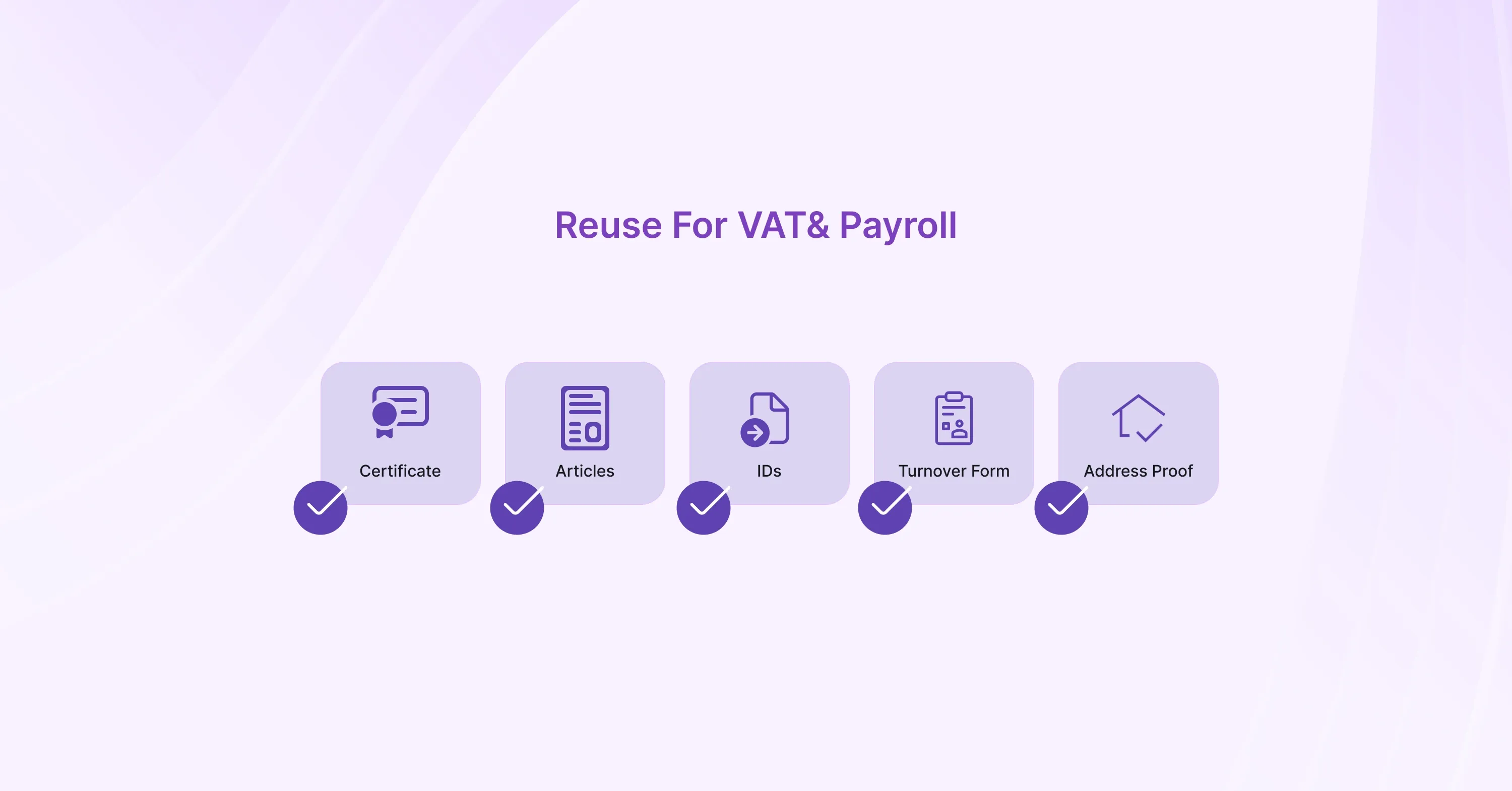
  • Certificate of incorporation or business license
  • Articles of association
  • Directors’ and shareholders’ IDs
  • Expected turnover and activity codes (NAICS, NACE, SIC)
  • Bank account details
  • Proof of local address

Small example: An e-commerce startup in Germany can upload most documents online via Elster, cutting paperwork time to around 45 minutes.

For a broader look at preparing for international compliance, consult the Sales Tax Registration and Compliance Guide for Global Sellers.

Keep digital copies organized, because the same pack will be reused for VAT and payroll accounts.

Step 3: Register for Corporate Income Tax

When to register

Most jurisdictions require registration within 30–90 days of incorporation or once your first invoice is issued.

  • UK: Companies House automatically shares details with HMRC, but you still file form CT41G within three months.
  • USA: After receiving your EIN from the IRS, states like California demand a separate franchise tax account.

How to complete the filing

  • Fill in the relevant application: CT41G (UK), Form 8832 if you elect S-Corp (US), or local equivalents.
  • Provide estimated start-up losses or profits.
  • Choose your accounting year end.

Concluding thought: Setting the wrong fiscal year can delay reliefs or refunds for months, so align it with your business cycle.

For a thorough framework on coordinating income tax and international obligations, see Aligning Cross-Border Tax and Accounting Practices for SMEs.

Step 4: Register for Indirect Taxes (VAT, GST, Sales Tax)

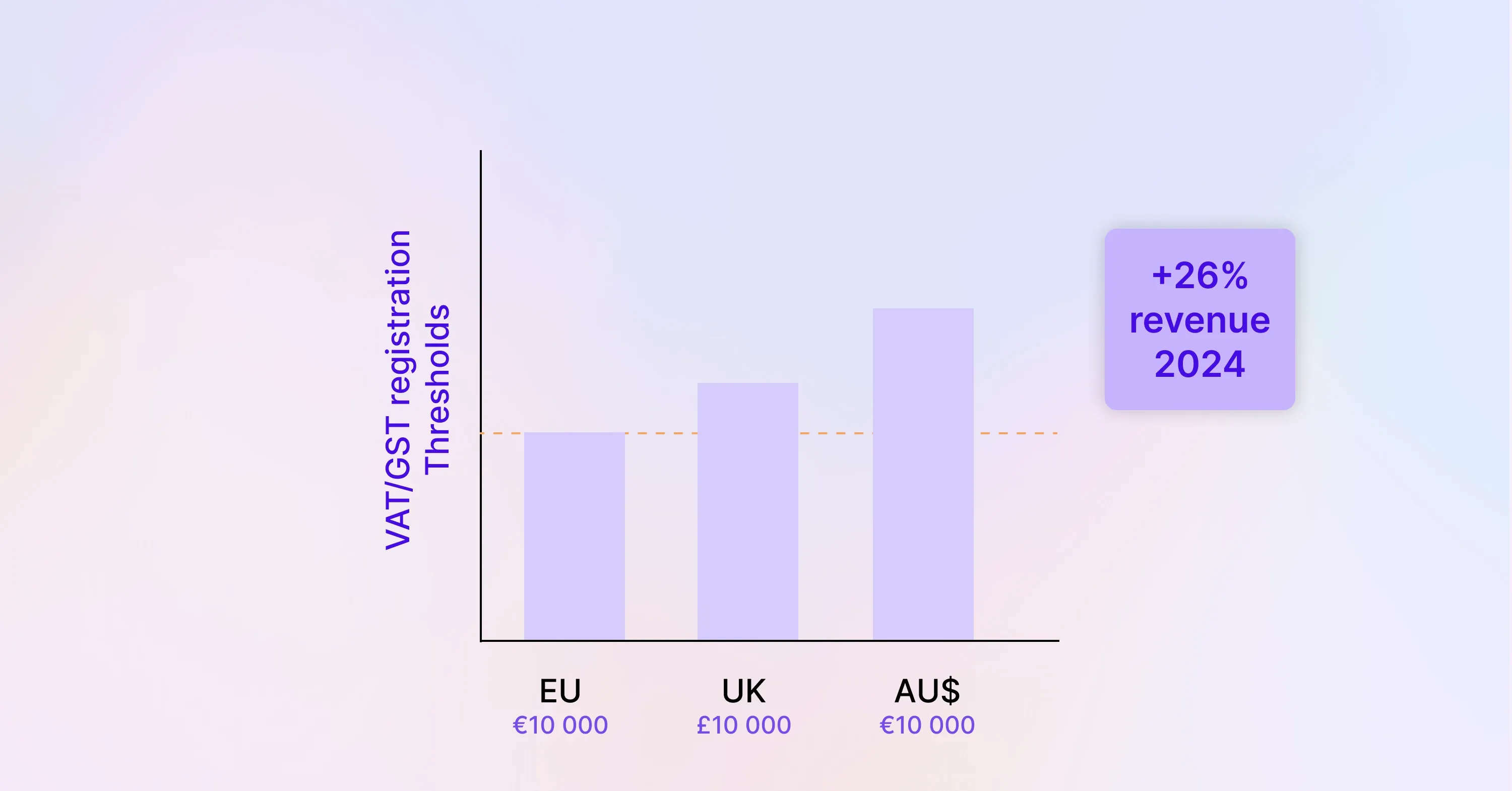
A bar chart comparing VAT and GST registration thresholds in the EU, UK, and Australia, highlighting a projected 26% revenue increase in 2024.

Indirect taxes often have lower thresholds, meaning you may need to register long before you earn a profit.

Determine if you need VAT/GST

  • EU distance-selling threshold: €10 000 across all member states.
  • UK VAT threshold: £90 000 turnover in any 12-month period.
  • Australia GST: AU$75 000.

Narrative: E-commerce sellers flocking to the EU’s OSS and IOSS schemes generated €33 billion in VAT revenues in 2024, a 26 % increase on the prior year. Over 170 000 businesses had signed up by December 2024, showing how critical timely VAT registration has become.

Wondering where to start? The VAT Compliance Checklist for Startups and Small Businesses breaks down thresholds, schemes, and documentation for new entities.

Apply for VAT/GST numbers

  • Submit the VAT1 (UK) or Form RC1 (Ireland) online.
  • Select standard, flat-rate, or OSS/IOSS schemes if selling across borders.
  • Provide evidence of cross-border sales or intent to trade.

Outsource wisely: Firms like 1stopVAT, whose 40+ specialists cover 100+ countries, can act as a single contact point for international VAT filings, sparing you multiple portals and languages.

Transition: Once your VAT or GST number arrives, display it on invoices and update marketplace dashboards to prevent account suspension.

Step 5: Set Up Payroll and Withholding Taxes

Hiring even one employee triggers new duties.

Key actions

  • Register for Pay-As-You-Earn (PAYE) in the UK or Federal/State withholding in the US.
  • Obtain unemployment insurance and workers’ compensation numbers.
  • Decide on pay frequency and submit Real-Time Information (RTI) or equivalent.

Example: A small café in London that misses its first RTI submission faces an immediate £100 penalty and daily surcharges if the lapse continues.

Takeaway: Accurate payroll registration protects staff morale and avoids spiraling fines.

Step 6: Understand Local and Industry-Specific Levies

Besides national taxes, you may face:

  • Business rates or property tax.
  • Digital services tax.
  • Environmental levies (plastic packaging, carbon credits).
  • Tourism or city taxes for hospitality trades.

Tip: Search municipal websites or call the local chamber of commerce early to identify hidden obligations.

Step 7: Build an Ongoing Compliance Calendar

A registration certificate is just the start.

  • Record filing deadlines: corporation tax, VAT returns, payroll filings, statutory accounts.
  • Map payment due dates and set bank reminders.
  • Assign responsibilities between founders, accountants, or external advisers.

For best practices on designing a tax calendar and aligning global reporting periods, see Aligning Cross-Border Tax and Accounting Practices for SMEs.

Why it matters: Compliant companies in the UK still spend at least £15.4 billion a year meeting tax duties, and a further £46.8 billion in unpaid tax forms the UK’s “tax gap.” A clear calendar keeps you out of both groups.

Business tax registration

Business tax registration is the process of officially notifying tax authorities that your new venture exists, obtaining ID numbers for corporate income tax, VAT or GST, payroll, and any local levies, then keeping those accounts active through regular filings and payments.

Conclusion

Registering your venture for taxes is less about ticking boxes and more about building a reliable platform for growth. By confirming your legal structure, gathering the right documents, and sequentially registering for corporation tax, VAT, payroll, and local levies, you sidestep penalties and preserve cash for expansion. Treat tax registration as an investment in credibility and peace of mind, and your business will be ready for whatever opportunities come next.

For more actionable breakdowns and checklists, see the VAT Compliance Checklist for Startups and Small Businesses

You usually need the certificate of incorporation, articles of association, proof of directors’ identities, bank account details, and an estimate of first-year turnover. These documents are attached to the corporation tax form (such as CT41G in the UK or IRS Form 1120 registration steps in the US). For a practical overview of gathering documents for sales tax and VAT, see the [Sales Tax Registration and Compliance Guide for Global Sellers](https://1stopvat.com/articles/sales-tax-registration-compliance-global-sellers#section-0).

You must register once your taxable turnover exceeds the national threshold, which is £90 000 in the UK, €10 000 EU-wide for distance sales, and AU$75 000 in Australia. Some firms register earlier to recover input tax on start-up costs. Find a comprehensive breakdown in the [VAT Compliance Checklist for Startups and Small Businesses](https://1stopvat.com/articles/vat-for-startups-step-by-step-compliance-guide#section-0).

Yes. Most jurisdictions let you open a payroll account in advance so that the first salary can be reported immediately. Early setup avoids last-minute errors when the employee joins.

Penalties range from fixed fines to back-dated tax plus interest. In severe cases, authorities can block import/export privileges or publish your company on a non-compliance list that suppliers and banks monitor.

The European Commission estimates its proposed BEFIT framework could reduce tax compliance costs by up to 65 % for multinationals operating in several EU states. Read more about BEFIT frameworks, streamlined compliance strategies, and tax risk reduction in [Aligning Cross-Border Tax and Accounting Practices for SMEs](https://1stopvat.com/articles/cross-border-tax-accounting-guide#section-0).

Simple Compliance

Free consultation with 1StopVAT experts

You Might Also Like

Discover more insights and articles

Business professional analyzing AI-driven search performance and growth metrics on a digital dashboard in a modern office.

Best Services for VAT Vendor Search: Find Reliable Suppliers

Sourcing new suppliers is a critical growth step for any business, but it carries hidden financial risks if you fail to validate their tax status. Working with a non-compliant vendor can lead to rejected input tax claims, hefty fines, and inadvertent involvement in supply chain fraud.

This guide outlines how to protect your procurement process by choosing the right verification methods. You will learn why validation is financially vital, which tools and services provide the most accurate data, and how to implement a step-by-step check for every new partner. We will also cover how to blend these checks into your daily purchasing workflow to ensure safety without slowing down business.

Two business executives analyze financial reports together in a modern office, focusing on data-driven decision-making and performance evaluation

VAT vs GST Registration: Key Differences Explained

VAT and GST look similar at first glance, yet they are applied, reported, and even named differently around the world. If your firm sells in multiple jurisdictions, misunderstanding one letter in the acronym can trigger late-registration penalties, denied input tax credits, or both.

Below is a streamlined comparison that shows how the two systems diverge and what that means for day-to-day compliance.

Stacks of coins, a calculator, and a magnifying glass on financial reports representing investment analysis, accounting, and financial planning

Best Cross-Border VAT Experts for International Businesses

International expansion is exhilarating until Value Added Tax slows you down. Multiple tax rates, real-time reporting mandates, and fast-changing rules make even a routine sale feel risky. The quickest safeguard is to lean on professionals who live and breathe cross-border VAT every day.

You are about to discover which firms are worth that trust and how they can turn VAT from a headache into a growth enabler.

A realistic photo of tax planning and accounting work showing a person calculating finances with a notebook and calculator, overlaid with digital tax, compliance, and financial growth icons

Top Experts to Explain VAT Numbers and Compliance

VAT identification can feel like alphabet soup until someone knowledgeable lays out the rules in plain English. That is exactly what the people on this list do every day. They demystify VAT numbers, explain cross-border filing requirements, and help businesses avoid expensive penalties.

Below is a practical guide that starts with the basics of a VAT number, then walks you through the seven most respected experts and advisory bodies you can turn to for reliable answers.