Overview
Finding affordable VAT registration support in Europe is not as simple as comparing starting prices. The real cost often depends on what is included, whether filings and routine guidance are bundled, and how well a provider can support businesses selling across multiple countries. This article explores how large accounting firms and niche VAT specialists typically structure their fees, where hidden costs tend to appear, and what sellers should evaluate before choosing a provider.
By the end, readers will understand how to compare VAT registration services based on total cost, transparency, and ongoing support rather than headline pricing alone. The article also outlines why a specialist provider with clear, bundled pricing can often be the most practical and cost-effective option for cross-border sellers operating in Europe.
Why the Cost of VAT Registration Matters More Than Ever
Cross-border e-commerce VAT obligations have expanded rapidly in recent years. In 2024, EU Member States collected over €33.0 billion through the OSS and IOSS schemes, showing just how closely cross-border digital sales are now monitored. The same report also confirms strong year-over-year growth in declared VAT under these schemes, reflecting how quickly compliance obligations are increasing for online sellers.
For marketplace businesses, the exposure is no longer limited to large enterprises. Since July 2021, a single EU-wide €10,000 threshold applies to intra-EU distance sales, which means even relatively small sellers can trigger VAT obligations once they scale across borders. By the end of 2024, more than 170,000 businesses were registered for OSS and IOSS, underlining how common these requirements have become.
The pressure goes beyond registration itself. According to the European Commission, the EU’s VAT compliance gap reached about €89.3 billion in 2022, reinforcing why tax authorities are investing more heavily in enforcement. For sellers, this means VAT registration is no longer just an administrative task. It is a business-critical decision that affects cost control, compliance risk, and the ability to grow across multiple markets with confidence. In practice, many sellers only feel the full cost of VAT compliance after expansion is already underway. A business may begin with one marketplace, one fulfilment location, and a manageable filing obligation, then discover that storing stock abroad or crossing distance-selling thresholds has triggered registrations in several countries at once. At that stage, the question is no longer how much one VAT number costs, but how much the full compliance setup will cost over the next year.
How Big Firms Price VAT Registration

Large accounting and advisory firms (think Big Four networks and major regional practices) certainly have the capacity to handle multi-country VAT registrations. But their pricing models reflect overhead that may not align with what a growing e-commerce seller actually needs.
For many online sellers, the gap becomes obvious very quickly. They do not need a complex international tax structuring project. They need VAT numbers issued on time, filings submitted correctly, and someone who can answer routine authority questions without turning every follow-up into an extra billable item.
The typical cost structure at large firms
-
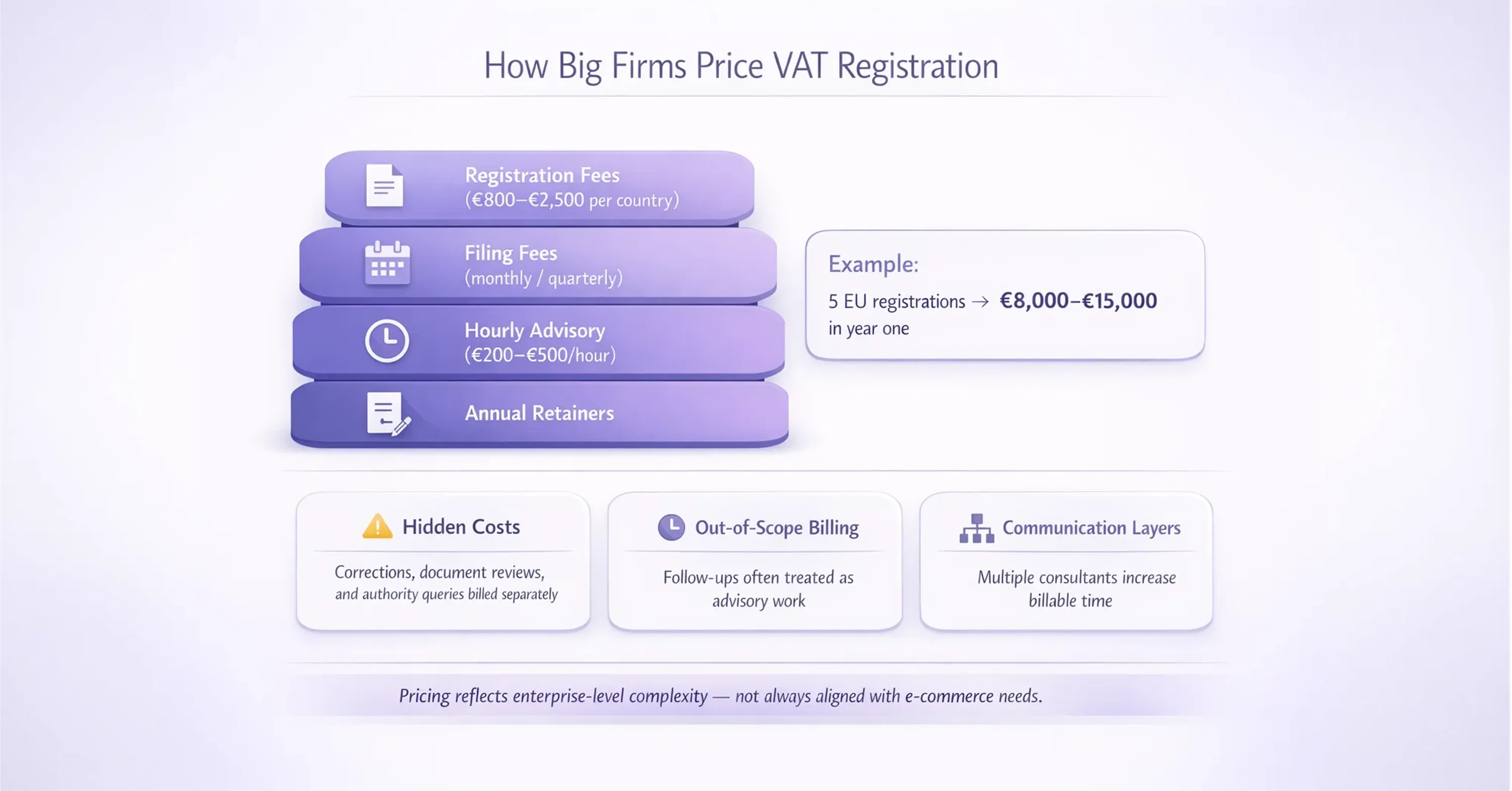
Per-country registration fees ranging from €800 to €2,500 or more, depending on the jurisdiction and complexity
-
Separate filing charges billed quarterly or monthly, often on top of the registration cost
-
Advisory time billed hourly, with rates between €200 and €500 per hour for senior tax consultants
-
Annual retainer fees that lock you into long-term contracts regardless of transaction volume
The result is a layered pricing model. You pay for registration, then for filing, then for any questions you ask along the way. A marketplace seller registering in five EU countries could easily spend €8,000 to €15,000 in the first year before a single strategic question is answered.
Where the hidden costs appear
Big firms often separate "compliance" from "advisory." If your German VAT return triggers a query from the Bundeszentralamt für Steuern, answering that query may fall outside your compliance package. Suddenly, you're on the clock at hourly advisory rates.
The same applies when a tax authority asks for corrected forms, extra supporting documents, or clarification during the registration process, since these steps are often treated as additional advisory work rather than part of the original scope.
This is a common point of frustration for sellers. A company may accept what looks like a reasonable registration quote, only to find later that document review, corrections, follow-up replies to tax authorities, and “out-of-scope” support are billed separately. The original price may have been accurate on paper, but not representative of the real cost of getting registered and staying compliant.
There's also the matter of communication layers. At a large firm, your file may pass through a junior associate, a manager, and a partner. Each handoff adds time, and time is billed. For a straightforward VAT registration, this structure creates cost without proportional value.
This doesn't mean big firms lack expertise. They don't. But their model is built for complex multinational tax planning, not for an online seller who needs five VAT numbers and reliable quarterly filings at a predictable cost.
What Niche VAT Providers Charge (and How They Differ)
Niche VAT compliance providers have grown rapidly precisely because the big-firm model doesn't fit most cross-border sellers. These smaller, specialized firms focus exclusively on VAT, which keeps their operations lean and their pricing focused.
For a data-rich overview comparing top VAT registration agencies - including timelines, fee structures, and scope - see the Top EU VAT Registration Agencies: 2025 Guide.
Common pricing approaches among niche providers
-
Flat-fee registration per country, typically between €150 and €600
-
Bundled packages that include registration, periodic filings, and basic consulting within a single monthly or annual price
-
Transparent fee schedules published on their websites, so you know the cost before any engagement
-
No hourly billing for routine questions about filing deadlines, rate changes, or authority correspondence
The difference is structural. A niche provider doesn't maintain the overhead of a full-service audit practice, a transfer pricing department, or a corporate finance team. That leaner operation translates into lower fees for the specific service you're buying: VAT registration and compliance.
Where niche providers can fall short
Not all niche firms are equal. Some cover only a handful of EU countries, leaving gaps if you expand into new markets. Others rely heavily on software automation without offering the human expertise needed when a tax authority raises a complex question. That can become a real weakness when a seller needs help collecting country-specific documents, understanding registration sequencing, or responding quickly to follow-up requests from a tax office. A few advertise low base prices but add surcharges for additional filings, amendments, or multi-currency transactions.
The key, then, is finding a niche provider that combines competitive pricing with genuine breadth of coverage and dedicated human support. This is where the comparison becomes most useful.
Comparing Cost Transparency: What to Look For
Before signing with any provider, big or small, run through a straightforward checklist. The goal is to identify where costs might surprise you after onboarding.
In practice, VAT registration rarely ends with a single application form. Sellers are often asked for incorporation documents, proof of trading activity, ID documents for directors, powers of attorney, marketplace details, or follow-up clarifications from local tax authorities. This is where cheap-looking offers can become expensive, especially if document handling, corrections, or tax office communication are billed separately.
-
Registration fees: Are they quoted per country, or is there a multi-country discount?
-
Filing fees: Are they included in the registration price, or billed separately per return?
-
Advisory support: Is routine guidance included, or does every email trigger an hourly charge?
-
Amendments and corrections: What happens if a filing needs to be corrected? Is there an extra fee?
-
Country coverage: Can the provider handle all your current and planned markets, or will you need a second firm?
-
Onboarding costs: Some firms charge a setup fee on top of registration. Ask explicitly.
A provider that bundles registration, filing, and support into a single transparent fee eliminates the most common source of budget surprises. You know what you'll pay each quarter, regardless of how many routine questions come up.
For marketplace sellers managing obligations across multiple EU countries, this kind of clarity is especially valuable. When your VAT costs are predictable, you can price your products accurately and protect your margins.
The Cost-Effective Path for Marketplace Sellers
Marketplace sellers have a specific set of needs that neither the big-firm model nor the cheapest niche provider fully addresses. They need multi-country registration, regular filings timed to marketplace reporting cycles, and someone who understands the intersection of platform rules and local tax authority requirements.
This is precisely the space where providers like 1StopVAT stand out. As a one-stop global VAT compliance provider, 1StopVAT offers VAT registration, compliance and filing, and consulting through a single point of contact, with a team of over 40 certified tax specialists covering 100+ countries. Their model bundles support into the pricing, which means no hourly billing for routine inquiries and no surprise surcharges when a tax authority sends a standard request.
To see how other leading providers stack up - and for a practical comparison by company type, service speed, and support model -check out the Best VAT Registration Services in 2025: Top Providers Reviewed.
In real registration projects, the pricing difference becomes clearer once the process starts. A marketplace seller expanding into Germany, France, Italy, Spain, and Poland may need VAT numbers before marketplace activation, submit different document sets for each jurisdiction, and respond to follow-up questions from local tax authorities after the initial filing. A provider that only offers a low entry price can quickly become more expensive if every clarification, correction, or authority response is billed separately. By contrast, a specialist that includes routine guidance and follow-up support in one transparent package is often far more cost-effective over the full registration cycle.
For example, a marketplace seller expanding into several EU countries may choose a provider based on a low registration quote, only to discover later that document corrections, tax office follow-ups, and ongoing support are billed separately. In that situation, the cheaper upfront option can quickly become the more expensive choice overall.
This bundled approach is particularly relevant now. Consumption taxes accounted for 26.9% of total tax revenue in the EU-27 in 2023, and authorities continue investing in compliance enforcement. Having a dedicated VAT partner who handles filings correctly the first time isn't a luxury; it's a cost-saving measure in itself, since penalties and interest on late or incorrect filings can dwarf the original registration fee.
How to Make Your Final Decision
Choosing an affordable VAT registration service comes down to three factors: total cost of ownership across all your markets, the quality of human support when issues arise, and pricing transparency that lets you budget with confidence.
-
Map your current and planned markets to ensure full coverage from a single provider
-
Request an all-inclusive quote that covers registration, filings, and standard advisory
-
Ask about penalty support: will they help resolve issues with tax authorities at no extra cost?
-
Check client references from sellers in your specific marketplace or industry
The cheapest quote isn't always the most affordable if it leaves gaps that create compliance risk. The most expensive option isn't always the best if you're paying for services you'll never use. The right provider sits in between: specialized, transparent, and built for the way you actually do business.
Conclusion
Affordable VAT registration in Europe is not about choosing the lowest advertised fee. It is about choosing a provider that gives you clear pricing, reliable support, and the ability to stay compliant as your business expands across borders. A low entry price can quickly lose its appeal if essential services like filings, corrections, or tax authority communication are charged separately.
Large firms may offer broad expertise, but their pricing often reflects a level of complexity many sellers do not actually need. Lower-cost providers can seem attractive at first, yet they may fall short when real compliance challenges appear. For most cross-border businesses, the better option is a specialist VAT partner that combines transparent pricing with practical, ongoing support.
The strongest choice is a provider that helps you control costs without increasing risk. When registration, filings, and routine guidance are built into one clear service model, VAT compliance becomes easier to manage and far less disruptive to your growth. In a market where regulations are becoming stricter and cross-border selling is only getting more complex, affordability means more than paying less upfront. It means getting lasting value, dependable support, and confidence that your VAT obligations are handled properly from the start.