
Expanding an e-commerce business into international markets is one of the most effective strategies for driving substantial revenue growth. However, true cross-border success requires much more than simply translating your website and enabling international shipping rates.
Many merchants fall into the trap of assuming that global buyers behave identically to domestic ones, just in a different language. In reality, around 40% of consumers completely avoid purchasing from websites that lack proper localization. This cultural disconnect triggers mistrust, slashes conversion rates, and ultimately leads to wasted marketing investments.
To establish a sustainable global footprint, businesses must shift from basic translation to comprehensive local adaptation. This comprehensive guide covers the critical operational, linguistic, and trust-building steps necessary to make your online store feel native to foreign buyers.
Cultural Translation vs. Mechanical Output
Relying entirely on automated machine translation tools like Google Translate or DeepL is a high-risk approach for entering a new market. While helpful for internal drafts, automatic tools fail to grasp local idioms, cultural context, emotional nuances, and industry-specific terminology.
Native Proofreading and Tone Alignment
True localization means tailoring your brand’s voice to the behavioral expectations of the target audience. Communication must feel entirely natural. To achieve this, implementing a post-editing and proofreading process managed by native speakers is essential. A native reviewer ensures that marketing slogans resonate correctly and that the formal or informal tone aligns precisely with local consumer preferences.
Technical and Product Details
Localization requires deep attention to technical and practical details, especially in industries like fashion, home decor, or consumer electronics:
- Sizing Guides & Standards: Measurement units, fit guides, and sizing charts must conform directly to local market expectations (e.g., converting between EU, UK, and US standards).
- Compliance & Care Instructions: Material descriptions, safety certifications, and washing or maintenance instructions must fulfill local consumer habits and legal requirements. Clear and localized information substantially reduces return rates driven by improper product care.
- The Checkout Flow: A native speaker should meticulously audit every micro-copy element within the checkout funnel to eliminate any linguistic friction that could spark hesitation.
Customer Support as a Catalyst for Trust
Providing high-quality customer support is arguably the single most important element for sustaining customer retention in a new country. Offering a native Customer Support (CS) experience allows cross-border merchants to compete on equal footing with domestic brands. Buyers in major European markets – such as Germany, France, and Spain – overwhelmingly expect to communicate in their mother tongue.
Support channels should always reflect local consumer habits. For instance, while buyers in Romania lean heavily toward phone support, customers in the United Kingdom generally prefer digital live chats or structured emails.
The Power of a Local Phone Number
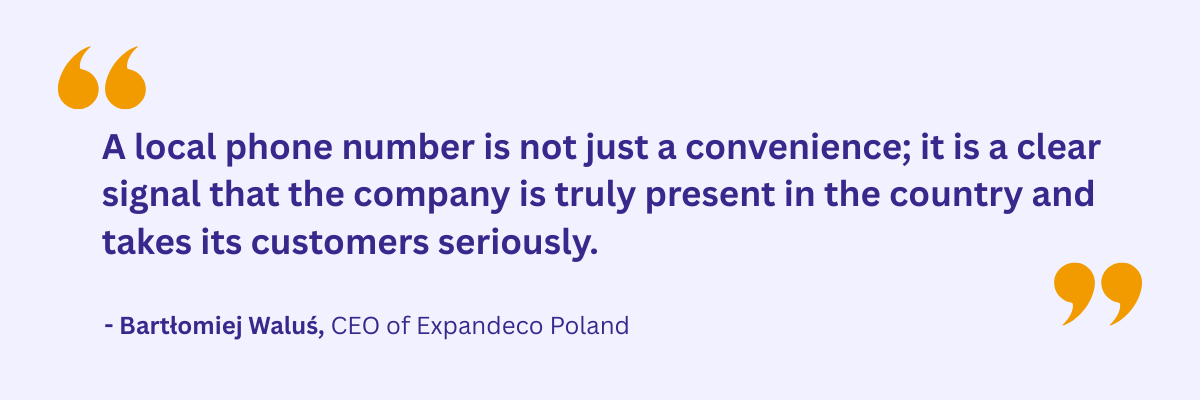
An operational element that heavily influences trust is the presence of a local telephone number. To a foreign buyer, a domestic number serves as a powerful psychological anchor, acting as concrete proof that a business is legitimate, accessible, and physically committed to their region.
Impact on Conversion Rates
E-commerce data demonstrates that online stores prominently displaying a local phone number achieve much stronger conversion rates. Placing this number near the shopping cart or on product pages acts as a safety net, alleviating buyer anxiety and significantly curbing shopping cart abandonment – even if the customer never actually places a call.
Real-Time Upselling and Recovery
Voice communication remains the fastest channel for resolving immediate buyer hesitation. Furthermore, live phone interactions create direct opportunities for strategic upselling and cross-selling. If an operational hitch occurs, such as a temporary stock shortage, a live support agent can instantly salvage the sale by offering alternative solutions in real time – a level of empathy and flexibility that automated systems cannot replicate.
Testing the Market via IVR
European digital regulations require businesses to provide straightforward, fast, and accessible contact methods for consumers. For companies not yet ready to deploy a full-scale native call center, an excellent intermediate solution is implementing a local phone number backed by an Interactive Voice Response (IVR) system in the target language.
An IVR setup allows callers to select their query type (e.g., returns, billing, shipping), which the system automatically routes to the appropriate digital helpdesk or email queue. This approach allows brands to gauge actual call volumes and collect vital data on customer needs without committing heavy upfront human resources. While standard FAQs can be automated, human empathy remains indispensable for handling complex customer issues.
Financial and Logistical Operational Standards
Even the most articulate linguistic localization will fall flat if the financial, legal, and transactional infrastructure fails to meet local expectations.
Currency, Payments, and Financial Trust
Tailoring payment gateways to local digital habits is non-negotiable. Buyers expect to see familiar payment methods at checkout:
- Regional Preferences: Consumers in Scandinavian countries heavily favor direct bank transfers, whereas credit cards and digital wallets like PayPal dominate the UK and US landscapes.
- The Localization of Funds: Failing to offer a local bank account or executing refunds in a foreign currency is a major operational pitfall. It exposes buyers to international transfer fees and unfavorable exchange rates, triggering immediate distrust. Integrating a localized payment gateway and establishing local financial infrastructure is vital for credibility.
Logistical Friction and Reverse Logistics
Modern European consumers expect rapid and highly transparent fulfillment, with acceptable delivery timelines usually ranging between 3 to 5 business days. Merchants must integrate delivery options that match local market standards, such as the extensive locker networks and pick-up-and-drop-off (PUDO) points popular across Central and Eastern Europe.
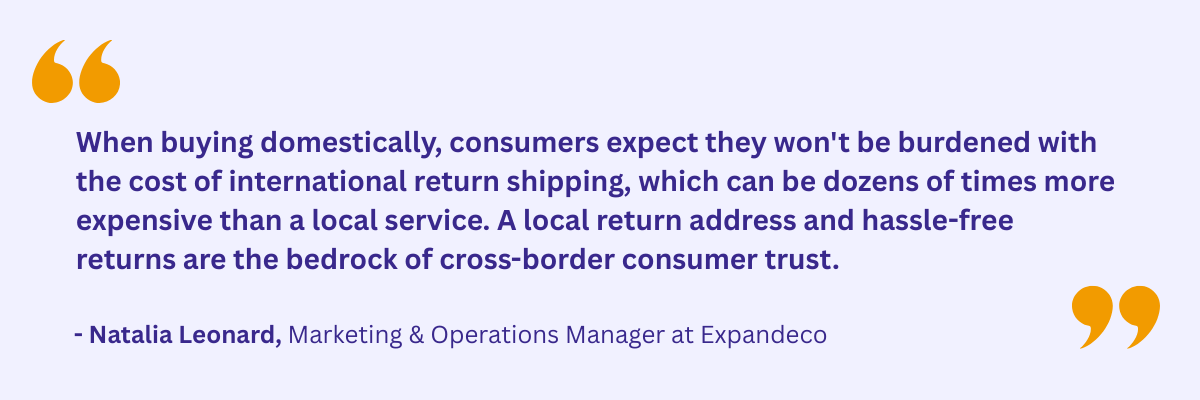
Efficient reverse logistics (returns) are just as critical as outbound shipping. In consumer-heavy markets like Germany, up to 30% of online purchases are returned. Providing a frictionless, cost-effective return process with a localized return address is a massive driver for customer lifetime value.
Conclusion: Strategic Investment for Long-Term Success
Cross-border expansion offers immense financial upside, but long-term profitability rests entirely on seamless localization. True adaptation ensures that the consumer never realizes they are buying from an international entity.
By methodically addressing linguistic authenticity, customer support accessibility, regional payment preferences, and local reverse logistics, global brands can maximize conversion rates, cultivate deep brand loyalty, and fully comply with regional operational expectations.
The Global Expansion Checklist
Before launching your e-commerce brand in a new territory, ensure your operational setup checks all of these strategic boxes:
- Language & Content: Human-verified translations, native proofreading, localized size charts, and fully adapted checkout flows.
- Customer Care: Native-speaking support teams, support channels aligned with local habits, and a local telephone number (or IVR system) with Bartłomiej Waluś’s highlighted principle of local presence.
- Payments & Finance: Local payment gateways integrated, pricing displayed in the local currency, and clear financial structures to avoid unnecessary exchange or international transfer fees.
- Logistics & Returns: Delivery methods matching local standards (PUDO/Lockers) and a local return address to simplify reverse logistics.
Seamless global expansion is built on details that foreign buyers should never have to notice – the right language, the right payment method, the right support channel. At 1stopVAT, we know that the brands winning in cross-border e-commerce are those that invest in the full picture. That is why our partnership with Expandeco covers every layer of your market entry – from native translations and local customer support to compliant financial infrastructure. Together, we help you turn international ambitions into sustainable, scalable growth.